Best 4G Security Cameras for Farms 2026
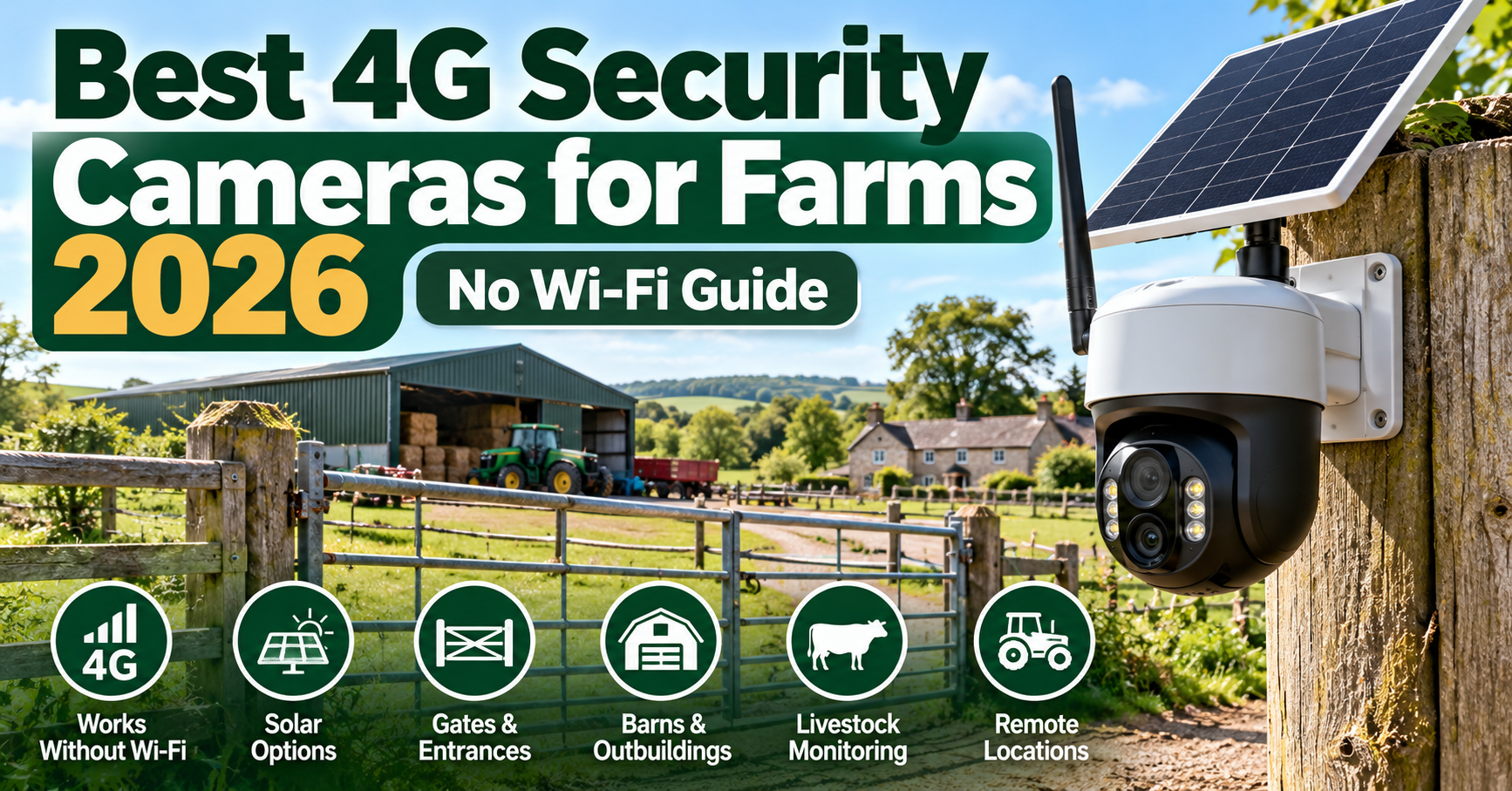
The best 4G security cameras for farms can monitor gates, barns, machinery, livestock and remote areas without depending on farmhouse Wi-Fi.
That makes cellular cameras particularly useful on agricultural properties, where the places that need monitoring are often hundreds of metres from the house or beyond the range of a conventional wireless network.
A 4G camera uses the mobile network in much the same way as a smartphone. Add battery or solar power and it becomes possible to install surveillance at locations where neither broadband nor mains electricity is readily available.
This 2026 guide explains how farm 4G cameras work, where they make sense and what farmers should check before buying one.
Affiliate disclosure: Some links in this guide are affiliate links. If you purchase through one of these links, we may earn a commission at no additional cost to you. Our recommendations are based on which camera technology best suits the farm location.
For an overview of cameras across an entire agricultural property, start with our Farm Security Cameras: Complete Guide 2026 .
Why 4G Security Cameras Make Sense on Farms
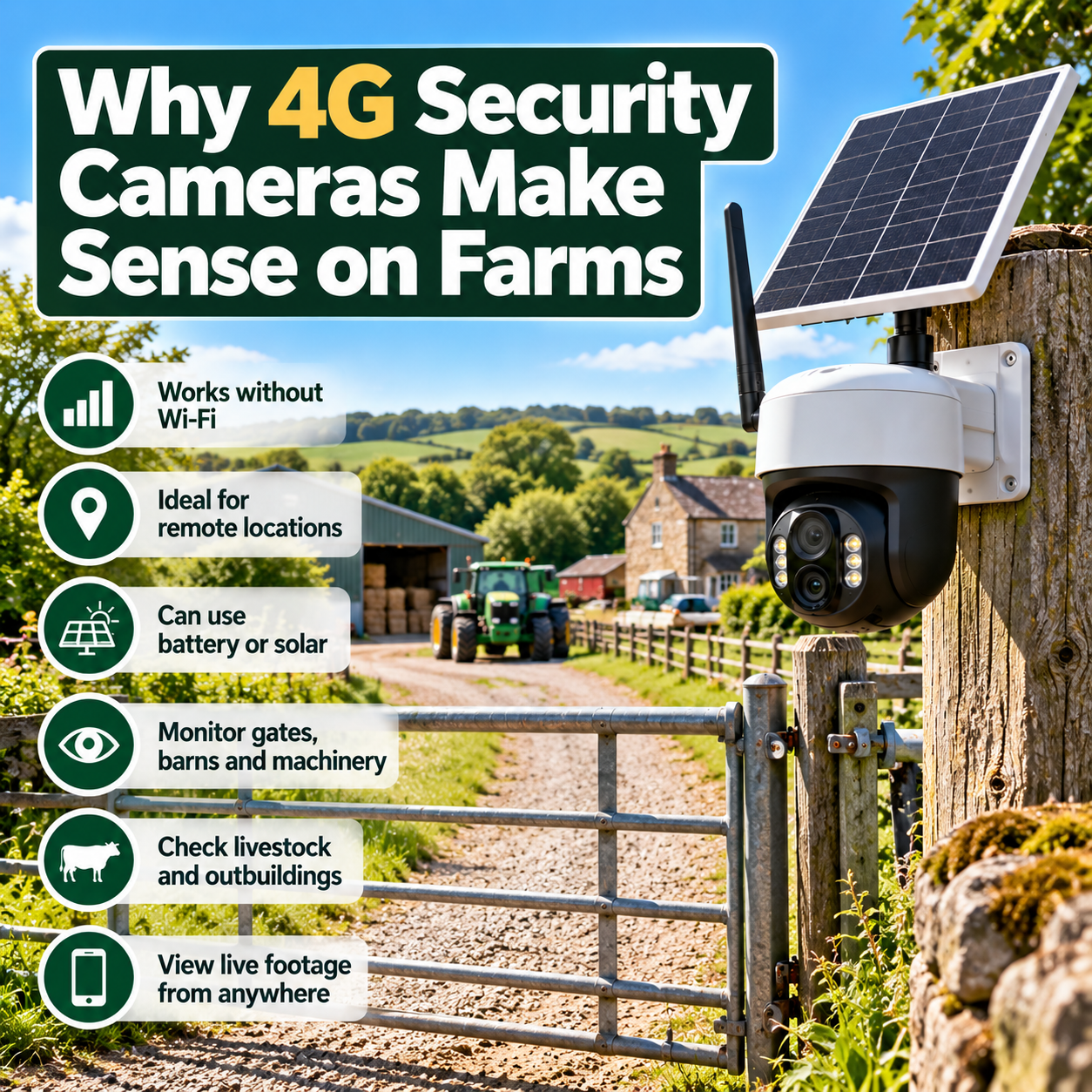
Conventional Wi-Fi cameras can work well around a farmhouse or central farmyard. The difficulty begins when surveillance is needed at a distant gate, livestock field, machinery shed or isolated outbuilding.
Wi-Fi range may simply not reach those locations.
A 4G security camera solves the connectivity problem differently. Instead of connecting to the property’s broadband router, it contains cellular hardware and uses a SIM or compatible mobile-data service.
That means the camera can potentially send alerts and provide remote viewing wherever there is adequate supported mobile coverage.
- Remote farm entrances
- Field gates
- Machinery sheds
- Fuel storage areas
- Livestock fields
- Calving and lambing areas
- Water pumps and irrigation equipment
- Remote barns and outbuildings
- Secondary access roads
How Does a 4G Farm Security Camera Work?
A 4G camera contains a cellular modem. Rather than transmitting video through Wi-Fi, it communicates over a compatible mobile network.
Mobile networks provide the cellular connection that allows compatible devices to communicate over wide areas. The GSMA provides further information about the global mobile industry and mobile-network ecosystem.
The basic system normally consists of four parts:
- Camera: captures video and detects activity.
- SIM or cellular connection: connects the camera to a mobile network.
- Power source: battery, mains electricity or solar charging.
- Storage: local memory, cloud storage or a combination of both, depending on the model.
This distinction is important. 4G provides connectivity; it does not provide power.
If there is no electricity at the installation point, the camera will also need a suitable battery and, in many farm applications, a solar panel.
Best Types of 4G Security Cameras for Farms
The right camera depends on what is being monitored. A camera positioned at a narrow entrance has different requirements from one overlooking a large machinery yard or livestock field.
4G Security Cameras for Farm Gates
A farm gate is one of the strongest locations for a cellular camera because vehicles and visitors usually pass through a relatively narrow area.
Instead of trying to monitor acres of open land, the camera can concentrate on a natural access point.
Useful features include person and vehicle detection, fast notifications, good night visibility and a viewing angle that covers approaching traffic.
Best for: main entrances, secondary gates and remote access roads.
For remote entrances without Wi-Fi, Xega and ieGeek both offer cellular camera ranges worth comparing.
View Xega 4G Cameras → View ieGeek 4G Cameras →
Affiliate links: we may earn a commission from qualifying purchases at no additional cost to you.
Solar 4G Security Cameras
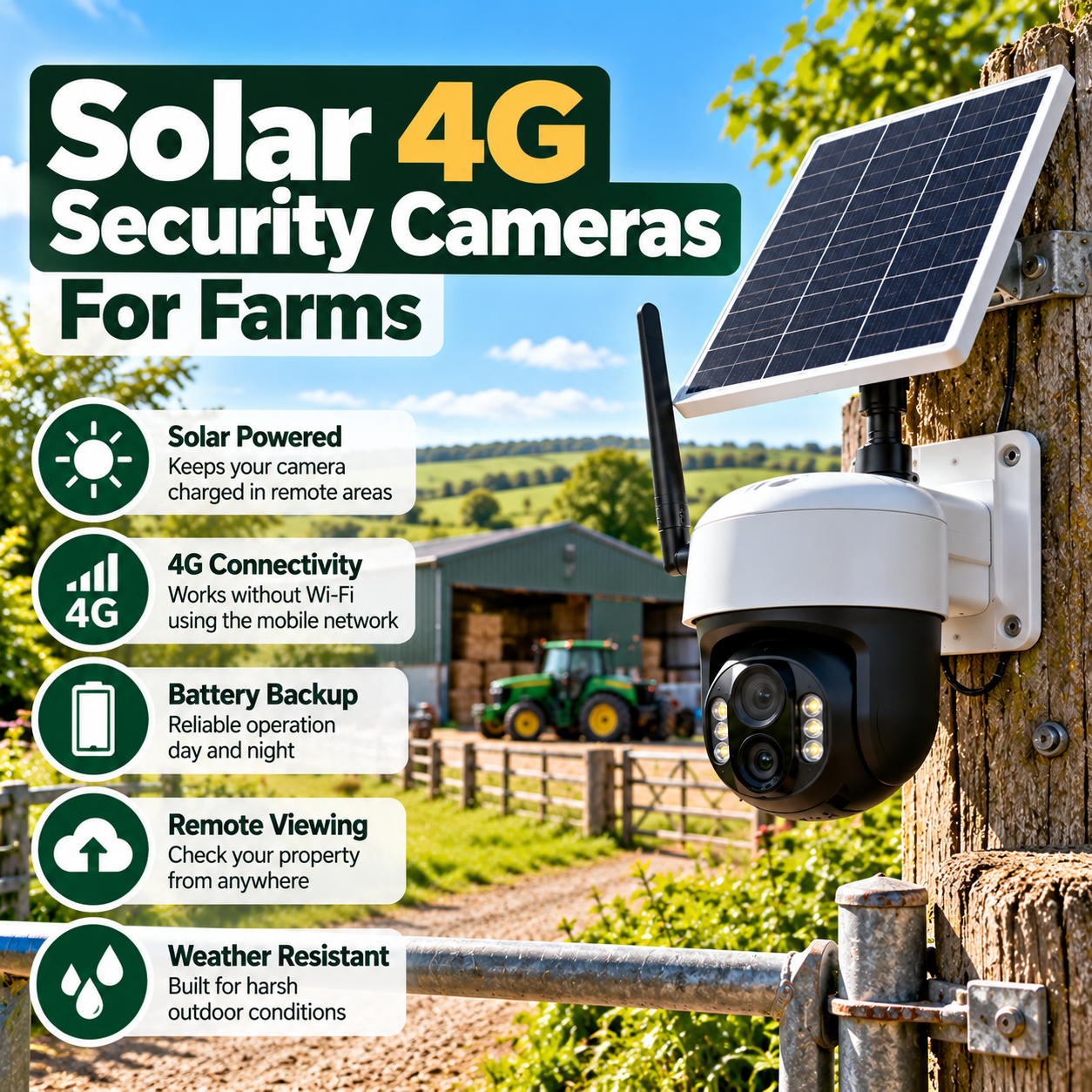
Combining 4G connectivity with solar charging creates one of the most flexible camera configurations for farms.
The mobile network removes the need for Wi-Fi, while the solar panel reduces dependence on mains electricity.
Solar 4G cameras can therefore be particularly useful at field entrances, livestock areas and isolated buildings.
However, the panel must receive sufficient daylight and the battery needs enough capacity to operate through nights and periods of poor weather.
For more detail, see our Best Solar Security Cameras for Farms 2026 .
4G PTZ Cameras for Farmyards
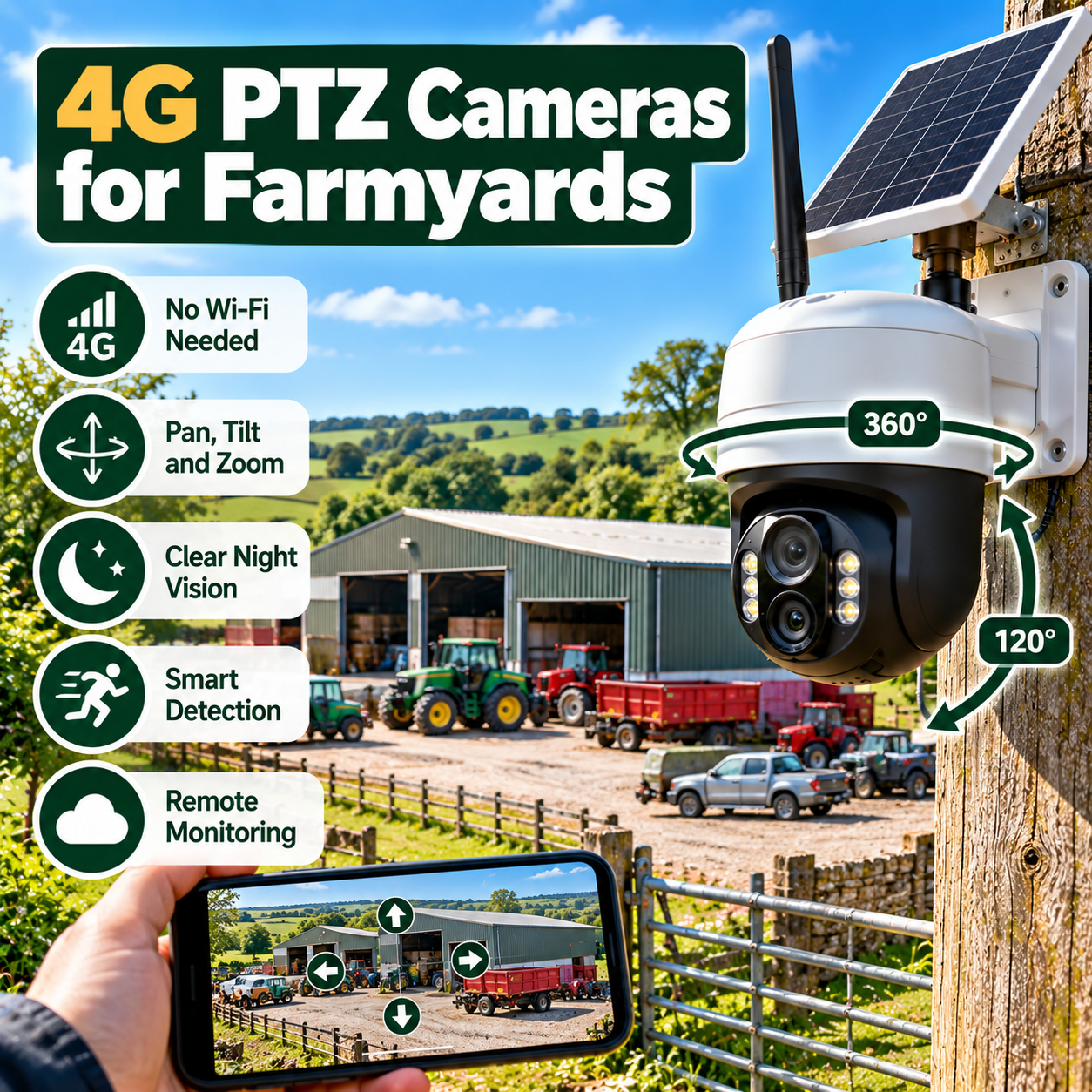
PTZ cameras can pan, tilt and sometimes zoom, allowing a wider area to be inspected remotely.
This can be useful around machinery yards, entrances and large open areas where activity may approach from different directions.
Some modern cameras can also track detected people or vehicles automatically.
Nevertheless, a PTZ camera does not literally watch every direction simultaneously. Important fixed locations may still benefit from their own dedicated camera.
Best for: machinery yards, wide entrances and large open areas.
4G Cameras for Livestock Monitoring
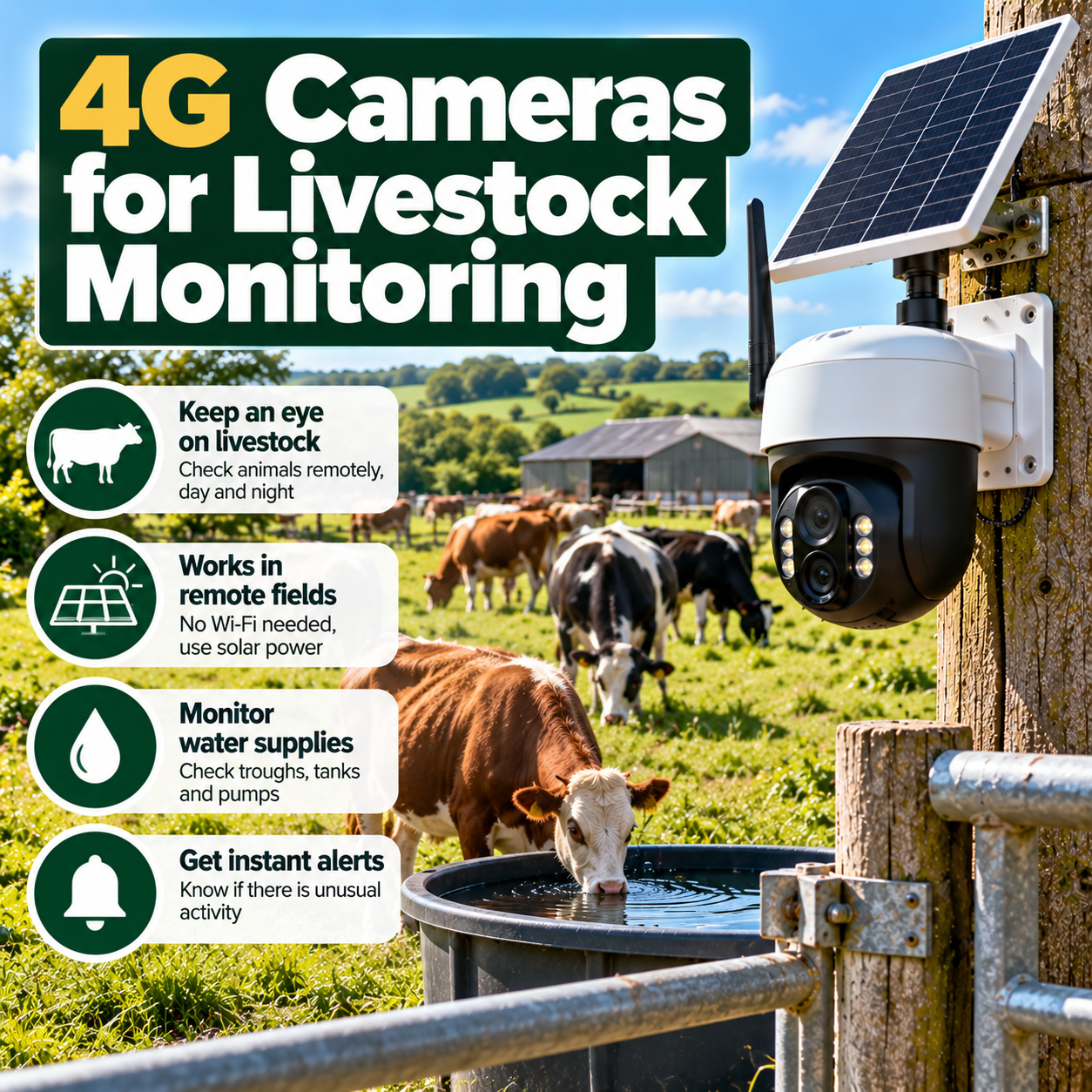
A cellular camera can serve two purposes on a farm: security and livestock monitoring.
Farmers may be able to remotely check cattle, sheep, horses, water troughs or calving and lambing areas without travelling to the location for every visual inspection.
For livestock use, reliable connectivity, good night vision and suitable camera positioning can be more valuable than alarms or security spotlights.
Best for: remote grazing areas, cattle, sheep, horses and livestock buildings.
4G vs Wi-Fi Security Cameras for Farms
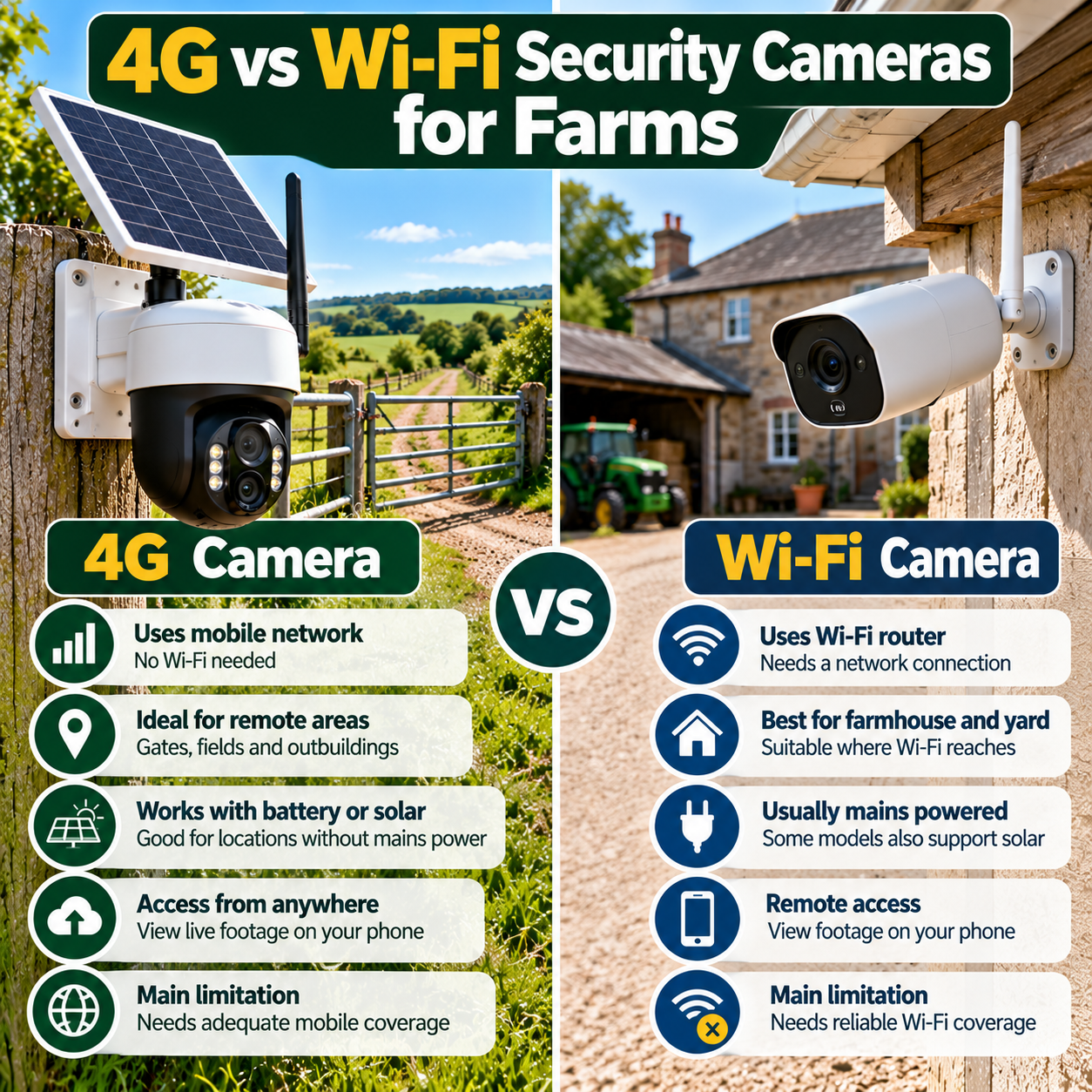
| Feature | 4G Camera | Wi-Fi Camera |
|---|---|---|
| Internet connection | Mobile network | Wi-Fi router or access point |
| Best location | Remote gates, fields and buildings | Farmhouse, yard and nearby barns |
| SIM/data plan | Usually required | Normally not required |
| Farmhouse Wi-Fi needed | No | Yes |
| Can use solar power | Yes, on compatible models | Yes, on compatible models |
| Main limitation | Needs adequate mobile coverage | Needs adequate Wi-Fi coverage |
Do 4G Security Cameras Need Wi-Fi?
No. A true 4G cellular security camera does not need Wi-Fi to communicate over the mobile network.
This is precisely why cellular cameras can be valuable for farms and rural properties.
However, always check the specification carefully. Some cameras marketed as wireless are simply Wi-Fi cameras without an Ethernet cable. That does not mean they contain cellular connectivity.
Do 4G Farm Cameras Need a SIM Card?
Most cellular security cameras require either a physical SIM, eSIM or manufacturer-provided cellular service.
The exact arrangement varies between manufacturers. Some cameras accept compatible third-party SIM cards, while others are designed around a supplied SIM or particular data service.
Before purchasing, check:
- Which mobile networks are supported
- Whether the camera is locked to a particular service
- Which 4G frequency bands it supports
- Whether roaming is available
- The cost of the data plan
- How much data the camera is likely to use
How Much Mobile Data Does a 4G Security Camera Use?
There is no single figure because data consumption depends heavily on how the camera is used.
Long live-viewing sessions, higher video resolution, frequent motion events and uploading clips to cloud storage can all increase consumption.
A camera overlooking a quiet farm entrance may use much less data than a camera facing a busy livestock yard where animals continually trigger recordings.
What to Look for in the Best 4G Security Cameras for Farms
1. Mobile Network Compatibility
This should be checked before almost anything else.
A feature-packed 4G camera is of little use if the supported mobile network has poor reception at the gate or field where the camera will be installed.
Test mobile coverage at the actual installation point rather than assuming reception will be identical to the farmhouse.
2. Battery Capacity
Battery capacity becomes especially important when mains electricity is unavailable.
Night recording, repeated motion detection, live viewing, cellular transmission and cold temperatures can all affect runtime.
3. Solar Charging
For completely remote locations, solar charging can significantly reduce the need to remove and manually recharge batteries.
Panel position matters. Avoid unnecessary shade and consider the lower sun angle and shorter days of winter rather than judging the location only during summer.
4. Person and Vehicle Detection
Farm environments contain plenty of movement: livestock, wildlife, vegetation, machinery and changing light.
Where available, intelligent person and vehicle detection can help reduce unwanted alerts.
5. Night Vision
Farm security does not stop when daylight disappears.
Infrared night vision can provide discreet monitoring, while cameras equipped with spotlights may provide colour footage at shorter distances.
6. Local Storage
Local storage can be particularly useful with cellular cameras because every recorded event does not necessarily need to be uploaded continuously over the mobile network.
Check whether the camera supports microSD storage and what happens when the card becomes full.
7. Weather Resistance
Farm cameras may be exposed to rain, dust, wind, frost and large temperature changes.
Choose equipment specifically designed for outdoor installation and check the manufacturer’s operating-temperature and weather-resistance specifications.
8. App and Remote Access
A major benefit of 4G surveillance is being able to check a remote location without physically travelling there.
The manufacturer’s app therefore matters. Look at live-view controls, notification settings, playback, detection zones and whether several cameras can be managed from the same account.
4G Farm Security Camera Options to Consider in 2026
For this particular job, we would start with manufacturers that actually offer cellular security-camera options rather than choosing a conventional Wi-Fi camera and trying to extend a farm network to reach it.
Xega
Best starting point for: remote gates, fields, livestock areas and isolated buildings where there is mobile coverage but no dependable Wi-Fi.
Xega is particularly relevant to this guide because its cellular-camera range targets the exact problem many farms face: monitoring a location beyond normal Wi-Fi coverage.
When comparing models, check network compatibility, solar-panel configuration, storage, detection features and whether the particular camera meets the requirements of your installation.
ieGeek
Best starting point for: farmers wanting to compare cellular and solar camera options for different parts of the property.
ieGeek is another useful buying route where a farm needs a cellular camera for a remote location but may also require other camera types around buildings closer to the main yard.
As with any cellular system, confirm the exact model’s network compatibility, SIM requirements, storage options and solar configuration before ordering.
Which One Should You Look at First?
If your main problem is a remote farm gate, field or isolated building with no Wi-Fi, we would start by comparing Xega’s cellular options.
If you are building a broader camera system and want to compare 4G, solar and other security-camera configurations, ieGeek is also worth checking.
The deciding factor should still be the installation itself. Confirm mobile coverage and compatibility before choosing either system.
Affiliate disclosure: These are affiliate links. If you make a qualifying purchase, we may receive a commission at no additional cost to you.
Where Should 4G Cameras Be Installed on a Farm?
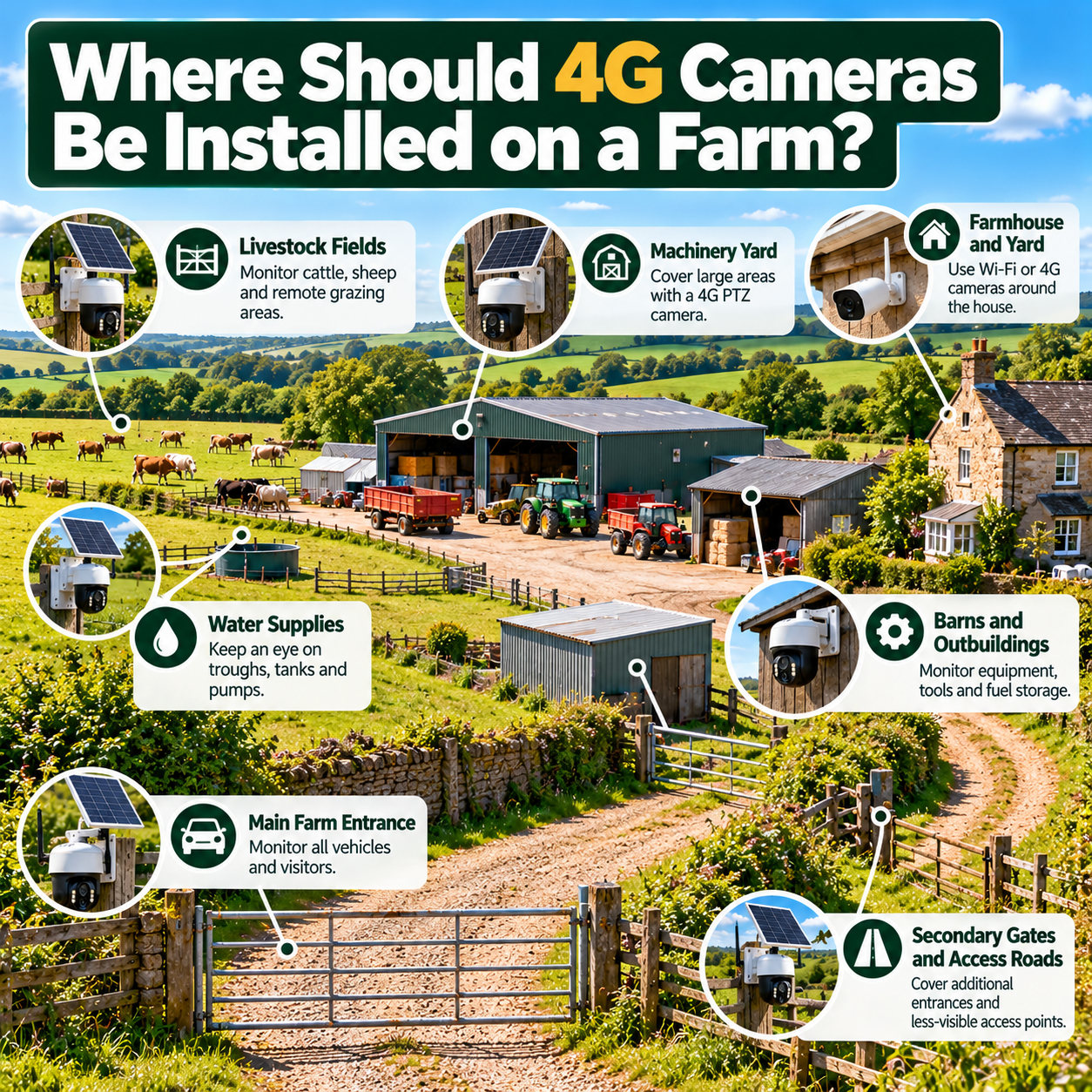
Do not begin by trying to monitor every acre.
Instead, identify locations through which people, vehicles or valuable equipment are likely to pass.
A sensible priority order is often:
- Main farm entrance
- Secondary or less-visible gates
- Machinery and vehicle storage
- Fuel tanks
- Workshops and tool storage
- Livestock buildings
- Remote livestock areas
- Irrigation and pumping equipment
One carefully positioned camera at an entrance may provide more useful information than several cameras pointed across large open fields.
Can a 4G Camera Read Vehicle Registration Plates?
Potentially, but this requires caution.
High resolution alone does not guarantee reliable registration-plate capture. Vehicle speed, distance, viewing angle, lighting, shutter settings and night-time reflections can all affect the result.
If reliable number-plate identification is essential, consider equipment specifically designed for licence-plate recognition rather than relying solely on a general-purpose security camera.
Can 4G Cameras Work Without Mains Electricity?
Yes, provided the particular camera supports battery operation or another independent power source.
A battery-powered 4G camera combined with a correctly positioned solar panel can potentially operate without a permanent mains supply.
This is one of the reasons cellular solar cameras are particularly well suited to remote farm locations.
Are 4G Cameras Better Than Trail Cameras for Farm Security?
They serve overlapping but slightly different purposes.
Cellular trail cameras are useful for discreet still images, wildlife monitoring and certain low-power remote applications. Many can also send images over the mobile network.
A dedicated security camera may provide features such as live video, two-way audio, pan-and-tilt control, sirens, spotlights and more sophisticated security notifications.
Therefore, the better choice depends on whether the priority is discreet monitoring, wildlife observation or active property surveillance.
Common Mistakes When Installing 4G Farm Cameras
- Buying the camera before checking mobile coverage
- Assuming “wireless” automatically means 4G
- Mounting the solar panel in seasonal shade
- Positioning the camera too high to capture useful detail
- Aiming directly into strong sunlight
- Allowing livestock or vegetation to trigger constant alerts
- Ignoring ongoing SIM and data costs
- Expecting one PTZ camera to cover every direction simultaneously
- Relying on advertised resolution alone when plate capture is important
A Practical 4G Camera Setup for a Farm
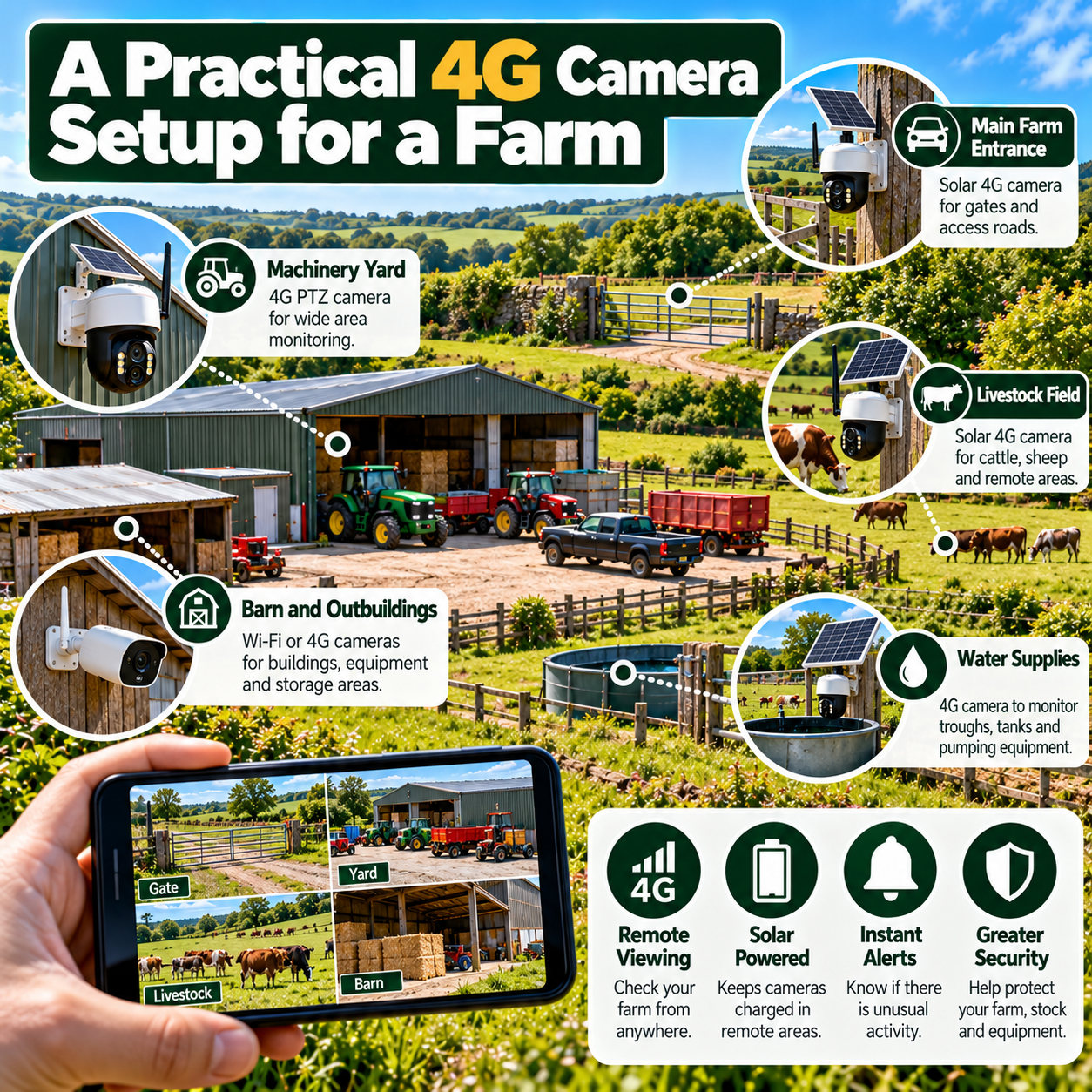
A farm does not necessarily need 4G cameras everywhere.
A more efficient system may combine different technologies.
- Main remote gate: solar 4G camera
- Machinery yard: 4G PTZ or several fixed cameras
- Barn near farmhouse: Wi-Fi camera
- Remote livestock field: solar 4G camera
- Workshop with network connection: wired or Wi-Fi camera
This approach uses cellular data where it provides a genuine advantage rather than paying for 4G connections at locations already served by reliable Wi-Fi.
Frequently Asked Questions About 4G Farm Security Cameras
What is the best 4G security camera for a farm?
The best option depends on the location and intended use. For remote gates and fields without mains electricity, a weather-resistant 4G camera with battery power and solar charging is often one of the most practical configurations.
Can a 4G security camera work without Wi-Fi?
Yes. A cellular 4G camera communicates through a supported mobile network rather than requiring a conventional Wi-Fi router.
Can I install a security camera at a remote farm gate?
Yes, provided the location has suitable mobile coverage and the camera has an appropriate power source. A solar-powered 4G camera can be particularly useful where neither mains electricity nor Wi-Fi reaches the gate.
Do 4G security cameras have monthly fees?
Usually there will be some cost for mobile data. Additional cloud-storage subscriptions may also apply depending on the camera and manufacturer. Local-storage options can sometimes reduce reliance on cloud recording.
Will a 4G camera work with weak mobile reception?
Performance depends on the camera, supported network bands and actual signal conditions. Weak or unstable reception can affect notifications, live viewing and uploads, so test network coverage at the intended mounting position before buying.
Can 4G cameras be used to monitor livestock?
Yes. Cellular cameras can be useful for remotely checking livestock, gates, troughs and other agricultural areas where Wi-Fi is unavailable.
Final Thoughts on the Best 4G Security Cameras for Farms
The best 4G security cameras for farms solve one of the biggest problems with rural surveillance: connectivity.
Instead of extending farmhouse Wi-Fi across fields and distant buildings, a cellular camera can communicate directly through the mobile network.
Combine that with battery and solar power and it becomes possible to monitor locations that would otherwise require considerable cabling and infrastructure.
For remote farm locations, Xega’s 4G camera range and ieGeek’s camera range give farmers two useful places to begin comparing cellular options.
However, start with mobile coverage. A sophisticated camera cannot overcome the absence of a compatible cellular signal.
Once coverage is confirmed, compare battery capacity, solar charging, storage, night vision, detection features, weather resistance and data costs.
For many farms, the strongest solution will ultimately be a mixture of 4G cameras in remote areas and conventional Wi-Fi or wired cameras around buildings where existing infrastructure is already available.
Building a Complete Farm Security System?
4G cameras are only one part of the system. Our main farm security guide covers gates, barns, livestock, solar cameras, remote monitoring and camera positioning across the property.