Choosing one of the top rated solar inverters in 2026 means matching the inverter to your roof, solar panels, battery plans and backup-power requirements rather than simply choosing the model with the highest advertised efficiency.
Some homes benefit from a conventional string inverter. Complex roofs may favour panel-level optimisation or microinverters, while homeowners planning battery storage should pay particular attention to modern hybrid inverters.
This guide compares current residential inverter systems from major manufacturers and explains which type of installation each is most suited to.
If you want a detailed explanation of the technology itself, read our separate guide to how solar inverters work. This page concentrates on comparing options before you buy.
Top Rated Solar Inverters 2026: Quick Comparison
Different inverter designs suit different properties, so our selections are based on use case rather than pretending there is one perfect inverter for every home.
We look at inverter architecture, battery compatibility, MPPT capability, backup options, monitoring, system expandability, warranty and support, installation flexibility and how well the product fits real residential applications.
Model specifications and availability vary by country. Always check the exact inverter model supplied on your installer quotation.
Best Solar Inverters to Compare in 2026
SolarEdge Home Hub Inverter
Type: Optimiser-based string inverter
Versions: Single-phase and three-phase
Battery ready: Yes
Backup: Available with compatible battery and backup equipment
SolarEdge uses power optimisers at individual solar panels together with a central inverter.
This architecture provides detailed module-level monitoring and can be particularly useful on complicated roofs where solar panels face different directions or experience different operating conditions.
The Home Hub platform also integrates with SolarEdge batteries, backup equipment and other home-energy products.
Best suited to: Complex residential roofs, homeowners wanting panel-level monitoring and people planning an integrated solar-and-battery system.
Enphase IQ8 Series
Type: Microinverter
2026 European models: IQ8MC, IQ8AC and IQ8HC
Panel-level operation: Yes
Warranty: Up to 25 years under applicable Enphase conditions
Enphase takes a very different approach by installing a microinverter with each solar panel.
This means individual panels operate independently instead of relying on one central inverter for the entire array.
The design is particularly attractive where shading, several roof orientations or panel-level monitoring are important.
The 2026 IQ8 range is designed for modern higher-output solar modules and integrates with the wider Enphase energy-management ecosystem.
Best suited to: Partially shaded roofs, complicated layouts, modular expansion and homeowners wanting individual panel monitoring.
Fronius GEN24 Plus
Type: Hybrid inverter
Versions: Single-phase Primo and three-phase Symo
MPPTs: Two on residential GEN24 models
Backup: PV Point and Full Backup options depending on system configuration
Fronius GEN24 Plus is designed as the centre of a residential solar and battery installation.
One particularly useful feature is Fronius’ backup approach. PV Point can provide a basic backup supply, while compatible GEN24 Plus systems can provide broader Full Backup operation when combined with suitable battery and switching equipment.
Fronius also uses active cooling to help manage operating temperatures.
Best suited to: Homeowners looking for a premium hybrid system, battery integration and flexible backup possibilities.
Sungrow SH6.0RS
Type: Single-phase hybrid inverter
Output: 6 kW
Battery: High-voltage battery support
Monitoring: iSolarCloud platform
Sungrow’s SH residential hybrid range combines solar generation, energy storage and backup functions in one platform.
The SH6.0RS remains part of Sungrow’s current residential energy-storage offering and is designed for both new installations and suitable retrofit applications.
Sungrow also offers compatible high-voltage battery systems, allowing the inverter, storage and monitoring components to operate within one ecosystem.
Best suited to: Homeowners wanting a straightforward single-phase solar-plus-battery installation.
Huawei SUN2000 MAP0
Type: Three-phase smart energy controller
Output range: 5–12 kW
MPPTs: Two
Battery: Compatible Huawei LUNA2000 storage
Huawei’s MAP0 range is designed around a complete residential energy ecosystem rather than the inverter operating in isolation.
The system can integrate compatible LUNA2000 battery storage, Huawei power optimisers, energy monitoring and SmartGuard backup equipment.
Current Irish specifications list maximum efficiency between 98.4% and 98.6%, depending on inverter size.
The platform is particularly relevant to homes with three-phase electricity supplies.
Best suited to: Three-phase homes wanting an integrated solar, storage, monitoring and backup system.
GoodWe ET G2
Type: Three-phase hybrid inverter
Output range: 6–15 kW
MPPTs: Three
Backup switching: UPS-level switching below 10 ms
The GoodWe ET G2 is aimed at modern homes with substantial electrical demand, larger solar arrays and high-voltage battery storage.
Its 6–15 kW range makes it particularly relevant where EV charging, heat pumps or other significant electrical loads are part of the household energy system.
GoodWe also supports integration with compatible batteries, EV chargers and smart-grid-ready appliances.
Best suited to: Larger three-phase homes, high electricity demand and homeowners planning an integrated battery system.
Victron MultiPlus-II
Type: Battery inverter/charger
Applications: Grid-connected ESS, backup and off-grid
Expansion: Parallel and three-phase configurations supported
Standard warranty: Five years
Victron MultiPlus-II should not be confused with a conventional rooftop string solar inverter.
It is primarily an inverter/charger used within battery-based energy systems and can be combined with Victron solar charge controllers or suitable AC-coupled solar equipment.
Its strength is flexibility. Victron systems are widely used in off-grid properties, remote installations, boats, motorhomes and custom home energy-storage systems.
Best suited to: Off-grid homes, advanced backup systems and installations where flexibility matters more than a simple all-in-one residential package.

Which Type of Solar Inverter Should You Choose?
SolarEdge vs Enphase: Which Approach Is Better?
SolarEdge and Enphase both provide panel-level management, but they achieve it differently.
SolarEdge
Each panel uses a power optimiser, while a central inverter converts the DC electricity into AC electricity.
This gives panel-level monitoring while retaining a central inverter architecture.
Enphase
Each panel has its own microinverter and converts DC electricity to AC directly at panel level.
This removes the need for one central solar inverter.
Best Hybrid Solar Inverters for Battery Storage
If battery storage is part of your plan, inverter choice becomes particularly important.
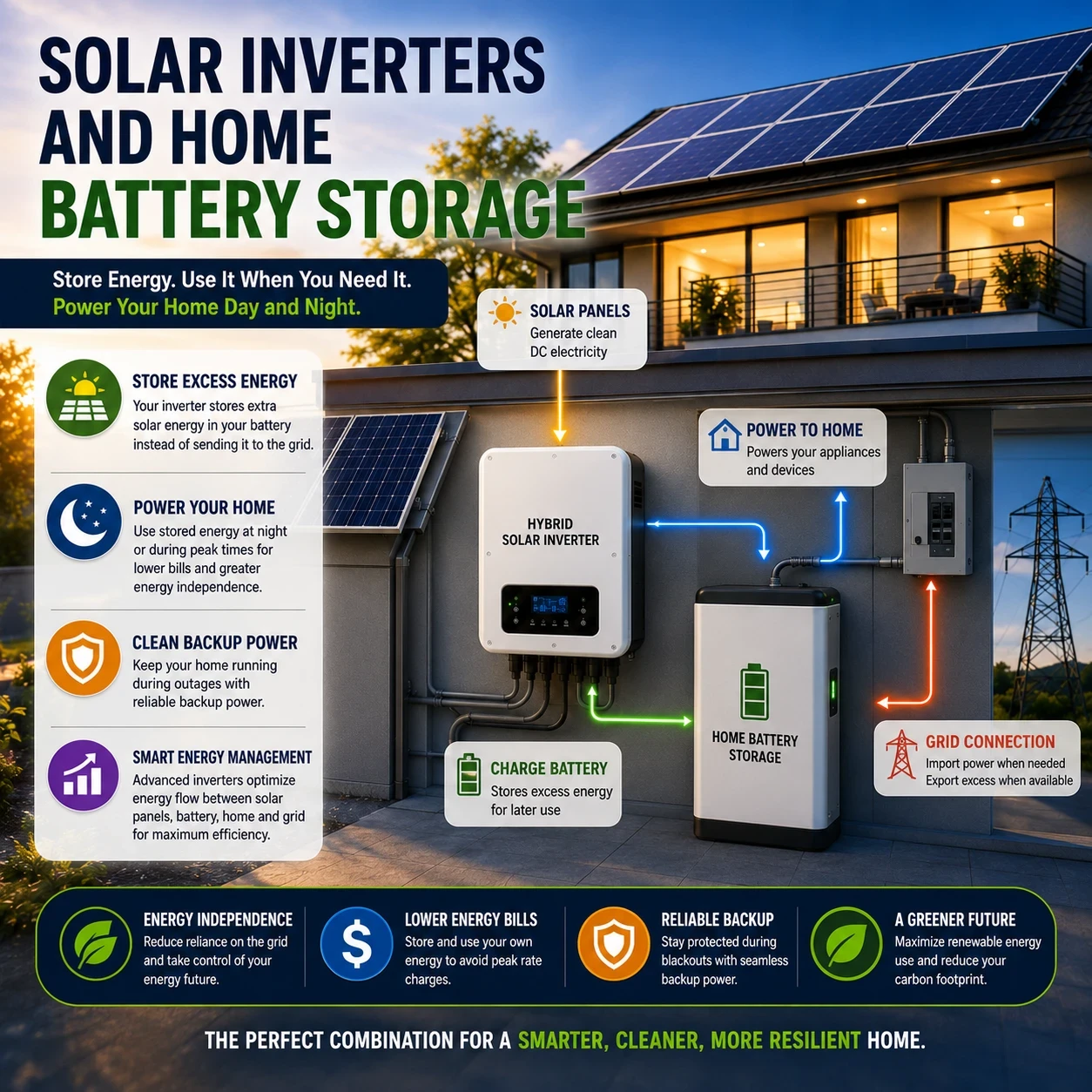
A hybrid inverter can manage solar generation and compatible battery storage within one system.
Current hybrid platforms worth comparing include:
- Fronius GEN24 Plus.
- Sungrow SH residential hybrid range.
- Huawei SUN2000 MAP0.
- GoodWe ET G2.
- SolarEdge Home Hub with compatible SolarEdge storage.
Do not assume that every battery works with every hybrid inverter. Battery compatibility is normally limited to approved models and communication protocols.
Read our complete Home Battery Storage Systems guide before choosing storage.
What Solar Inverter Size Do You Need?
The inverter’s AC rating does not always need to exactly equal the total DC rating of the solar panels.
Professional system designers consider:
- Total solar-panel capacity.
- Inverter AC output.
- Maximum DC voltage.
- Maximum input current.
- Number of MPPT inputs.
- Permitted DC oversizing.
- Roof direction and pitch.
- Local climate.
- Grid-connection restrictions.
- Future system expansion.
Some systems deliberately use a solar array with a higher DC nameplate rating than the inverter’s AC output. This can increase inverter utilisation during lower-light conditions.
Too much oversizing, however, can increase clipping when available solar power exceeds the inverter’s maximum output.

MPPT Inputs: An Important Specification
You do not need to become an electrical engineer to compare inverters, but the number of Maximum Power Point Tracking inputs can materially affect system design.
Separate MPPTs can be useful when groups of panels face different directions or operate under significantly different conditions.
An east-facing array and west-facing array, for example, can often be managed separately when connected to different MPPT inputs.
The installer should confirm that panel voltage and current remain within the inverter manufacturer’s permitted MPPT operating range.
Do You Need Blackout Backup?
One of the most common misunderstandings about residential solar is assuming that installing solar panels automatically keeps a home powered during an outage.
A standard grid-connected system normally shuts down when the electricity network fails.
Backup power requires equipment specifically designed to safely isolate the property from the public grid.
Depending on the system, this may include:
- A backup-capable hybrid or battery inverter.
- Compatible battery storage.
- A backup interface or automatic transfer equipment.
- Essential-load circuits or whole-home backup equipment.
- Correct electrical protection and isolation.
Solar Inverter Efficiency: Don’t Choose on One Number
Modern quality solar inverters already operate at very high conversion efficiency.
A difference of a few tenths of a percentage point in headline maximum efficiency should not outweigh more important considerations such as:
- Correct electrical matching.
- MPPT configuration.
- Battery compatibility.
- Backup capability.
- Operating temperature.
- Monitoring quality.
- Warranty support.
- Installer experience.
The best inverter is therefore not automatically the model with the highest efficiency number on its datasheet.
Monitoring and Smart Energy Management
Monitoring has become one of the most useful differences between modern inverter systems.
Depending on the equipment installed, homeowners may be able to monitor:
- Live solar generation.
- Daily and historical generation.
- Household electricity use.
- Battery state of charge.
- Grid imports and exports.
- Individual solar-panel performance.
- System faults and warnings.
- EV charging and other controllable loads.
Panel-level monitoring is particularly associated with systems such as Enphase and SolarEdge, while hybrid platforms increasingly provide detailed information about solar, battery and grid energy flows.
Warranty and Local Support
Warranty length matters, but a long warranty is only useful if the product has dependable support where you live.
Before accepting an inverter quotation, ask:
- What is the standard warranty?
- Can the warranty be extended?
- Who processes a claim?
- Is labour included?
- Does the installer handle warranty replacement?
- Is technical support available locally?
- How quickly can replacement equipment normally be obtained?
Enphase’s current 2026 Irish IQ8 documentation, for example, specifies warranty coverage of up to 25 years when the applicable conditions are met. Warranty terms from every manufacturer should still be checked for the exact market and model being offered.
Questions to Ask Your Solar Installer
- What is the exact inverter manufacturer and model?
- Why have you chosen it for my roof?
- Is it single-phase or three-phase?
- How many MPPT inputs does it provide?
- How will different roof directions or shading be handled?
- What is the permitted solar-array size?
- How much inverter clipping is expected annually?
- Can I add more solar panels later?
- Can battery storage be added later?
- Which batteries are officially compatible?
- Does the system provide blackout backup?
- Is backup for essential circuits or the whole property?
- What monitoring is included?
- Does monitoring show individual solar panels?
- What warranty is included?
- Who handles after-sales support?
Common Mistakes When Choosing a Solar Inverter
- Choosing solely on price.
- Choosing solely on maximum efficiency.
- Ignoring future battery-storage plans.
- Assuming every hybrid inverter works with every battery.
- Ignoring roof orientation and shading.
- Not checking MPPT requirements.
- Assuming solar automatically provides blackout power.
- Ignoring warranty and local support.
- Choosing an inverter before finalising the solar-panel layout.
- Failing to consider future EV or heat-pump electricity demand.
Which Solar Inverter Would We Compare First?
For a straightforward unshaded roof without batteries, start by comparing good-quality string inverters available from experienced local installers.
For complicated or shaded roofs, compare SolarEdge and Enphase.
For solar plus battery storage, compare hybrid platforms such as Fronius GEN24 Plus, Sungrow SH, Huawei MAP0 and GoodWe ET G2 alongside the equipment supported by your installer.
For off-grid or highly customised battery systems, Victron deserves particular consideration.
The final decision should still be based on the complete installation rather than the inverter brand alone.

Frequently Asked Questions
What are the top rated solar inverters in 2026?
SolarEdge Home Hub, Enphase IQ8, Fronius GEN24 Plus, Sungrow’s residential hybrid range, Huawei SUN2000 MAP0, GoodWe ET G2 and Victron MultiPlus-II are all worth comparing for their respective use cases. They use different architectures, so the most suitable choice depends on the property.
Which inverter is best for a shaded roof?
Microinverters such as Enphase IQ8 or an optimiser-based system such as SolarEdge can be particularly useful where panels experience different levels of shading.
Which inverter is best for battery storage?
Hybrid inverters such as Fronius GEN24 Plus, Sungrow SH, Huawei MAP0 and GoodWe ET G2 are designed around solar-plus-storage applications. The correct choice depends heavily on which battery system you intend to use.
Are microinverters better than string inverters?
Not automatically. Microinverters provide panel-level operation and are useful on complex roofs, but a quality string inverter can provide excellent performance and lower system complexity on a straightforward unshaded roof.
Can a solar array be larger than the inverter?
Yes. Many inverter manufacturers permit DC solar capacity greater than the inverter’s nominal AC output, provided voltage, current, oversizing and other manufacturer limits are followed.
Can I add a battery later?
Often yes, but the ease of doing so depends on the original inverter and battery architecture. If battery storage is likely in the future, discuss this before the solar system is designed.
Will my solar inverter work during a power cut?
Not necessarily. Normal grid-connected inverters shut down during an outage. Backup power requires a compatible inverter, battery and safe grid-isolation system designed for backup operation.
How long do solar inverters last?
There is no single lifespan for every inverter. Operating temperature, design, loading, installation quality and manufacturer all influence longevity. Warranty coverage and local replacement support are therefore important buying considerations.
Should I choose the installer or inverter brand first?
Ideally compare both together. A strong inverter installed and configured poorly can perform worse than a well-designed system using another reputable inverter brand.
Final Thoughts
The top rated solar inverters in 2026 cover several very different technologies.
SolarEdge provides an optimiser-based approach with detailed panel monitoring. Enphase places a microinverter behind each module. Fronius, Sungrow, Huawei and GoodWe offer strong hybrid platforms for homes combining solar and battery storage, while Victron remains particularly relevant to off-grid and highly customised battery systems.
There is therefore no reason to force every home into the same inverter category.
Start with the roof layout, solar-array size, electricity supply, battery plans and backup requirements. Then compare the inverter systems that actually suit those requirements.
The best solar inverter is the one that fits the complete energy system—not simply the product with the biggest specification or the highest price.
Authoritative Resources
- National Renewable Energy Laboratory — solar-energy research and technical information.
- U.S. Department of Energy Solar Energy Technologies Office — residential and grid-connected solar information.
- Always check the current manufacturer datasheet and warranty document for the exact inverter model included in your quotation.
Return to the Home Energy Systems homepage .