Solar Water Heater Installation Tips 2026: Complete Homeowner Guide
Solar water heater installation tips can make the difference between a solar thermal system that performs efficiently for years and one that loses valuable heat through poor positioning, incorrect sizing or badly planned pipework.
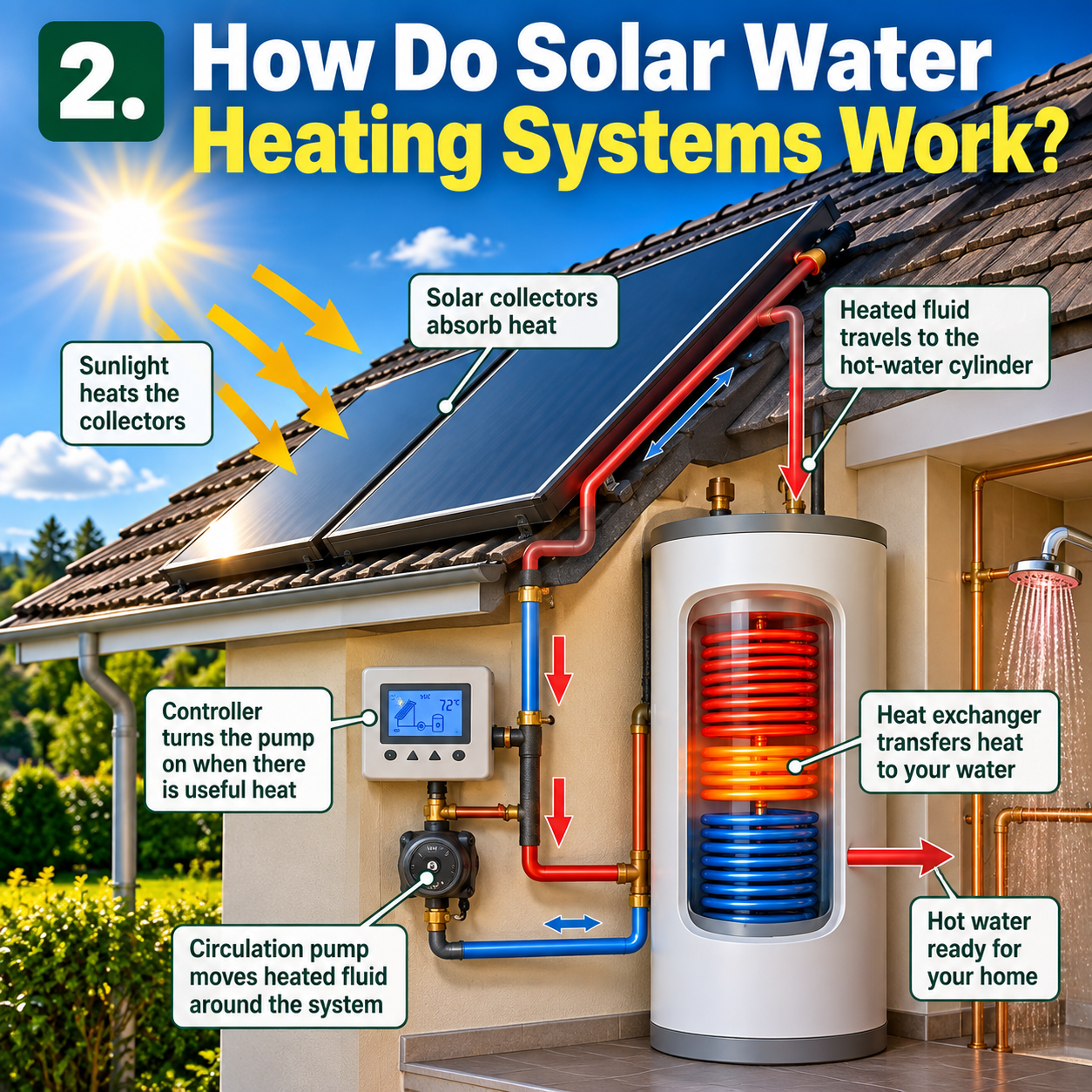
A well-designed solar water heating system uses roof-mounted collectors to capture heat from sunlight and transfer that energy to your domestic hot water. But installing solar thermal is not simply a matter of putting collectors on a sunny roof. Collector orientation, cylinder capacity, pipe length, insulation, frost protection and system controls all need to work together.
These solar water heater installation tips explain the main points homeowners should understand before installation, from checking the property and positioning the collectors to choosing the correct cylinder and commissioning the finished system.
1. What to Check Before Installing a Solar Water Heater
Before buying equipment, check whether your home is suitable for solar thermal. The first consideration is the amount of usable sunlight reaching the proposed collector location throughout the year.
A roof with good solar exposure and limited shading is normally preferable. Trees, neighbouring buildings, chimneys and other roof structures can reduce the amount of useful solar energy reaching the collectors.
You should also consider the condition of the roof, available space for the collectors, the location of the hot-water cylinder and the route that the solar pipework will need to follow.
Check Your Existing Hot-Water System
The installer also needs to understand how your water is currently heated. A solar thermal system normally supplements another heat source rather than replacing it completely.
The backup may be a boiler, immersion heater, heat pump or another compatible water-heating system. This becomes particularly important during winter and periods of prolonged cloudy weather.
For independent information on solar thermal systems, see the SEAI guidance on hot water from solar energy.
2. Choose the Best Position for the Solar Collectors
Collector position is one of the most important solar water heater installation tips. Collectors need good exposure to sunlight and should be positioned where shading is kept to a minimum.
In the Northern Hemisphere, a broadly south-facing position generally provides strong annual solar exposure, although southeast and southwest orientations can also work effectively. The precise result depends on roof pitch, location, shading and household hot-water use.
Do not judge the roof only by how sunny it looks at midday in summer. The sun is lower during winter, which can cause nearby trees, buildings and chimneys to cast much longer shadows.
Roof Strength and Condition
The roof must also be capable of supporting the collector mounting system. If roofing work is already due, it can make sense to complete that work before installing solar thermal equipment rather than removing and reinstalling collectors later.
3. Choose the Right Solar Thermal Collector
The two common collector technologies used for domestic solar water heating are flat-plate collectors and evacuated-tube collectors.
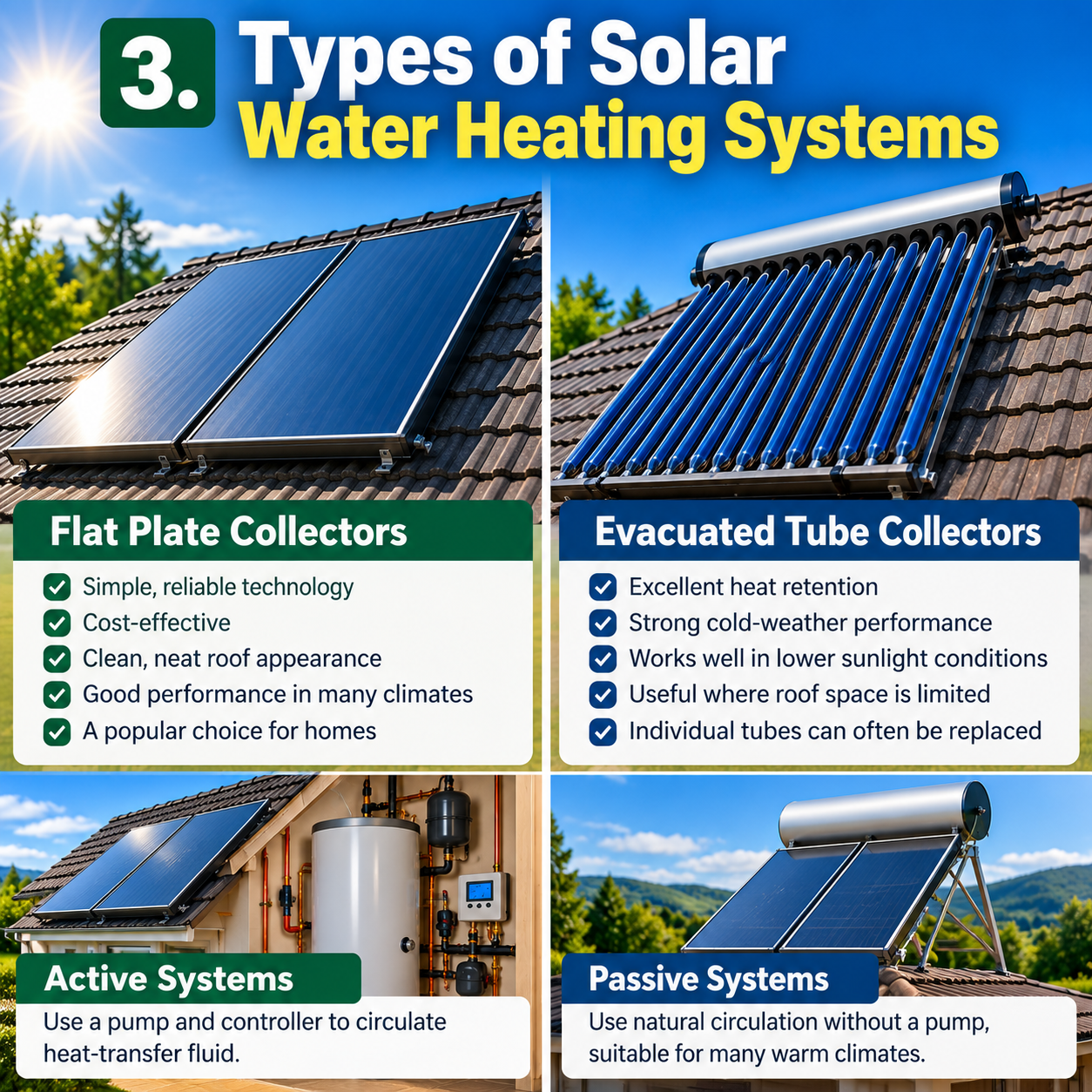
| Feature | Flat-Plate Collector | Evacuated-Tube Collector |
|---|---|---|
| Feature Design | Flat-Plate Collector Large insulated glazed collector | Evacuated-Tube Collector Rows of individual evacuated glass tubes |
| Feature Appearance | Flat-Plate Collector Low-profile rectangular panel | Evacuated-Tube Collector More visible tubular construction |
| Feature Cold conditions | Flat-Plate Collector Good when properly sized | Evacuated-Tube Collector Can retain heat particularly well in colder conditions |
| Feature Maintenance | Flat-Plate Collector Relatively simple construction | Evacuated-Tube Collector Individual tubes may be replaceable on some systems |
| Feature Best choice | Which is best? The right choice depends on climate, roof area, installation design, budget and household hot-water requirements. | |
The collector with the highest specification is not automatically the best choice for every property. Correct system design is more important than choosing a technology based on one performance figure alone.
For more information, see our complete guide to solar hot water panels.
4. Size the Solar Water Heater Correctly
Another of the most important solar water heater installation tips is to size the system around realistic household hot-water demand. Installing too little collector area limits useful solar contribution, while substantially oversizing the system can create excessive summer heat that must be managed safely.
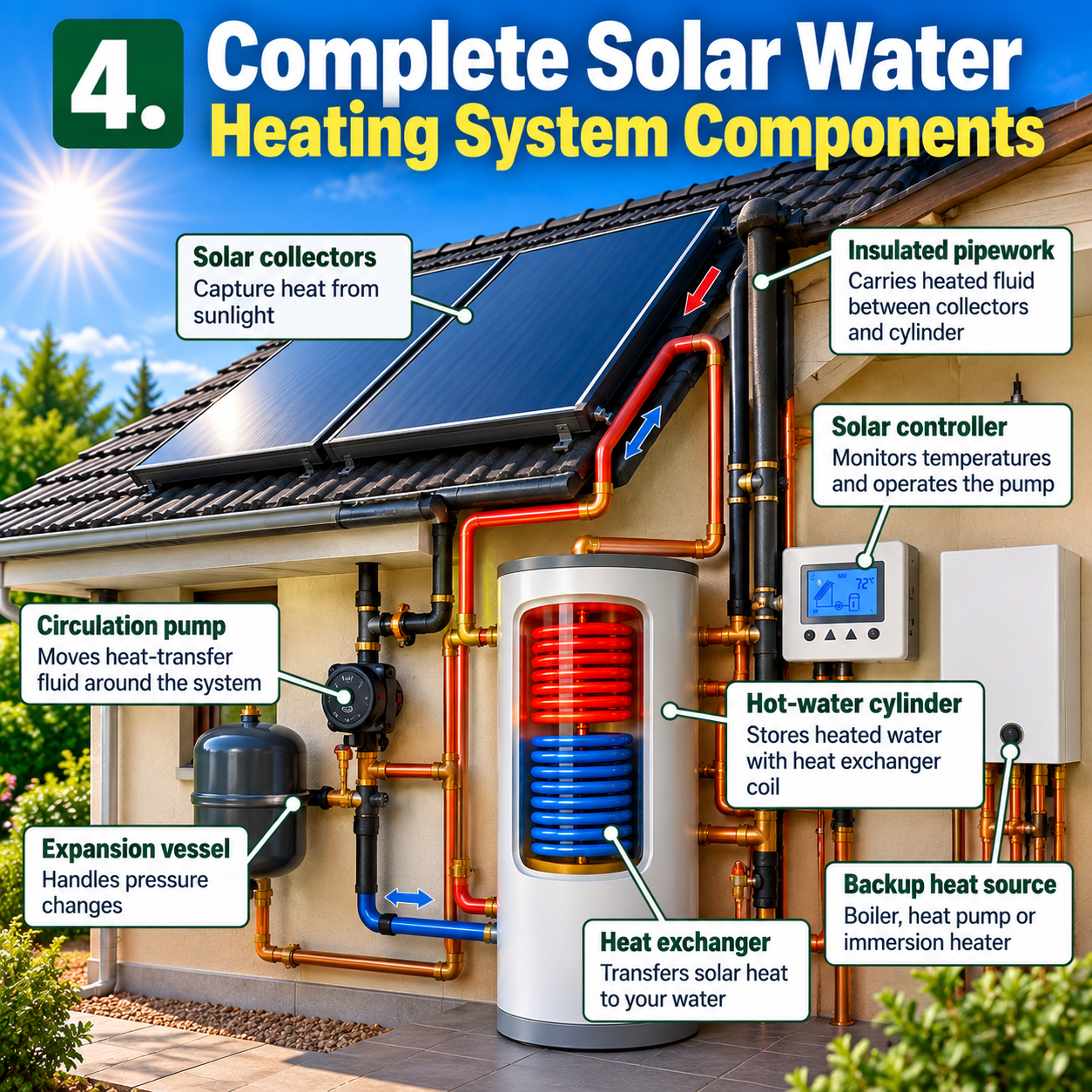
The installer should consider household size, normal daily hot-water use, available collector area, climate, cylinder capacity and the backup heating system.
Do Not Size From Household Size Alone
Two homes with the same number of occupants can have very different hot-water requirements. Shower habits, bath use, appliance connections and periods when the home is unoccupied can all affect demand.
5. Choose the Correct Hot-Water Cylinder
The hot-water cylinder is the storage centre of many domestic solar thermal systems. Solar energy collected during the day can be transferred into stored water for use later.

Many installations use a cylinder with separate heat-exchanger coils. One can accept heat from the solar circuit while another works with the main backup heat source.
The cylinder needs sufficient capacity for the household while still allowing the solar system to make useful contributions. Good cylinder insulation is also important because energy collected from the roof should not simply be lost from the storage tank.
Consider Available Space
Larger cylinders need more room. Before ordering equipment, check the physical dimensions, access route and service clearances. This can be especially important when replacing an existing cylinder located in a cupboard or confined utility area.
6. Keep Solar Pipe Runs Short and Well Insulated
Good pipework is another of our essential solar water heater installation tips. Solar thermal collectors may become very hot, but that energy still has to reach the cylinder without excessive heat loss.
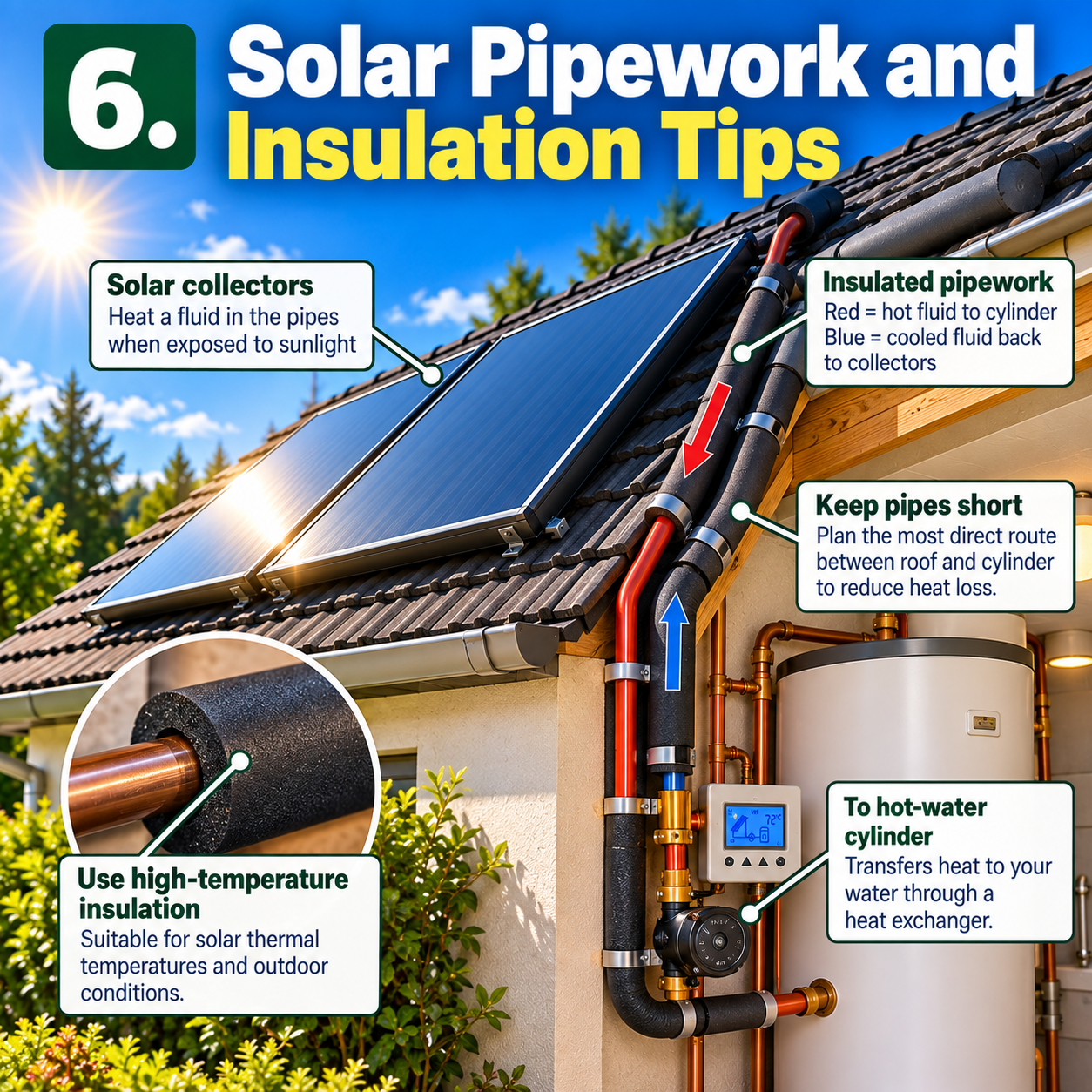
Where practical, the pipe route should be direct, properly supported and well insulated. Insulation used around solar thermal pipework must be suitable for the temperatures the system can experience.
Outdoor sections also need insulation and finishes suitable for exposure to sunlight and weather. Damaged insulation should not be ignored because exposed hot pipework can increase system losses.
Plan the Route Before Fitting the Collectors
A little planning at the beginning can avoid unnecessarily long pipe runs, awkward bends and difficult-to-service components later.
7. Plan for Frost and Overheating
Solar thermal systems operate through very different conditions during the year. A system may face freezing temperatures in winter and periods of intense heat during summer when the household is using little hot water.
Depending on the system design and local climate, frost protection may involve an appropriate heat-transfer fluid and correctly configured controls. The fluid should be maintained according to the system manufacturer’s requirements.
Overheating also needs to be considered during system design. Expansion vessels, pressure-relief components, controls and other safety measures must be correctly selected and commissioned.
8. Typical Solar Water Heater Installation Process
Following good solar water heater installation tips throughout the job helps ensure that the collectors, cylinder, pipework, controls and safety equipment work together as one complete system.
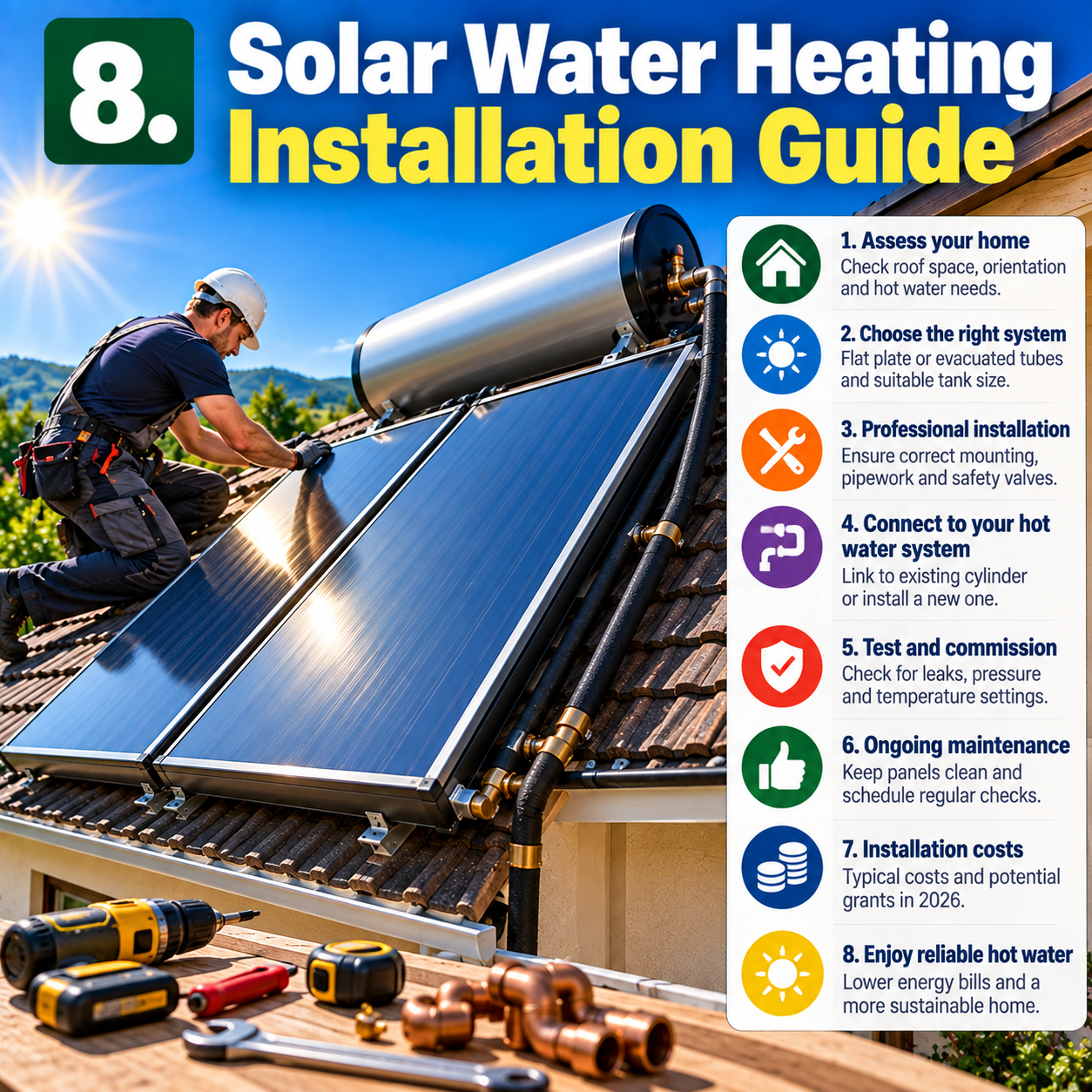
- Survey the property: assess the roof, orientation, shading, cylinder location and household hot-water demand.
- Design the system: select suitable collectors, storage capacity, controls and hydraulic components.
- Install the mounting system: securely attach the collector mounting hardware to the roof structure.
- Fit the collectors: position and secure them according to the approved system design.
- Install the cylinder: fit or adapt the hot-water storage and install pumps, controls and required equipment.
- Connect the solar circuit: route and insulate the flow and return pipework between the collectors and heat exchanger.
- Fill and test: check pressure, circulation, connections and safety equipment.
- Commission the system: configure the controls and verify that the installation operates as designed.
For further independent guidance, see the Energy Saving Trust guide to solar water heating.
How Much Does Solar Water Heater Installation Cost?
The cost of installing a solar water heater varies considerably between homes. Collector type, cylinder replacement, roof access, scaffolding, pipe routing, controls and the complexity of integrating the system with existing heating equipment can all affect the final price.
Rather than comparing quotes solely on the headline cost, check exactly what each quotation includes. A lower initial price may not represent better value if important installation work or components are excluded.
Ask for an Itemised Quotation
A useful quotation should make it reasonably clear what collectors, cylinder, controls and installation work are included, together with warranty information and ongoing maintenance requirements.
Grant and incentive schemes can change, so check current eligibility and technical requirements directly with the appropriate national or local authority before purchasing a system.
Solar Water Heater Installation vs Solar PV
Solar thermal and solar photovoltaic systems use sunlight in different ways. Solar thermal collectors capture heat specifically for water heating, while solar PV panels generate electricity that can be used throughout the home.
| Feature | Solar Water Heating | Solar PV |
|---|---|---|
| Feature Main output | Solar Water Heating Heat for domestic hot water | Solar PV Electricity |
| Feature Energy storage | Solar Water Heating Hot-water cylinder | Solar PV Optional battery storage |
| Feature Primary purpose | Solar Water Heating Reduce energy used for water heating | Solar PV Supply household electrical loads |
| Feature Roof equipment | Solar Water Heating Solar thermal collectors | Solar PV Photovoltaic panels |
| Feature Maintenance | Solar Water Heating Fluid, pressure, pump and thermal-system checks | Solar PV Generally fewer hydraulic components |
If you are comparing the technologies, see our guide to solar panels for homes.
Homeowners interested in storing electricity from solar PV can also read our guide to home battery storage systems.
Solar Water Heater Maintenance After Installation
A properly installed solar thermal system can provide useful service for many years, but it should not simply be installed and forgotten.
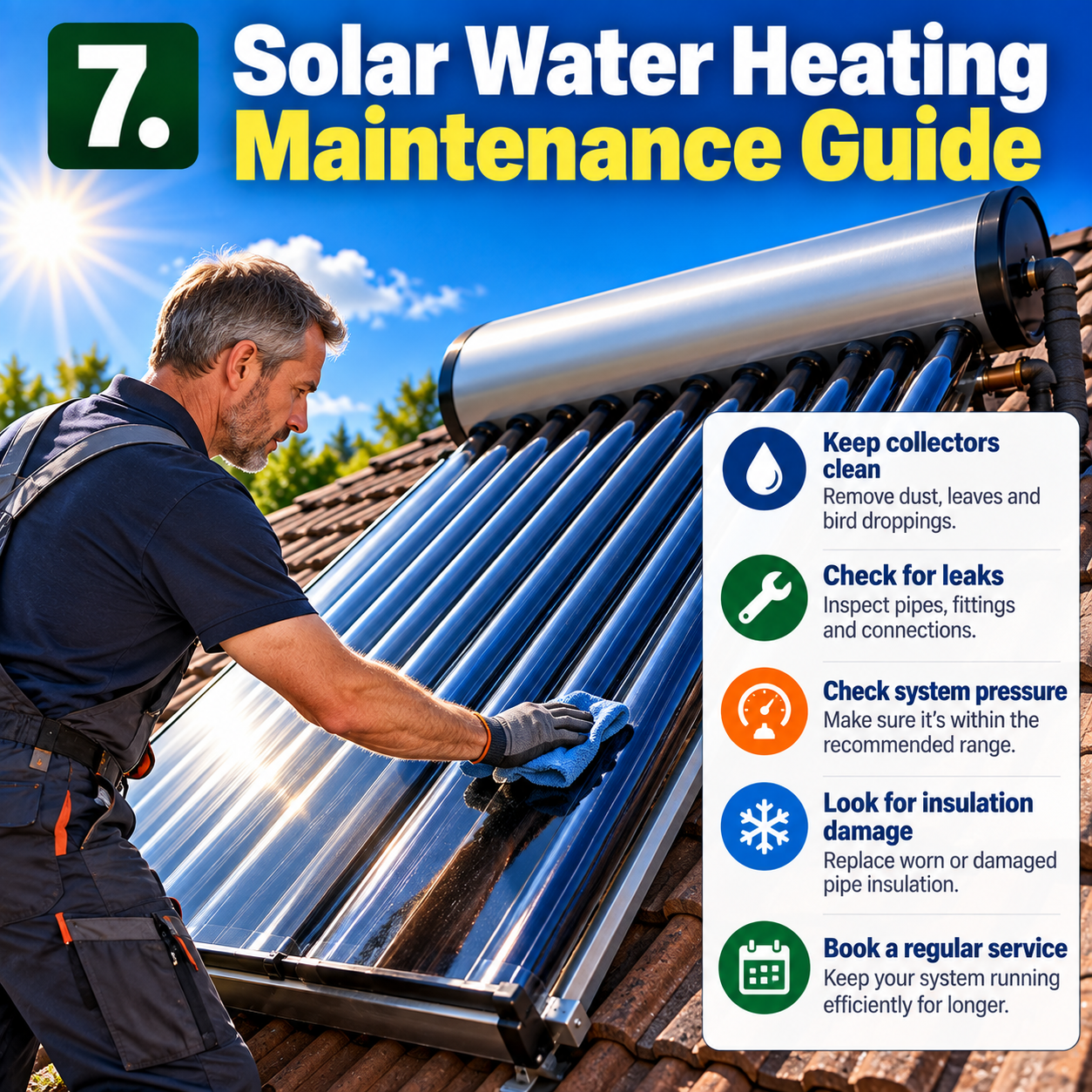
Maintenance requirements vary by system, but periodic checks can include system pressure, heat-transfer fluid condition, pump operation, controls, insulation, valves and visible pipework. The collectors should also be inspected for obvious damage or excessive dirt and debris.
Signs That a System Needs Attention
- Hot-water contribution falls noticeably without an obvious weather-related reason.
- The controller reports unusual temperatures or faults.
- System pressure changes significantly.
- Leaks or staining appear around components or connections.
- Pipe insulation becomes damaged or deteriorated.
- The circulation pump becomes unusually noisy or stops operating.
Problems involving pressure, high temperatures, heat-transfer fluid or safety equipment should be handled by a qualified technician.
Common Solar Water Heater Installation Mistakes
Many performance problems can be traced back to design or installation choices rather than the collector technology itself.
- Poor collector positioning: unnecessary shading reduces available solar energy.
- Incorrect system sizing: collector area and storage do not match household requirements.
- Long pipe runs: unnecessary distance between collectors and storage increases heat loss.
- Poor insulation: valuable collected heat escapes before reaching the cylinder.
- Inadequate expansion planning: the system is not designed correctly for changing temperatures.
- Poor service access: components are installed where future inspection and maintenance become unnecessarily difficult.
Is Solar Water Heating Worth Installing in 2026?
Solar water heating can make sense for homes with suitable solar exposure and consistent hot-water demand, particularly where the system can displace a meaningful amount of energy otherwise used for water heating.
However, there is no universal answer. Installation cost, climate, household demand, existing heating equipment, available roof space and alternative technologies all affect the economics.
For some households, solar PV may provide greater flexibility because the electricity can power many different loads. For others, a dedicated solar thermal system can remain an effective way to reduce conventional water-heating demand.
Frequently Asked Questions
What is the best position for a solar water heater?
A location with strong solar exposure and minimal shading is generally best. In the Northern Hemisphere, broadly south-facing collectors often receive good annual solar exposure, although southeast and southwest orientations can also be suitable.
Can I install a solar water heater myself?
Solar thermal installation involves roof work, high-temperature fluid, pressurised components and integration with domestic hot-water equipment. Professional installation is normally the safer option and may also be required for warranties, regulations or incentive schemes.
Does a solar water heater need a backup heater?
Usually, yes. Solar availability changes with the weather and season, so most domestic systems work alongside a boiler, immersion heater, heat pump or another compatible backup heat source.
Do solar water heaters work during winter?
They can still collect useful solar energy during winter, but output is generally lower because days are shorter and available solar radiation is reduced. The backup heat source therefore becomes more important.
How important is solar pipe insulation?
Very important. The solar circuit transports collected heat from the roof to the cylinder. Correct high-temperature insulation helps prevent unnecessary energy loss along that route.
How long does solar water heating last?
Service life varies according to equipment quality, installation, climate and maintenance. Collectors can remain useful for many years, while pumps, controls, fluid and other components may require servicing or replacement during the life of the installation.
Are evacuated tubes better than flat-plate collectors?
Not automatically. Both technologies can work well. Roof space, climate, installation design, cost and household requirements should be considered before choosing between them.
How do I choose the right size solar water heater?
System sizing should consider actual hot-water demand, collector area, local solar conditions, storage capacity and the backup heating system. A professional installer can calculate these requirements for the property.
Final Solar Water Heater Installation Tips
The most important solar water heater installation tips are straightforward: assess the property carefully, position the collectors for good solar exposure, size the collectors and cylinder together, minimise heat loss through the pipework and make sure frost, expansion and overheating protection are properly designed.
The quality of the installation matters just as much as the equipment itself. A carefully planned solar thermal system can reduce the amount of conventional energy required for domestic hot water while providing a practical source of renewable heat for many years.
Before purchasing a system, compare several professional quotations and make sure each installer has assessed your actual roof, hot-water demand and existing heating equipment rather than relying on a generic package size.
Plan Your Home Energy System
Solar water heating is only one part of a modern home-energy strategy. Home-Energy-Systems.COM provides independent guides covering solar panels, battery storage, backup power, heat pumps and renewable-energy technologies.