Farm Security Cameras: Complete Guide 2026
Farm security cameras have changed dramatically. Protecting a farm no longer necessarily means running hundreds of metres of cable from the farmhouse or trying to extend Wi-Fi to a distant gate. Solar power, 4G cellular connections, battery cameras and intelligent motion detection have made it possible to monitor barns, machinery, livestock, entrances and remote fields that were previously difficult to cover.
But choosing the right farm camera is not simply a matter of buying the model with the highest resolution. A camera at a machinery shed has very different requirements from one overlooking livestock or a gateway half a mile from the farmhouse.
This complete 2026 guide explains the different types of farm cameras, where to install them, when solar or 4G makes sense, what features are worth paying for and how to build a practical security system around the areas of your farm that matter most.
Affiliate disclosure: Some links in this guide are affiliate links. If you buy through one of these links, we may earn a commission at no additional cost to you. This does not affect which camera technology we recommend for a particular farm location.
Why Farms Need a Different Approach to Security
A farm can be far more difficult to monitor than an ordinary home or small business. There may be several entrances, multiple sheds, expensive machinery, fuel tanks, livestock and equipment spread across a large area.
Some vulnerable locations may also be hundreds of metres from the farmhouse.
That creates three basic problems: distance, power and connectivity.
This is why a camera designed for a suburban house may not automatically be suitable for agricultural use.
Farm security is also about more than theft. Cameras may help owners check livestock, see whether a gate has been left open, monitor deliveries, watch machinery areas and inspect remote locations without physically travelling across the property.
An Garda Síochána’s farm security guidance recommends CCTV as one part of farm security, particularly for places that cannot be seen from the farmhouse. Garda guidance also stresses access control, gates, boundaries, lighting, alarms and protecting valuable machinery. In other words, cameras work best as part of a wider security plan rather than as the only line of defence.
Types of Farm Security Cameras
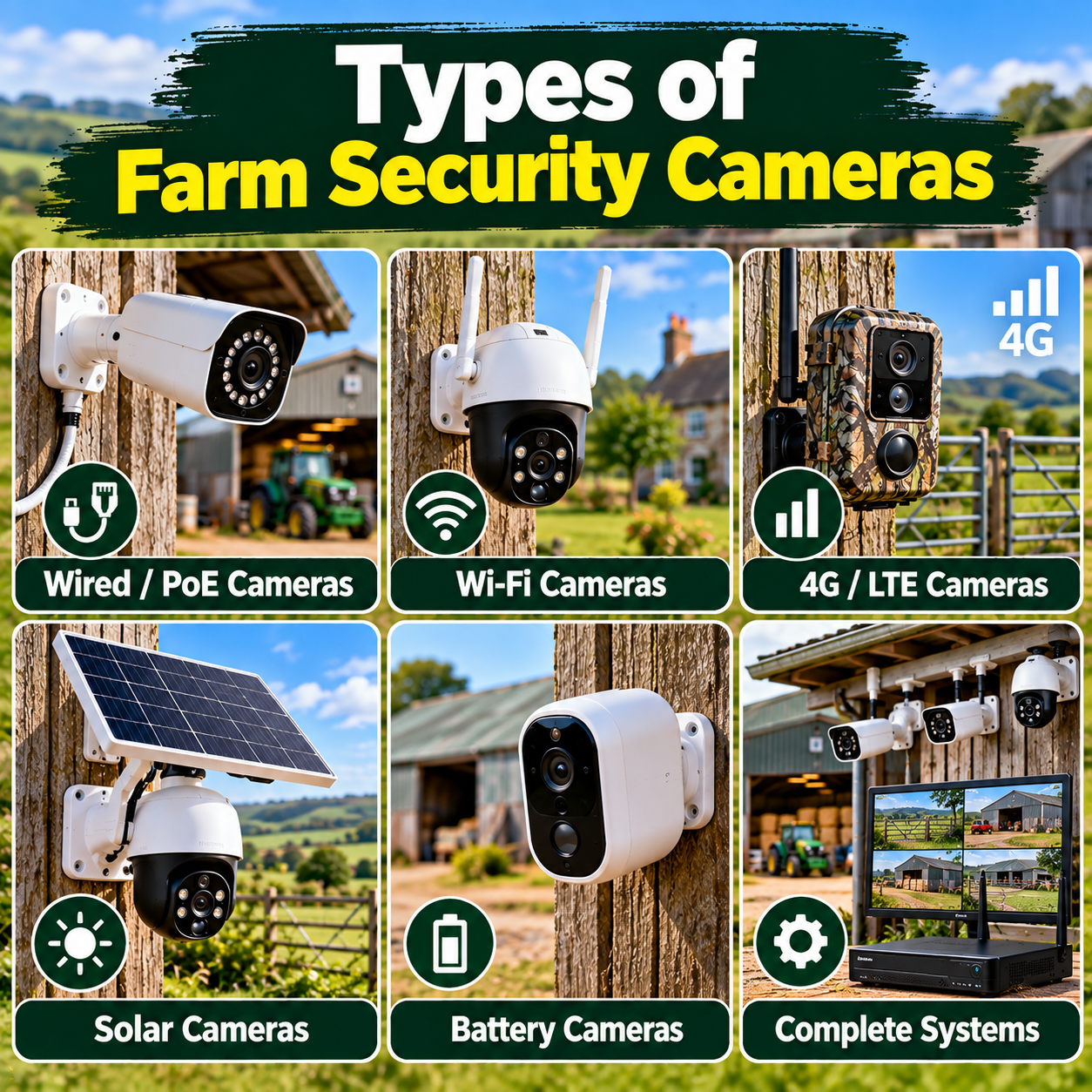
There is no single best type of camera for every farm. The right technology depends largely on where the camera will be positioned and what services are available at that location.
| Camera type | Best suited to | Main consideration |
|---|---|---|
| Wired / PoE | Farmyards, workshops, barns and buildings | Requires cable installation |
| Wi-Fi | Areas close to farmhouse or strong network coverage | Depends on reliable Wi-Fi |
| 4G/LTE | Remote gates, fields and isolated sheds | Needs cellular coverage and data |
| Battery | Locations where wiring is difficult | Battery eventually requires charging |
| Solar | Remote outdoor locations | Needs suitable daylight and correct panel positioning |
Wired and PoE Farm Cameras
If electricity and network cabling are already available around the main yard, wired cameras remain an attractive solution.
PoE, or Power over Ethernet, allows compatible cameras to receive power and transmit data through an Ethernet cable. This can provide a stable connection and can be particularly useful where several cameras continuously protect workshops, sheds or machinery areas.
The disadvantage is installation. Running cables over long distances or digging trenches simply to reach one remote farm gate may make little sense.
Wireless Farm Cameras
The term wireless farm cameras can be confusing because it does not always mean completely wire-free.
A Wi-Fi camera may transmit footage wirelessly but still require a power cable. A battery camera may be wire-free but still depend on Wi-Fi for remote access. A 4G camera can communicate through the mobile network but may need battery charging or a solar panel.
Wi-Fi vs 4G Farm Security Cameras
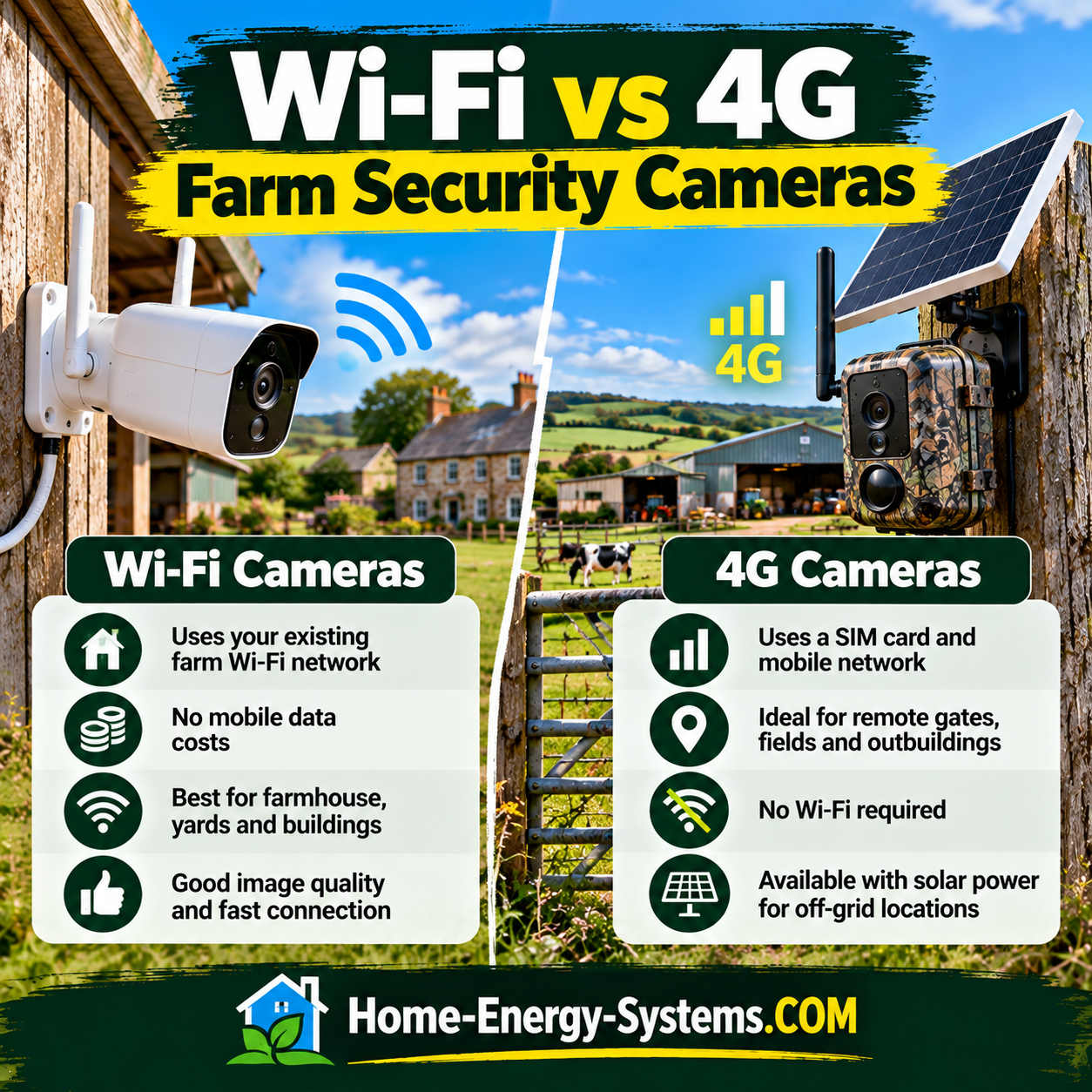
This is one of the most important decisions when choosing cameras for rural properties.
Wi-Fi Farm Cameras
Wi-Fi cameras make sense around areas where a strong and dependable network already exists.
Typical locations include:
- the farmhouse;
- the main farmyard;
- nearby machinery sheds;
- workshops;
- calving or lambing sheds close to the main buildings.
They can be economical because they normally use the farm’s existing broadband connection. The problem comes when the camera is moved farther away.
A Wi-Fi signal that appears adequate on a phone may not necessarily provide the dependable connection expected from a security camera throughout the year.
For farms with reliable Wi-Fi around the farmhouse, yard or nearby buildings, wire-free systems can also avoid running power cables to every camera. Arlo UK security cameras are one option worth considering for these connected areas, particularly where app-based monitoring, intelligent detection and wire-free installation are priorities.
4G/LTE Farm Cameras
Remote farm cameras increasingly solve the connectivity problem by using the mobile network rather than farm broadband.
A cellular camera normally uses a SIM or eSIM and a mobile data connection. Current 4G camera systems are specifically designed for locations where Wi-Fi is unavailable, although they still require adequate mobile coverage.
This can make cellular cameras particularly useful for:
- remote entrances;
- field gates;
- isolated sheds;
- livestock areas;
- machinery stored away from the main yard;
- fuel tanks;
- temporary farm locations.
Solar Security Cameras for Farms
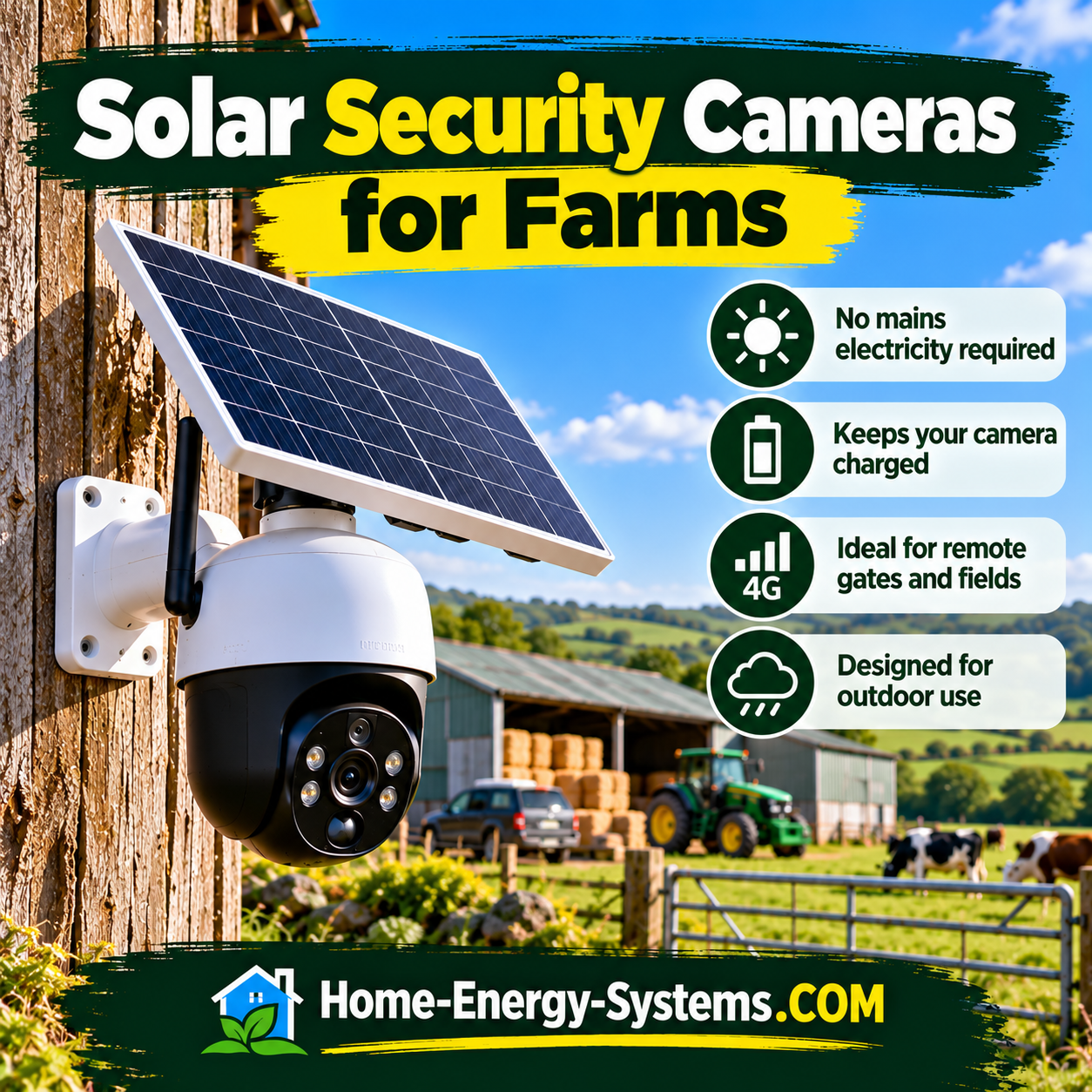
Solar farm cameras are particularly interesting because they address one of the biggest problems with rural security: getting electricity to the camera.
The basic system consists of a rechargeable battery camera connected to a small solar panel. During daylight hours the panel helps replenish energy used by the camera.
Combine that with 4G connectivity and it becomes possible to operate a camera in some locations without either mains electricity or farm Wi-Fi.
This makes solar security cameras attractive for remote fields, gates and outbuildings.
What Solar Panels Actually Do
A common mistake is assuming that a small camera solar panel behaves like a large solar system and rapidly charges a flat battery.
In many camera systems, the panel is better understood as a way of maintaining the rechargeable battery. Manufacturer guidance also warns that very heavy camera usage can consume energy faster than a small solar panel replenishes it.
Performance can therefore depend on:
- available sunlight;
- panel orientation;
- shade from trees and buildings;
- temperature;
- number of motion events;
- recording duration;
- frequency of live viewing;
- camera settings.
This matters on busy farm entrances. A camera overlooking a quiet field gate may trigger only occasionally, while one facing a busy yard could activate hundreds of times.
For a broader explanation of independent solar power, see our complete guide to off-grid solar systems.
Where Should Farm Security Cameras Be Installed?
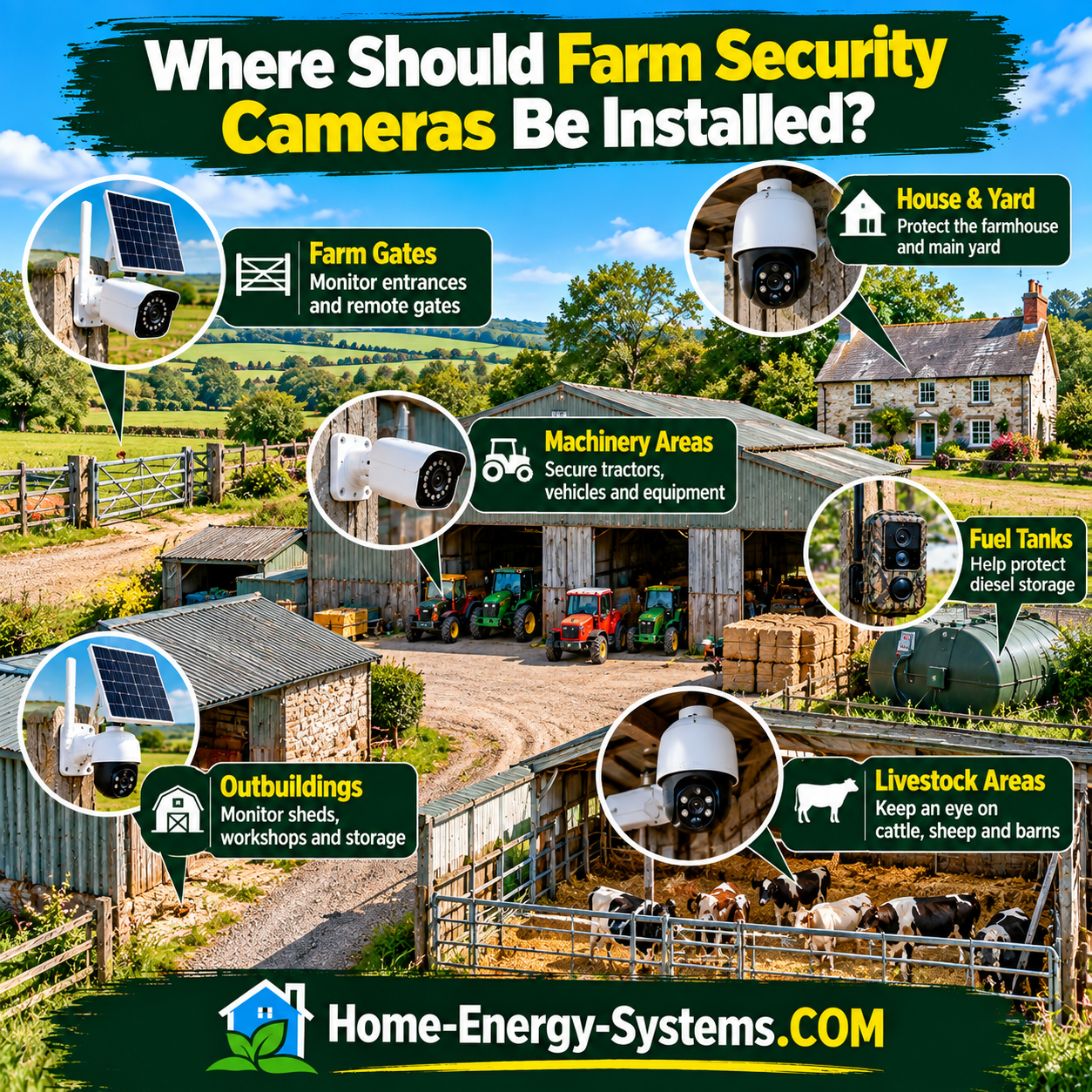
The best camera is of limited value if it is watching the wrong place.
Rather than attempting to cover every acre, begin by identifying the points where people, vehicles, machinery or livestock are most likely to pass.
1. Main Farm Entrance
The main entrance is normally one of the highest-priority positions because vehicles and visitors must pass through it.
The objective should not simply be to obtain a wide image of the road. Position the camera so that useful identifying detail can be captured when somebody enters the property.
2. Remote Gates
Remote gates are a natural application for solar and cellular cameras.
A strategically positioned camera can alert the farmer when a vehicle or person arrives without requiring electricity or broadband to be extended from the main farmyard.
3. Machinery and Equipment Areas
Tractors, quad bikes, trailers, tools and other farm equipment can represent substantial value.
Camera coverage should complement locked buildings, immobilisers, secure key storage, trackers and physical security rather than replace them.
4. Fuel Tanks
Fuel storage can be another useful monitoring point, particularly if the tank is positioned away from the farmhouse.
A camera with person or vehicle detection may be preferable to basic motion detection in locations where animals and vegetation could otherwise generate unnecessary alerts.
5. Barns and Outbuildings
Outdoor farm cameras can monitor entrances to barns, workshops and storage buildings. Where power and Ethernet are already available, a wired system may make more sense than installing numerous independent battery cameras.
6. Livestock Areas
Cameras can serve both security and management purposes around livestock.
Depending on the setup, farmers may be able to check animals remotely without repeatedly travelling to the shed or field.
Livestock Security Cameras
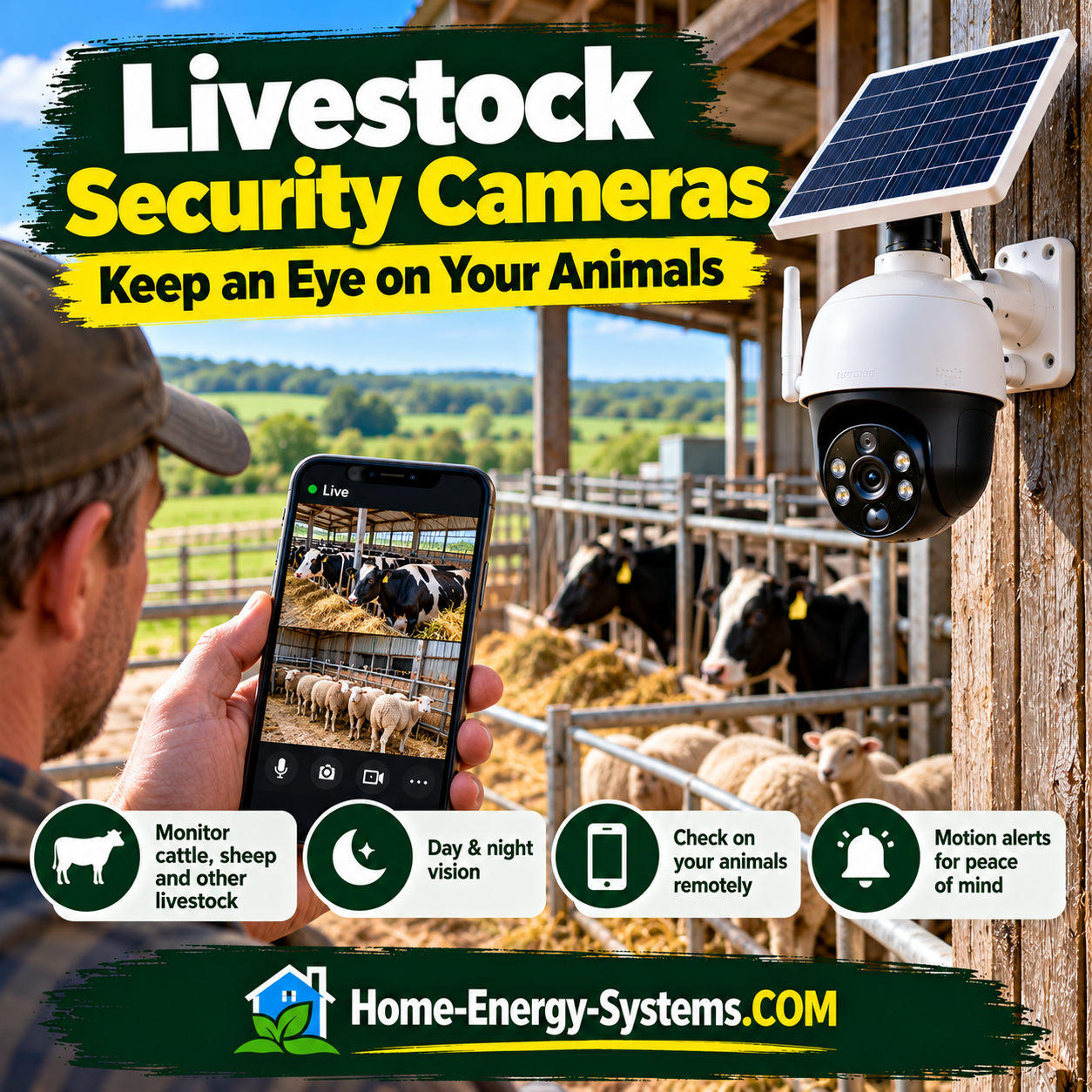
Livestock security cameras deserve special consideration because the objective may be broader than detecting intruders.
A camera may also be used to observe:
- calving areas;
- lambing sheds;
- feeding areas;
- water points;
- field entrances;
- livestock trailers;
- animal movement around buildings.
Night vision can be especially important in livestock buildings, but placement matters. A camera mounted too high or too far from the animals may provide a wide view without enough useful detail.
For indoor livestock monitoring where electricity and farm Wi-Fi are already available, solar or cellular capability may offer little advantage. A reliable wired or Wi-Fi camera may be simpler.
What Features Matter in Farm Security Cameras?
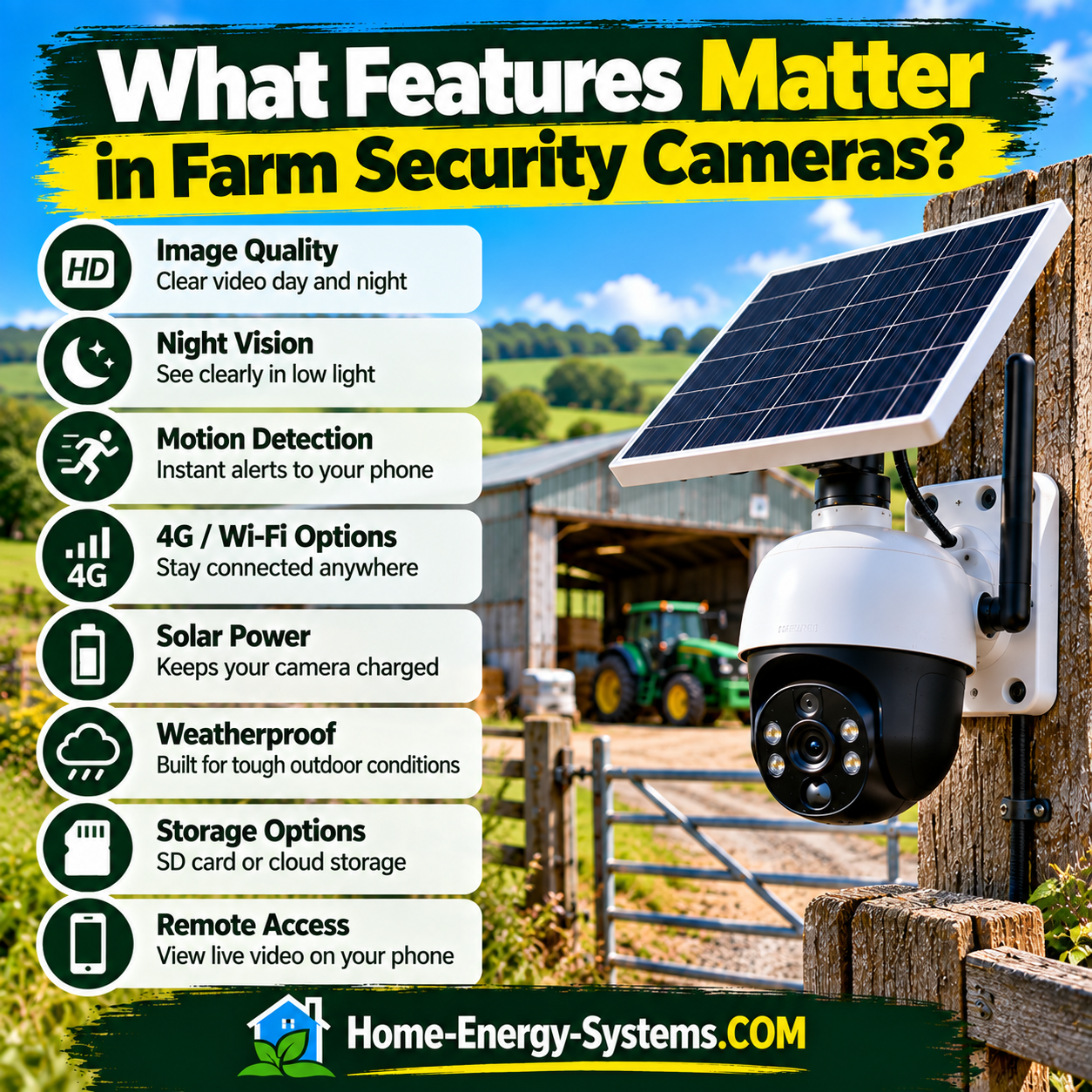
Camera specifications can become a numbers game. Resolution matters, but several less glamorous features can be more important on a farm.
Person and Vehicle Detection
Basic motion detection can become frustrating outdoors.
Animals, branches, rain, shadows and vegetation can all cause movement. Cameras capable of distinguishing people or vehicles can help reduce irrelevant notifications, although no detection system should be assumed to be perfect.
Night Vision
Many important security events happen after dark, so night performance deserves as much attention as daytime resolution.
Some cameras use infrared illumination, while others use spotlights to produce colour images in low light.
Weather Resistance
A farm camera can face rain, wind, dust, frost and prolonged exposure to sunlight.
Check the manufacturer’s weather-resistance rating and operating-temperature range rather than assuming every camera described as “outdoor” will suit every exposed location.
Local Storage
MicroSD cards, hubs and network video recorders can reduce dependence on cloud storage.
Some systems can continue recording locally if the internet connection is interrupted, although remote viewing and alerts may be unavailable until connectivity returns.
Cloud Storage
Cloud storage has an important advantage: footage can remain available even if a thief damages or removes the camera.
The trade-off may be an ongoing subscription.
Before buying, check which features require a paid plan. Functions advertised on the box may not all be included indefinitely without a subscription.
Two-Way Audio
A microphone and speaker allow the camera operator to hear activity and speak through the camera.
Audio recording can have additional privacy implications, so it should not simply be enabled automatically without considering applicable rules.
Pan, Tilt and Zoom
PTZ cameras can cover a large area and allow remote adjustment of the view.
However, a camera looking in one direction cannot simultaneously capture detail somewhere else. For critical entrances, a fixed camera permanently watching the access point may sometimes be preferable.
Farm Camera Option: Arlo UK
For farmhouses, main yards, barns and other areas with dependable Wi-Fi, Arlo’s wire-free security cameras are worth considering. Current Arlo systems include high-resolution camera options and intelligent detection features designed to help distinguish relevant activity.
The important limitation for farms is connectivity. Arlo should not automatically be treated as a replacement for a dedicated 4G/LTE camera at a remote gate or field where farm Wi-Fi does not reach. We see its strongest role around the connected parts of the farm, where wire-free installation and app-based monitoring are useful.
Before purchasing, check the specifications of the individual camera, Wi-Fi requirements, battery life, storage options and which features require an Arlo Secure subscription.
View Arlo Security Cameras UK →
Affiliate link: We may earn a commission if you purchase through this link, at no additional cost to you.
Farm Camera Connection and Power Comparison
| Setup | Main advantage | Best use |
|---|---|---|
| PoE + NVR | Stable continuous system | Main yard and buildings |
| Wi-Fi + mains | Simple where services exist | Farmhouse and nearby sheds |
| Wi-Fi + battery | Easy installation | Occasional-use positions within Wi-Fi range |
| Wi-Fi + solar | Little power wiring | Outdoor locations with Wi-Fi |
| 4G + battery | No Wi-Fi required | Temporary remote monitoring |
| 4G + solar | No mains or Wi-Fi required | Remote gates, fields and outbuildings |
How Many Security Cameras Does a Farm Need?
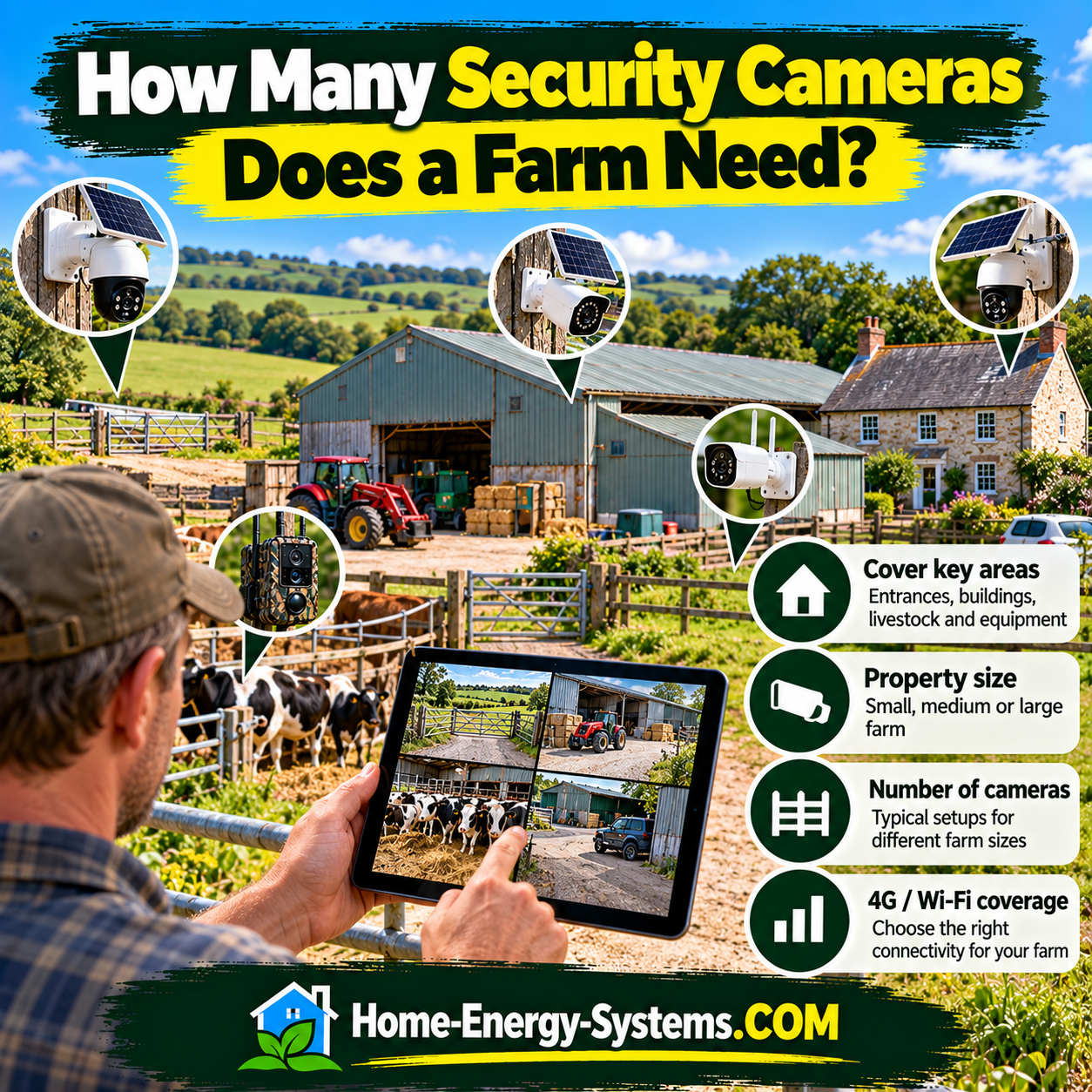
There is no sensible universal number because a compact farm with one entrance is completely different from a property with multiple yards, fields and remote buildings.
A better approach is to divide the farm into security zones.
- Access: Where can vehicles and people enter?
- High-value assets: Where are machinery, fuel, tools and vehicles stored?
- Buildings: Which sheds or workshops need protection?
- Livestock: Which animal areas need monitoring?
- Remote locations: Which gates or fields cannot be seen from occupied buildings?
Then prioritise each area according to risk.
One correctly positioned camera covering the only entrance to a remote yard may provide more useful information than several poorly positioned cameras covering open ground.
How to Install Farm Security Cameras
A good installation begins before the camera is attached to a wall or post.
Step 1: Survey the Farm
Walk around the property and identify entrances, vulnerable buildings, high-value assets and areas hidden from the farmhouse.
It is useful to do this both during daylight and after dark.
Step 2: Check Connectivity
If you intend to use Wi-Fi, test the actual signal at the proposed camera location.
For a 4G camera, check cellular reception using the network the camera or SIM will use.
Step 3: Check the Power Source
Decide whether mains electricity, PoE, battery or solar power is most practical.
If solar is being used, inspect the site for seasonal shade. A position that receives plenty of summer sunshine can look very different in winter.
Step 4: Choose the Viewing Angle
A very wide view is not always the most useful view.
For security, think about where a person or vehicle will pass and whether the camera will capture useful detail at that point.
Step 5: Mount Equipment Securely
Cameras should be difficult to tamper with but still accessible enough for legitimate maintenance.
Solar panels also need secure mounting because exposed farm locations can experience substantial wind loads.
Step 6: Configure Detection Zones
If the camera allows detection zones, exclude irrelevant areas such as a busy public road or vegetation moving continuously in the wind.
Step 7: Test Day and Night
Do not assume that an installation that looks good at midday will work equally well at night.
Check:
- daytime image quality;
- night vision;
- person detection;
- vehicle detection;
- mobile notifications;
- recorded footage;
- solar charging where applicable;
- Wi-Fi or cellular stability.
Farm Cameras Should Be Part of a Wider Security System
A security camera records or detects activity. It does not physically prevent somebody from entering a farm.
This distinction matters.
Current Garda farm-security advice recommends restricting access, maintaining robust boundaries, securing gates, improving lighting, protecting vehicles and equipment and using CCTV or alarms in vulnerable areas. The Garda farm security advice highlights measures including gates, lighting, CCTV and protection of farm property.
A stronger farm-security strategy therefore combines:
- locked and secure gates;
- well-maintained fencing and boundaries;
- appropriate lighting;
- alarms;
- security cameras;
- vehicle immobilisation;
- equipment trackers;
- secure key storage;
- property identification and records;
- good relationships with neighbours and local community networks.
The camera is one layer of the system.
Should You Use Solar Cameras on the Whole Farm?
Probably not.
Solar security cameras solve a particular problem extremely well: powering cameras where running electricity is difficult.
If a workshop already has electricity and Ethernet cabling, installing a solar 4G camera outside it may add unnecessary batteries, cellular data and wireless connections.
The better strategy is often a hybrid farm security system.
Main Farmyard
Consider wired, PoE or reliable Wi-Fi cameras where infrastructure is readily available.
Remote Gate
A solar-powered 4G camera may eliminate the need to run power and broadband to the location.
Livestock Shed
Use existing mains power and network infrastructure where possible, with strong night performance.
Remote Field
Battery, solar and cellular technology can make monitoring practical where fixed services do not exist.
What About Camera Resolution?
Higher resolution can provide additional image detail, but resolution alone does not determine whether a farm security camera is useful.
A high-resolution camera mounted too far from the entrance can still produce disappointing identifying detail. Conversely, a well-positioned camera with a narrower field of view may provide much more useful footage.
Consider resolution alongside:
- distance from the target;
- field of view;
- night performance;
- lighting;
- compression;
- connection quality;
- storage capacity.
For farm security, good positioning normally beats chasing specification numbers.
Do Farm Security Cameras Need Internet?
Not necessarily for every function.
Some camera systems can record to local storage without an active internet connection. Depending on the equipment, recording may continue to an SD card, hub or NVR even when internet access is interrupted.
However, internet connectivity is generally required when you want to receive remote notifications or watch the camera from your phone while away from the farm.
This creates an important distinction:
What Does a 4G Farm Camera Cost to Run?
The camera itself is only part of the cost.
A cellular system may also require a SIM and mobile data plan. Data usage depends heavily on how the camera is used.
Frequent live viewing, high-resolution uploads and long event recordings generally consume more data than a camera that records locally and is checked only when an alert occurs.
When comparing systems, consider the total ongoing cost:
- camera purchase;
- solar panel if separate;
- SIM/data charges;
- cloud subscription;
- memory card or local storage;
- replacement batteries where relevant.
This is another reason not to automatically install cellular cameras everywhere. Use them where cellular connectivity solves a genuine problem.
Farm CCTV, Privacy and Data Protection
Farm security cameras may record workers, contractors, visitors or people passing areas accessible to the public. That means privacy and data-protection responsibilities should be considered before installation.
For Ireland and the EU, the Data Protection Commission’s guidance on the use of CCTV explains that CCTV images containing identifiable individuals are personal data. Organisations using CCTV should consider the purpose and legal basis for recording, necessity, proportionality, security, retention and transparency.
Camera positioning matters too. The DPC advises that systems should be designed to collect only the personal data necessary for the intended purpose. Features such as pan, tilt and zoom can increase the potential impact on privacy.
Recording should therefore be targeted at the area that genuinely needs protection rather than unnecessarily capturing neighbouring property or public areas.
Choosing Farm Security Cameras in 2026
Before comparing brands, write down the requirements for each location.
For every proposed camera, answer these questions:
- What exactly am I trying to monitor?
- Is mains electricity available?
- Is Ethernet available?
- Is reliable Wi-Fi available?
- Is there strong 4G coverage?
- Does the location receive enough daylight for solar charging?
- Do I need person or vehicle detection?
- How important is night vision?
- Do I want local or cloud storage?
- Do I need continuous recording or motion-triggered clips?
- Are there subscription or cellular charges?
- Can the camera withstand the weather at this location?
Once those questions are answered, choosing the right camera becomes considerably easier.
Looking for Solar Farm Cameras?
Our dedicated guide looks at solar security cameras for remote gates, livestock areas, farm buildings and locations where mains electricity may not be available.
Farm Security Cameras: Frequently Asked Questions
What are the best security cameras for farms?
The best farm security camera depends on the location. Wired or PoE cameras are often suitable around buildings with existing infrastructure, while solar-powered 4G cameras can be particularly useful at remote gates, fields and outbuildings without mains power or Wi-Fi.
Can farm security cameras work without Wi-Fi?
Yes. 4G/LTE security cameras use a cellular connection instead of Wi-Fi. Some cameras can also record locally without internet access, although remote viewing and alerts may require a connection.
Do solar farm cameras work in winter?
They can, but performance depends on available daylight, panel position, battery capacity, temperature and camera activity. Heavy use can consume energy faster than a small solar panel replenishes it, so winter conditions should be considered when choosing and positioning the system.
Can I put a security camera at a farm gate with no electricity?
Yes. A battery camera paired with a suitable solar panel can avoid the need for mains electricity. If Wi-Fi does not reach the gate, a 4G/LTE camera can provide connectivity where adequate cellular coverage exists.
Can I monitor livestock with a security camera?
Yes. Cameras can be useful for remotely checking livestock sheds, calving or lambing areas, feeding points and field entrances. Choose the camera according to lighting, distance, connectivity and whether the location is indoors or outdoors.
How many farm security cameras do I need?
There is no fixed number. Start with entrances, high-value machinery, vulnerable buildings, livestock areas and remote locations. Prioritising important views is generally more useful than simply installing the largest possible number of cameras.
Are 4G farm cameras expensive to run?
A 4G camera normally requires cellular data, so there may be an ongoing SIM or data cost. Cloud storage may also carry a subscription. Actual data use varies according to recording settings, resolution and how frequently live video is viewed.
Where should security cameras be placed on a farm?
Priority locations commonly include the main entrance, remote gates, machinery areas, fuel storage, workshops, barns, livestock areas and buildings that cannot be seen from the farmhouse.
Final Thoughts on Farm Security Cameras
Farm security cameras are becoming much more practical for rural properties because cameras are no longer tied to a nearby electrical socket or home broadband connection.
Wired systems still make excellent sense around established farm buildings. Wi-Fi cameras can work well within reliable network coverage. But solar power and 4G connectivity have opened up locations that were once extremely difficult or expensive to monitor.
The key is not to choose one technology for the entire farm.
Start with the risk. Identify what needs protecting, determine what power and connectivity are available at that location, and then choose the camera technology that solves that particular problem.
A remote gateway may need solar and 4G. A workshop may be better served by PoE. A livestock shed may simply need a reliable mains-powered camera with strong night vision.
For connected areas around the farmhouse, yard and nearby buildings, wire-free systems such as Arlo UK security cameras can also be worth considering where reliable Wi-Fi is available.
Used alongside secure gates, strong boundaries, lighting, alarms, trackers and sensible equipment security, cameras can form an important part of a modern farm-security strategy.
Farm-security recommendations: An Garda Síochána farm security guidance covers practical measures for protecting farms, machinery and property.
CCTV and data protection: Ireland’s Data Protection Commission CCTV guidance covers issues including purpose, lawfulness, necessity, proportionality, security, retention and transparency.
Always check current local regulations and manufacturer specifications before installing or purchasing security equipment.