Wondering how many solar panels for a 3 bedroom house you really need? For many households, 8–12 modern solar panels provide a practical starting point, delivering roughly 3.2–5.4 kWp depending on panel wattage. But the right answer comes from your electricity bills, your roof and the sunshine where you live—not bedroom count alone.
Disclosure: This guide contains affiliate links. If you buy through one, we may earn a commission at no additional cost to you. We independently explain the sizing principles and recommend comparing several suppliers.
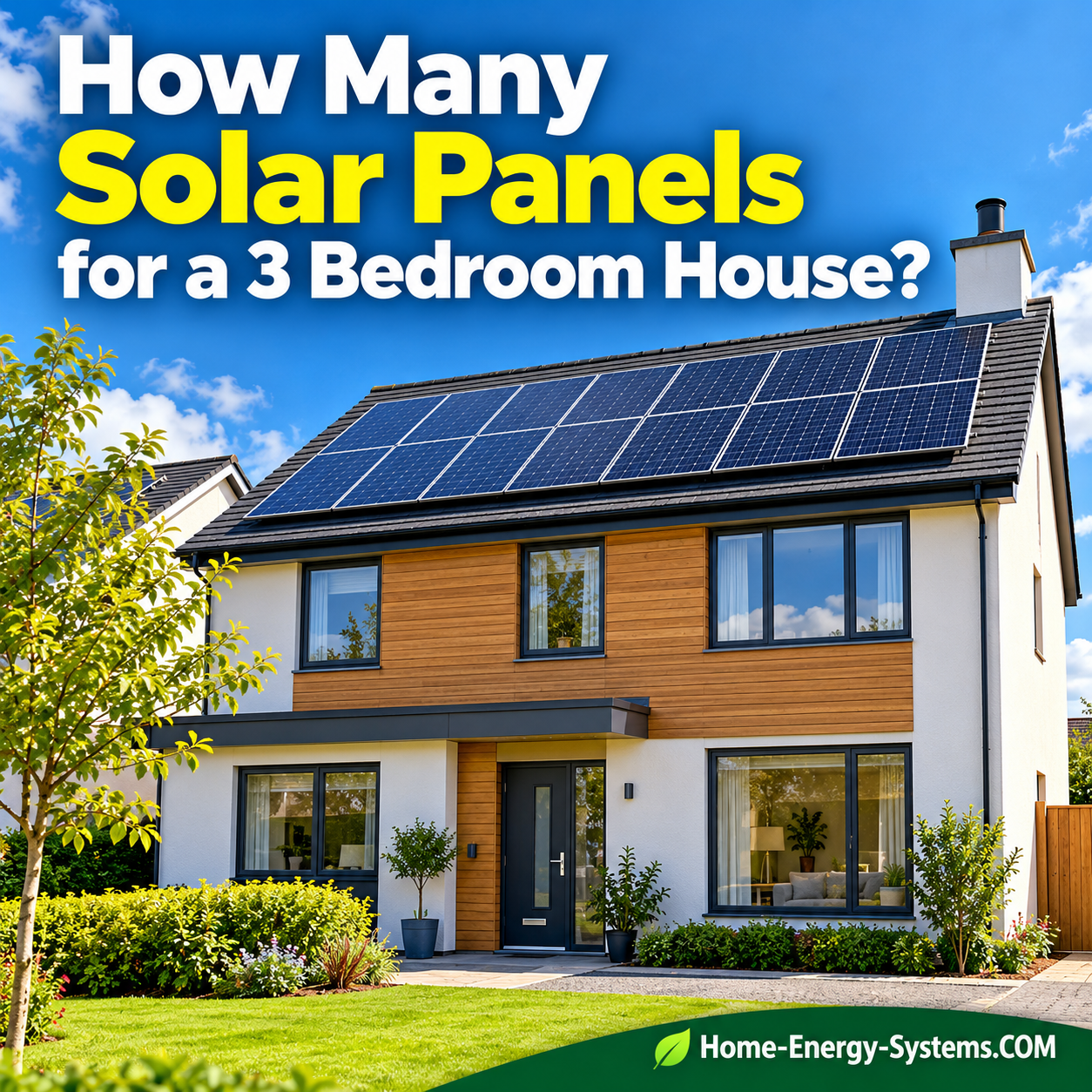
How many solar panels for a 3 bedroom house?
Start with 8–12 panels if your home has ordinary household loads, then adjust for your actual consumption. Eight 450W panels provide 3.6 kWp; ten provide 4.5 kWp; twelve provide 5.4 kWp. A heat pump, electric vehicle or all-electric heating may justify a larger array, provided your roof, connection and budget allow it.
| 450W panels | System size | Illustrative annual output at 950 kWh/kWp |
|---|---|---|
| 8 | 3.6 kWp | 3,420 kWh |
| 10 | 4.5 kWp | 4,275 kWh |
| 12 | 5.4 kWp | 5,130 kWh |
| 16 | 7.2 kWp | 6,840 kWh |
These are illustrations using one assumed solar yield, not predictions for every country. For a location-specific estimate, use the European Commission’s PVGIS solar calculator.
How much electricity does a 3 bedroom house use?
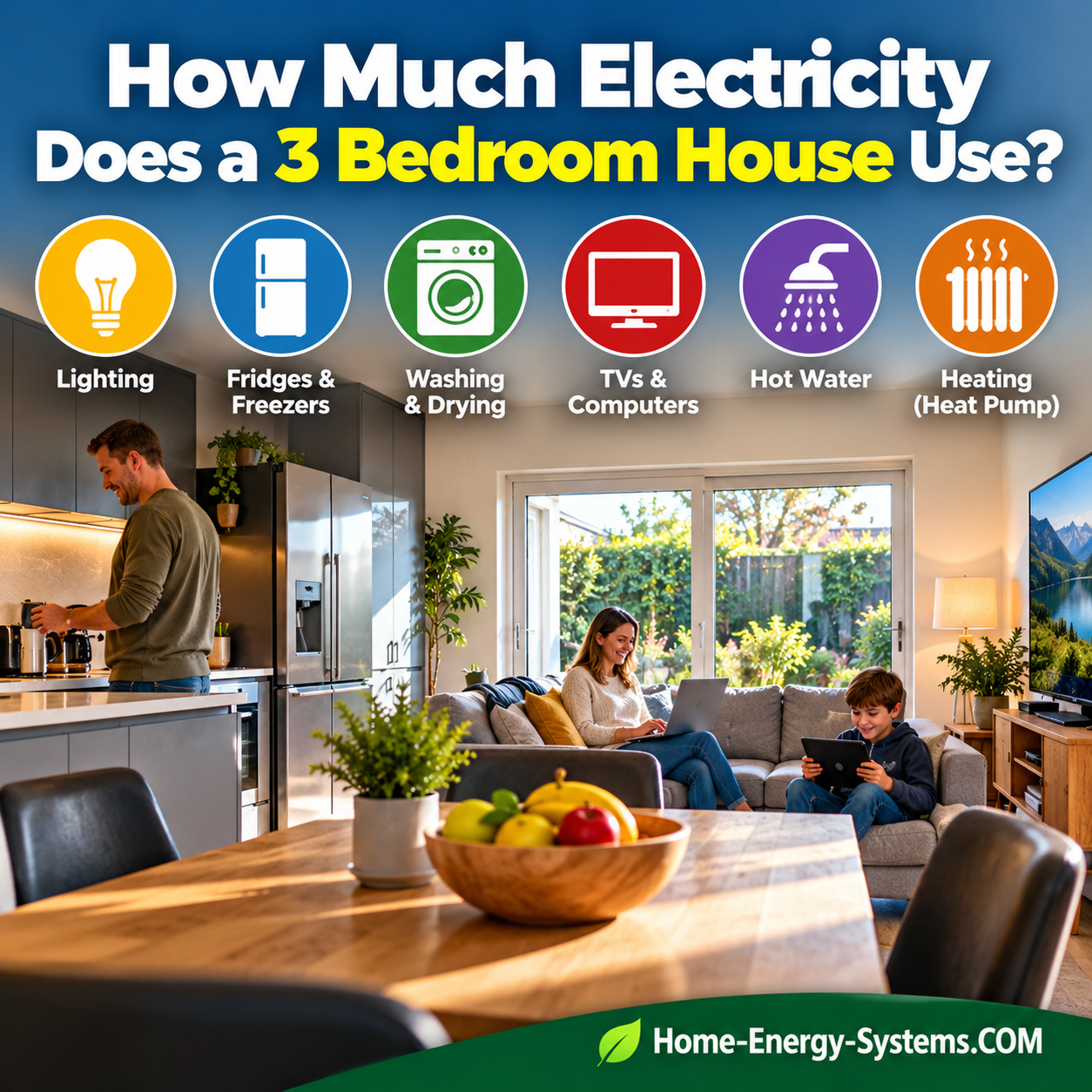
Two houses with three bedrooms can have dramatically different electricity bills. A household with gas heating and efficient appliances may use substantially less electricity than a similar house with electric space heating, a heat pump, hot water immersion and EV charging.
Check your last 12 months of electricity bills and add up the kWh consumed. For example, 4,500 kWh per year averages about 12.3 kWh per day. Your solar system must be assessed against annual demand and when you actually use power—not simply that daily average.
Solar panel sizes: 400W vs 450W vs 500W
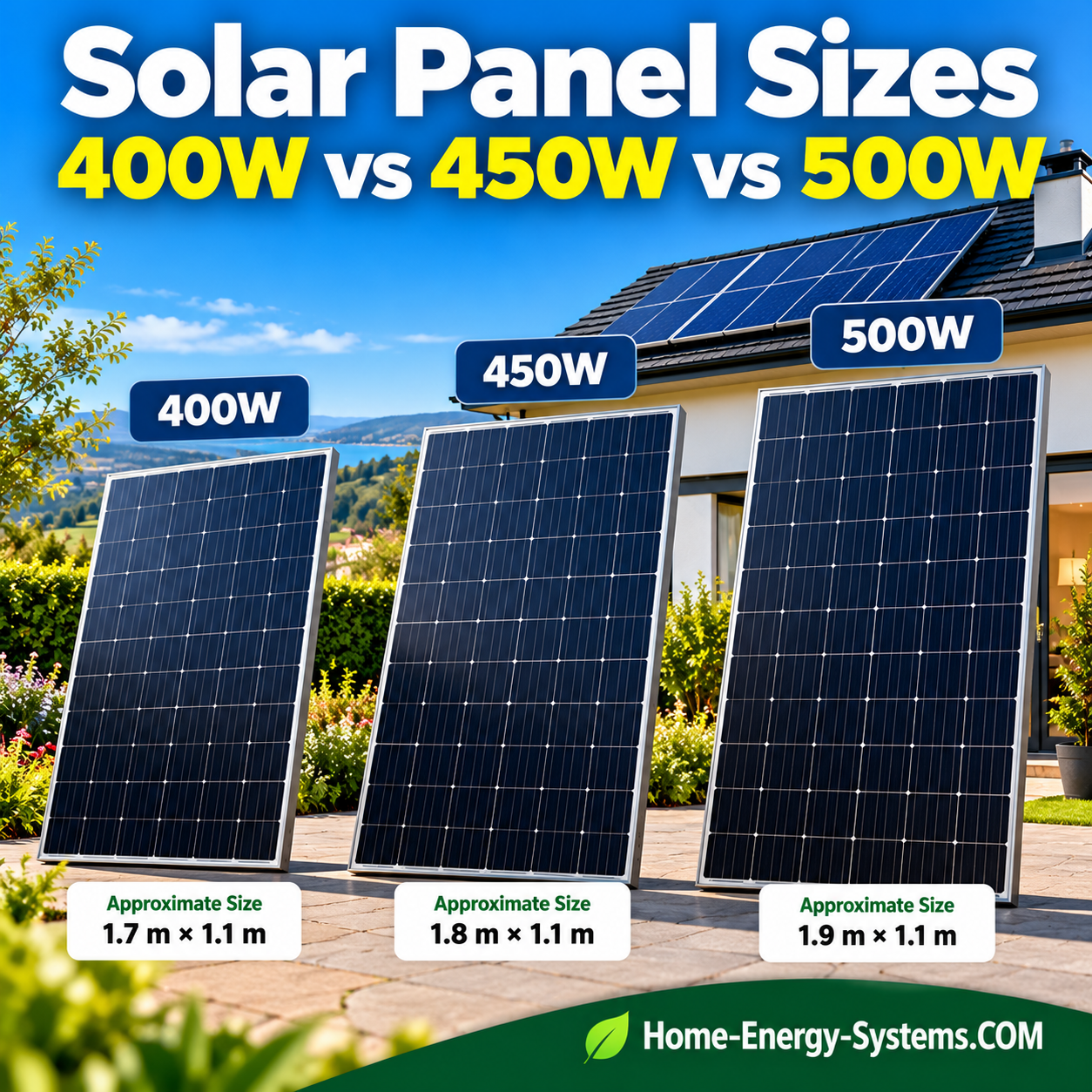
| Target size | 400W panels | 450W panels | 500W panels |
|---|---|---|---|
| At least 4 kWp | 10 | 9 | 8 |
| At least 5 kWp | 13 | 12 | 10 |
| At least 6 kWp | 15 | 14 | 12 |
Actual panel dimensions, efficiency, warranty, roof layout and price matter more than wattage alone. Check the manufacturer’s datasheet before assuming that a larger-wattage panel fits your roof.
What size solar system does a 3 bedroom house need?

A 3–5 kWp array may suit a modest-use home, while 5–8 kWp or more can be worth investigating for high-use households. These are planning ranges, not installation recommendations. Your installer should assess usable roof area, shading, orientation, electrical infrastructure and local export rules.
Solar panel installation costs for a 3 bedroom house
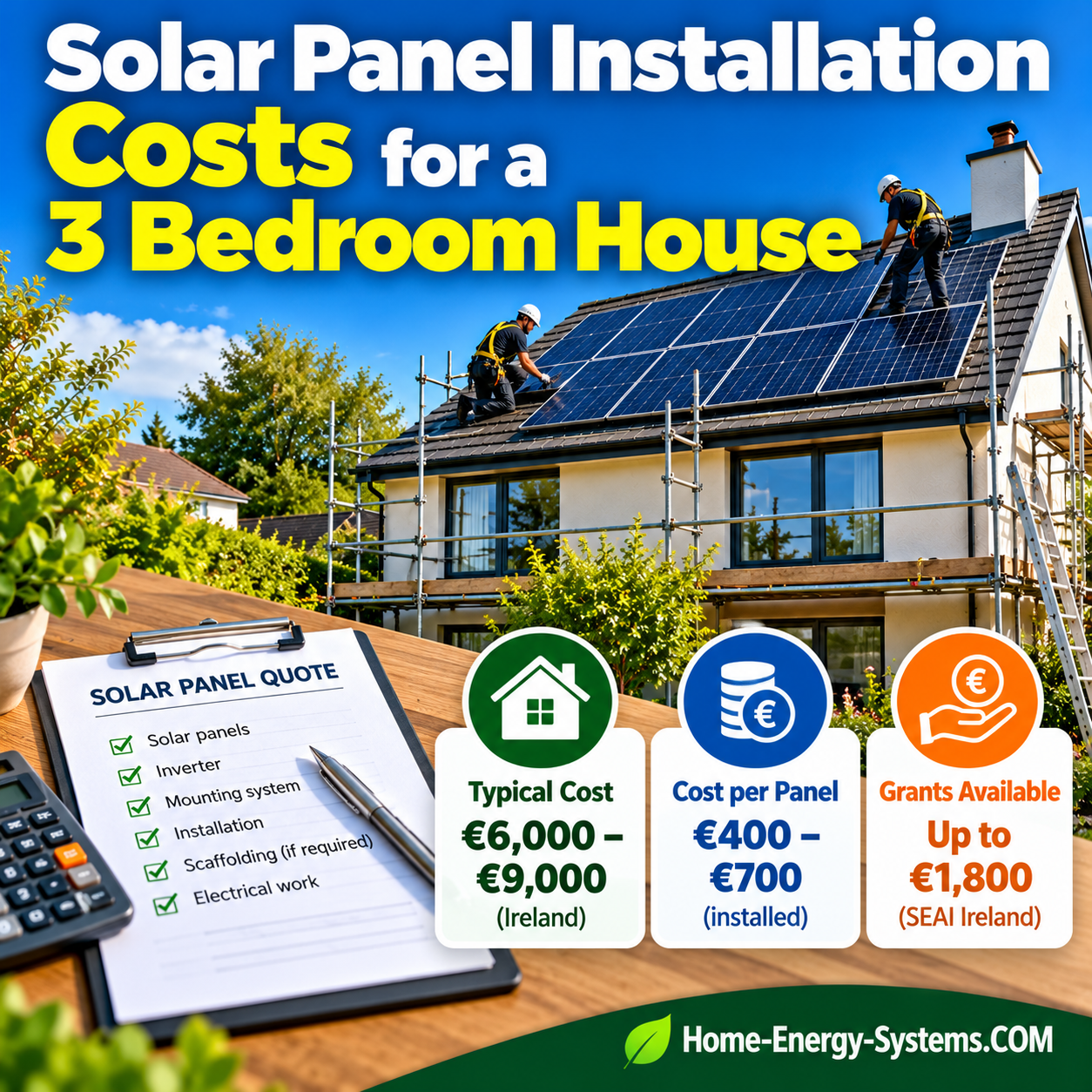
Costs vary significantly between Ireland, the UK, the US, Canada, Australia and New Zealand. Obtain itemised local quotes showing panel brand, inverter, mounting, scaffolding, monitoring, electrical work, labour, warranties and whether a battery is included. The prices pictured above are illustrative Irish figures, not universal or guaranteed quotes.
In Ireland, the SEAI domestic solar PV grant is currently capped at €1,800 for eligible installations, and its official guidance also lists a separate battery grant subject to eligibility. Always confirm the current scheme before making a purchase: SEAI solar electricity grant.
Do you need battery storage with solar panels?

A battery is optional for most grid-connected solar installations. It can store surplus daytime generation for later, potentially reducing grid purchases. Whether it saves money depends on battery price, electricity tariffs, export payments, round-trip losses and your usage pattern. Backup power during an outage is not automatic: the inverter, battery and wiring must specifically support it.
See our home battery storage systems guide for further reading. For region-specific battery products, explore BLUETTI UK or BLUETTI US.
Solar panels with heat pumps and electric cars
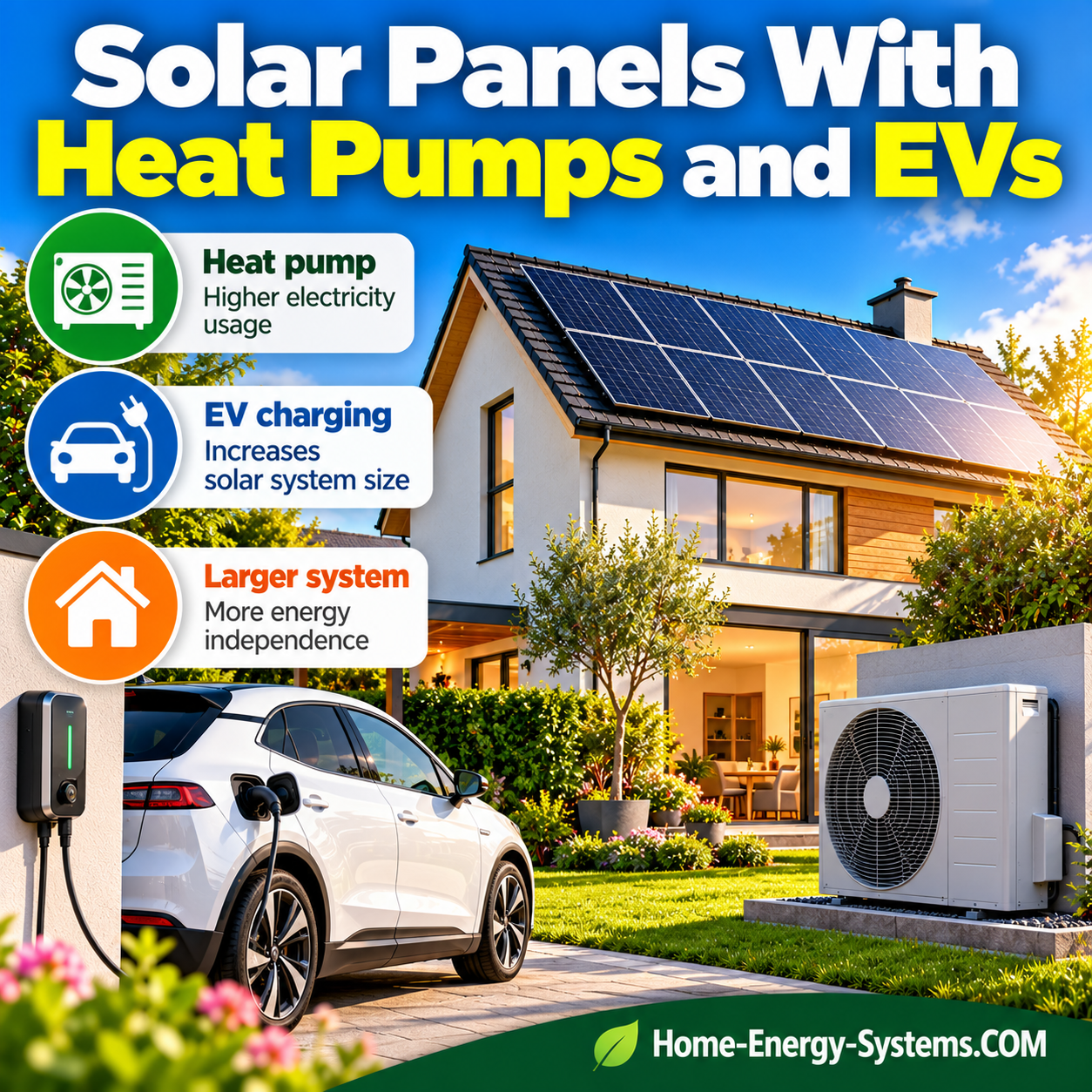
If you plan to buy an EV or install a heat pump, estimate their extra annual kWh before sizing your panels. For example, an EV travelling 12,000 km annually at 18 kWh per 100 km uses about 2,160 kWh before charging losses. A heat pump’s consumption depends on insulation, climate, heat demand and efficiency.
Adding solar panels may offset some of these loads over a year, but winter heat-pump demand often rises when solar production falls. A smart EV charger can help shift charging into sunny periods.
How to calculate the number of solar panels you need
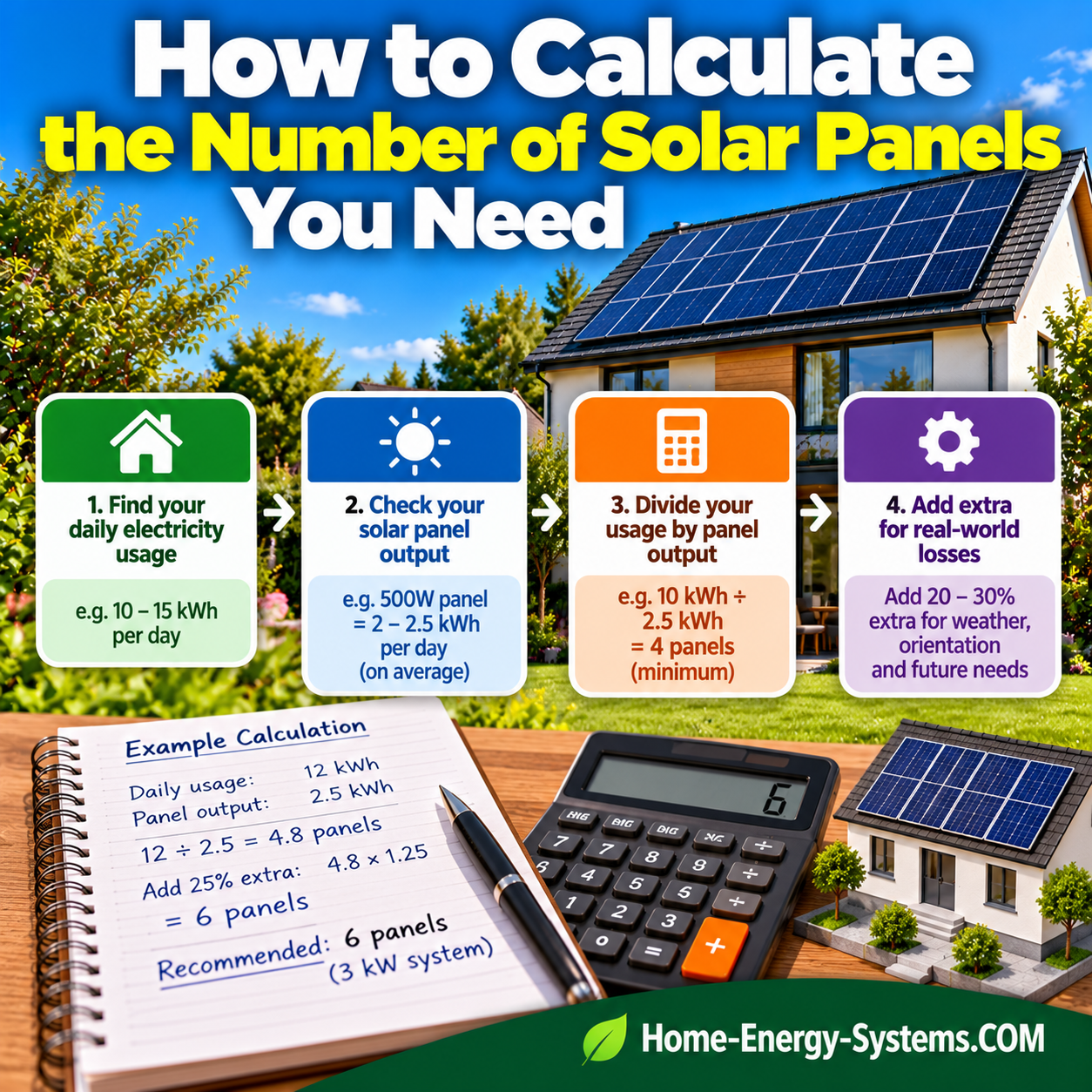
For a simple first-pass estimate, divide the electricity you want your solar array to generate annually by the expected yearly output per kWp at your location. Then divide the required kWp by each panel’s kW rating and round up. This estimates annual generation capacity, not the amount of electricity you can use directly.
Solar panel calculator
Enter your annual electricity use and a local solar yield. The calculator estimates the panel count required to generate the selected share of your annual electricity use.
The 950 default is an illustrative yield suitable for some temperate locations, not a global average. Use PVGIS or a local solar production model for your address. The estimate does not account separately for roof shading, orientation, export constraints or self-consumption.
Where to buy solar panels and equipment
Compare product specifications, regional delivery, warranty support and local installation requirements before ordering. These are approved affiliate partners; availability and suitability vary by country.
A1 SolarStore — USA
Compare residential PV modules, brands and solar equipment for US projects.
Browse solar panels at A1 SolarStoreRenogy — Europe
Explore solar panels and equipment, particularly for DIY and smaller-scale applications.
Browse Renogy EUSupplier link; affiliate tracking not verified.
BLUETTI — UK
Explore portable solar solutions and storage options; check whether equipment is appropriate for fixed-home integration.
Browse BLUETTI UKBLUETTI — USA
Compare portable solar and backup power equipment with local product support.
Browse BLUETTI USFor a grid-connected rooftop installation, a qualified local installer should confirm electrical design, permissions, safety standards and commissioning. Portable panels and power stations are not direct substitutes for a certified rooftop PV installation.
Frequently asked questions
Are 10 solar panels enough for a 3 bedroom house?
Ten 450W panels provide 4.5 kWp. That may be a good fit for a moderate-use household, but suitability depends on annual electricity consumption, local solar yield and when electricity is used.
Can four solar panels power a house?
Four 450W panels make a 1.8 kWp system. They can offset part of a typical household’s consumption but are unlikely to supply all its needs throughout the year.
Is a 4 kW solar system enough for a 3 bedroom house?
A 4 kWp system can be a sensible starting point for a moderately sized home. Check your bills and local production forecast before choosing a final size.
How many panels do I need if I have a heat pump?
Start by estimating the heat pump’s annual electricity consumption, add it to your other household demand, then calculate solar generation for your location. Do not assume solar can cover winter heating at the time it is needed.
Do solar panels work without a battery?
Yes. A grid-connected solar PV system can supply daytime loads and export excess electricity without a battery, subject to the system design and local rules.
How much roof space do 10 panels need?
Ten modern panels may occupy around 18–23 square metres of panel area, depending on model dimensions, with additional layout clearances sometimes needed.
Does the same number of panels work in every country?
No. Solar yield varies by climate, location, roof angle and shading. A system in a sunnier location may produce substantially more electricity than the same system in a cloudier one.
Choose your solar system with confidence
Use your electricity bills, compare panel specifications and request a site-specific production forecast. Browse our Home Energy Systems guides for more practical advice on solar, battery storage and home backup power.