Wind Farm Battery Storage: Complete Guide 2026
Wind farm battery storage allows electricity generated by wind turbines to be stored and used later instead of having to be consumed or exported at the exact moment it is produced. As more wind power is added to electricity grids, this ability to move renewable energy from one period to another is becoming increasingly valuable.
Modern wind farm energy storage systems can do far more than simply save spare electricity. Battery energy storage systems, commonly called BESS, can respond extremely quickly, help balance electricity supply and demand, support grid stability and shift renewable electricity from one part of the day to another.
What Is Wind Farm Battery Storage?
Wind farm battery storage combines wind generation with a battery energy storage system. Instead of every unit of electricity produced by the turbines having to be consumed or exported immediately, some electricity can be directed into batteries and used later.
This creates a more flexible renewable-energy system. A battery may charge during periods of strong wind or lower electricity demand and discharge during periods when demand is higher, wind generation falls or additional grid support is required.
The wind farm and battery can be designed together as a hybrid renewable-energy project, or battery storage can sometimes be added to an existing wind project.
Importantly, a battery does not make a wind turbine generate electricity when there is no wind. Instead, it changes when previously generated electricity can be used.
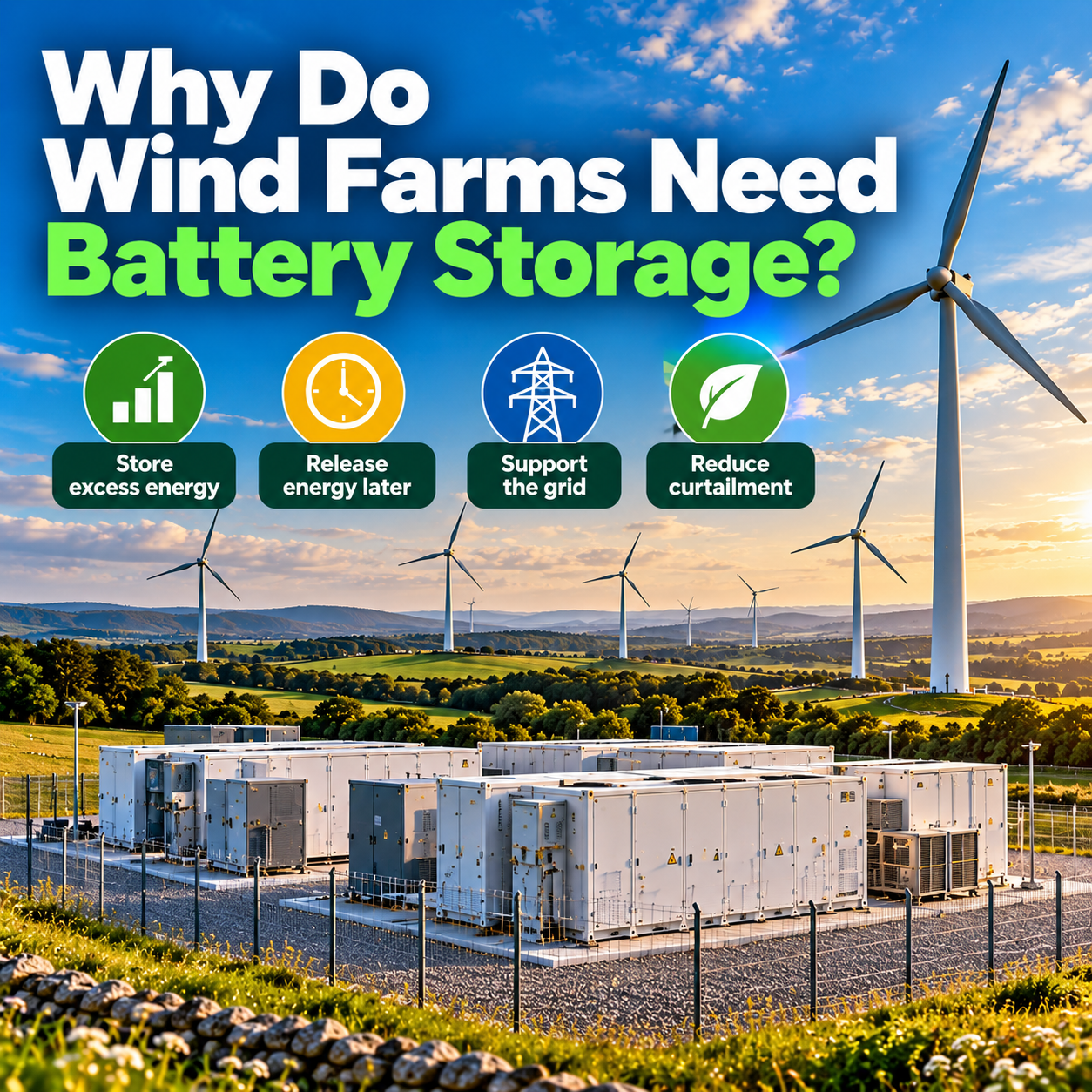
Why Do Wind Farms Need Battery Storage?
Wind energy is variable. A modern wind turbine can produce substantial power when conditions are suitable, but its output naturally changes as wind speeds change.
Electricity grids, meanwhile, must continually balance generation and consumption.
This creates one of the most important challenges in renewable energy: electricity may sometimes be plentiful when demand is relatively low and less plentiful when demand rises.
Wind farm battery storage helps bridge that timing gap by allowing some electricity to be held back and supplied when it is more useful.
Store Excess Energy
When suitable conditions create plentiful wind generation, batteries can absorb electricity rather than requiring all of it to be exported immediately.
Release Energy Later
Stored electricity can be discharged when demand increases, electricity prices rise or renewable generation falls.
Support the Grid
Batteries can react extremely quickly to changes in the electricity system and provide valuable balancing and frequency-support services.
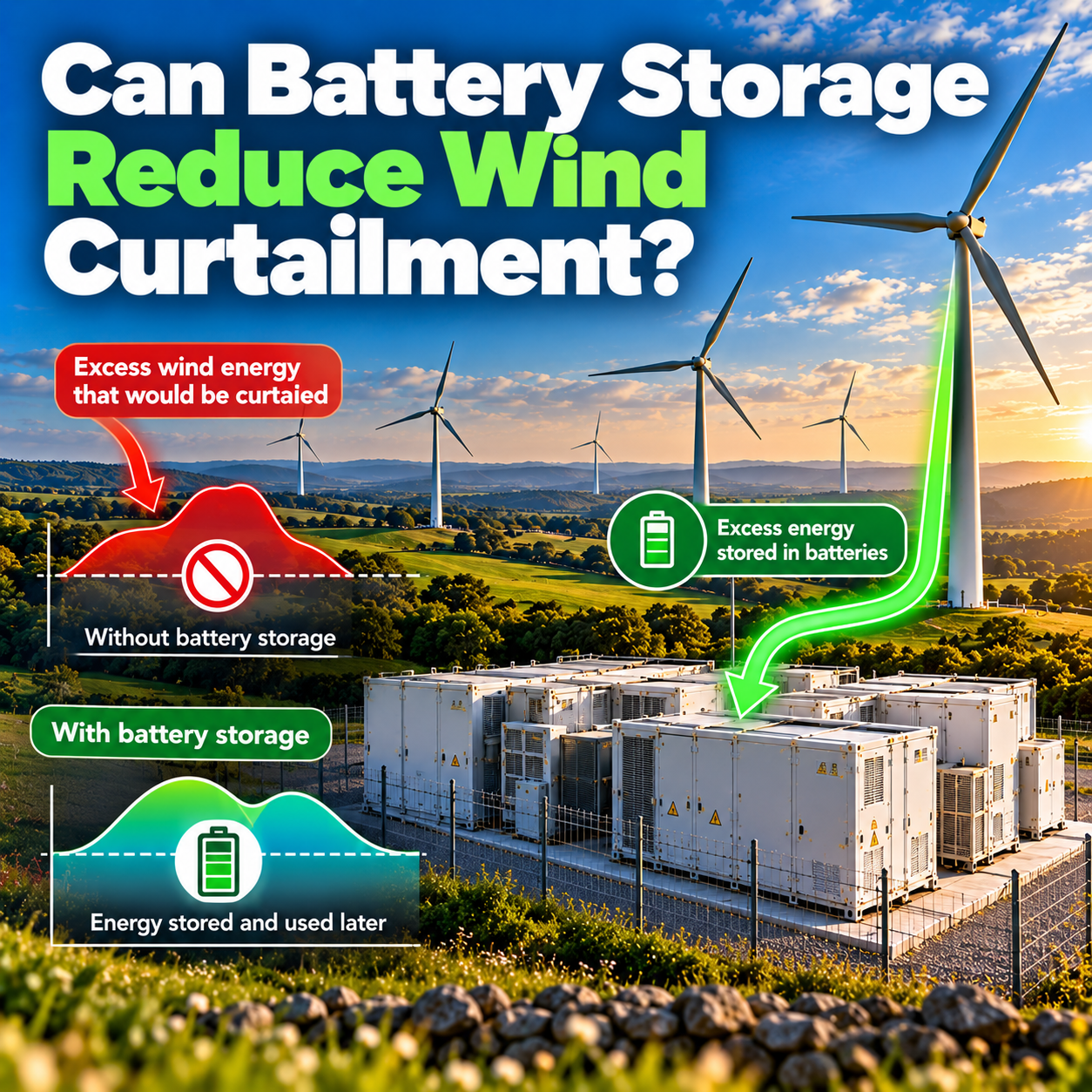
Reduce Curtailment
Where grid conditions permit, storage can capture some renewable electricity that might otherwise have been curtailed because the network could not accept all available generation.
How Does Wind Farm Battery Storage Work?
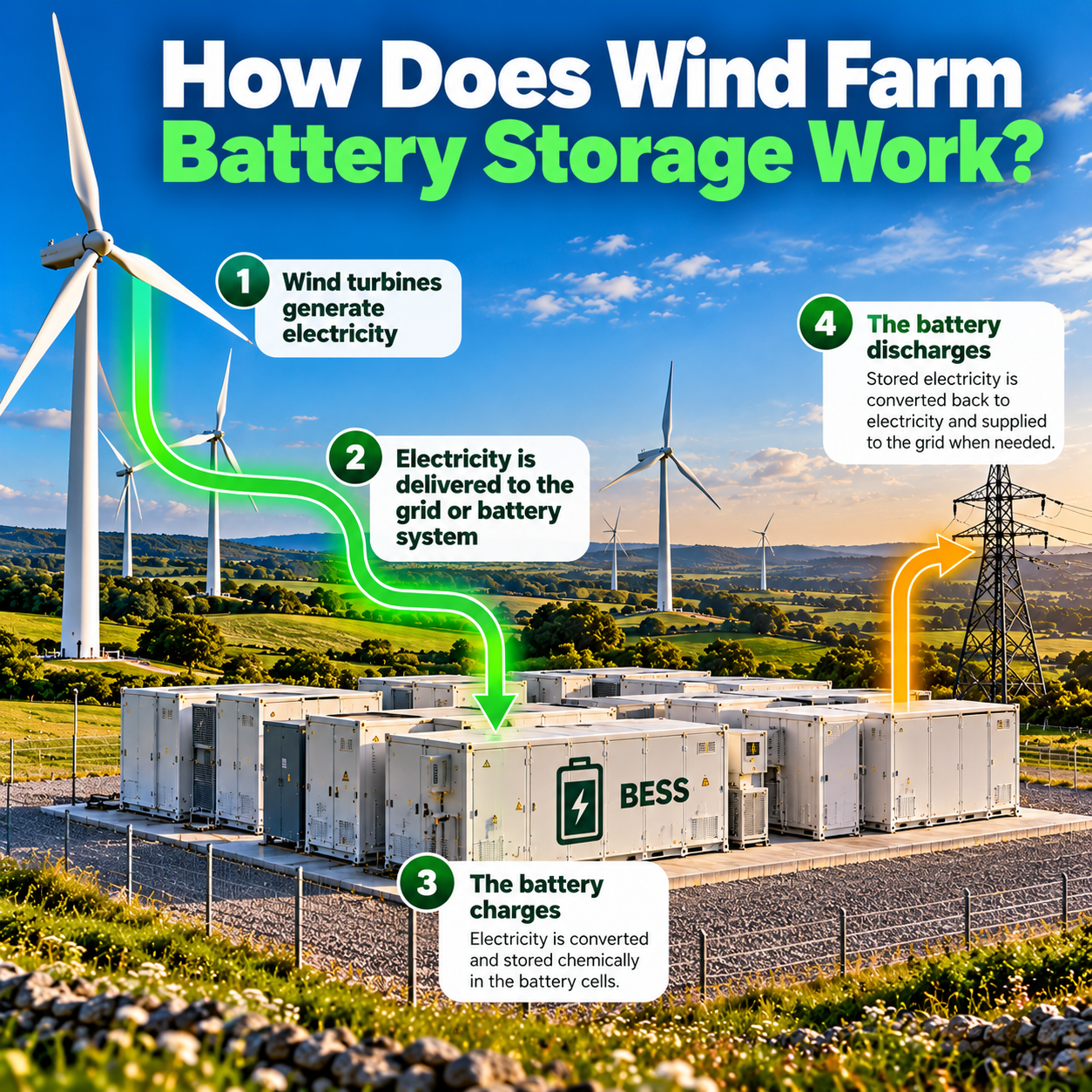
The basic process behind wind farm battery storage can be broken into four stages.
- Wind turbines generate electricity. Moving air turns the turbine blades and the generator converts that mechanical energy into electrical energy.
- Electricity is delivered to the grid or battery system. Controls determine how available generation should be managed.
- The BESS charges. Electrical energy is converted and stored chemically inside the battery cells.
- The battery discharges. When required, the process is reversed and electricity is supplied through power-conversion equipment for use by the grid.
Behind this apparently simple process is sophisticated software. Modern battery-management and energy-management systems continuously monitor battery condition, state of charge, temperature, grid conditions and other operating limits.
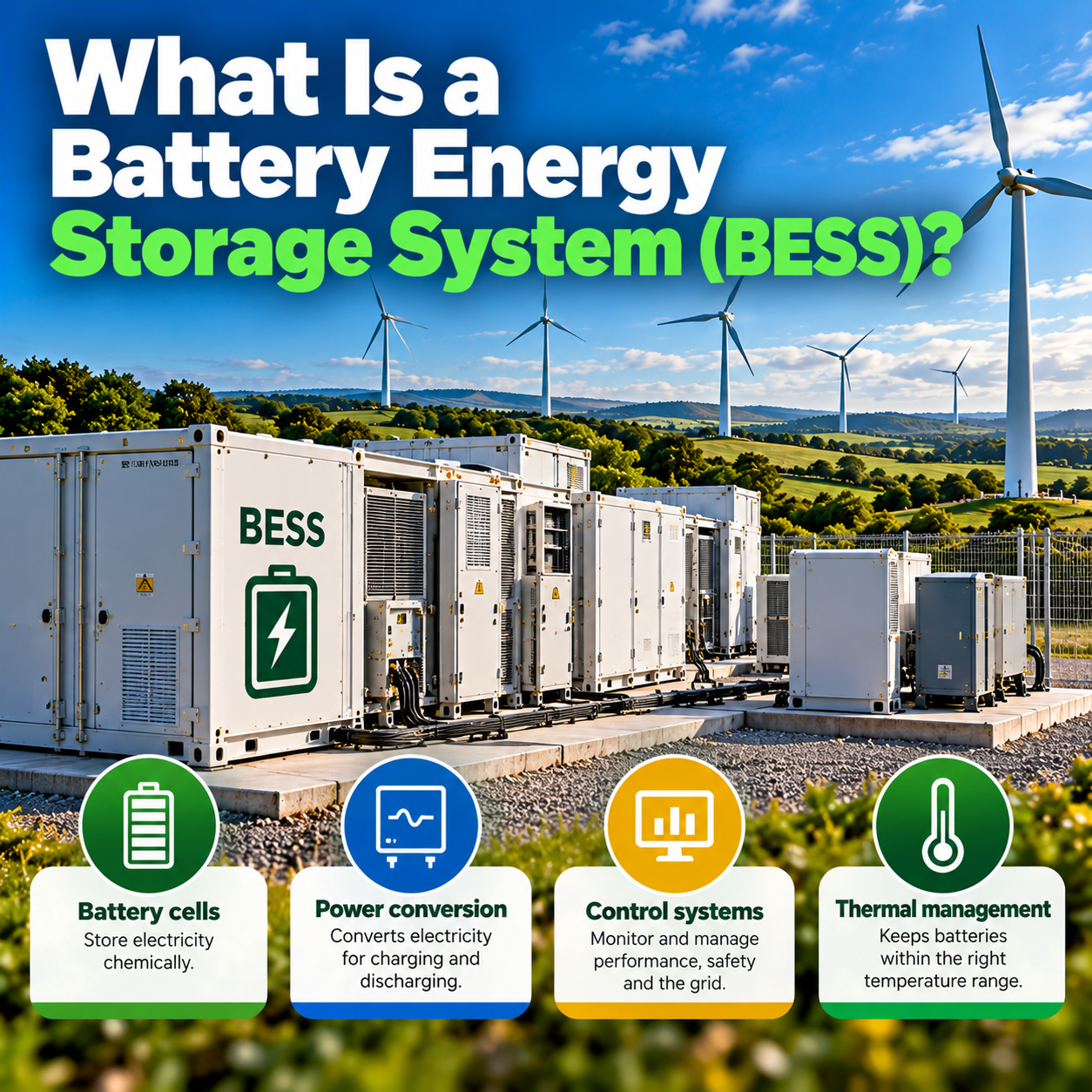
What Is a Battery Energy Storage System (BESS)?
A battery energy storage system (BESS) is much more than a collection of battery cells.
A utility-scale installation normally incorporates battery modules or racks, power-conversion equipment, monitoring systems, thermal management, protection equipment, controls and safety systems.
Two ratings are particularly important.
| Rating | What It Means | Example |
|---|---|---|
| Power (MW) | How quickly the battery can charge or discharge | A 50 MW system can deliver up to approximately 50 MW at its rated output |
| Energy (MWh) | How much usable energy the system can store | A 200 MWh battery contains four times the nominal energy of a 50 MWh battery |
| Duration | Approximately how long the battery can deliver its rated power | 50 MW / 200 MWh represents roughly four hours at full rated output |
This distinction is important. Saying that a wind farm has a “100 MW battery” tells us its power rating, but not necessarily how much energy it can store.
What Types of Batteries Are Used With Wind Farms?
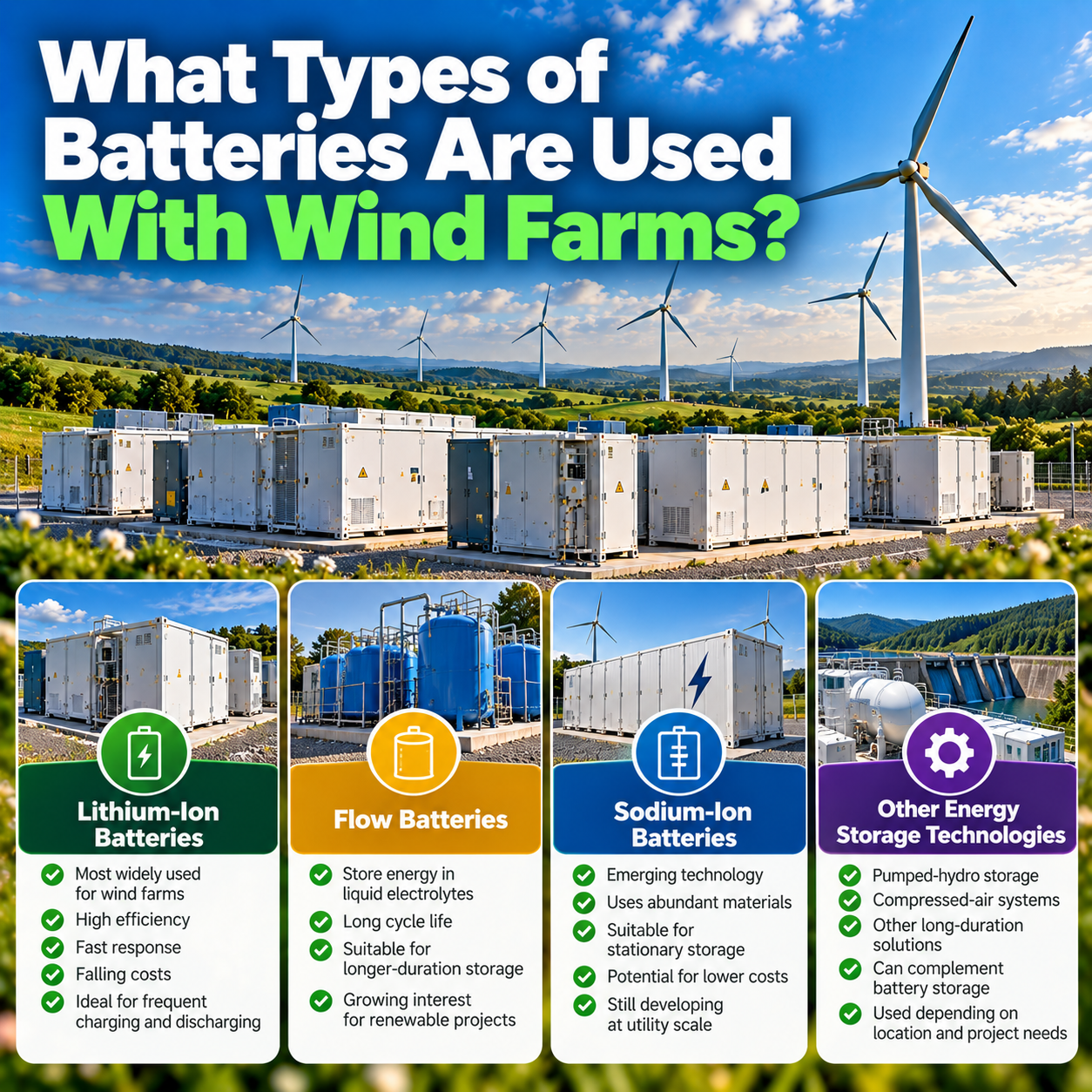
Lithium-Ion Batteries
Lithium-ion technology dominates today’s utility-scale battery market. In particular, lithium iron phosphate — usually abbreviated to LFP — has become extremely important for stationary storage.
LFP batteries are attractive because of their cycle capability, declining costs and suitability for frequent charging and discharging.
Flow Batteries
Flow batteries store energy in liquid electrolytes held in tanks. They can offer long cycle lives and can be attractive where longer-duration storage is required.
They currently represent a much smaller part of the market than lithium-ion systems but remain an interesting technology for longer-duration renewable storage.
Sodium-Ion Batteries
Sodium-ion technology is developing rapidly. Sodium is abundant, and the technology has potential for stationary storage applications where energy density is less critical than it is in an electric vehicle.
It is still much less established than lithium-ion at utility scale, so its eventual role in wind energy storage will depend on cost, performance, manufacturing scale and project requirements.
Other Energy Storage Technologies
Not every wind energy storage project has to use conventional batteries. Depending on geography and required storage duration, renewable electricity can also be paired with technologies such as pumped-hydro storage, compressed-air systems and other forms of long-duration energy storage.
How Long Can Wind Farm Batteries Store Energy?
There is no single answer because storage systems are designed for different jobs.
A battery intended primarily to provide rapid frequency response may have very different requirements from a system designed to move several hours of wind generation into a later period.
| Approx. Duration | Typical Purpose | Wind Application |
|---|---|---|
| Under 1 hour | Fast grid services | Frequency and short-term balancing |
| 1–2 hours | Short energy shifting | Smoothing short supply-demand differences |
| 2–4 hours | Energy shifting and capacity | Moving wind generation into higher-demand periods |
| 4+ hours | Longer energy shifting | Greater ability to bridge extended differences between generation and demand |
The global trend is toward longer battery duration as storage takes on a larger role in shifting renewable electricity rather than being used solely for very short grid-support services.
How Large Does a Wind Farm Battery Need to Be?
There is no simple rule such as “one megawatt-hour of battery for every megawatt of wind.” Correct sizing depends on what the battery is expected to accomplish.
Engineers may consider:
- wind farm generating capacity;
- historical and forecast wind patterns;
- grid-connection limits;
- frequency and severity of curtailment;
- electricity-market prices;
- required discharge duration;
- desired grid services;
- battery degradation;
- available land;
- connection infrastructure; and
- project economics.
For example, a 100 MW wind farm does not automatically require a 100 MW battery. A smaller battery could be sufficient for a particular grid-support application, while a project designed for several hours of substantial energy shifting could require much greater energy capacity.
Benefits of Wind Farm Battery Storage
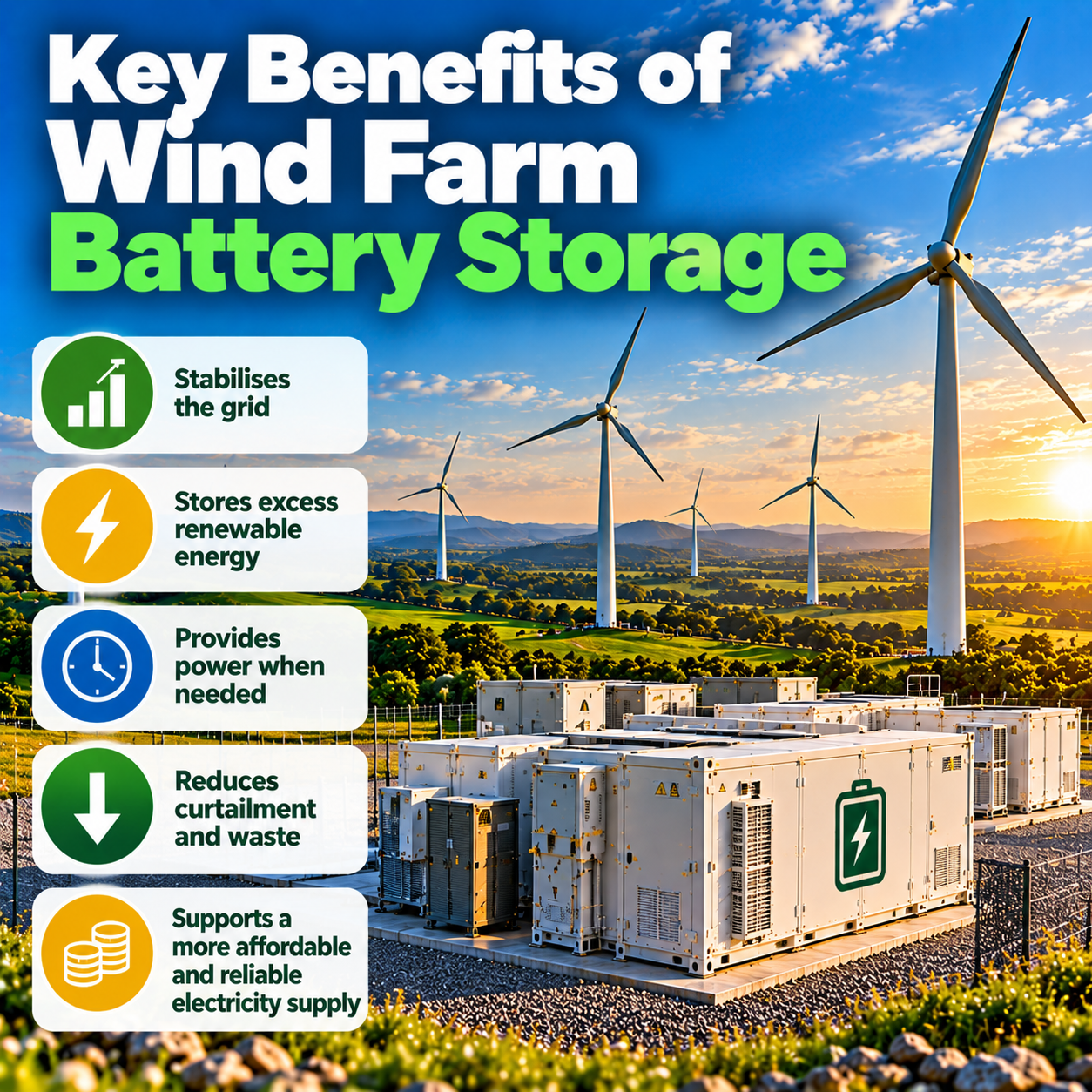
The strongest case for wind farm battery storage is flexibility. Storage gives operators more control over when renewable electricity is delivered and can provide several services from the same installation.
1. Energy Shifting
Electricity generated during windy, lower-demand periods can potentially be stored and supplied during a later period when electricity is more valuable or more urgently needed.
2. Fast Response
Battery systems can change their charging or discharging behaviour very rapidly. This makes them particularly useful for balancing an electricity system in which generation and demand are constantly changing.
3. Grid Stability
BESS installations can provide services such as frequency response and voltage support, depending on their design and grid connection.
4. Better Use of Renewable Generation
Storage can improve the usefulness of wind generation by separating the time electricity is generated from the time it is supplied.
5. Reduced Pressure on Networks
In some applications, strategically located batteries can reduce peak flows and make better use of existing transmission and distribution infrastructure.
6. Additional Revenue Opportunities
A battery may earn revenue from more than simply buying or storing electricity at one time and selling it later. Depending on the electricity market, storage projects may participate in balancing, capacity and ancillary-service markets.
Can Battery Storage Reduce Wind Curtailment?
Yes — in suitable circumstances.
Wind curtailment occurs when turbines are capable of producing electricity but their output is deliberately reduced. This can happen because of transmission congestion, excessive generation relative to demand or other grid constraints.
A battery located appropriately within the electricity system may absorb some energy during periods when exporting additional wind generation would otherwise be difficult and release it later.
This is one of the potentially valuable applications of wind farm battery storage, particularly where periods of high renewable production coincide with network constraints.
However, batteries are not a universal cure for curtailment.
If a transmission constraint lasts for a long period, a battery can eventually become fully charged. At that point it cannot absorb additional energy until it has an opportunity to discharge.
Transmission upgrades, interconnection, demand response, flexible generation, improved market design and other storage technologies can therefore all form part of the wider solution.
How Much Does Wind Farm Battery Storage Cost?
The cost of wind farm battery storage varies substantially between projects and countries. Capacity, duration, battery chemistry, grid connection, site preparation, fire protection, power electronics, construction and financing all affect the final figure.
Battery prices have nevertheless fallen dramatically over the longer term, making large-scale renewable-plus-storage projects increasingly practical.
The International Energy Agency reported that battery storage project costs fell by roughly 40% during 2024 to around $150 per kWh on its reported project-cost measure. Actual installed project costs can differ considerably, so this figure should not be treated as a quotation for a particular wind farm.
Project developers also have to consider lifetime economics rather than purchase price alone.
Important calculations include:
- expected cycles per year;
- round-trip efficiency;
- degradation;
- augmentation or battery replacement;
- operations and maintenance;
- market revenue;
- avoided curtailment;
- grid-service revenue; and
- project financing.
How Long Do Wind Farm Batteries Last?
Battery lifespan depends on chemistry, temperature, depth of discharge, charging rate and how frequently the system cycles.
Battery capacity gradually declines with use and age. Utility-scale projects therefore model degradation from the beginning and may add battery capacity later — often called augmentation — to maintain required performance.
Modern battery-management systems also help keep cells within appropriate operating limits.
When comparing storage projects, the useful questions are therefore not simply “How many years does the battery last?” but also:
- How much usable capacity remains after thousands of cycles?
- What operating conditions are assumed?
- What warranty applies?
- Will modules be augmented or replaced?
- What happens to the batteries at the end of their useful life?
Are Wind Farm Battery Storage Systems Safe?
Utility-scale batteries contain very large amounts of stored energy, so safety has to be designed into the project from the outset.
Battery installations can require temperature monitoring, battery-management systems, electrical isolation, ventilation or cooling, fire detection and suppression strategies, emergency procedures and appropriate separation between equipment.
Lithium-ion batteries can experience thermal runaway if a cell is severely damaged, overheated or develops certain internal faults. Modern BESS design therefore uses multiple layers of monitoring and protection to reduce risk and limit the consequences of a failure.
Safety standards and planning requirements vary between countries, so utility-scale installations must comply with the regulations and technical standards applicable to their location.
Wind Battery Storage vs Home Battery Storage
The underlying principle is similar to the home battery storage systems used alongside residential solar: electricity is stored when available and used later.
The scale and purpose, however, are very different.
| Feature | Home Battery | Wind Farm BESS |
|---|---|---|
| Typical scale | kWh | MWh and potentially GWh |
| Main purpose | Household self-consumption and backup | Energy shifting and grid services |
| Power level | Usually kW | Often MW |
| Controls | Home energy management | Utility and electricity-market controls |
| Energy source | Often rooftop solar/grid | Wind, grid or hybrid renewable generation depending on design |
Wind, Solar and Battery Storage Together
Wind and solar can also complement one another.
Solar generation naturally peaks during daylight, while wind patterns vary by region and can sometimes provide stronger generation at night or during different seasons.
Combining wind, solar and batteries can therefore create a more diversified renewable-energy system.
A hybrid plant may share grid infrastructure while using storage to manage periods of high renewable output and shift electricity toward periods of stronger demand.
This same principle applies on a much smaller scale to homes, farms and off-grid systems, where combining renewable sources can reduce dependence on a single weather-dependent technology.

The Future of Wind Farm Energy Storage Systems
The direction of travel is clear: electricity storage is becoming a much larger part of the world’s power system.
The International Energy Agency reported that 108 GW of new battery storage capacity was deployed worldwide in 2025, around 40% more than during 2024. Around 80% of those additions were utility-scale.
LFP batteries represented around 90% of battery-storage deployments, demonstrating how rapidly this chemistry has become established in stationary energy storage.
Battery duration is also increasing. While many projects remain around the two-hour level, a growing number are being designed for four hours or longer as batteries increasingly shift larger quantities of renewable electricity across the day.
That development is particularly relevant to wind power and the future of wind farm battery storage.
As electricity systems install more wind and solar, flexibility becomes increasingly valuable. Batteries, interconnectors, demand response, stronger electricity networks and long-duration storage technologies are likely to work together rather than compete as a single solution.
The future wind farm may therefore be viewed less as an isolated collection of turbines and more as part of an integrated energy system combining generation, storage, intelligent controls and flexible demand.
Frequently Asked Questions About Wind Farm Battery Storage
Do wind farms have battery storage?
Some do, but battery storage is not fitted to every wind farm. Batteries may be built alongside new wind projects, added to existing renewable sites or installed elsewhere on the grid where their services are most valuable.
Can electricity from a wind turbine be stored in batteries?
Yes. Electricity generated by wind turbines can be used to charge a battery energy storage system and then be discharged later when required.
What batteries are used for wind farms?
Lithium-ion batteries dominate today’s utility-scale battery market, with LFP now particularly important. Flow batteries, sodium-ion and other storage technologies may also have roles depending on project requirements.
How long can wind energy be stored?
The electricity can remain stored until required within the operating limits of the system, but the more important specification is discharge duration. Many utility batteries are designed to provide roughly two to four hours of rated output, while longer-duration systems are increasingly being developed.
What happens when a wind farm battery is full?
Once a battery reaches its permitted maximum state of charge, it cannot continue absorbing electricity until some stored energy is discharged. If the grid cannot accept additional wind generation, curtailment may still be necessary.
Can battery storage make wind power reliable?
Battery storage can make wind electricity more flexible and easier to integrate by shifting energy and responding rapidly to grid needs. It cannot guarantee unlimited electricity through prolonged periods of low wind, so grids still require a broader mix of generation, storage, networks and demand flexibility.
What does BESS mean in wind energy?
BESS stands for Battery Energy Storage System. It includes the battery cells plus the power-conversion, control, thermal-management, monitoring and safety equipment needed to operate the storage system.
Does battery storage reduce wasted wind energy?
It can. Where the battery has available capacity and the network configuration allows it, storage can absorb electricity that might otherwise be curtailed and make that energy available later.
Final Thoughts
Wind farm battery storage is changing the way renewable electricity can be managed. Instead of wind power having to be used precisely when it is generated, batteries provide a way to shift some of that energy into a more useful period.
That can reduce some curtailment, provide fast grid support, move renewable electricity into higher-demand periods and give electricity systems more flexibility as the proportion of wind and solar increases.
Battery storage is not a replacement for stronger grids, diverse renewable generation or long-duration storage. It is another increasingly important part of the system.
And as battery costs, technologies and energy-management systems continue to develop, wind farm energy storage systems are likely to become an increasingly familiar feature of renewable-energy projects around the world.
Sources & Further Reading
Explore More Home & Renewable Energy Guides
Home Energy Systems covers practical renewable energy, battery storage, wind technology, solar power and backup-energy solutions for homes, farms and off-grid applications.
Visit Home-Energy-Systems.com to explore our latest independent energy guides.