How Do Wind Farms Work? Complete Guide 2026
How wind farms work is surprisingly straightforward at its core: wind turns the blades of multiple turbines, generators convert that movement into electricity, and an electrical network collects the power and sends it towards the electricity grid.
Behind that simple explanation, however, is an impressive system of turbine controls, generators, transformers, underground or subsea cables, substations, monitoring equipment and increasingly, energy storage.
This guide explains the entire journey — from moving air reaching a turbine blade to usable electricity reaching homes and businesses.
What Is a Wind Farm?
A wind farm is a group of wind turbines installed within the same general area and connected through shared electrical infrastructure.
Wind farms range enormously in size. A relatively small project may contain only a handful of turbines, while major onshore and offshore projects can contain dozens or even hundreds.
The individual turbines generate electricity independently, but their output is collected and exported through the wind farm’s electrical network.
This shared infrastructure is one reason building turbines together as a wind farm can make sense. Roads, electrical cables, substations, grid connections and monitoring systems can serve multiple turbines.
How Do Wind Farms Work?
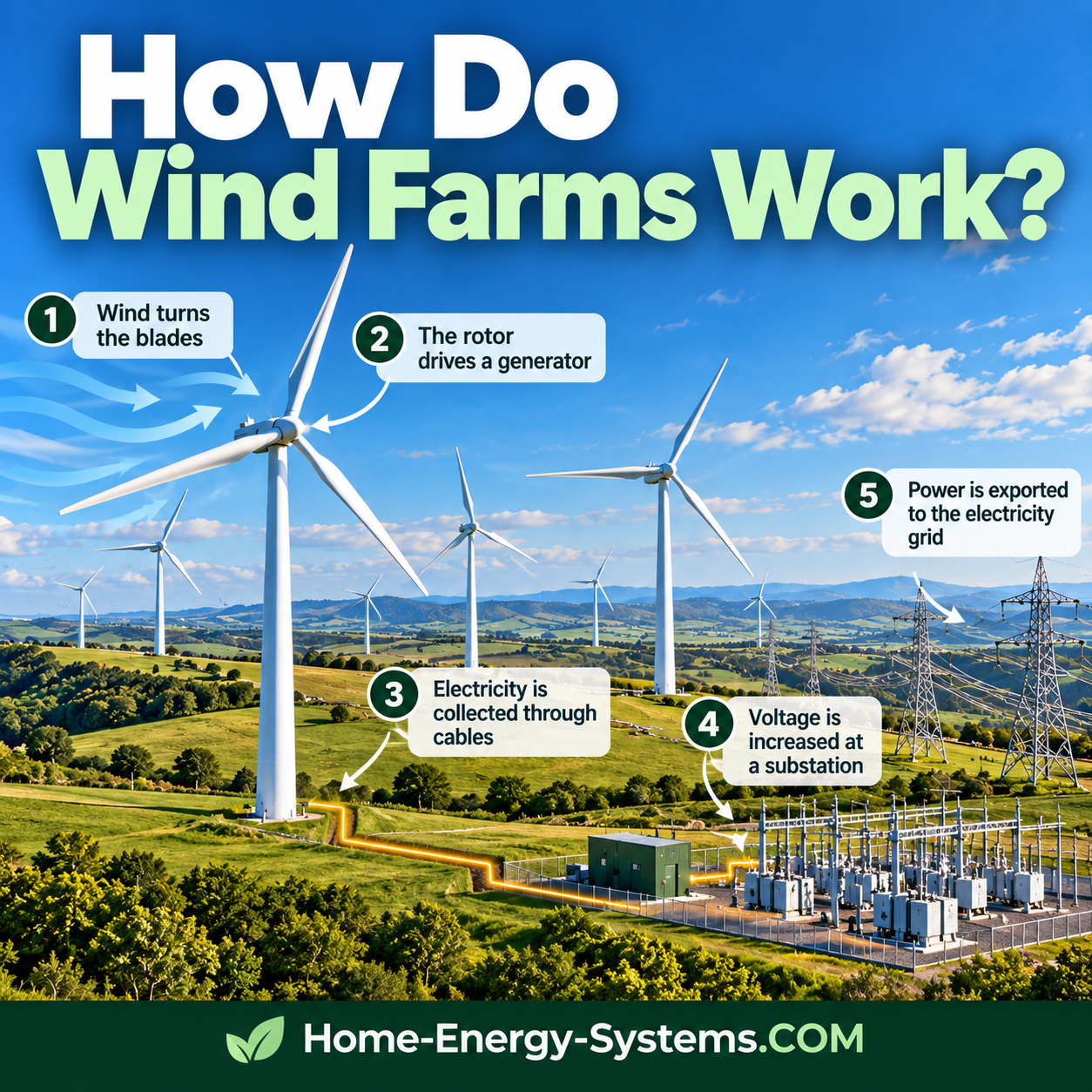
Understanding how wind farms work becomes easier when we follow the electricity from the wind itself to the electricity grid.
Wind Reaches the Turbine
Moving air passes across the turbine’s specially shaped blades, creating aerodynamic forces that cause the rotor to turn.
The Rotor Turns
The blades are connected to a hub. Together, the blades and hub form the rotor, which converts some of the wind’s kinetic energy into rotational mechanical energy.
The Generator Produces Electricity
The rotating drivetrain drives a generator. Depending on turbine design, a gearbox may increase rotational speed before the generator, while some turbines use direct-drive systems without a conventional gearbox.
Voltage Is Increased
Transformers increase the voltage so electricity can be transported more efficiently through the wind farm and onwards to the grid.
Electricity Is Collected
Cables connect individual turbines to the wind farm’s collection system and substation.
Power Enters the Grid
The wind farm’s output is exported through its grid connection, allowing the electricity to become part of the wider power system.
How Does a Wind Turbine Generate Electricity?
A wind turbine does not simply “catch” the wind like an old-fashioned windmill sail.
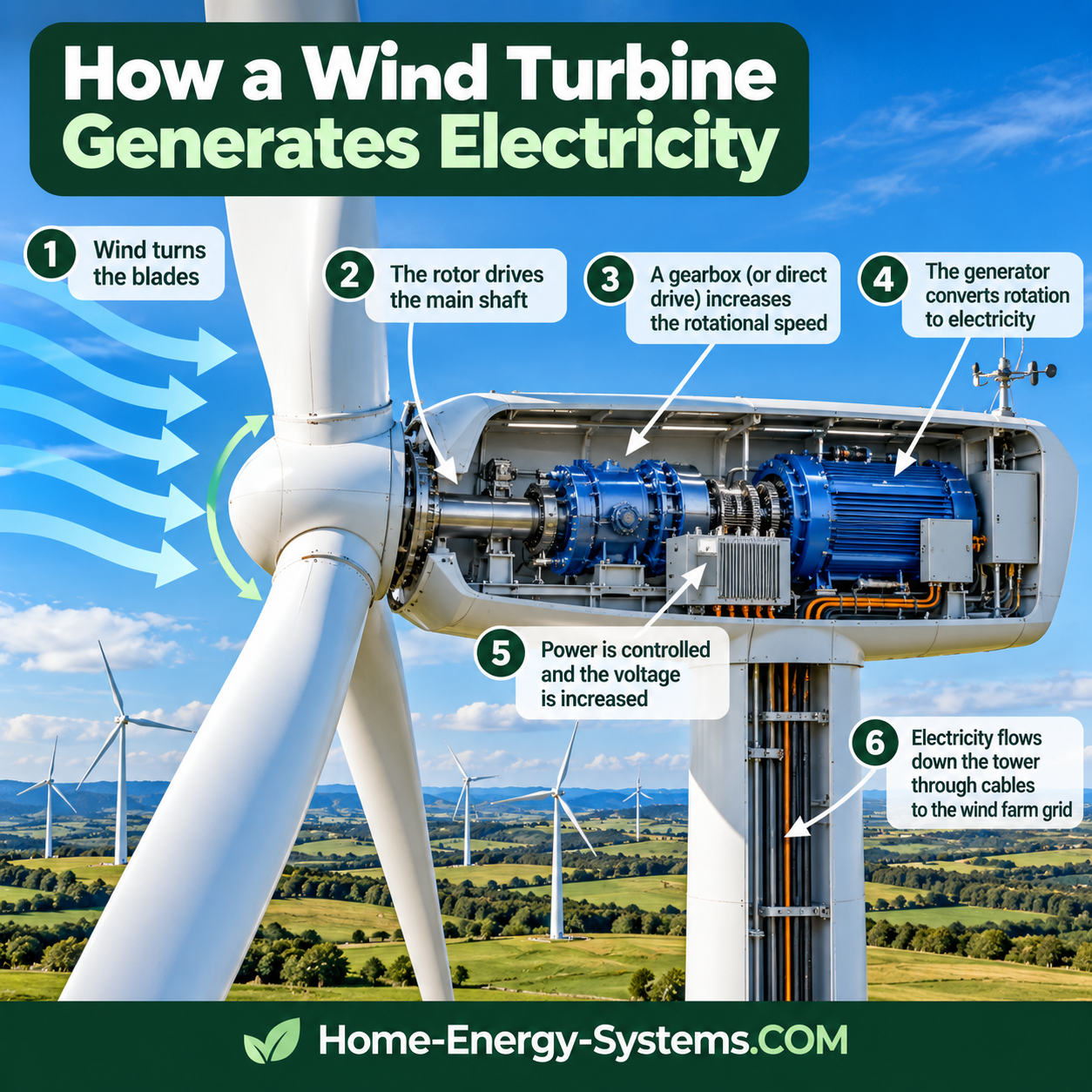
Modern blades are aerodynamic structures. As air flows around a blade, differences in pressure create lift. That aerodynamic force helps turn the rotor.
The rotating rotor transfers mechanical energy through the turbine’s drivetrain to its generator.
The generator then converts mechanical rotation into electrical energy using electromagnetic principles.
Modern turbines continually adjust themselves to changing conditions. Control systems can turn the nacelle so that the rotor faces the wind and alter the pitch of individual blades to manage power production and loads.
What Are the Main Parts of a Wind Turbine?
Blades
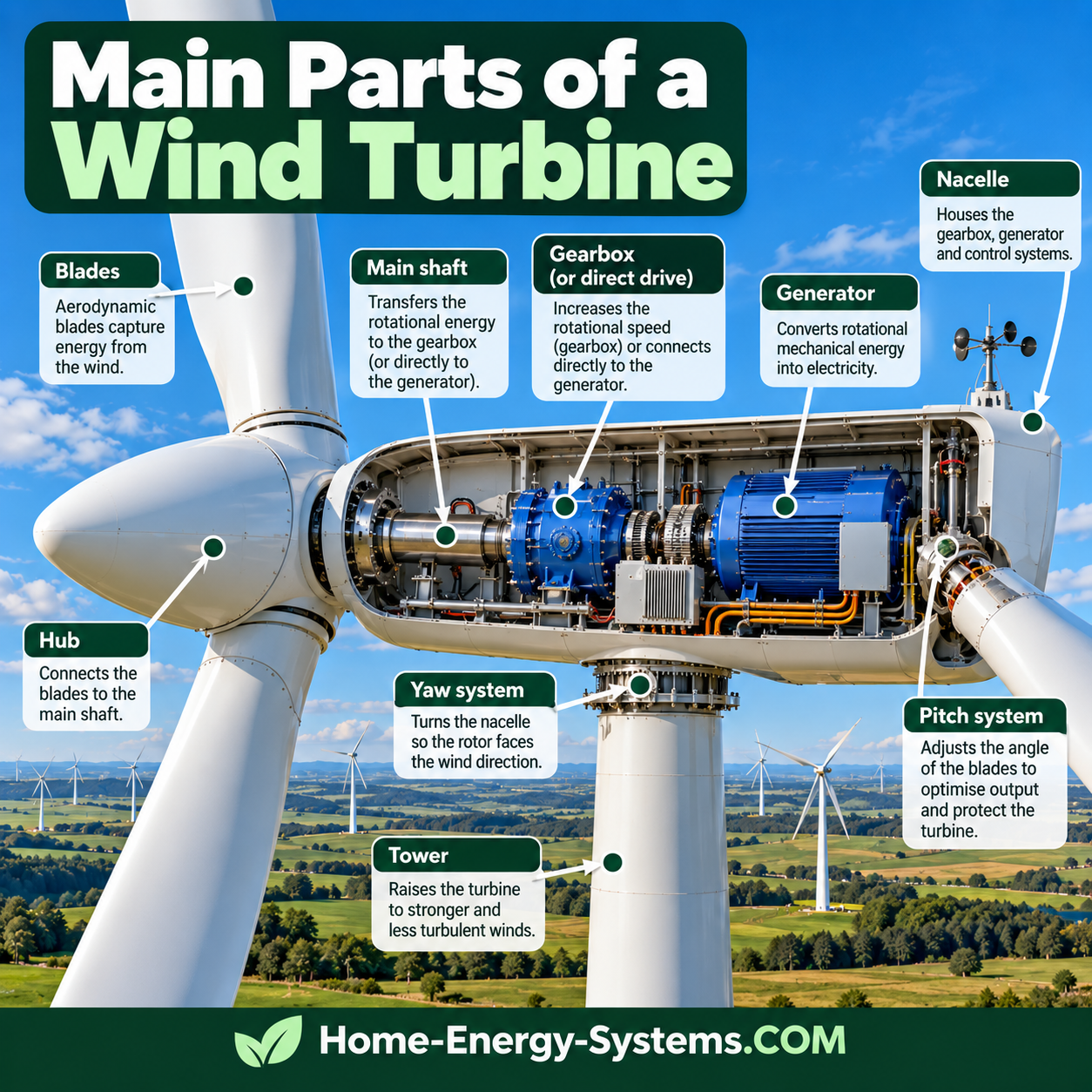
Aerodynamic blades capture energy from moving air and create the forces that rotate the rotor.
Rotor & Hub
The blades connect to the hub, forming the rotating assembly at the front of the turbine.
Nacelle
The nacelle sits behind the rotor and contains major mechanical and electrical equipment.
Generator
The generator converts rotational mechanical energy into electricity.
Gearbox or Direct Drive
Some turbines use gearboxes to increase rotational speed, while direct-drive designs connect the rotor more directly to the generator.
Tower
The tower raises the rotor into stronger and generally less turbulent winds above the ground or sea surface.
Pitch System
Pitch controls rotate the blades around their own axes to optimise output and protect the turbine during unsuitable conditions.
Yaw System
The yaw system turns the nacelle so the rotor remains appropriately aligned with wind direction.
How Does Electricity Get From a Wind Farm to the Grid?
Generating electricity at each turbine is only the beginning.
Electricity must then be collected and transported efficiently.
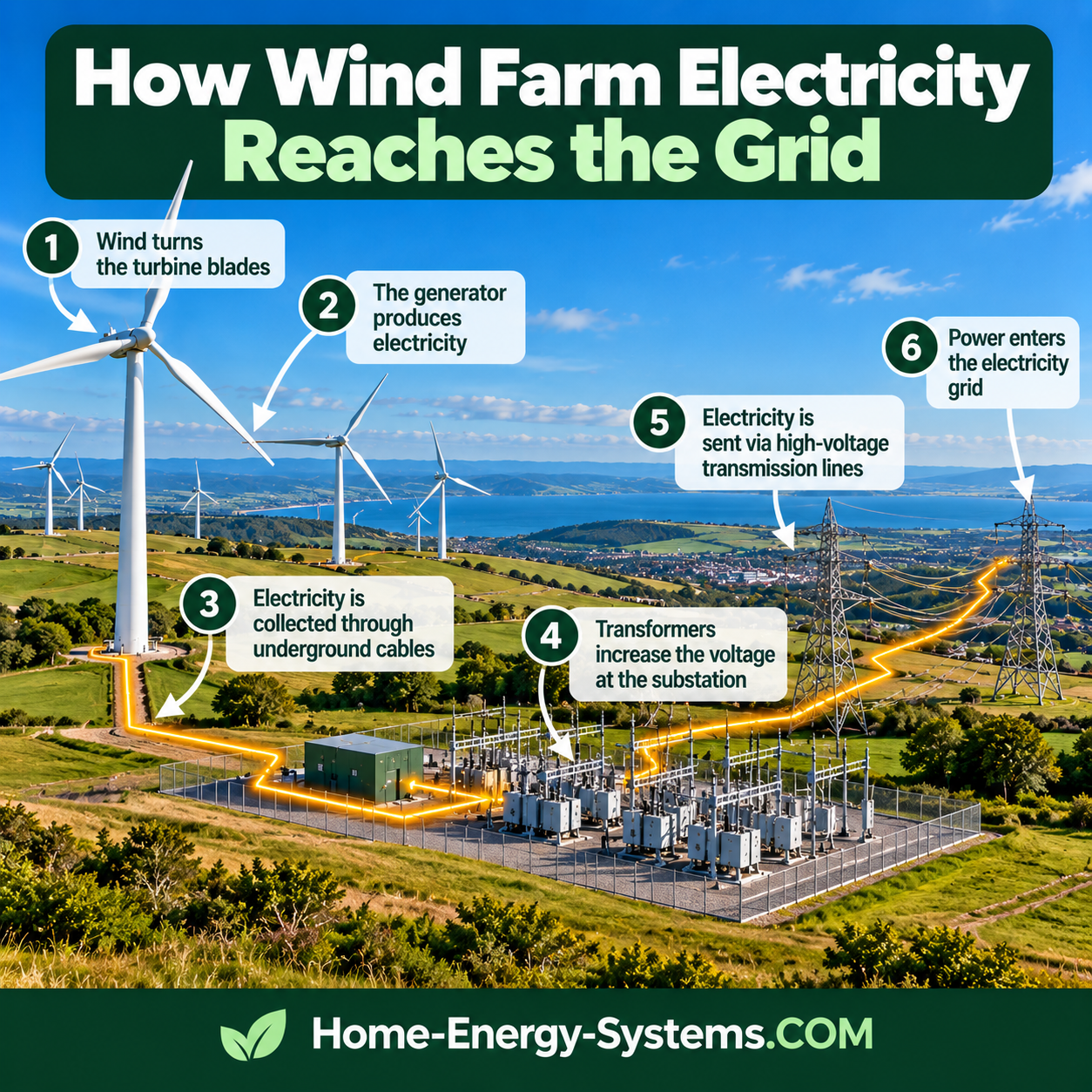
Individual turbines are connected through electrical collection cables. On an onshore wind farm these cables are commonly buried underground. Offshore turbines are connected using subsea array cables.
The electricity reaches a substation where transformers and other electrical equipment prepare it for export.
For large offshore wind farms, this can involve an offshore substation before high-voltage export cables carry electricity towards land.
Once the electricity reaches the appropriate grid connection, it becomes part of the wider power system rather than remaining identifiable as electricity from one particular turbine.
How Much Wind Does a Wind Farm Need?
Wind turbines operate across a range of wind speeds rather than simply being either “on” or “off.”
Below the turbine’s cut-in wind speed, there is generally insufficient wind for useful generation.
As wind speed increases, output rises until the turbine reaches its rated power.
When wind becomes exceptionally strong, the turbine may shut down at its cut-out speed to protect itself from excessive mechanical loads.
| Wind Condition | Typical Turbine Behaviour | Electricity Output |
|---|---|---|
| Very low wind | Rotor may be stationary or turning without generating | Little or none |
| Above cut-in | Turbine begins producing useful electricity | Increasing |
| Stronger wind | Output increases toward rated capacity | High |
| Rated region | Controls limit output around rated power | Approximately rated output |
| Extreme wind | Turbine may shut down for protection | None while stopped |
Exact cut-in, rated and cut-out speeds depend on the particular turbine model.
Why Are Wind Turbines Spaced So Far Apart?
If turbines produce more electricity when exposed to strong wind, it might seem logical to place as many turbines as possible into the available land or sea area.
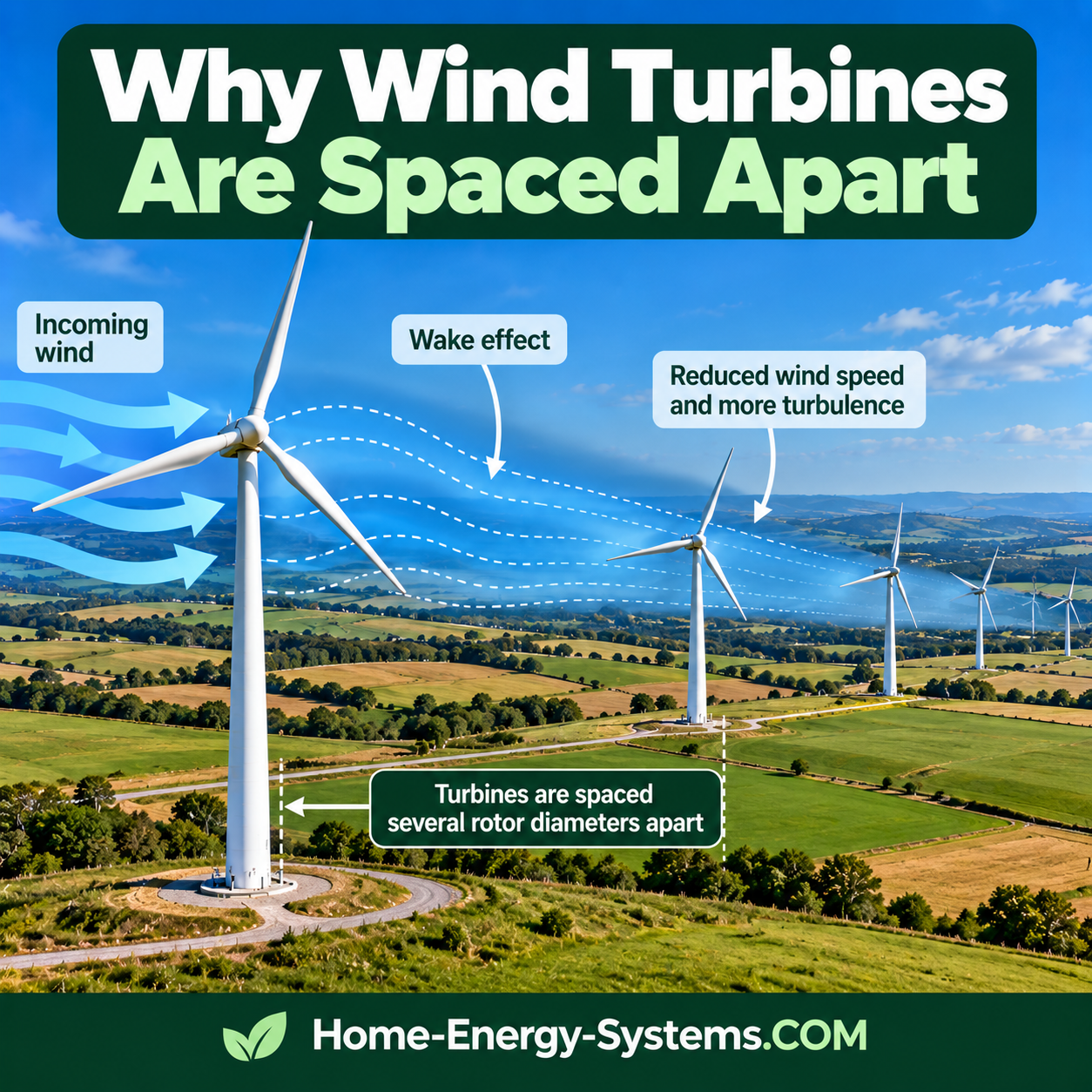
In reality, turbines interfere with the airflow behind them.
After wind passes through a turbine rotor, the air behind it contains less energy and becomes more turbulent. This region is known as the turbine’s wake.
If another turbine sits directly within that wake, its electricity production can fall and turbulent loading can increase.
Wind farm designers therefore carefully model turbine positions, prevailing wind directions, terrain, turbine dimensions and wake behaviour.
The goal is not necessarily to fit the maximum possible number of turbines onto a site. It is to optimise the performance of the wind farm as a complete system.
Onshore vs Offshore Wind Farms
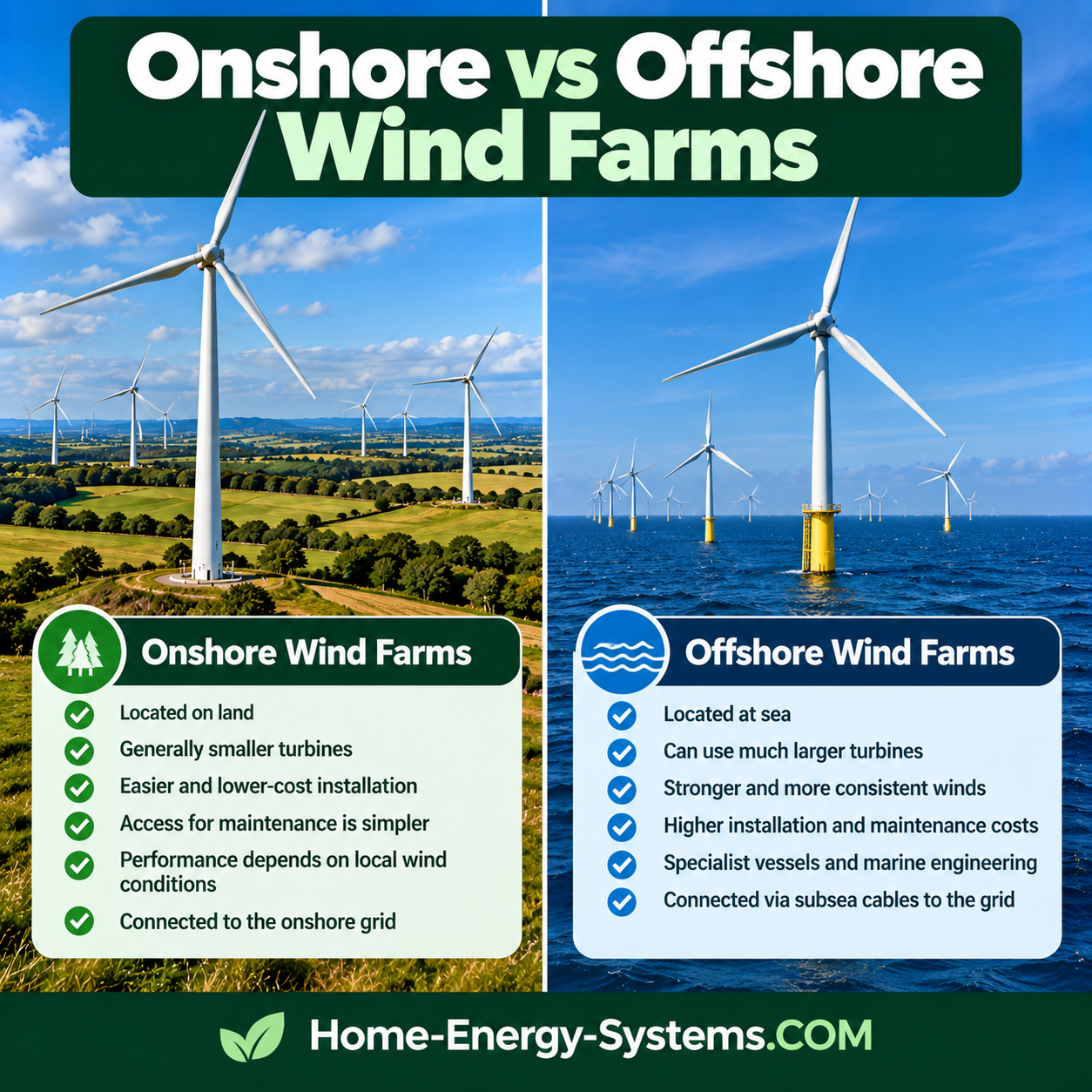
The fundamental principle of how wind farms work is the same on land and at sea, but the engineering and economics can be very different.
| Feature | Onshore Wind | Offshore Wind |
|---|---|---|
| Location | Land | Sea |
| Turbine size | Generally smaller | Can be considerably larger |
| Installation | Usually easier to access | Specialist vessels and marine engineering |
| Wind resource | Highly site dependent | Often stronger and more consistent |
| Grid connection | Land-based cables | Subsea export cables |
| Maintenance access | Generally easier | Weather and sea conditions can restrict access |
| Foundation | Ground foundation | Fixed-bottom or floating systems |
Fixed-Bottom Offshore Wind
Many offshore turbines are mounted on structures fixed to the seabed. Different foundation designs can be used depending on water depth and seabed conditions.
Floating Offshore Wind
Floating wind turbines sit on floating platforms anchored to the seabed with mooring systems.
This technology can potentially allow wind development in deeper waters where conventional fixed foundations become impractical.
What Happens to a Wind Farm When There Is No Wind?
If there is insufficient wind, turbine electricity production falls and can eventually stop.
This is one of the fundamental characteristics of wind energy: the fuel is free and renewable, but it is variable.
Electricity systems therefore do not normally depend on one individual wind farm continuously producing its maximum output.
Instead, wind operates as part of a wider electricity system containing multiple generators, interconnectors, storage systems and flexible electricity demand.
Wind forecasting has also become an important part of operating modern electricity systems. Weather data and forecasting models allow grid operators to estimate expected wind generation ahead of time.
Do Wind Farms Store Electricity?
Traditionally, most wind farms simply generated electricity whenever suitable wind was available and exported that electricity directly to the grid.
That is changing.
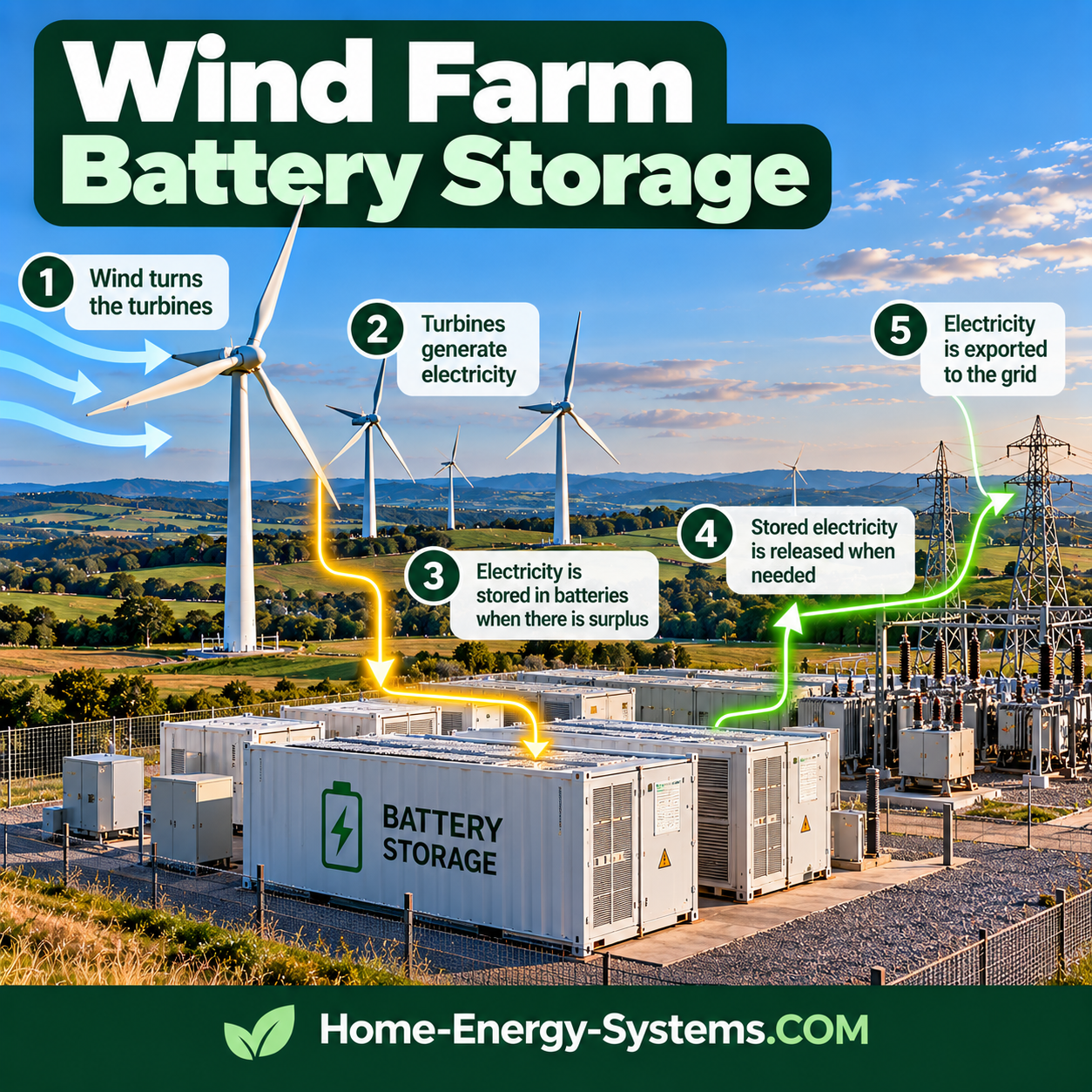
Some modern projects incorporate battery energy storage, while batteries can also be installed elsewhere on the electricity network to help manage renewable generation.
Storage can charge when electricity is plentiful and discharge later when electricity is more valuable or the grid needs additional support.
We cover this subject in much greater detail in our Wind Farm Battery Storage: Complete Guide 2026.
How Efficient Are Wind Farms?
Wind-farm performance cannot be described accurately using one simple efficiency percentage.
One useful measure is capacity factor.
Capacity factor compares the electricity actually generated over a period with the amount that would have been generated if the wind farm operated continuously at maximum rated output.
A 100 MW wind farm does not normally produce 100 MW every hour of every day. Output changes with wind conditions, maintenance, grid constraints and other factors.
Capacity factor therefore provides a much more useful picture of real-world energy production than simply looking at the nameplate capacity of the turbines.
Offshore wind projects can achieve particularly strong capacity factors because offshore wind resources can be stronger and more consistent, although performance varies substantially by location and project.
How Long Does a Wind Farm Last?
Wind farms are major infrastructure projects intended to operate for decades.
A turbine’s working life depends on its design, operating conditions, maintenance history and component condition.
Throughout its life, a turbine undergoes planned maintenance and inspection, while components may be repaired or replaced.
At the end of the original project’s operating life, developers generally have several possible options.
Continue Operation
Where technically and legally appropriate, turbines may continue operating beyond their original design period following suitable assessment.
Repower the Site
Older turbines may be replaced with newer, larger and more productive machines while continuing to use a proven wind-energy location.
Decommission
Turbines and associated equipment can be removed and the site dealt with according to planning, lease and environmental requirements.
Recycle Components
Large quantities of turbine materials such as steel and copper can be recovered, while blade recycling remains an area of continuing development.
How Many Homes Can a Wind Farm Power?
You will often see wind farms described as being capable of powering a certain number of homes.
These figures can be useful for communicating scale, but they are estimates rather than a literal description of how electricity reaches households.
The number depends on several variables:
- wind farm capacity;
- capacity factor;
- annual electricity generation;
- average household electricity consumption; and
- the methodology used in the calculation.
For example, once electricity enters the grid it mixes with electricity from many other generating sources. Individual homes are not normally connected directly to particular wind turbines.
Can Wind Farms Produce Too Much Electricity?
At certain times, a region can have more available renewable generation than the electricity network can efficiently accommodate.
Transmission constraints can also prevent electricity from moving from where it is generated to where it is needed.
Wind output may then have to be reduced. This is known as curtailment.
Several technologies can help reduce curtailment, including stronger transmission networks, interconnectors, flexible electricity demand and battery storage.
This is another reason understanding how wind farms work requires looking beyond the turbines themselves. Grid capacity can be just as important as generating capacity.
What Are the Environmental Considerations?
Wind farms generate electricity without burning fuel during normal operation, but that does not mean they have no environmental footprint.
Projects require materials, manufacturing, transport, construction and eventual decommissioning.
Potential local considerations can include:
- visual impact;
- noise;
- birds and bats;
- habitat disturbance;
- roads and construction access;
- marine ecology for offshore projects;
- fishing and navigation offshore; and
- end-of-life material management.
These issues are one reason wind projects normally undergo environmental assessment and planning processes before construction.
The appropriate question is therefore not whether wind energy has zero impact. Every major energy technology has impacts. The more useful comparison considers lifecycle emissions, land and resource requirements, environmental effects and the alternatives available for generating electricity.
How Are Wind Farms Controlled?
Modern wind farms are highly automated.
Sensors throughout each turbine monitor variables including wind speed, wind direction, rotor speed, temperatures, vibration and electrical performance.
Supervisory control and data acquisition systems — commonly known as SCADA — allow operators to monitor turbines and the wider wind farm remotely.
Individual turbines can automatically adjust blade pitch, orientation and operating state in response to changing conditions.
Operators can also identify abnormal behaviour and plan maintenance before some problems become serious failures.
This digital layer is becoming increasingly important as turbines become larger and wind farms operate further offshore.
The Future of Wind Farms
The basic physics behind how wind farms work will remain familiar: moving air turns turbines and generators produce electricity.
The surrounding technology, however, continues to develop.
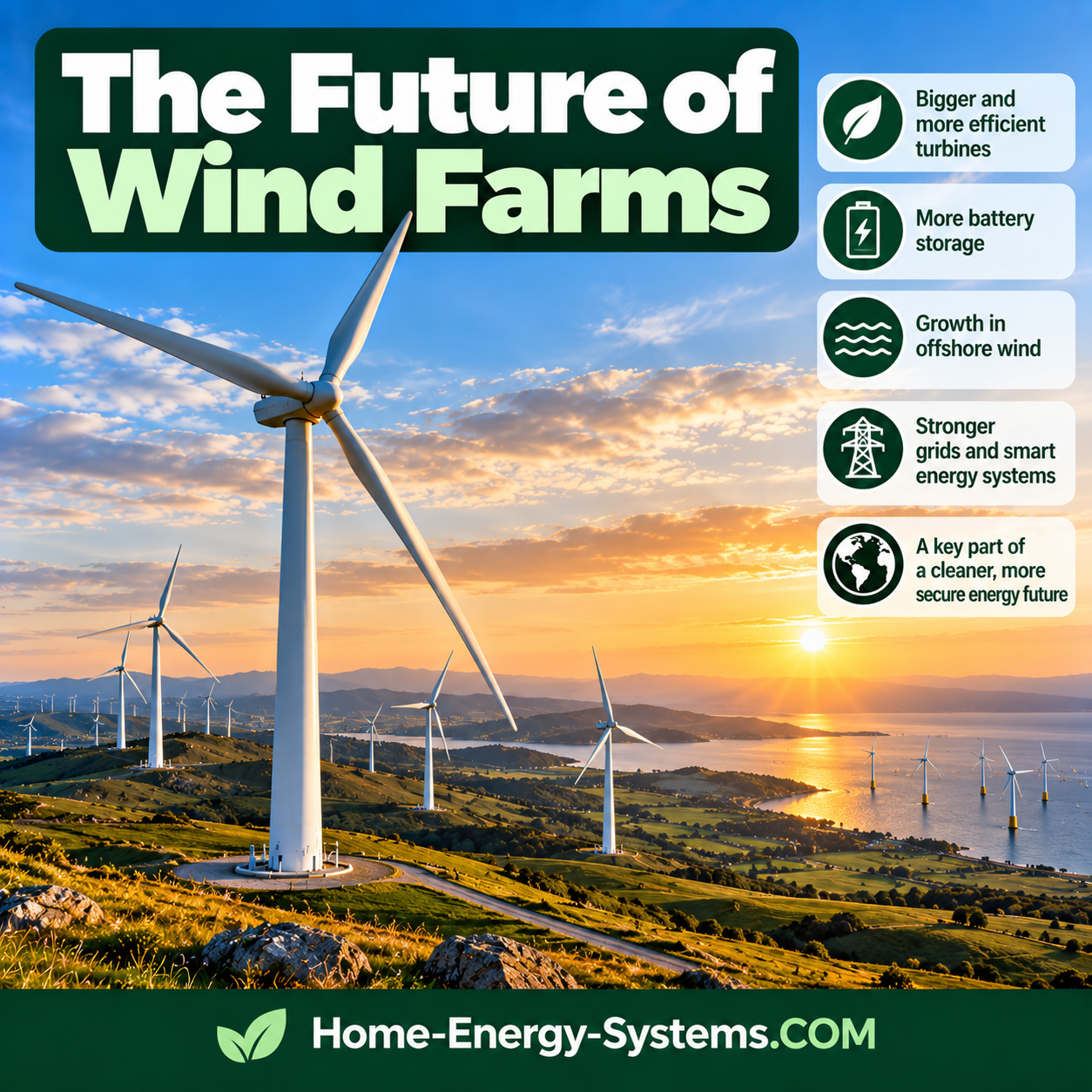
Future wind projects are likely to benefit from larger turbines, improved forecasting, smarter controls, better grid integration and increasingly sophisticated energy storage.
Floating offshore wind could also open areas of deeper water that are unsuitable for conventional fixed-bottom turbines.
Another important development is hybrid renewable generation.
Wind farms can potentially share parts of their electrical infrastructure with solar generation and battery storage. Because wind and solar production patterns do not always coincide, combining technologies can sometimes make better use of a grid connection.
Meanwhile, repowering existing wind farms with modern turbines may allow established wind-energy locations to generate considerably more electricity without developing an entirely new site.
The wind farm of the future is therefore likely to become increasingly integrated with storage, forecasting, electricity markets and smart-grid technology.
Frequently Asked Questions About How Wind Farms Work
How does a wind farm generate electricity?
Wind turns the turbine blades and rotor. This rotational mechanical energy drives a generator, which produces electricity. Transformers, cables and substations then collect and export electricity from the wind farm to the wider grid.
Do wind turbines work when there is no wind?
No. Turbines require sufficient wind to generate useful electricity. Below their cut-in wind speed, electricity generation normally stops.
Why don’t wind turbines spin all the time?
A turbine may stop because wind is too weak, wind is exceptionally strong, maintenance is being carried out, a fault has occurred or grid conditions require output to be reduced.
Do wind farms have batteries?
Some do, but batteries are not required for a wind farm to operate. Battery storage is increasingly being paired with renewable generation to provide energy shifting and grid-support services.
Do wind turbines face the wind?
Most large horizontal-axis turbines use yaw systems to orient the nacelle and rotor appropriately relative to wind direction.
Why are wind turbines so tall?
Wind speeds generally increase and become less turbulent higher above the ground. Taller towers can therefore give turbines access to a better wind resource while also allowing larger rotor diameters.
Where does wind farm electricity go?
Electricity from individual turbines is collected through cables and usually passes through a substation before being exported through the project’s grid connection into the wider electricity network.
Can offshore wind farms work in deep water?
Conventional offshore turbines generally use foundations connected to the seabed, while floating wind technology can potentially allow turbines to operate in much deeper water.
Final Thoughts
Once the complete system is understood, how wind farms work becomes much clearer.
The wind supplies kinetic energy. Aerodynamic blades convert some of that energy into rotation. A generator converts the rotation into electricity, and transformers, cables and substations move that electricity towards the grid.
But the turbines are only part of the story.
Wind forecasting, electrical networks, control systems, grid connections and increasingly battery storage all influence how effectively wind electricity can be used.
That is why a modern wind farm is better viewed as an integrated power station rather than simply a collection of turbines.
Sources & Further Reading
Continue Exploring Wind & Energy Storage
Want to understand what happens when wind electricity is generated at the wrong time?
Read our complete guide to wind farm battery storage and see how batteries can store renewable electricity, support the grid and help reduce some wind curtailment.