How to Install Security Cameras on a Farm: Complete Guide 2026
Learning how to install security cameras on a farm is very different from installing a camera outside an ordinary home. Farms can include remote gates, barns, machinery sheds, livestock areas, fuel tanks and fields hundreds of metres from the farmhouse — often with no Wi-Fi or mains electricity nearby.
The good news is that modern solar, battery and 4G security cameras make it possible to monitor parts of a farm that would once have required expensive cabling. The key is choosing the right camera technology and, just as importantly, installing each camera in the right location.
In This Guide
- Plan Your Farm Camera Installation
- Where Should Farm Security Cameras Be Installed?
- How High Should Farm Security Cameras Be Mounted?
- Can Farm Security Cameras Work Without Internet?
- Wi-Fi vs 4G Farm Security Cameras
- How to Install Solar Farm Security Cameras
- Step-by-Step Farm Camera Installation
- How to Monitor a Farm Remotely
- Common Installation Mistakes
- Building a Complete Farm Security System
- Frequently Asked Questions
Plan Your Farm Camera Installation First
Before buying cameras, walk around the farm and identify the areas where people or vehicles can enter the property and where valuable equipment is stored.
Trying to cover every acre with cameras is rarely necessary. A better approach is to monitor the locations that people, vehicles or machinery must pass through.
Main Farm Entrance
The main entrance is often the highest-priority camera location. Positioning a camera here can help record vehicles, visitors and activity entering or leaving the property.
Remote Gates
Remote field gates can be difficult to protect because they may have neither electricity nor Wi-Fi. Solar-powered 4G cameras are particularly useful in these locations.
Machinery & Equipment
Tractors, trailers, tools and agricultural machinery can represent a substantial investment. Cameras should cover machinery sheds and regular parking areas.
Fuel & Storage Areas
Fuel tanks, workshops and storage buildings are useful locations for cameras because they may contain valuable equipment or consumables.
For a broader look at protecting an agricultural property, see our guide to farm security cameras.
Where Should Farm Security Cameras Be Installed?
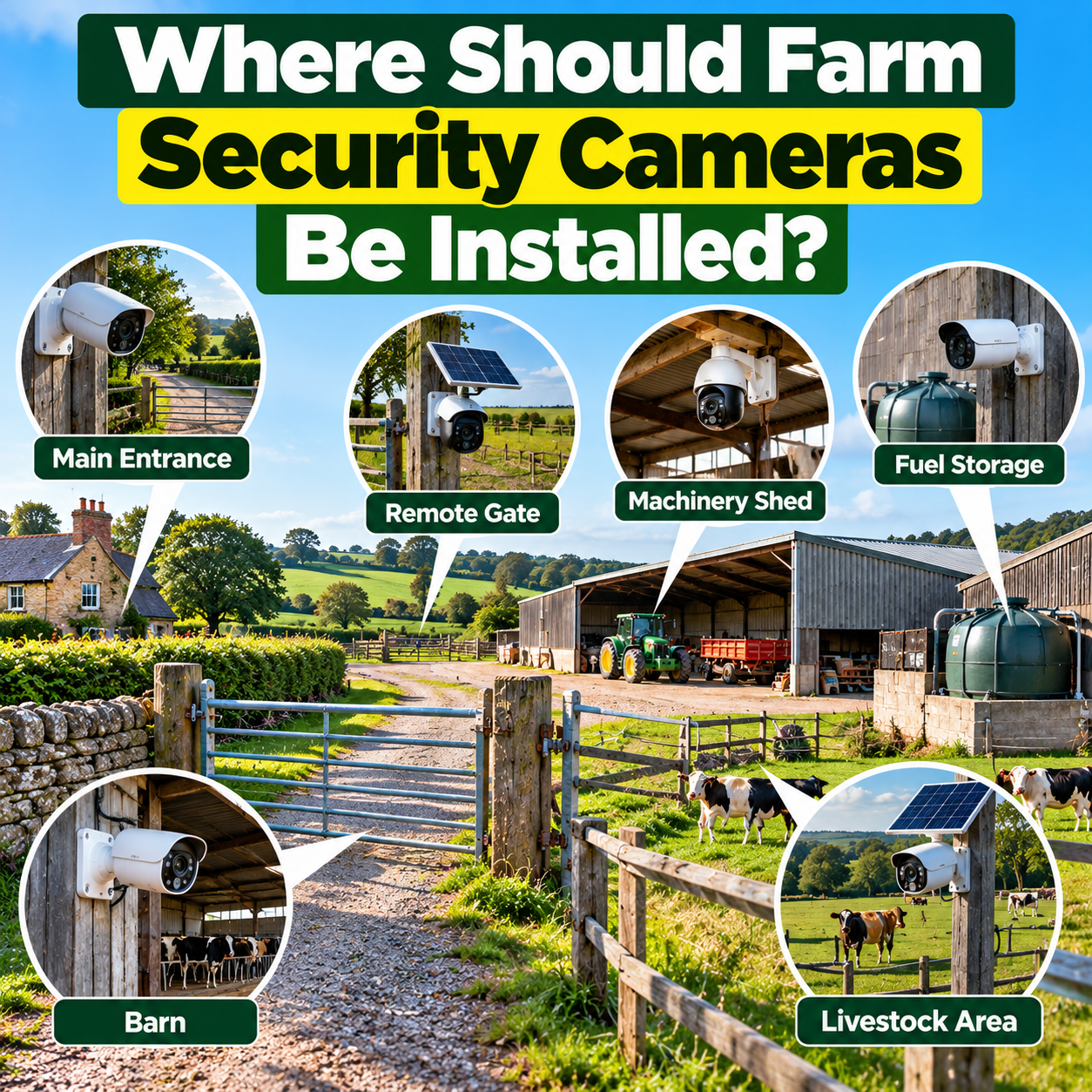
The best location depends on what you need the camera to identify. A wide view of a field may show that somebody entered the property, but it may not provide enough detail to identify a person or vehicle.
For that reason, cameras are generally most useful at choke points where movement is predictable.
| Location | Main Purpose | Suitable Camera |
|---|---|---|
| Main entrance | Vehicles and visitors | PoE, Wi-Fi or 4G |
| Remote gate | Unauthorised access | Solar 4G |
| Machinery shed | Equipment protection | PoE or Wi-Fi |
| Fuel tank | Theft monitoring | 4G, Wi-Fi or wired |
| Barn | Security and livestock | Wi-Fi or wired |
| Livestock area | Animal monitoring | Wi-Fi, 4G or solar |
How High Should Farm Security Cameras Be Mounted?
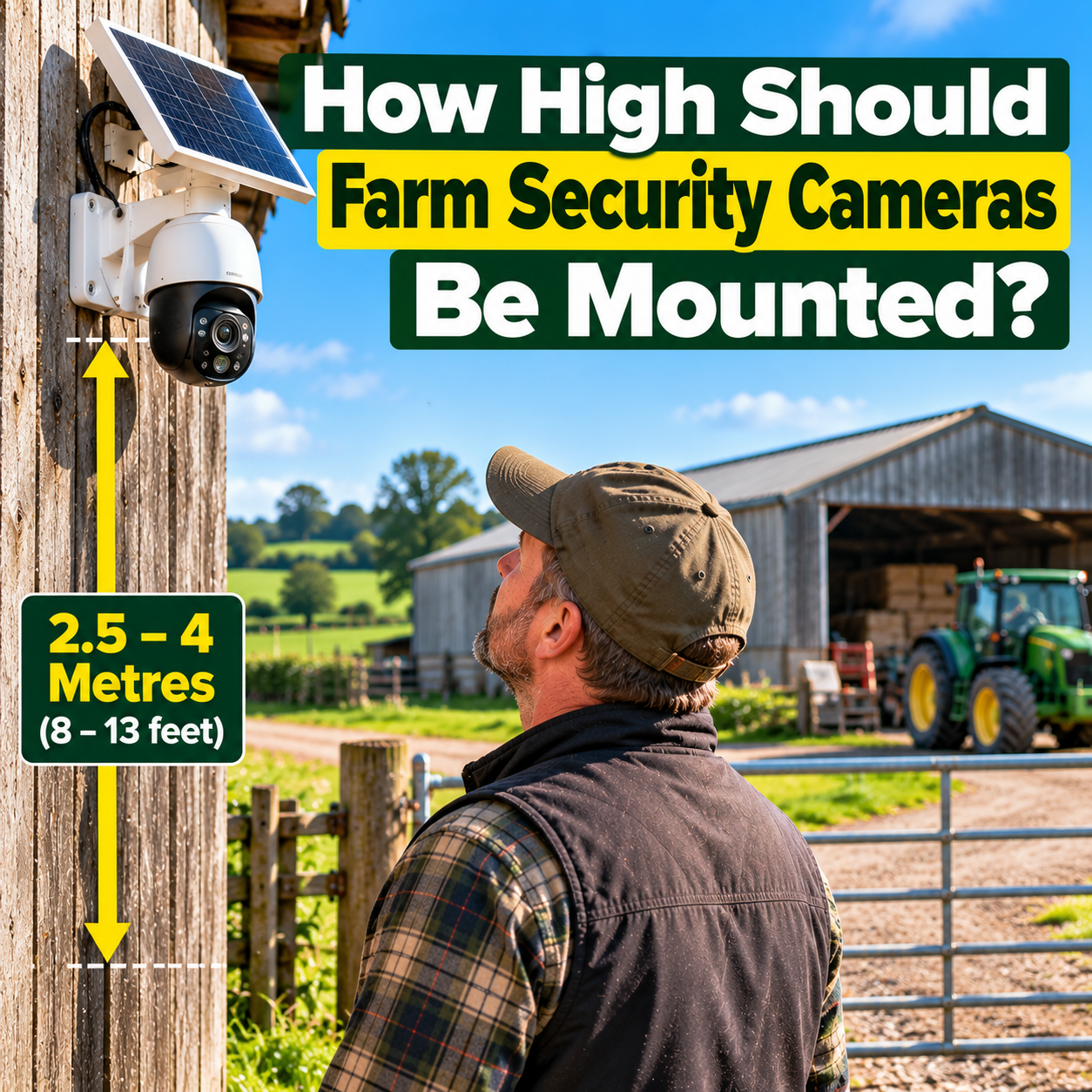
There is no single mounting height suitable for every farm. In many situations, roughly 2.5 to 4 metres above ground level provides a useful compromise between image detail and protection from easy tampering.
Mounting a camera extremely high may give a wider view, but faces and vehicle details can become harder to recognise. A camera aimed primarily at a gateway may therefore benefit from being positioned lower than one providing general surveillance over a machinery yard.
The viewing angle matters just as much as height. Avoid pointing the camera too steeply downward if identifying faces or vehicles is important.
Can Farm Security Cameras Work Without Internet?
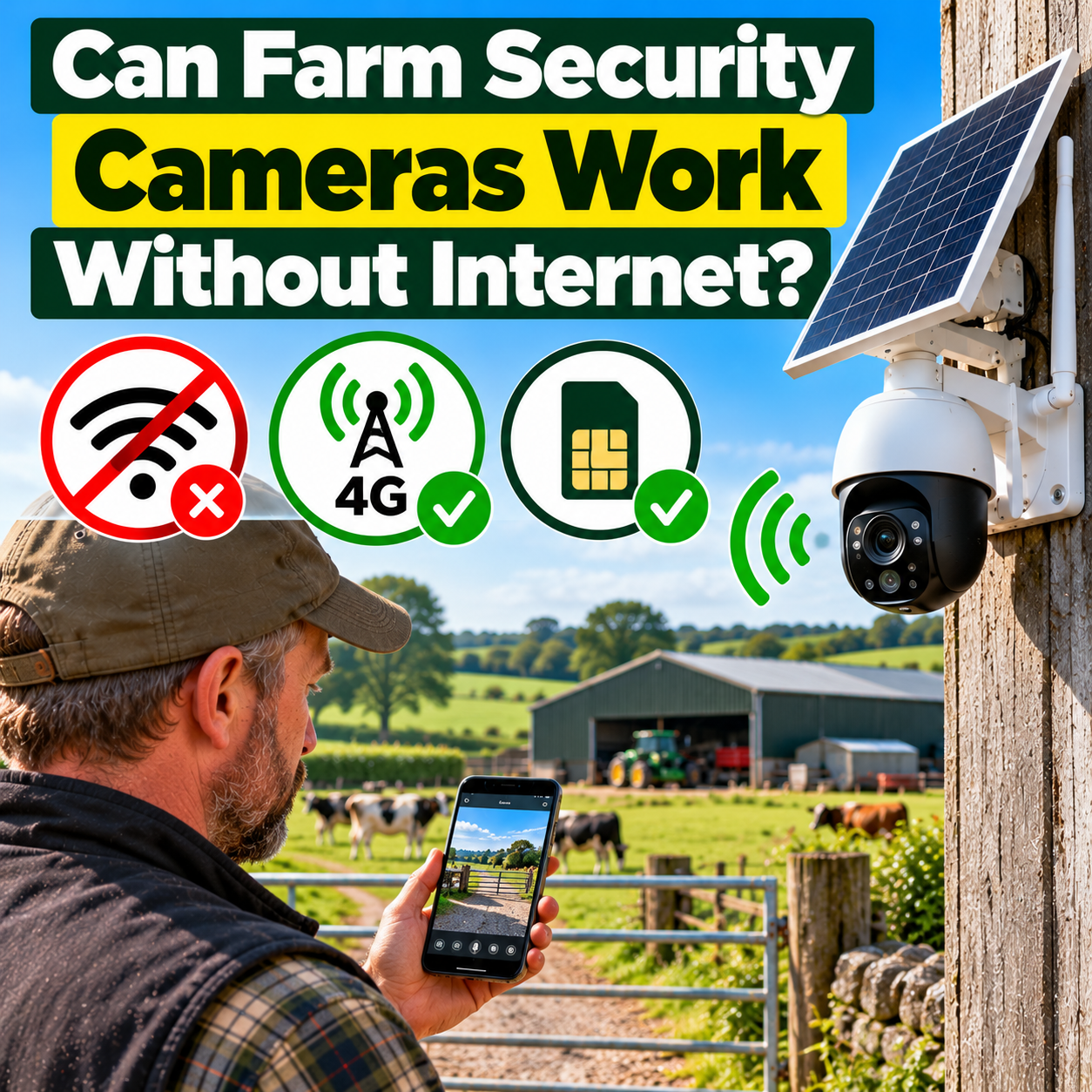
Yes. Farm security cameras can work in locations without conventional broadband or Wi-Fi, although the correct camera system is important.
A 4G/LTE security camera connects directly to a mobile network using a SIM or supported cellular service. This makes cellular cameras particularly useful for remote farm gates, fields, barns and equipment areas beyond the farmhouse Wi-Fi network.
4G Camera Option: Xega
Xega offers cellular security cameras designed for locations where conventional Wi-Fi may not be available. This type of camera can be worth considering for remote farm gates, fields and outbuildings where suitable mobile coverage is available.
View Xega 4G Security Cameras →Some cameras can also record footage locally to a memory card even when an internet connection is unavailable. However, remote alerts and live viewing normally require some form of network connection.
We explain this option in more detail in our best 4G security cameras for farms guide.
Wi-Fi vs 4G Farm Security Cameras
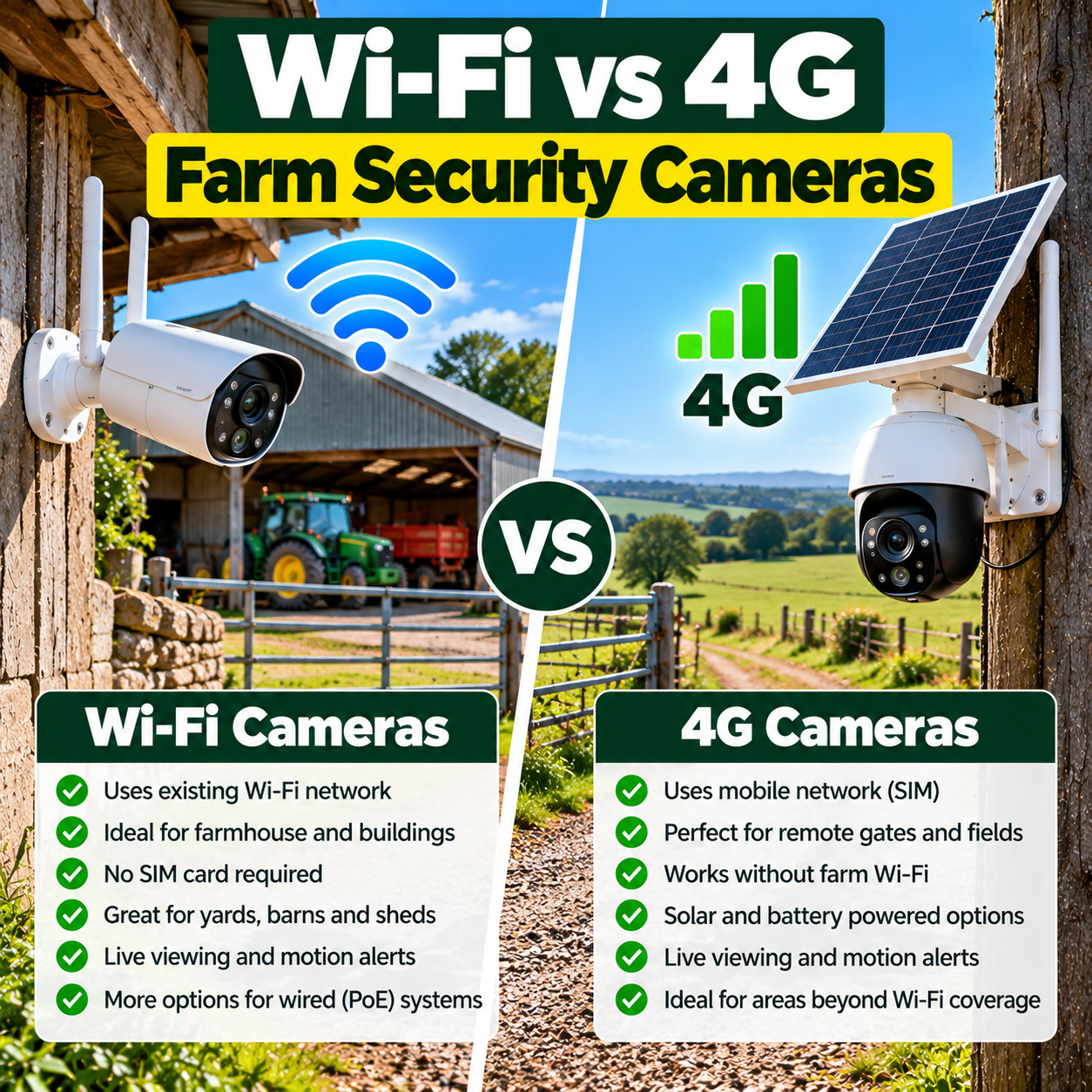
One of the biggest decisions when installing farm cameras is how each camera will communicate.
| Feature | Wi-Fi Camera | 4G Camera |
|---|---|---|
| Internet connection | Existing Wi-Fi | Mobile network |
| Best location | Farmhouse, yard, barn | Remote gates and fields |
| SIM required | No | Usually yes |
| Remote viewing | Yes | Yes |
| Works beyond farm Wi-Fi | Usually no | Yes, with mobile coverage |
| Solar compatible | Some models | Many models |
Wi-Fi cameras make sense around the farmhouse and buildings where a reliable network already exists. Installing Wi-Fi extenders simply to reach a gate hundreds of metres away can become complicated.
Where there is a usable mobile signal, a 4G camera can often be the simpler solution.
How to Install Solar Farm Security Cameras
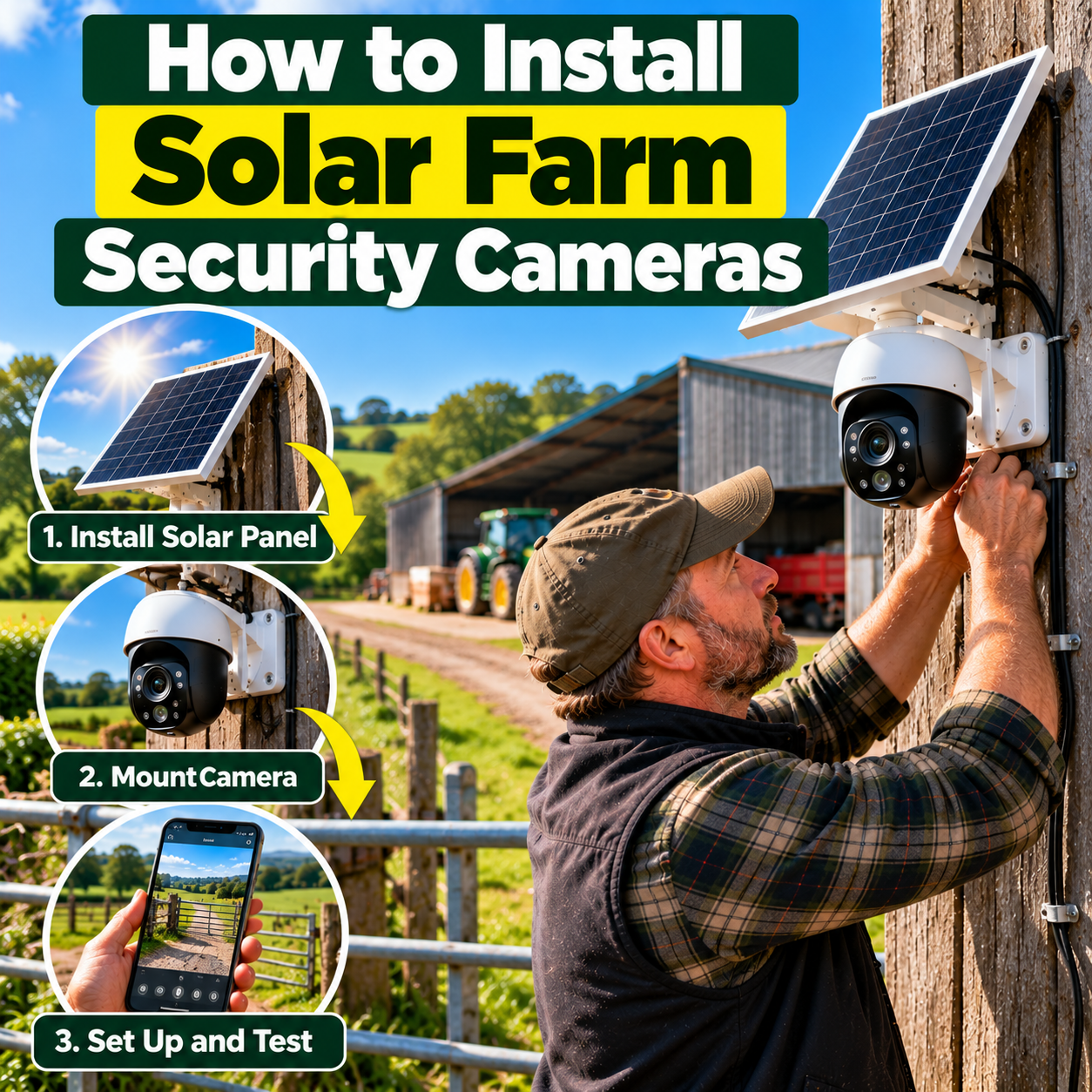
Solar security cameras are particularly useful on farms because the camera and solar panel can operate without a permanent mains electricity connection.
This makes them suitable for gates, fields, livestock areas and isolated buildings.
Solar Camera Option: ieGeek
ieGeek offers outdoor battery and solar security camera options that may suit farmyards, barns, gates and other locations where running a permanent power cable would be inconvenient.
View ieGeek Security Cameras →Choose a Position With Good Sunlight
The solar panel should receive adequate direct sunlight throughout the year. A position that receives plenty of sunshine during summer can become shaded during winter when the sun is lower.
Keep the Solar Panel Clear
Dust, leaves, bird droppings and agricultural debris can reduce solar output. Check and clean the panel periodically according to the manufacturer’s instructions.
Check Mobile Signal Before Mounting
For a solar 4G camera, test the mobile signal at the exact installation point before permanently mounting the equipment.
A strong signal beside the farmhouse does not guarantee good coverage at a remote gate or behind a large agricultural building.
For more on this type of system, see our guide to the best solar security cameras for farms.
How to Install Security Cameras on a Farm Step by Step
- Survey the farm. Identify entrances, remote gates, machinery, fuel tanks, barns and other vulnerable areas.
- Decide what each camera needs to see. Determine whether you need general activity monitoring, facial detail, vehicle identification or livestock monitoring.
- Check connectivity. Test Wi-Fi or cellular coverage at each proposed camera location.
- Choose the power source. Decide between mains power, PoE, rechargeable battery or solar power.
- Test the camera temporarily. Check the viewing angle and signal before drilling holes or permanently fixing brackets.
- Install the mounting bracket securely. Use fixings suitable for the wall, timber, pole or structure.
- Position the camera. Avoid excessive sky in the image and aim the camera toward the area where identification is most likely.
- Install the solar panel if required. Position it for good year-round sunlight and secure the cable.
- Configure motion detection. Set activity zones and sensitivity to reduce unnecessary alerts.
- Test during daylight and darkness. Make sure night vision, notifications and recordings work as expected.
Installing Cameras at Farm Gates
Farm gates deserve particular attention because they naturally funnel vehicles and visitors through a relatively narrow area.
Rather than mounting a camera simply to show the entire entrance, consider the position from which it can obtain the most useful view of an approaching vehicle or person.
Avoid positioning the camera directly toward strong sunrise or sunset where possible. Vegetation should also be kept away from the camera because moving branches can trigger unnecessary motion alerts.
Our farm gate security systems guide looks at cameras, locks, alarms, driveway sensors and access-control options as part of a layered gate-security setup.
Installing Cameras Around Barns and Machinery
Buildings close to the main farmyard often have more installation options because electricity, Ethernet and Wi-Fi may already be available.
Where practical, a wired Power over Ethernet (PoE) system can provide a stable connection while carrying both power and data through one Ethernet cable.
Wireless cameras can be easier to install, but always check Wi-Fi strength through thick walls and metal agricultural buildings before relying on them.
Useful positions include doors, machinery parking areas, workshops and routes between buildings.
How Do I Monitor a Farm Remotely?
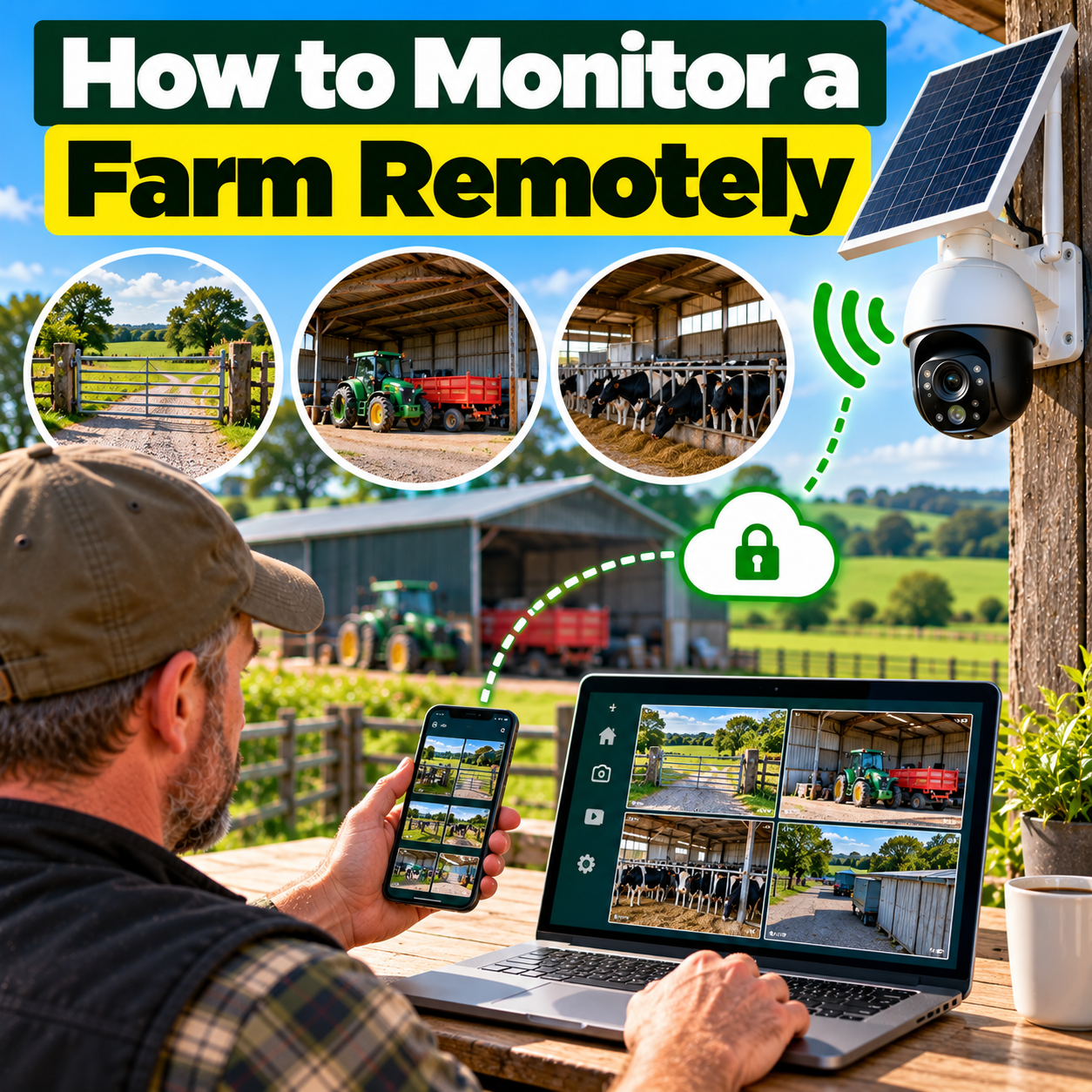
Modern security systems can allow farmers to check cameras from a smartphone while away from the property.
Depending on the camera and service, remote monitoring can include:
- Live video viewing
- Motion notifications
- Person or vehicle detection
- Recorded event playback
- Two-way audio
- Battery-level monitoring
- Camera health notifications
For remote parts of the farm, 4G cameras can send notifications directly over the mobile network without depending on the farmhouse broadband connection.
Should You Use Person and Vehicle Detection?
Basic motion detection can generate large numbers of alerts on a farm. Animals, trees, rain, insects and machinery can all create movement.
Cameras capable of distinguishing between people, vehicles and general motion can therefore be particularly useful.
At an entrance, vehicle detection may be valuable. Around machinery or buildings, person detection may be more important.
No detection system is perfect, so sensitivity settings and detection zones normally need some adjustment after installation.
Common Farm Security Camera Installation Mistakes
Mounting Cameras Too High
A very high camera can provide an impressive overview while producing poor facial or vehicle detail when it matters.
Ignoring Mobile Signal
Always test 4G coverage at the actual mounting position before permanently installing a cellular camera.
Poor Solar Panel Position
Shade from trees, buildings and hedges can significantly reduce charging, particularly during winter.
Too Many Motion Alerts
Poor detection zones can result in constant notifications from animals, vegetation and normal farm activity.
Leaving Cameras Easy to Reach
Cameras should be difficult to interfere with while still being accessible enough for maintenance when required.
Trying to Cover Everything
Strategically monitoring entrances and important assets is usually more effective than attempting to watch every part of the farm.
Build a Layered Farm Security System
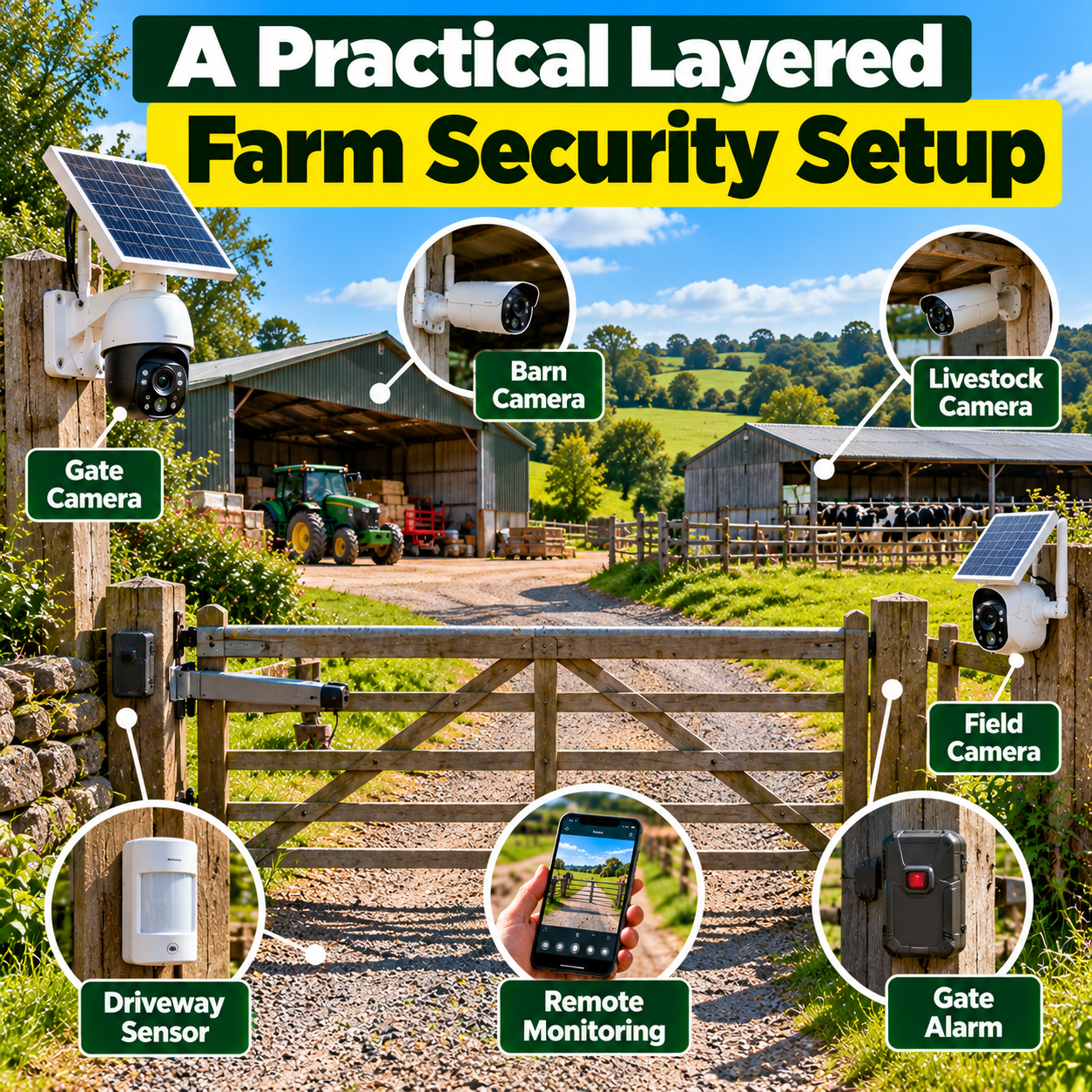
Security cameras work best as one part of a wider farm-security strategy.
A camera can record an incident and provide an alert, but physical measures can make the property more difficult to enter in the first place.
A practical layered system might combine:
- Strong gates and locking points
- Security cameras
- Driveway or vehicle sensors
- Lighting around key buildings
- Gate-opening alerts
- Equipment immobilisation
- Secure fuel and tool storage
- Visible warning signage where appropriate
The objective is not simply to collect footage. It is to deter, detect and respond.
How Many Security Cameras Does a Farm Need?
There is no universal number because farms vary enormously in layout and size.
A small farm may gain useful coverage from cameras at the entrance, machinery area, main buildings and one remote gate. A larger property with multiple entrances and isolated buildings may require considerably more.
Start with the highest-risk locations rather than buying a large number of cameras immediately. Once those cameras are operating, gaps in coverage become easier to identify.
Privacy and Camera Positioning
Security cameras should be positioned with privacy in mind. Avoid capturing neighbouring homes, private areas or public spaces unnecessarily.
Rules governing CCTV, recording, signage, audio and personal data vary between countries and regions. Farmers using surveillance equipment should check the privacy and data-protection requirements that apply where the farm is located.
Choosing Cameras for a Farm
The right camera depends largely on location. Around the farmhouse and main yard, Wi-Fi or wired cameras can work well. For remote entrances, fields and buildings, 4G and solar-powered cameras can eliminate the need to extend broadband and mains electricity across the farm.
Arlo
Arlo is an established wireless security-camera brand and can be worth comparing for farmhouses, yards, barns and other locations with suitable connectivity.
View Arlo Security Cameras →Xega
Xega is particularly relevant to remote farm-security applications because of its range of cellular and 4G security cameras.
View Xega 4G Security Cameras →ieGeek
ieGeek offers outdoor wireless, battery and solar camera options that may suit farmyards, barns, gates and other agricultural locations.
View ieGeek Security Cameras →For more detailed comparisons, see our guides to 4G security cameras for farms, solar security cameras for farms and farm security cameras.
Frequently Asked Questions
How do you install security cameras on a farm?
Start by identifying entrances, machinery, buildings and other high-value areas. Check power and network availability, choose suitable wired, Wi-Fi, battery, solar or 4G cameras, test each viewing position and signal, then securely mount and configure the cameras.
Can farm security cameras work without Wi-Fi?
Yes. 4G/LTE security cameras can use a mobile network instead of Wi-Fi. Some cameras can also record locally without internet access, although remote viewing and alerts normally require connectivity.
Where should security cameras be installed on a farm?
Priority locations commonly include the main entrance, remote gates, machinery sheds, fuel storage, barns, workshops and livestock areas.
How high should farm security cameras be mounted?
Many installations use a height of roughly 2.5 to 4 metres, although the ideal position depends on the viewing angle and purpose of the camera. Mounting too high can reduce useful facial and vehicle detail.
Are solar security cameras suitable for farms?
Solar cameras can be particularly useful at remote farm locations without mains electricity. Their effectiveness depends on adequate sunlight, battery capacity, power consumption and correct solar-panel positioning.
Do 4G farm cameras need a SIM card?
Many cellular security cameras require a SIM, eSIM or manufacturer-supported mobile data service. Requirements vary by camera, so check network compatibility and ongoing data costs before purchasing.
Can I monitor my farm from my phone?
Yes. Many modern Wi-Fi and 4G cameras provide smartphone apps for live viewing, recorded events and motion notifications when a suitable internet or cellular connection is available.
Should I use Wi-Fi or 4G security cameras on a farm?
Wi-Fi cameras are usually most practical near the farmhouse and connected buildings. 4G cameras are often better for remote gates, fields and buildings outside reliable Wi-Fi coverage.
Final Thoughts
Knowing how to install security cameras on a farm is largely about matching each location with the right technology. There is little benefit in installing an excellent Wi-Fi camera at a remote gate if the wireless signal cannot reach it.
Use wired or Wi-Fi cameras where infrastructure already exists, and consider solar-powered 4G cameras for remote areas. Concentrate first on entrances, machinery, fuel, buildings and other locations where useful identification footage can be captured.
A carefully planned handful of cameras in the right locations can often provide more useful farm security than a much larger system installed without a clear strategy.