
How to Install a Home Wind Turbine: Step-by-Step Guide 2026
If you’re researching how to install a home wind turbine, the first step isn’t buying the turbine. It’s making sure your property has enough wind, sufficient space and the right conditions for a safe, productive installation.
A home wind turbine can generate renewable electricity for a rural property, farm or off-grid home. However, the success of the system depends on much more than the turbine’s advertised power rating.
Wind speed, tower height, planning permission, electrical compatibility and installation quality all influence the amount of electricity a turbine can produce.
In this guide, we’ll explain how to install a home wind turbine, from the initial site assessment through to tower erection, electrical connection and commissioning. We’ll also examine installation costs, common mistakes and whether professional installation is worth the expense.
If you’re still choosing equipment, our Best Home Wind Turbines 2026 guide explains the different turbine options available.
Quick Answer: How Do You Install a Home Wind Turbine?
To install a home wind turbine, you generally need to:
- Assess your property’s wind resource.
- Calculate your electricity requirements.
- Choose a suitable turbine and tower.
- Check planning and electrical regulations.
- Construct an engineered foundation.
- Assemble and erect the turbine tower.
- Connect the approved electrical equipment.
- Test, commission and monitor the system.
Safety: Tower erection, structural work and electrical connections should be undertaken by appropriately qualified professionals. This guide explains the process but is not a substitute for engineering plans or manufacturer instructions.
1. Is Your Property Suitable for a Home Wind Turbine?

Before learning how to install a home wind turbine, establish whether your location has enough usable wind to make the investment worthwhile.
Open rural areas, exposed coastal properties and some elevated sites may offer better wind conditions than sheltered residential gardens. However, even a rural property can perform poorly if nearby trees, buildings or hills disrupt the airflow.
Check the Average Wind Speed
Small wind turbines generally work best in locations with consistent, relatively smooth wind.
As an initial screening guideline, the US Department of Energy identifies an annual average wind speed of approximately 4 metres per second (9 mph) at hub height as a minimum worth investigating.
That does not guarantee a worthwhile installation. Expected electricity generation must be calculated using reliable wind data, the proposed hub height and the selected turbine’s power curve.
Look for Turbulence and Obstructions
Buildings, trees and other obstacles can create turbulent airflow, reducing generation and increasing mechanical stress.
A commonly used guideline is to position the bottom of the rotor at least 9 metres (30 feet) above obstacles within approximately 90 metres (300 feet).
Final tower height should always be based on a proper site assessment and applicable planning restrictions.
Check Planning Permission
Planning requirements differ between countries, regions and local authorities.
Restrictions may cover tower height, noise, visual impact, property boundaries, aviation safety and environmental considerations.
Check the rules before purchasing equipment or starting foundation work.
2. What Equipment Do You Need to Install a Home Wind Turbine?
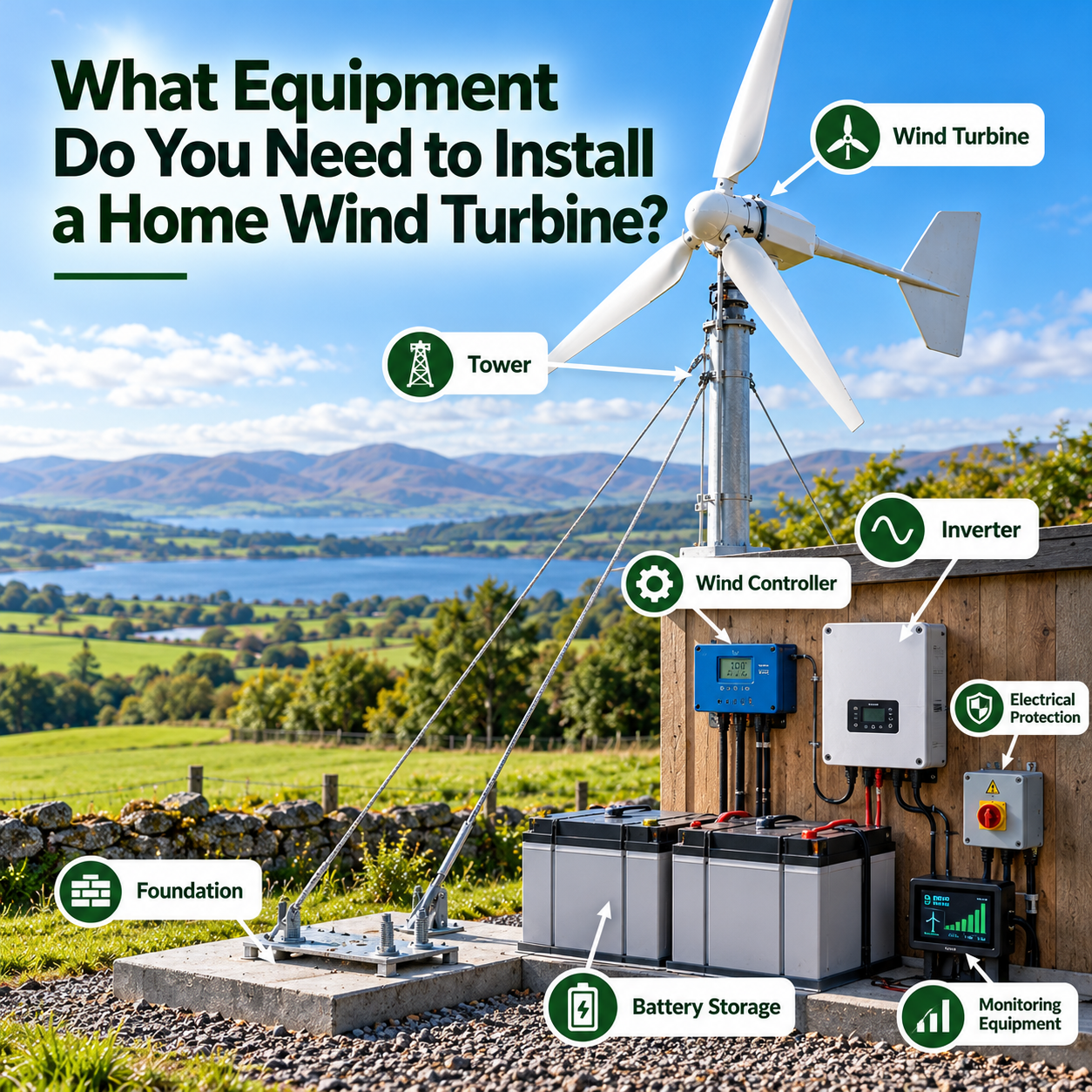
A complete wind turbine installation involves several components working together.
| Component | Purpose |
|---|---|
| Wind turbine | Converts wind energy into electrical energy. |
| Tower and foundation | Support the turbine at its operating height. |
| Wind controller | Manages turbine output and specified control functions. |
| Braking or diversion equipment | Helps manage rotor operation and excess generation as designed. |
| Inverter | Converts electricity into compatible AC power where required. |
| Battery storage | Stores electricity for suitable off-grid or hybrid systems. |
| Electrical protection | Provides specified isolation, grounding, surge and fault protection. |
| Monitoring equipment | Tracks output, operating conditions and faults. |
Not every system needs batteries. A grid-connected installation may operate without storage, while an off-grid installation generally requires batteries or another suitable energy-management arrangement.
3. How to Install a Home Wind Turbine: Step by Step
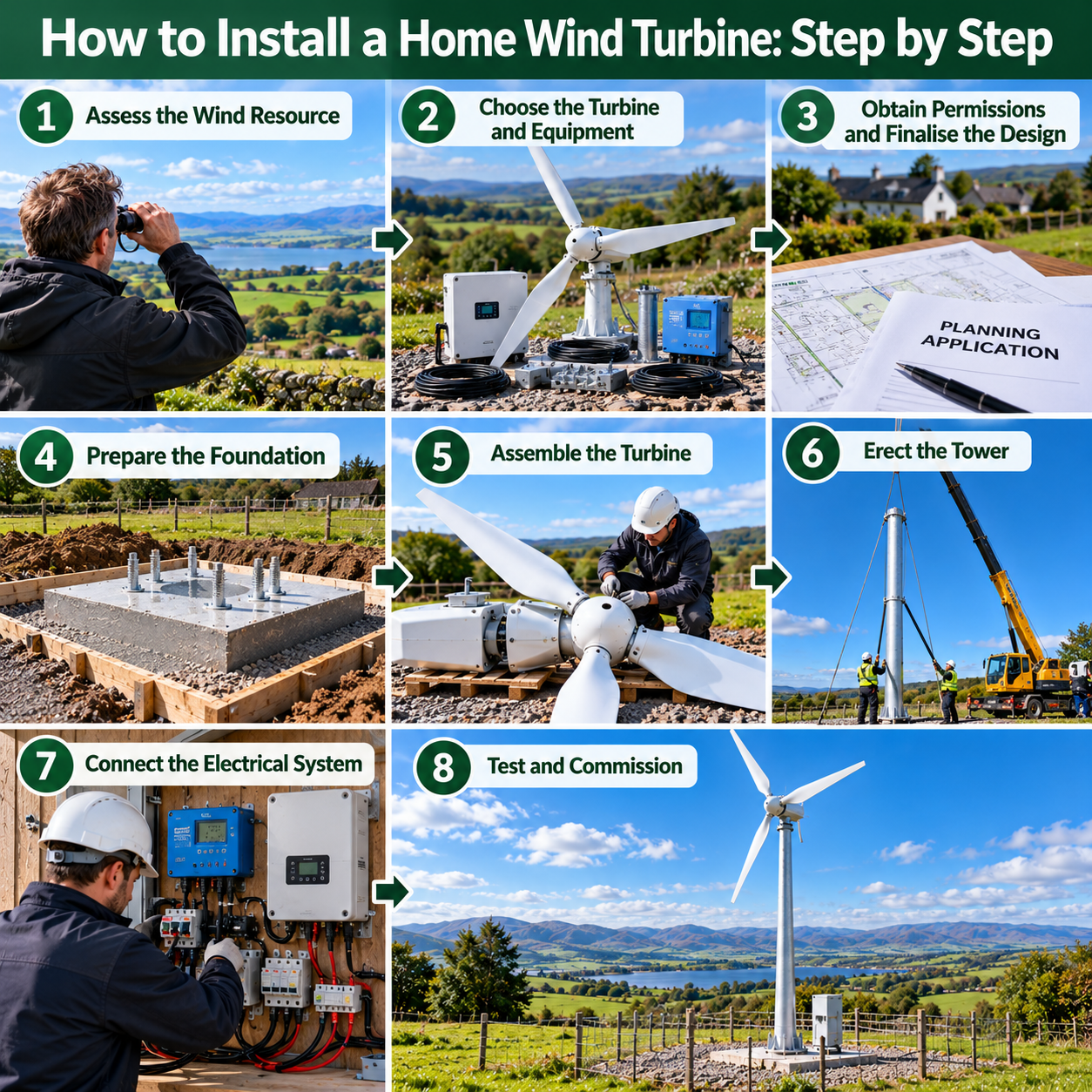
The installation process varies according to turbine size, tower design and site conditions. The following stages explain the general workflow used for residential wind systems.
Step 1: Assess the Wind Resource
Start by examining average wind speeds, seasonal conditions and nearby obstacles.
- Review local wind-resource information.
- Identify clear, exposed installation locations.
- Consider turbulence from buildings and trees.
- Check access for construction and maintenance.
- Estimate annual energy production at the proposed hub height.
For larger investments, a professional wind assessment can help establish whether the project is financially sensible.
Step 2: Calculate Your Electricity Requirements
Review your household’s electricity consumption in kilowatt-hours (kWh), preferably over a full year.
Decide whether the turbine will supplement grid electricity, charge an off-grid battery system or operate alongside solar panels.
A turbine rated at 3 kW does not continuously produce 3 kW. Actual generation depends on wind speed, turbine performance and operating conditions.
Step 3: Choose the Turbine and Tower
Select equipment suitable for the site’s wind conditions, electricity requirements and available space.
Compare independently documented performance data, warranty coverage, certification where available and replacement-part availability.
The tower must be engineered for the turbine and site conditions, including extreme wind loads.
Step 4: Obtain Permissions and Finalise the Design
Before construction begins, confirm planning permission, structural requirements and any necessary electrical or grid-connection approvals.
For grid-connected systems, consult the electricity network operator about interconnection requirements.
Have the foundation, tower and electrical design reviewed by appropriately qualified professionals.
Step 5: Prepare the Foundation
The turbine foundation transfers structural loads from the tower into the ground.
Its design depends on tower height, soil conditions, turbine loading and local engineering requirements.
Follow the approved structural design for excavation, reinforcement, anchoring and concrete work. Allow the foundation to achieve the specified strength before tower erection.
Step 6: Assemble the Turbine
Qualified installers assemble the turbine and tower components according to the manufacturer’s instructions.
Depending on the model, this may involve the nacelle, rotor blades, tail assembly, mounting equipment and tower sections.
All lifting arrangements and temporary restraints must follow an approved installation plan.
Step 7: Erect the Tower
The tower is raised using the lifting equipment and procedures specified for its design.
Installers establish a safe exclusion zone, verify weather conditions and secure all structural connections.
Once erected, the tower should be checked for alignment, anchoring and guy-wire condition where applicable.
Step 8: Connect the Electrical System
A qualified electrical professional installs the specified cables, controller, inverter, protection equipment and optional battery storage.
All equipment must be compatible with the turbine’s electrical characteristics and manufacturer-approved system configuration.
Particular attention is required for safe stopping, isolation, overvoltage protection and diversion loads where specified.
Step 9: Test and Commission the Turbine
Before normal operation, the installer checks the structural installation, electrical protection and control equipment.
Commissioning should verify correct output, monitoring, braking or shutdown functions and fault responses according to the manufacturer’s procedures.
Keep installation certificates, commissioning records, manuals and warranty documents.
4. Choosing the Right Wind Turbine Tower
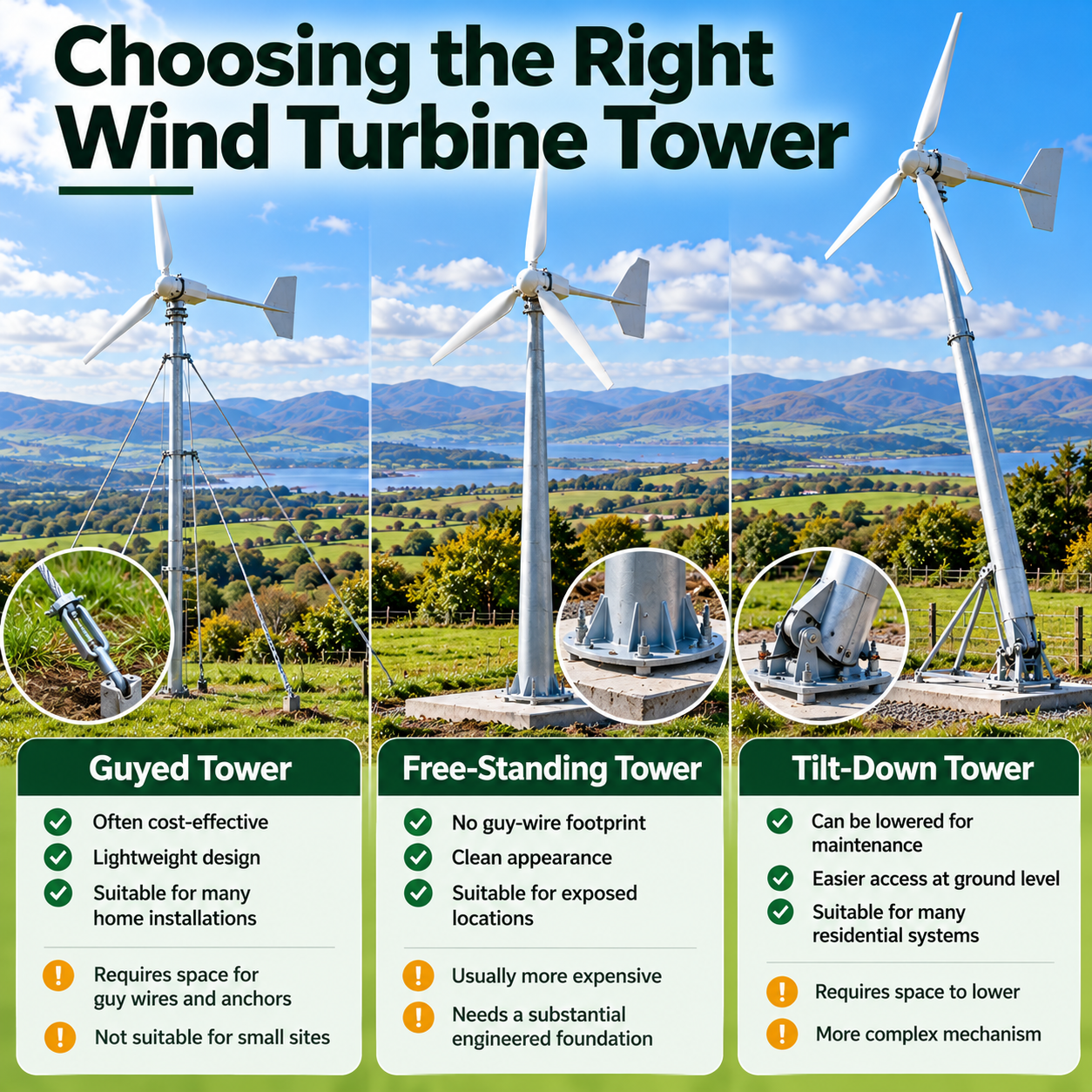
The tower is one of the most important parts of a residential wind installation.
Its purpose is to position the turbine in stronger, smoother airflow while safely supporting the equipment.
| Tower type | Advantages | Limitations |
|---|---|---|
| Guyed tower | Often relatively economical and lightweight. | Requires space for guy wires and anchors. |
| Free-standing tower | No guy-wire footprint. | Usually needs a substantial engineered foundation. |
| Tilt-down tower | Can simplify servicing at ground level. | Requires adequate lowering space and suitable equipment. |
Can You Install a Wind Turbine on Your Roof?
Rooftop turbines may appear convenient, but buildings often create turbulent wind.
Vibration, noise and additional structural loads can also make rooftop installations challenging.
For many properties, a properly designed ground-mounted tower is more suitable than attaching a turbine directly to the roof.
5. How to Connect a Wind Turbine to Your House
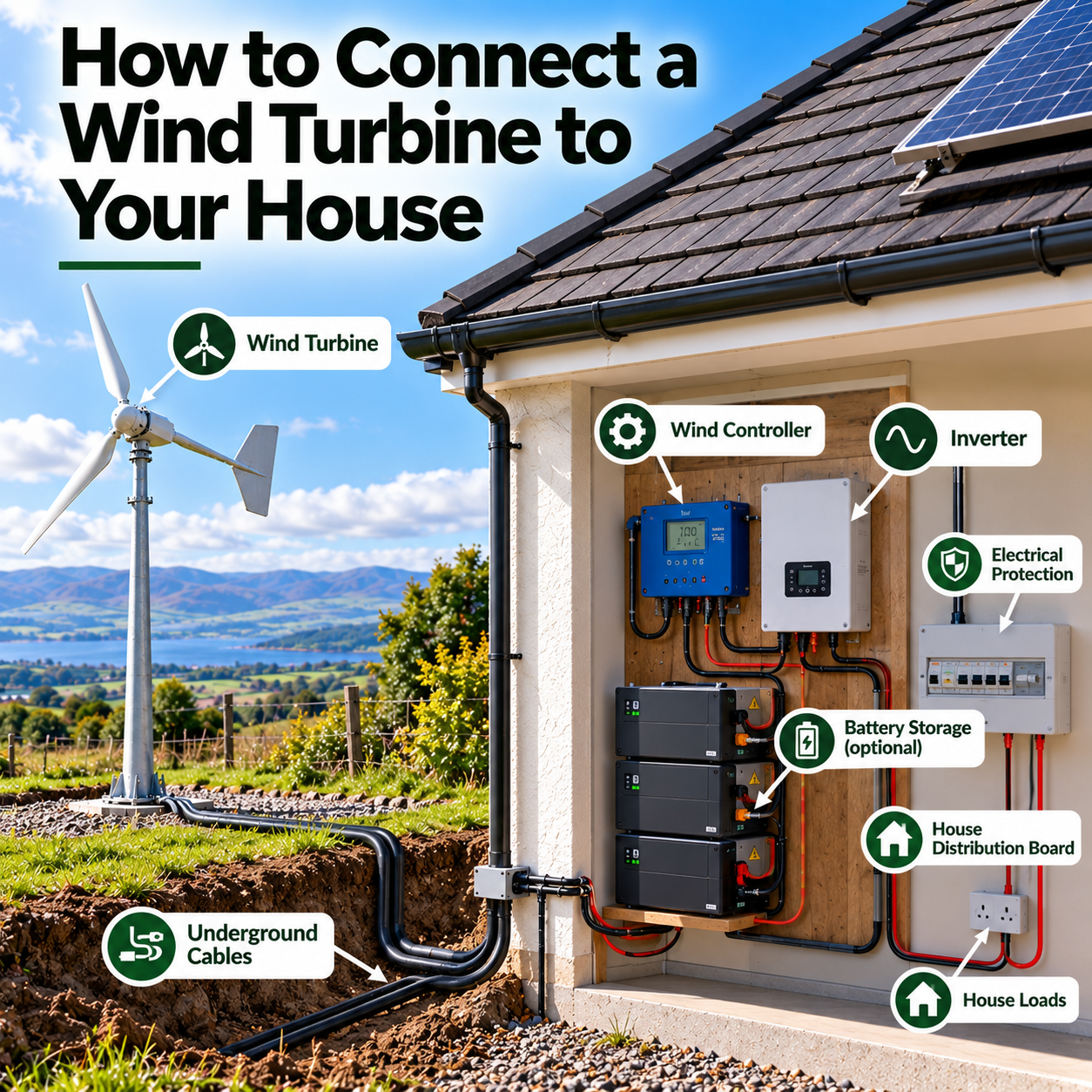
One of the most common questions homeowners ask is how to connect a wind turbine to a house safely.
The answer depends on whether the system is grid-connected, off-grid or part of a combined wind and solar installation.
Grid-Connected Wind Turbine
A grid-connected turbine uses suitable power-conditioning equipment to supply electricity compatible with the household electrical system and local grid.
The installation must meet applicable electrical standards and network requirements, including protection against unintentional islanding.
Connection approval and certification may be required before operation.
Off-Grid Wind Turbine
An off-grid wind turbine commonly supplies electricity through a compatible wind controller, battery storage and inverter.
The controller and associated protection equipment must manage turbine output, battery charging and excess generation safely.
Wind systems have different operating requirements from solar panels. An ordinary solar charge controller should not be assumed suitable for a wind turbine.
Connecting Wind and Solar Together
Wind and solar generation can complement one another at suitable locations.
In some regions, stronger winter winds may provide additional electricity when solar generation is lower.
However, the system needs properly coordinated controllers, inverters and battery management.
Do not connect a turbine directly to an existing solar inverter unless the complete configuration is explicitly approved by the relevant equipment manufacturers.
6. How Much Does It Cost to Install a Home Wind Turbine?
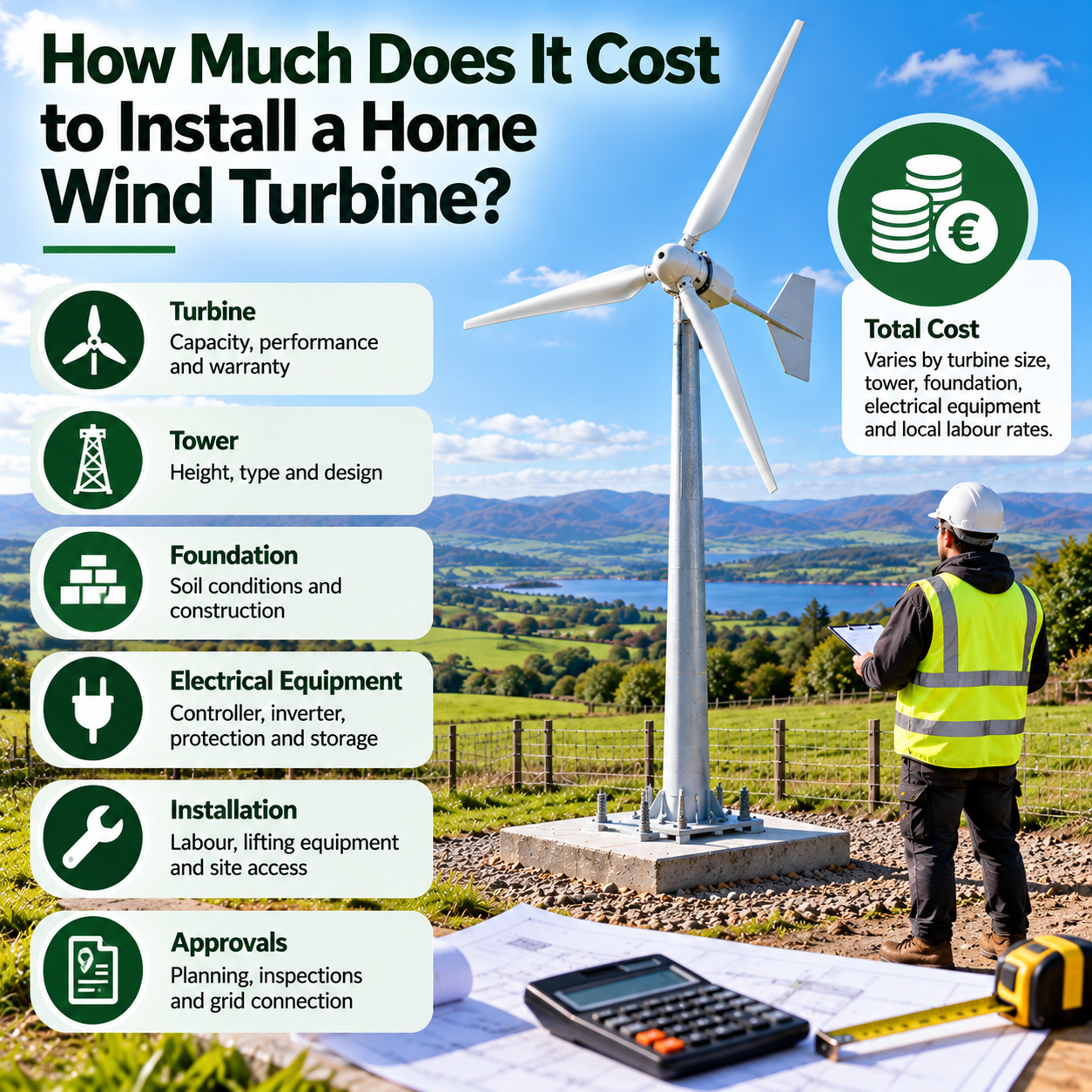
Home wind turbine installation costs vary considerably depending on the turbine, tower, foundation, electrical equipment and local labour rates.
A low-cost turbine kit does not necessarily mean a low-cost completed installation.
| Expense | What influences the cost? |
|---|---|
| Turbine | Capacity, performance, certification and warranty. |
| Tower | Height, material, design and lifting requirements. |
| Foundation | Soil conditions, structural design and construction. |
| Electrical equipment | Controllers, inverters, protection and storage. |
| Installation | Labour, site access and lifting machinery. |
| Approvals | Planning, inspections and network connection. |
As a historical reference, the US Department of Energy has reported an average installed cost of approximately $5,120 per kW for a small sample of US small-wind projects completed in 2021.
This is not a current 2026 quotation. Prices differ substantially between regions and individual installations.
Always obtain itemised local quotations before committing to a project.
Example: Calculating the Value of Wind Electricity
Suppose a turbine generates 3,000 kWh annually and the electricity used on-site is worth €0.25 per kWh.
3,000 kWh × €0.25 = €750 gross annual electricity value.
This example is illustrative rather than a production forecast. It excludes maintenance, financing, replacement parts, energy losses and any differences between electricity used on-site and exported to the grid.
Actual financial returns depend heavily on wind conditions and the completed installation cost.
7. Common Home Wind Turbine Installation Mistakes
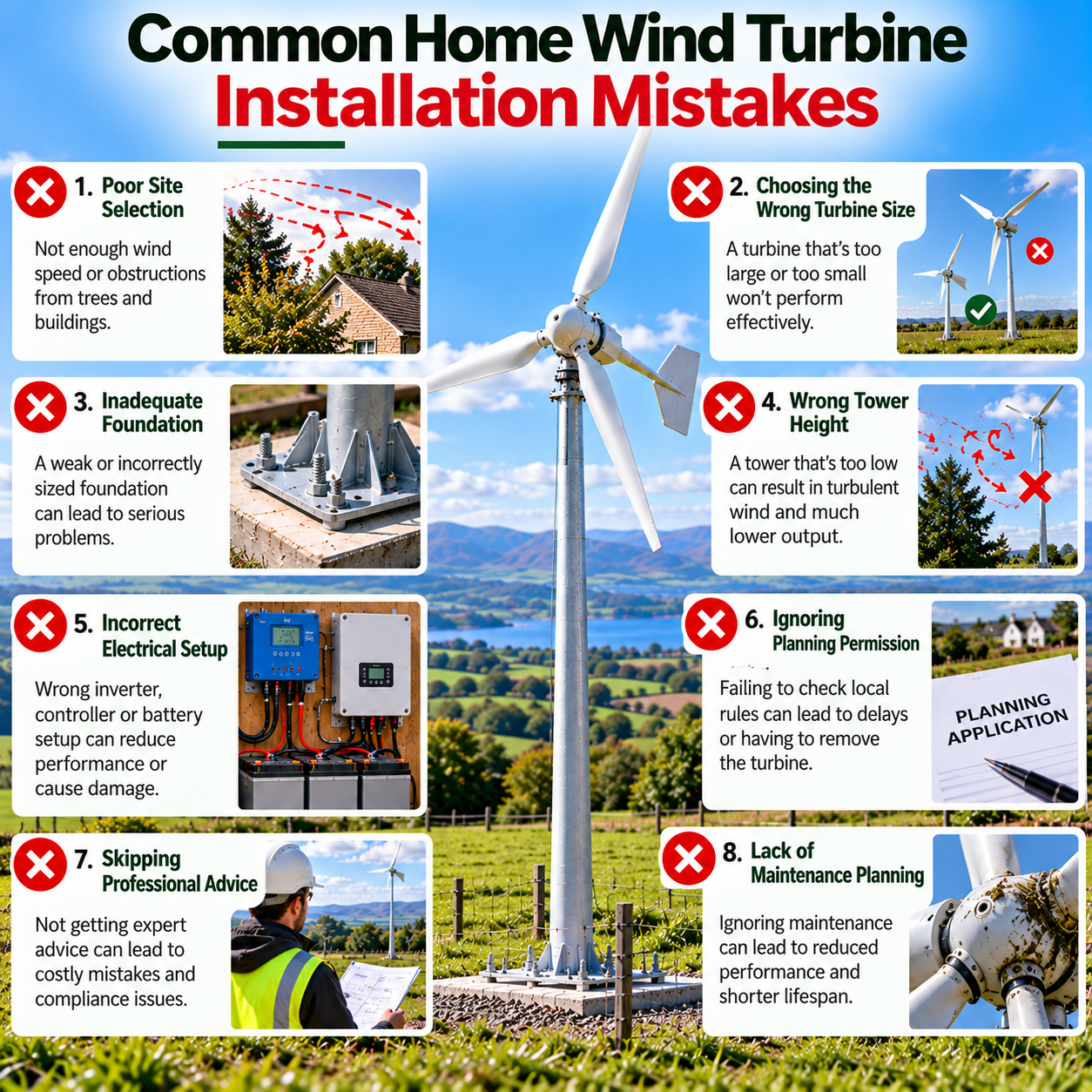
Even a good turbine may perform poorly when installed in the wrong location or connected to unsuitable equipment.
- Installing too close to buildings: Turbulence can reduce generation and increase wear.
- Using a tower that is too low: The rotor may not reach stronger, smoother wind.
- Choosing by rated wattage alone: Annual energy output is more useful than maximum advertised power.
- Ignoring planning restrictions: Permission problems can delay or prevent installation.
- Buying incompatible electrical equipment: Controllers, inverters and batteries must be properly matched.
- Underestimating structural loads: Towers and foundations require suitable engineering.
- Forgetting maintenance: Moving parts and exposed structures require regular inspection.
- Assuming DIY is always cheaper: Specialist lifting and electrical work can make professional installation more practical.
8. Maintaining a Home Wind Turbine
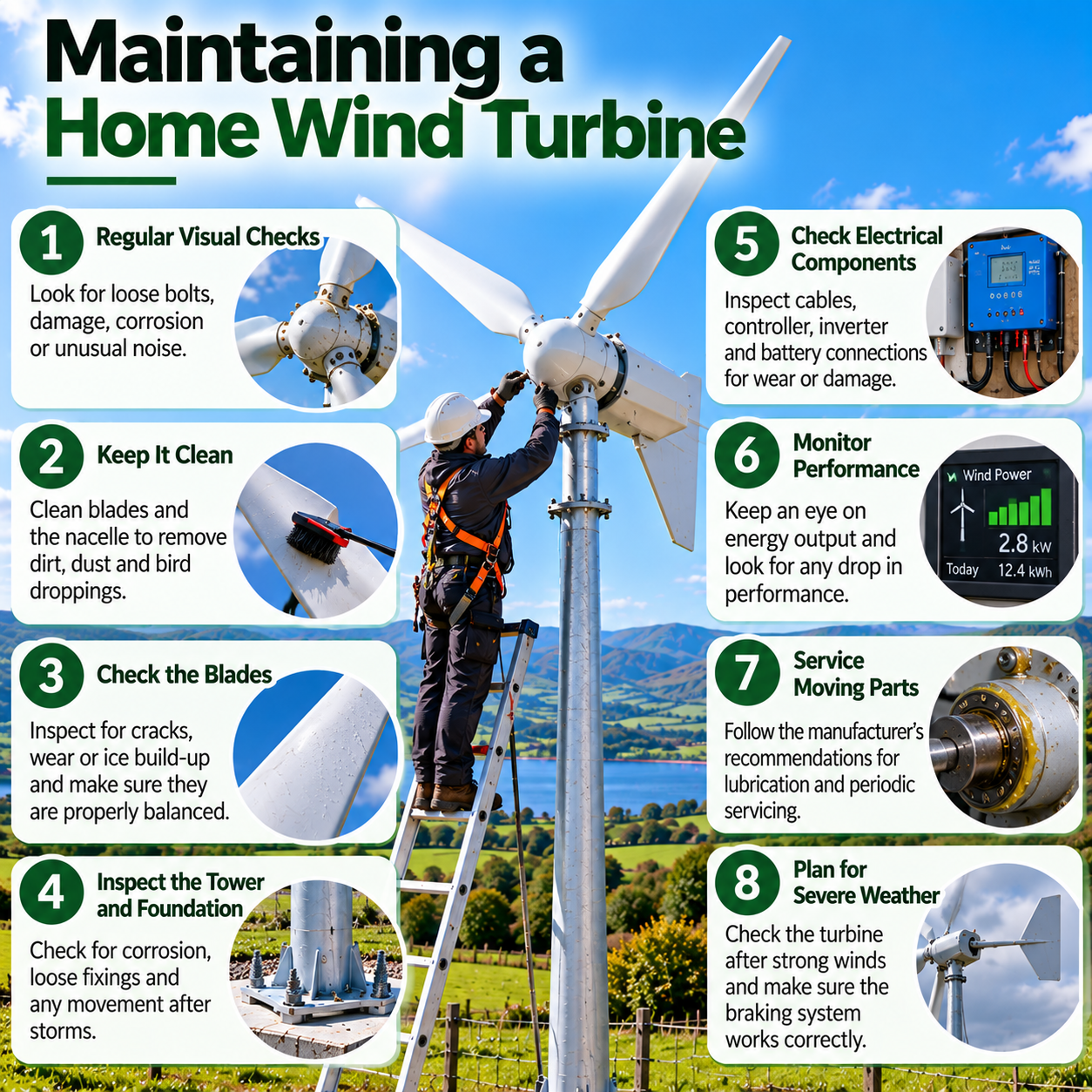
Regular maintenance helps protect the turbine, support reliable generation and identify problems before they become serious.
Follow the manufacturer’s maintenance schedule, which may include checking:
- Rotor blades for damage or erosion.
- Tower connections and corrosion.
- Guy wires and anchors where applicable.
- Braking and control equipment.
- Electrical connections and protective devices.
- Bearings and other serviceable components.
- Monitoring records for unusual performance changes.
Inspections involving tower access, moving machinery or electrical exposure should be carried out by competent personnel using approved safety procedures.
9. Should You Install a Home Wind Turbine Yourself?
Some experienced property owners may be able to assist with limited non-specialist preparation work, subject to the approved installation plan.
However, tower erection, structural assembly, lifting operations and electrical connections require specialist knowledge.
Professional installation is strongly recommended for substantial towers, grid-connected systems, complex battery arrangements and challenging locations.
Before hiring an installer, ask about experience with your chosen turbine model, insurance, structural design, commissioning and maintenance support.
Frequently Asked Questions
Can I install a wind turbine in my garden?
Possibly, but it depends on wind exposure, available space, planning restrictions and the proposed tower. Small sheltered gardens are often unsuitable for efficient wind generation.
How high should a home wind turbine be installed?
The correct height depends on surrounding obstacles, wind conditions, structural requirements and planning regulations. A professional site assessment should determine the final tower height.
Do home wind turbines need batteries?
Not always. Grid-connected turbines may operate without batteries, while off-grid systems generally require storage or another suitable method of managing electricity supply and demand.
How do you connect a wind turbine to your house?
A wind turbine is connected through suitable control, power-conditioning and protection equipment. The arrangement depends on whether the installation is grid-connected or off-grid and should be designed and installed by qualified professionals.
Can I connect a wind turbine to my solar inverter?
Only if the complete configuration is explicitly supported by the relevant manufacturers and system design. Most ordinary solar inputs should not be treated as direct wind turbine connections.
Can a small wind turbine power an entire house?
It may be possible at suitable locations with appropriately sized equipment. However, generation varies with wind conditions, so annual demand and expected production must be carefully compared.
How long does a home wind turbine last?
A well-designed and maintained turbine may operate for 20 years or longer, although individual components can require servicing or replacement sooner. Lifespan depends on equipment quality, site conditions and maintenance.
Final Thoughts: Is a Home Wind Turbine Worth Installing?
Understanding how to install a home wind turbine is only part of the decision. The most important question is whether the turbine can generate enough useful electricity at your property to justify its total cost.
A successful installation begins with reliable wind data, realistic energy estimates, appropriate tower height and properly designed electrical equipment.
For exposed rural homes, farms and suitable off-grid properties, small wind generation may provide a useful addition to an existing energy system.
For sheltered locations with limited wind, solar panels or energy-efficiency improvements may offer better value.
Explore More Home Wind Energy Guides
Continue researching your options with our related guides:
At Home-Energy-Systems.COM, we help homeowners and rural property owners make informed decisions about renewable energy, backup power and off-grid living.
Sources and Further Reading
Editorial note: This guide provides general educational information. Planning requirements, electrical codes and installation procedures vary by location. Always follow applicable regulations, approved engineering designs and manufacturer instructions.