Home Wind Turbines: The Complete Guide to Wind Energy at Home
When most people think about generating renewable energy at home, home wind turbines come after solar panels because they are probably the first thing that comes to mind. But there is another source of clean energy passing many homes every day: wind.
A home wind turbine can convert that wind into electricity, providing another way to reduce dependence on the grid and generate renewable energy on your own property.
For the right home, farm or rural property, a small wind turbine can work alongside solar panels, battery storage and other renewable technologies to create a more complete home energy system.
However, wind power isn’t suitable for every property. The amount of wind available, turbine location, tower height, surrounding buildings and trees, local regulations and installation costs can all make an enormous difference.
This guide explains how home wind turbines work, how much electricity they can produce, what they cost and, most importantly, how to decide whether installing one actually makes sense for your home.
What Is a Home Wind Turbine?
A home wind turbine is a relatively small wind-powered generator designed to produce electricity for a house, farm, workshop, cabin or other private property.
Although it works on the same basic principle as the enormous turbines found in commercial wind farms, a residential turbine is considerably smaller.
Wind pushes against the turbine blades, causing them to rotate. This rotational energy drives a generator, which converts the mechanical energy into electrical energy that can then be used as part of the property’s electrical system.
Depending on the installation, the electricity may be:
- Used immediately within the home.
- Stored in a home battery system for later use.
- Used as part of an off-grid energy system.
- Combined with electricity generated by solar panels.
- Exported to the electricity grid where local regulations and utility arrangements permit it.
This flexibility is one reason small wind turbines can be particularly interesting for rural and off-grid properties.
How Do Home Wind Turbines Work?
The basic idea behind wind generation is surprisingly straightforward.
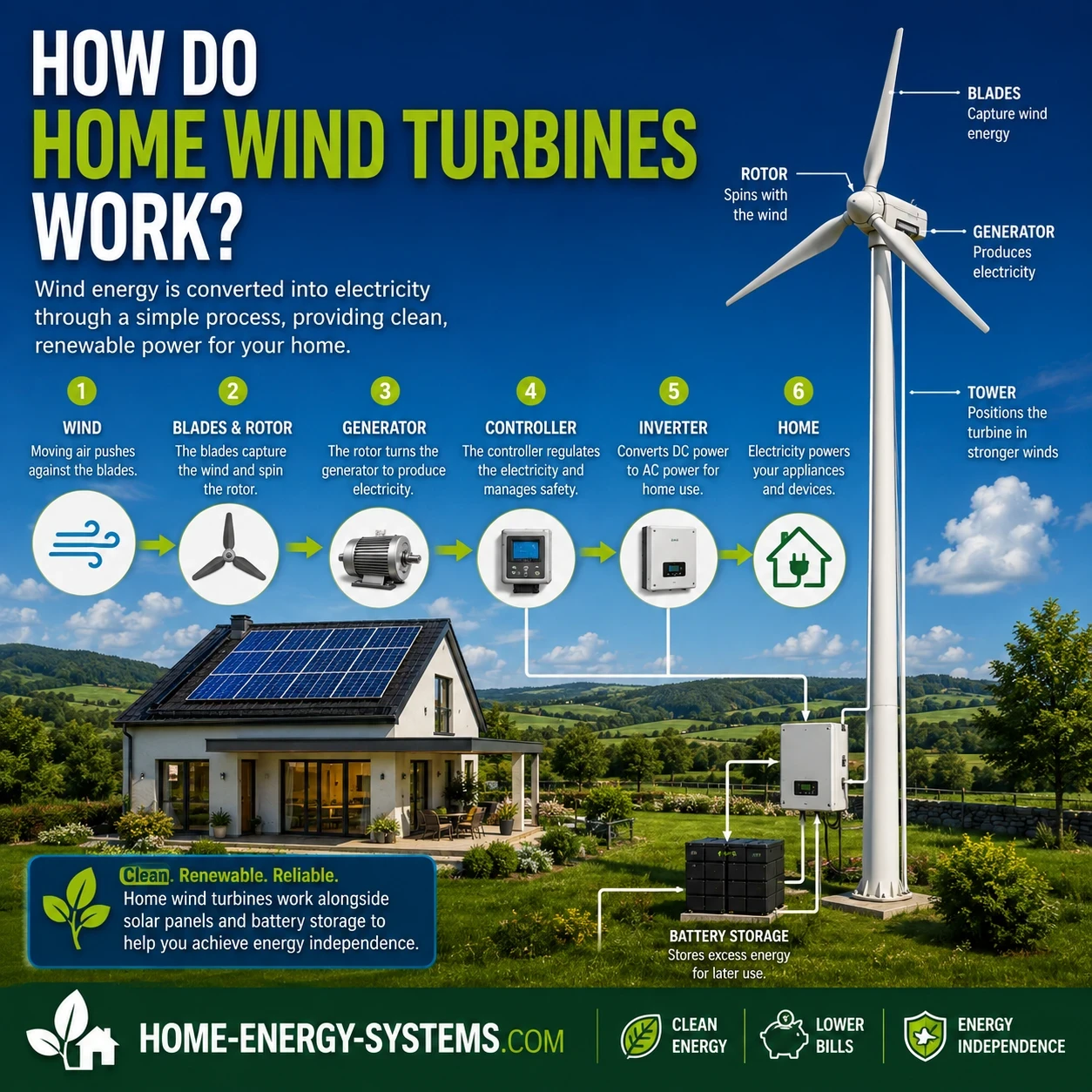
Moving air contains kinetic energy. When wind passes across the turbine blades, aerodynamic forces cause the rotor to turn. The spinning rotor transfers mechanical energy to a generator, which produces electricity.
A typical home wind energy system may include:
- Turbine blades to capture energy from the wind.
- A rotor that turns as the blades move.
- A generator that converts rotation into electricity.
- A tower or mounting system that positions the turbine where it can access stronger, cleaner airflow.
- A controller that helps manage the electricity produced.
- An inverter where required to provide electricity suitable for household equipment.
- Battery storage when electricity needs to be stored for later use.
The exact equipment depends on whether the turbine is being used in a grid-connected, off-grid or hybrid system.
This is also where wind energy begins to overlap with technologies we’ve already covered at Home-Energy-Systems.com.
A property could, for example, generate electricity from solar panels during bright daytime conditions while the wind turbine continues generating when suitable winds arrive later in the day or overnight.
Can a Wind Turbine Really Power a Home?
Yes, but there is an important catch.
Asking whether a home wind turbine can power a house is a little like asking whether solar panels can power a house. The answer depends on the size of the system, the property’s electricity consumption and the amount of renewable energy actually available at that location.
A small turbine installed in an exposed, consistently windy location could generate considerably more electricity than the same turbine installed behind a house surrounded by trees.
That’s why the turbine’s advertised power rating should never be treated as the amount of electricity it will continuously produce.
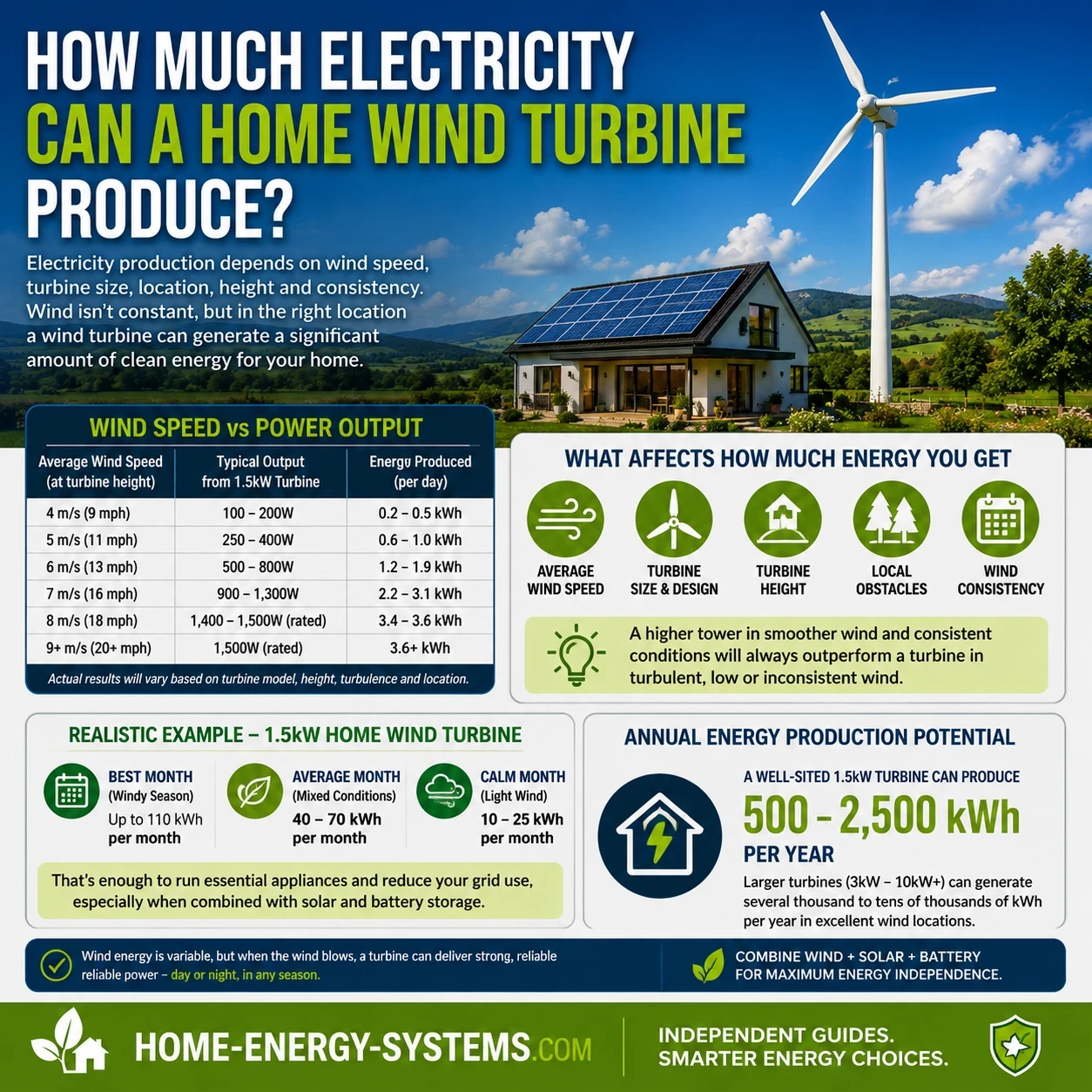
A turbine rated at 1,500 watts, for example, does not normally generate 1,500 watts every hour of every day. Its actual output changes with wind speed and operating conditions.
For some homeowners, a wind turbine may provide only part of their electricity. For others, particularly those with excellent wind resources and carefully designed systems, wind can make a much larger contribution.
And for an off-grid energy system, the objective doesn’t necessarily have to be powering the entire property from wind alone.
Wind can become another source of generation alongside solar, batteries and, where necessary, backup generation.
How Much Electricity Can a Home Wind Turbine Produce?
This is one of the most important questions to answer before buying a turbine — and one of the easiest areas in which to have unrealistic expectations.
The electricity produced by a home wind turbine depends on several factors, including:
- Average wind speed at the turbine location.
- Turbine rotor diameter.
- Tower or mounting height.
- Turbulence caused by buildings and trees.
- The turbine’s power curve and efficiency.
- Local terrain.
- Seasonal weather patterns.
- Electrical and system losses.
Wind speed is particularly important because the energy available in wind increases very rapidly as wind speed rises.
This means a relatively small difference in average wind conditions can produce a surprisingly large difference in annual electricity generation.
It also explains why simply mounting a small turbine on a roof doesn’t automatically make it an effective source of household electricity.
Rated Power vs Real-World Energy Production
When comparing home wind turbines, you’ll commonly see ratings such as 400W, 600W, 1kW, 1.5kW or considerably larger.
These figures are useful for comparing equipment, but they don’t tell you how much energy the turbine will produce over an entire year.
The rated output is generally achieved only under particular wind conditions specified by the manufacturer.
What homeowners really need to estimate is annual energy production, usually measured in kilowatt-hours (kWh).
For example, two homeowners could purchase identical turbines but receive very different results because one turbine is installed on open, elevated land while the other is positioned in turbulent airflow near buildings and trees.
Home Energy Systems Tip:
Don’t choose a home wind turbine based on its maximum wattage alone. Understanding the wind resource at your property is far more important than simply buying the biggest turbine you can afford.
What Size Wind Turbine Do You Need?
There isn’t one ideal wind turbine size for every home.
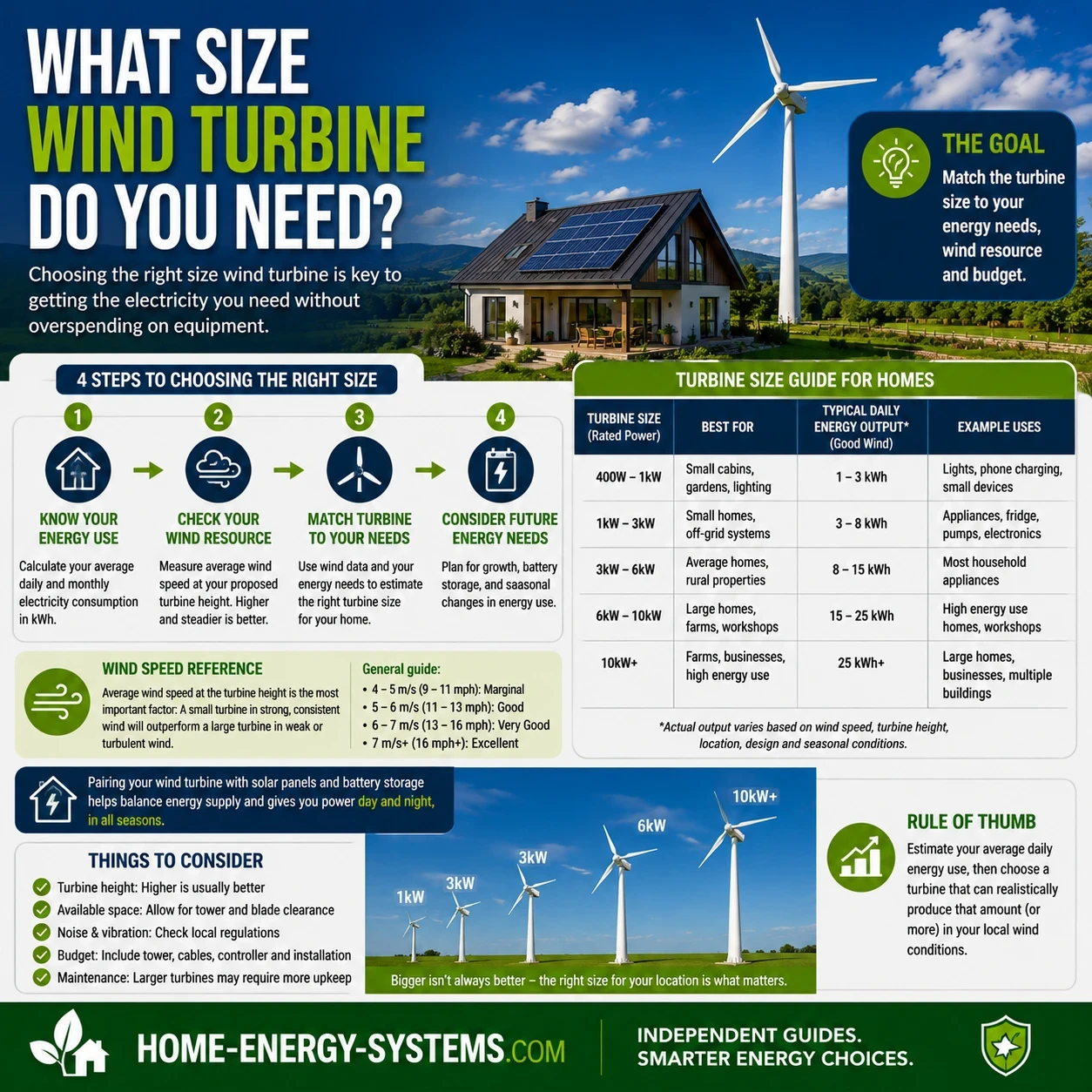
The right size depends on what you’re trying to achieve.
A smaller turbine might be used to supplement another renewable energy source, maintain battery charge or provide electricity for a modest off-grid application.
A homeowner hoping to make a significant contribution toward the electricity consumption of an entire house will generally require a substantially larger and better-sited system.
Before choosing a turbine, consider:
- Your average daily and annual electricity consumption.
- How much of that consumption you want wind power to cover.
- Whether solar panels will also generate electricity.
- Whether the system will include battery storage.
- The wind conditions available on your property.
- How much space is available for the turbine and tower.
- Your overall installation budget.
Looking at electricity consumption first is far more useful than starting with a turbine catalogue and trying to make the numbers fit afterwards.
Horizontal vs Vertical Home Wind Turbines
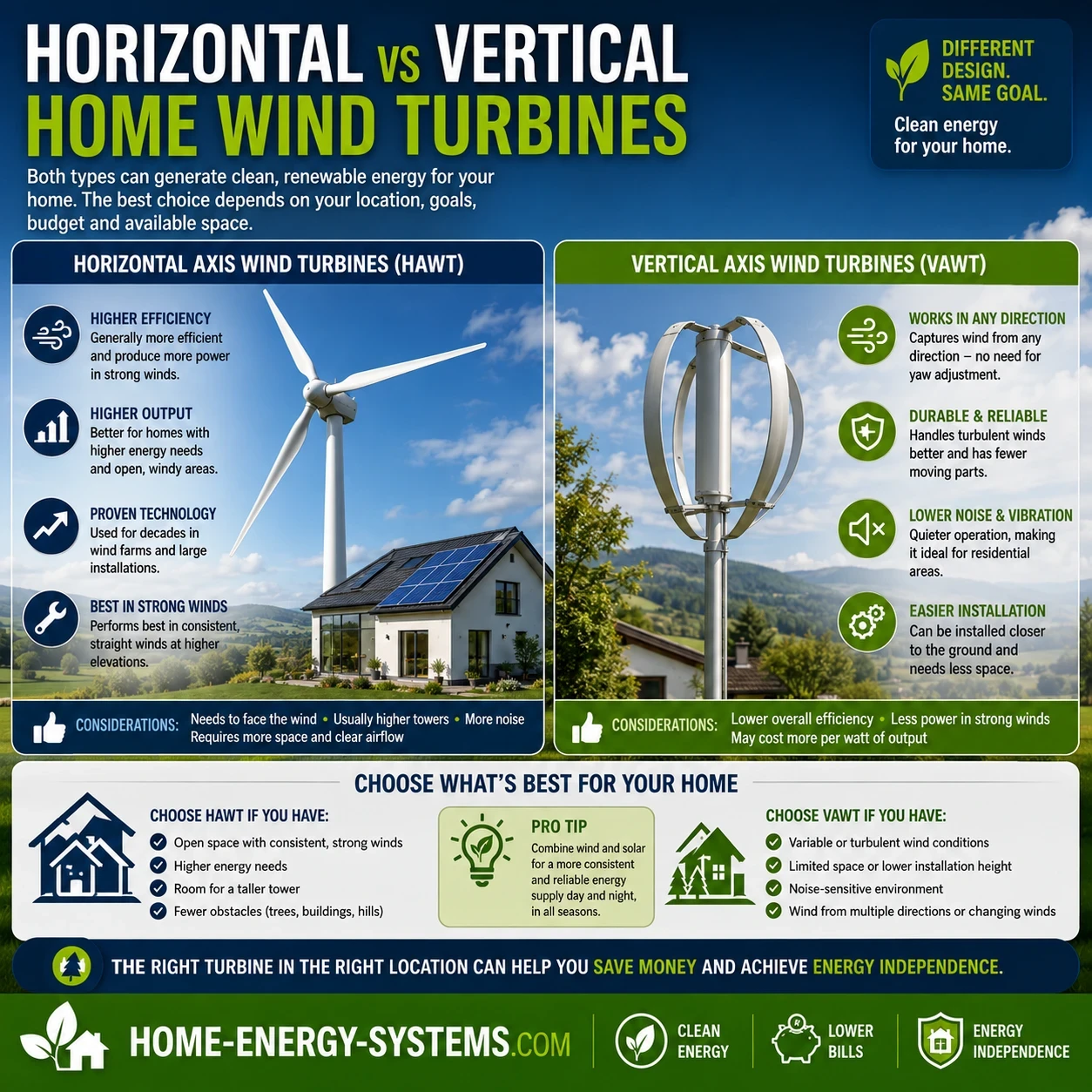
Homeowners researching wind power will quickly encounter two main designs: horizontal-axis wind turbines (HAWTs) and vertical-axis wind turbines (VAWTs).
Horizontal-Axis Wind Turbines
Horizontal-axis turbines are the familiar propeller-style design most people associate with wind energy.
The rotor turns around a horizontal axis, and the turbine normally needs to face into the wind. Small residential versions can range from compact battery-charging turbines to much larger systems capable of making a significant contribution to household electricity demand.
When installed in a good location with clean airflow, horizontal-axis turbines can be highly effective.
Vertical-Axis Wind Turbines
Vertical-axis turbines rotate around a vertical shaft. Their appearance can be dramatically different from traditional wind turbines, with some using curved or helical blades.
One attraction is that certain designs can accept wind from different directions without needing to turn the rotor toward the wind.
They are sometimes marketed for homes and built-up environments, but homeowners should be cautious about assuming that a compact vertical turbine will automatically perform well simply because it can fit on a roof or beside a building.
The available wind resource still matters enormously.
Which Type Is Better for a Home?
For many properties with enough open space, a correctly sized horizontal-axis turbine positioned high enough to reach relatively unobstructed airflow may provide the stronger option.
Vertical-axis turbines can have advantages in particular applications, but the decision shouldn’t be based on appearance or convenience alone.
Before buying either design, compare its independent performance information, rated wind speed, cut-in speed, expected annual output, warranty and installation requirements.
And perhaps most importantly, look carefully at where the turbine will actually be installed.
That’s what we’ll examine next, because when it comes to home wind energy, location can make the difference between a useful renewable-energy system and an expensive ornament.
Is Your Property Suitable for a Home Wind Turbine?
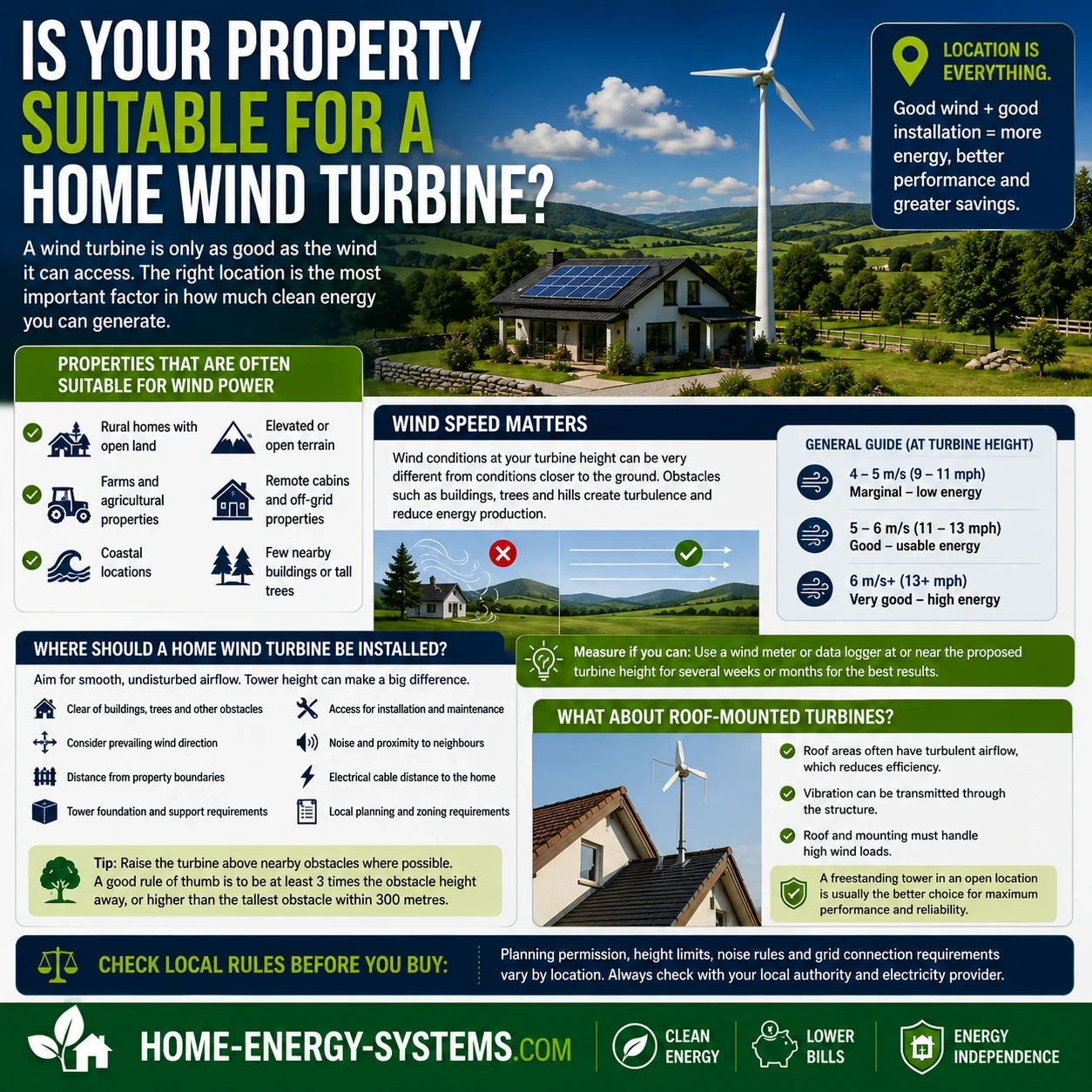
Before comparing turbine prices or deciding how large a system you need, there is a more important question: do you actually have enough usable wind?
A good wind turbine installed in a poor location can produce disappointing results, while a properly selected turbine installed in an exposed location with consistent wind can be a completely different story.
Properties that may be particularly suitable for home wind energy include:
- Rural homes with plenty of open land.
- Farms and agricultural properties.
- Exposed coastal properties.
- Homes on elevated or open terrain.
- Remote cabins and off-grid properties.
- Locations with few nearby buildings or tall trees.
Suburban and urban properties can be more challenging because buildings, trees and other obstacles disturb airflow and create turbulence. That doesn’t automatically rule out wind power, but it makes proper assessment particularly important.
Wind Speed Matters More Than You Might Think
One of the biggest mistakes when considering a home wind turbine is assuming that a location is suitable simply because it often feels windy. What matters is the wind available at the actual turbine position and height.
Wind conditions close to ground level can be very different from conditions higher above the property. Buildings, hedges, trees, hills and other obstacles can slow the wind and create turbulent airflow. Turbulence not only reduces energy production but can also place additional mechanical stress on a turbine.
For a larger home installation, measuring wind conditions at or near the proposed turbine location over an extended period can provide much better information for estimating potential energy production.
Understanding Cut-In and Rated Wind Speed
When looking at turbine specifications, you’ll often see terms such as cut-in wind speed and rated wind speed. The cut-in speed is approximately the wind speed at which the turbine begins producing usable electricity, while the rated wind speed is the wind speed at which the turbine is designed to reach its stated rated output.
These figures are not the same thing. A turbine may begin generating in a relatively light breeze but still need considerably stronger wind before reaching its advertised maximum output.
That’s why a headline such as “1500W Wind Turbine” doesn’t mean the turbine continuously supplies 1,500 watts.
Where Should a Home Wind Turbine Be Installed?
Generally, a home wind turbine performs best where it can access smooth, unobstructed airflow. Open areas are preferable to locations surrounded by buildings and trees.
Tower height can therefore be extremely important. Raising a turbine above nearby obstacles may expose it to stronger and less turbulent wind. However, tower requirements vary considerably between systems, and any structure must be properly designed and installed to withstand the forces involved.
Before choosing a location, consider:
- The height of nearby buildings and trees.
- Prevailing wind direction.
- Distance from property boundaries.
- Tower foundation and support requirements.
- Access for installation and future maintenance.
- Noise and proximity to neighbours.
- Electrical cable distance to the home or battery system.
- Local planning, zoning and building requirements.
What About Roof-Mounted Wind Turbines?
The idea of putting a compact turbine on the roof can be attractive. It saves ground space and appears to place the turbine higher in the air. But roof-mounted turbines need particularly careful consideration.
Air flowing around and over a building can become highly turbulent. The turbine may also transmit vibration through the structure, while the roof and mounting system must be capable of handling the additional mechanical loads.
For these reasons, a freestanding tower in a suitable open location may sometimes provide better operating conditions than simply mounting a turbine to the highest convenient point on a house. Always follow the turbine manufacturer’s installation requirements and obtain professional structural or electrical advice where appropriate.
How Much Does a Home Wind Turbine Cost?
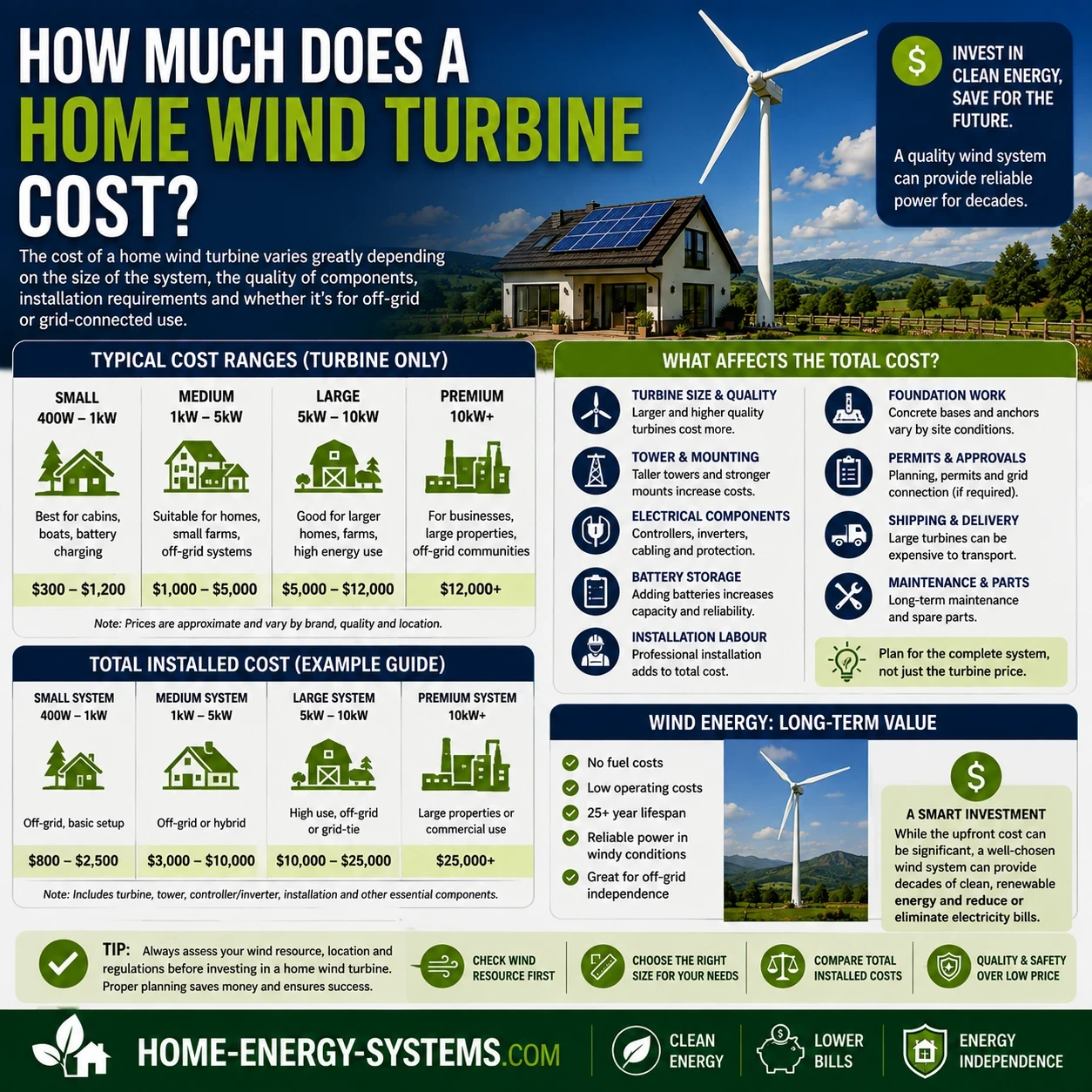
The cost of home wind energy varies enormously. A small turbine designed primarily for battery charging can cost relatively little compared with a substantial residential turbine installed on a dedicated tower.
The turbine itself is also only one part of the total cost. A complete installation may require:
- The wind turbine.
- Tower and mounting hardware.
- Foundation work.
- Charge controller or other control equipment.
- An appropriate inverter.
- Battery storage where required.
- Electrical cabling and protection equipment.
- Professional installation.
- Planning or permitting costs.
- Grid-connection equipment where applicable.
As a result, comparing home wind turbines purely by their online purchase price can be misleading. A lower-cost turbine that requires substantial tower, foundation and electrical work may ultimately cost considerably more to install than expected.
Are Affordable Home Wind Turbines Worth Considering?
There are many affordable home wind turbines available, particularly in the smaller power categories. Some can be useful for applications such as battery charging, cabins, workshops, boats, remote equipment or supplementing an existing renewable-energy system.
But inexpensive turbines should be assessed carefully. Before buying, look beyond the advertised wattage and check:
- The wind speed required to achieve rated output.
- Rotor diameter.
- Power curve information where available.
- Controller compatibility.
- Voltage requirements.
- Weather protection.
- Overspeed protection.
- Warranty.
- Availability of replacement parts.
- Manufacturer and supplier support.
A turbine that looks inexpensive initially isn’t necessarily good value if it produces very little electricity at your location or becomes difficult to repair.
Planning Permission and Local Regulations
Planning and permitting requirements for home wind turbines vary considerably between countries and even between local authorities within the same country. Rules may cover turbine height, tower position, distance from neighbouring properties, noise, visual impact, electrical connections and environmental considerations.
Never assume that because a small wind turbine is available to purchase online it can automatically be installed wherever you want. Before purchasing a substantial system, check with your relevant local planning or building authority and, for grid-connected systems, your electricity network or utility provider.
Before You Buy:
Check the wind resource, installation location and local regulations before choosing a turbine. Buying the equipment first and figuring out where it can go afterwards can become an expensive mistake.
Home Wind Turbine Installation
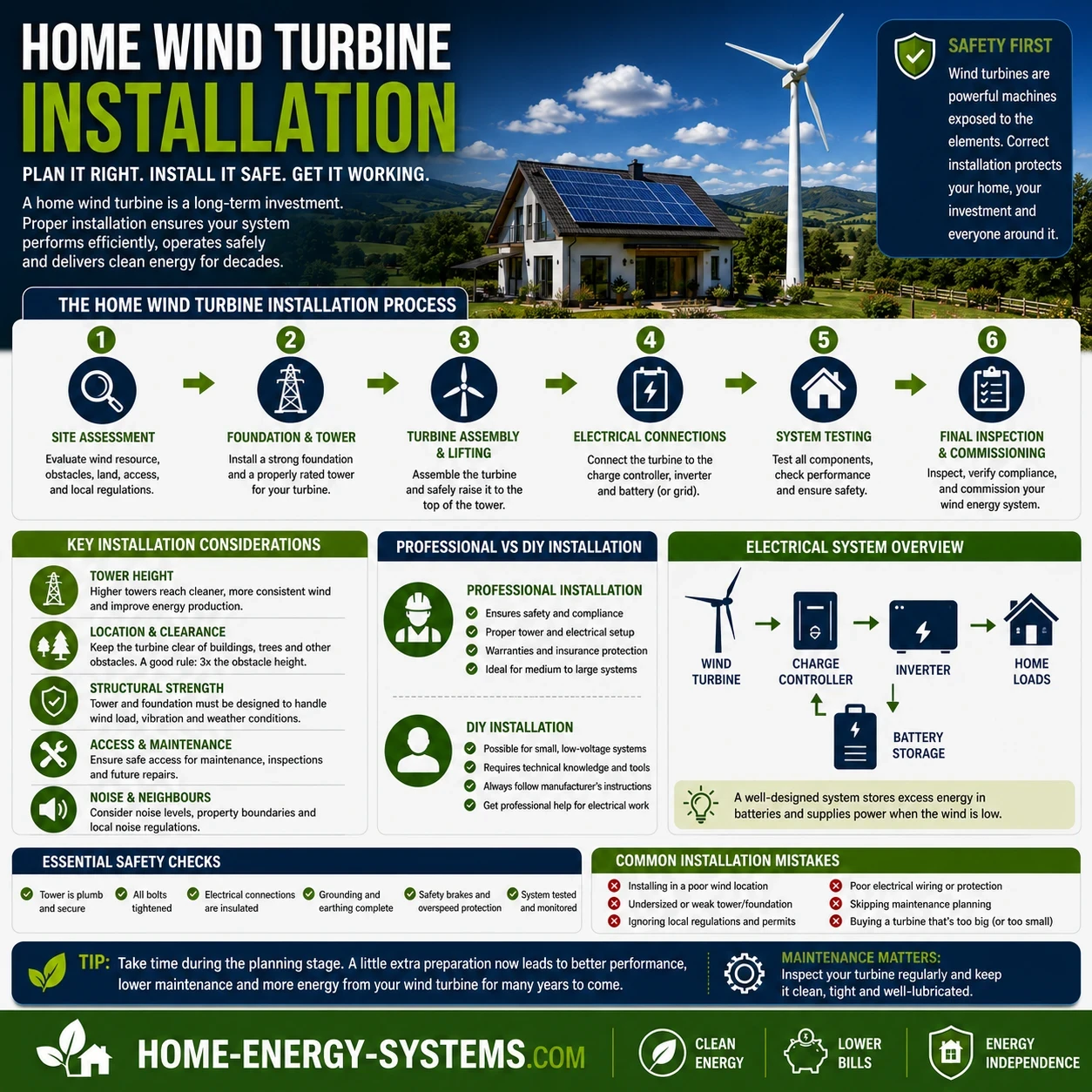
Small renewable-energy products can sometimes make home energy generation look deceptively simple. A substantial home wind turbine is different. The installation has to deal with a moving machine exposed to wind, weather and significant mechanical forces.
Depending on the size and type of system, professional installation may involve:
- Assessing the proposed turbine location.
- Designing or installing the foundation.
- Erecting the tower.
- Installing the turbine safely.
- Running appropriately sized electrical cabling.
- Installing isolation and protection equipment.
- Connecting controllers, batteries and inverters.
- Commissioning and testing the system.
Grid-connected installations may have additional electrical and regulatory requirements. DIY installation may be possible with some smaller systems, particularly those intended for low-voltage battery charging, but users should follow the manufacturer’s instructions closely and use qualified professionals for work requiring electrical, structural or other specialist expertise.
Wind Turbine + Solar Panels: A Powerful Combination
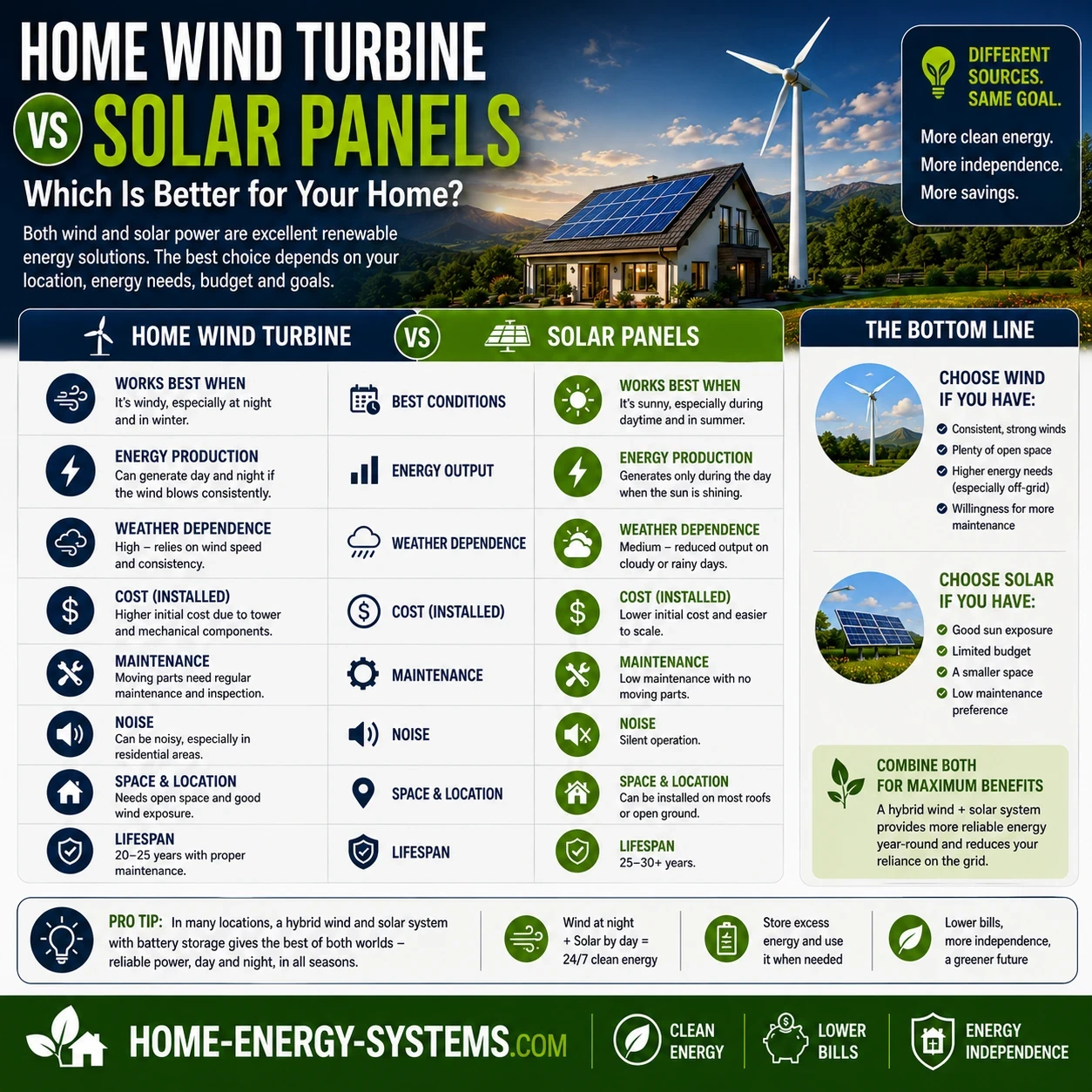
This is where home wind energy gets particularly interesting. You don’t necessarily have to choose between a home wind turbine and solar panels — the two technologies can complement each other.
Solar generation is strongest during daylight hours and generally performs best during sunnier periods. Wind generation depends on wind conditions and can continue after sunset or during weather conditions when solar production is reduced.
That doesn’t mean wind always blows when the sun isn’t shining, but combining different renewable-energy sources can reduce reliance on a single source of generation.
Solar Panels + Wind Turbine → Controller / Inverter → Battery Storage → Home
During suitable conditions, solar panels and the wind turbine generate electricity. The home can use that energy immediately, while surplus generation may be stored in batteries where the system is designed to do so. When renewable generation falls, stored electricity can then help supply the property’s loads.
Why Wind Can Be Useful for Off-Grid Homes
This combination can be especially valuable for people building a more resilient off-grid energy system.
A solar-only system may need enough battery capacity to carry the property through periods of poor solar generation. Adding a suitable wind turbine introduces another potential charging source.
Imagine several cloudy days when solar output is relatively low but the weather is windy. A wind turbine may continue putting energy into the system while the solar array produces less. During calm sunny weather, solar panels can take the lead.
The important word is may. The benefit depends entirely on the wind and solar resources available at the particular location.
Adding Battery Storage to a Home Wind Turbine
Wind doesn’t necessarily arrive at the same time you need electricity. That’s why home battery storage can play an important role in off-grid and hybrid wind systems.
Instead of wasting useful renewable generation when household demand is low, compatible batteries can store energy for later use.
A properly designed system may therefore use:
- Solar generation during suitable daylight conditions.
- Wind generation whenever wind conditions allow.
- Battery storage to balance generation and consumption.
- Grid electricity or a backup generator where required.
The turbine, controller, inverter and batteries must all be electrically compatible. Adding wind to an existing solar-and-battery installation shouldn’t simply involve connecting another generator wherever there appears to be a spare terminal.
The complete system needs to be designed around voltage, charging limits, protection requirements and the capabilities of the individual components.
Could Wind and Solar Reduce the Battery Capacity You Need?
Potentially — but this needs careful modelling rather than assumptions. If wind generation reliably complements solar generation at a particular property, the combination may reduce the number or duration of periods when the batteries receive little renewable energy.
That could improve the overall resilience of an off-grid system, but installing a turbine doesn’t automatically mean you should buy a smaller battery.
Battery capacity should still be calculated from household electricity demand, expected renewable generation, desired backup duration and the worst conditions the system is reasonably expected to encounter.
Home Wind Turbine Maintenance
A home wind turbine contains moving components and operates outdoors in changing weather conditions, so some maintenance should be expected.
The amount of maintenance required varies between turbine designs and manufacturers, but regular inspection can help identify small problems before they become expensive ones.
Typical maintenance may include checking:
- Turbine blades for cracks, chips or other damage.
- Bolts, fasteners and mounting points.
- Tower condition and structural connections.
- Guy wires where used.
- Electrical connections and cabling.
- Bearings and other moving components.
- Braking and overspeed protection systems.
- Charge controllers and inverters.
- Battery condition in systems using energy storage.
Some components may eventually require replacement as the system ages.
This is worth considering when comparing turbines. A slightly more expensive turbine from a manufacturer offering replacement parts, technical support and a meaningful warranty may prove better value over its lifetime than a cheaper system with little after-sales support.
How Long Do Home Wind Turbines Last?
There isn’t one lifespan that applies to every home wind turbine.
Quality of construction, installation, local weather conditions, operating hours and maintenance all influence how long a system remains productive.
A well-designed and properly maintained turbine may provide many years of service, although individual components can require servicing or replacement during that period.
When comparing systems, don’t concentrate solely on the turbine’s purchase price.
Also investigate:
- Manufacturer warranty.
- Expected servicing requirements.
- Availability and cost of replacement blades.
- Replacement bearings and other mechanical parts.
- Controller availability.
- Technical support.
- Installer support in your region.
A home wind turbine is better viewed as a long-term energy system than as a simple appliance.
Advantages of Home Wind Turbines
For a suitable property, wind energy can provide some compelling advantages.
1. Renewable Electricity at Home
Once installed, the turbine uses the naturally available energy in moving air to generate electricity without consuming fuel during normal operation.
2. Generation Isn’t Limited to Daylight
Unlike solar panels, wind turbines don’t need sunlight.
If suitable wind is available, a turbine can generate electricity during the day or night.
3. Wind Can Complement Solar Power
One of the strongest arguments for residential wind may be using it alongside solar rather than treating the technologies as competitors.
A properly designed solar-wind hybrid system has two potential renewable sources instead of relying entirely on one.
4. Particularly Interesting for Rural Properties
Farms, rural homes and properties with large areas of exposed land can sometimes offer much better turbine locations than densely built-up areas.
They may also have greater electricity requirements for workshops, pumps, outbuildings and other equipment.
5. Useful for Off-Grid Energy Systems
For an off-grid property, every reliable source of renewable generation can help.
Wind can supplement solar and charge compatible battery storage when conditions are favourable.
Disadvantages of Home Wind Turbines
Wind energy also has disadvantages, and they shouldn’t be hidden behind optimistic claims about free electricity.
1. Wind Conditions Are Highly Location-Dependent
A turbine that performs extremely well on one property may perform poorly only a short distance away.
Buildings, trees, hills and other obstacles can dramatically affect airflow.
2. Installation Can Be More Complicated Than Expected
A serious residential turbine may require a tower, foundations, electrical work and specialist installation.
That can make the total project substantially more expensive than the turbine’s advertised purchase price.
3. Moving Parts Require Maintenance
Solar panels have no moving parts during normal operation. Wind turbines do.
Bearings, blades, braking systems and other components can therefore require inspection and eventual servicing.
4. Planning and Neighbour Considerations
Tower height, visual impact, noise and proximity to neighbouring properties can affect whether an installation is practical or permitted.
5. Output Is Variable
Just as solar production changes with sunlight, wind generation changes with wind speed.
A turbine shouldn’t be treated as a source of constant rated power.
Home Wind Turbine vs Solar Panels
Wind power is more dependent on very local conditions. Wind speed, turbine height and nearby obstacles can make a major difference to performance.
Energy Source
☀️ Solar Panels: Generate electricity from sunlight.
💨 Home Wind Turbine: Generates electricity from wind.
Night Generation
☀️ Solar Panels: Do not generate electricity at night.
💨 Home Wind Turbine: Can continue generating at night when sufficient wind is available.
Moving Parts
☀️ Solar Panels: Generally have no moving parts.
💨 Home Wind Turbine: Contains rotating and mechanical components.
Maintenance
☀️ Solar Panels: Generally require relatively little maintenance.
💨 Home Wind Turbine: Usually requires more regular inspection and maintenance.
Location Sensitivity
☀️ Solar Panels: Roof or ground orientation, sunlight and shading are important.
💨 Home Wind Turbine: Wind speed, turbine height, surrounding obstacles and turbulence are critical.
Hybrid Potential
☀️ Solar Panels: Work extremely well with battery storage and can be combined with wind generation.
💨 Home Wind Turbine: Can complement solar generation and help charge battery storage when suitable wind is available.
So Which Is Better?
For many homes, solar panels will be the simpler renewable-energy option. But for an exposed rural property with a strong wind resource, a home wind turbine can provide something solar cannot — the potential to generate electricity after sunset and during periods of poor solar production.
For the right property, therefore, the answer doesn’t necessarily have to be wind or solar.
Wind + Solar + Battery Storage can provide a more diversified home energy system, with each technology helping when conditions suit it.
The interesting answer, therefore, isn’t always wind versus solar.
For the right property, it can be:
Wind + Solar + Battery Storage
Each part of the system can perform a different job.
Solar provides electricity when sunlight is available. Wind provides another opportunity for generation when conditions are suitable. Battery storage can save surplus electricity for periods when household demand exceeds renewable generation.
Are Home Wind Turbines Worth It?
A home wind turbine can be worth considering — but only when the property has a genuinely useful wind resource.
This is probably the single most important conclusion from this guide.
If your property has good exposure, adequate space and consistent wind, a turbine could make a valuable contribution to your electricity supply.
If your property is surrounded by buildings and mature trees with turbulent, inconsistent airflow, buying a turbine simply because its rated output looks impressive may lead to disappointment.
Before deciding whether a home wind turbine is worth the investment, consider four things:
- Your wind resource – Is there sufficient usable wind at the proposed turbine height?
- Your electricity consumption – How much energy are you actually trying to generate?
- Total installed cost – Include the tower, electrical equipment, installation and maintenance rather than looking only at the turbine price.
- Expected annual generation – Estimate realistic kWh production rather than relying on maximum wattage.
From there, you can estimate the potential value of the electricity produced and compare it with the complete cost of owning the system.
Who Should Consider a Home Wind Turbine?
Residential wind is particularly worth investigating if you:
- Live in a consistently windy rural or exposed location.
- Have enough land for a properly positioned turbine.
- Own a farm or rural business with suitable open space.
- Are building an off-grid home energy system.
- Already have solar and want another renewable generation source.
- Want to charge battery storage from more than one renewable source.
- Have checked that local regulations allow an appropriate installation.
Someone living in a dense residential neighbourhood may find that investing further in solar panels, energy efficiency or battery storage provides a simpler solution.
Common Home Wind Turbine Mistakes to Avoid
If you’re seriously considering wind power, avoid these common mistakes:
- Buying based solely on rated wattage. Maximum output doesn’t tell you annual energy production.
- Ignoring local wind conditions. Regional wind data is useful, but conditions at your turbine location matter most.
- Mounting the turbine in turbulent airflow. Nearby buildings and trees can seriously affect performance.
- Underestimating installation costs. Tower, foundation, cabling, controllers and professional installation can add considerably to the project.
- Ignoring maintenance. Wind turbines contain moving mechanical components that need attention over time.
- Buying before checking regulations. Establish what you are permitted to install before ordering expensive equipment.
- Assuming wind has to replace solar. For some properties, combining the two technologies can make considerably more sense.
Questions to Ask Before Buying a Home Wind Turbine
Before spending money, ask the manufacturer, supplier or installer:
- At what wind speed does the turbine begin generating?
- At what wind speed does it reach rated output?
- Is a complete power curve available?
- What annual energy production could reasonably be expected at my average wind speed?
- What tower height is recommended?
- What controller is included or required?
- Can the system work with my existing solar equipment?
- Which batteries and inverters are compatible?
- What happens during extremely high winds?
- What maintenance is required?
- How long is the warranty?
- Are replacement parts readily available?
Those answers are much more useful than choosing whichever product has the largest wattage printed in its advertisement.
Frequently Asked Questions About Home Wind Turbines
Can one wind turbine power an entire house?
Potentially, but it depends on household electricity consumption, turbine size and, most importantly, the wind resource available at the property. Many residential systems use wind as one part of the overall energy supply rather than expecting a small turbine to power everything continuously.
Can a home wind turbine generate electricity at night?
Yes. A wind turbine doesn’t require sunlight. If there is sufficient wind, it can generate electricity during the night, which is one reason wind can complement solar power.
Can I connect a wind turbine to my solar battery?
Wind and solar can charge the same battery-storage system when the system is specifically designed to accommodate both generation sources. Controllers, voltage, charging limits and protection equipment must all be compatible.
Do home wind turbines work in low winds?
Some turbines begin generating at relatively low wind speeds, but electricity production can remain modest until wind speed increases. Always distinguish between the turbine’s cut-in speed and the wind speed required to reach rated power.
Can I put a wind turbine on my roof?
Some turbines are designed or marketed for roof mounting, but buildings can create turbulent airflow and transmit turbine vibration into the structure. Structural suitability, performance and local regulations should all be investigated first.
Which is better: a vertical or horizontal wind turbine?
Neither design is automatically best for every situation. Horizontal-axis turbines are widely used and can perform well in clean, unobstructed airflow. Vertical-axis designs can offer advantages for particular applications, but actual performance at the proposed site should guide the decision.
Is a home wind turbine better than solar?
Not necessarily. Solar is likely to be the easier option for many homes, while wind can be particularly attractive for exposed rural and off-grid properties. In suitable locations, using wind and solar together may provide greater benefits than choosing one technology exclusively.
Final Thoughts: Is Wind Energy Right for Your Home?
A home wind turbine can be a fascinating addition to a modern home energy system, but successful residential wind generation begins with the location — not the turbine.
Good wind exposure, correct sizing, sensible installation and realistic expectations are far more important than simply choosing the turbine with the highest advertised output.
For homeowners with suitable conditions, wind power can provide renewable electricity during periods when solar generation is limited and can become particularly valuable when combined with solar panels and battery storage.
For properties without a good wind resource, putting the same investment into solar, storage or energy-efficiency improvements may produce better results.
That’s why the first step shouldn’t be buying a turbine.
First understand your wind. Then choose the system.
Ready to Compare Home Wind Turbines?
Our next guide looks at the best home wind turbines for 2026, including different turbine sizes, applications and the features worth comparing before you buy.
Coming next: Best Home Wind Turbines 2026 →
Continue Exploring Home Energy Systems
Wind power works best when considered as part of the bigger energy picture. These guides can help you plan the rest of your system:
- Off-Grid Solar Systems – Complete Guide
- Home Battery Storage Systems
- Solar Panels for Homes
- Top-Rated Solar Inverters
Home-Energy-Systems.com provides independent educational information about home energy technologies. Product performance and installation requirements vary, so always check manufacturer specifications and obtain appropriate professional advice before installing electrical or structural equipment.
Reference
https://www.google.com/url?sa=t&source=web&rct=j&opi=89978449&url=https://www.seai.ie/case-studies/dkit-small-wind-turbine-r&ved=2ahUKEwjs9vvrx5GWAxWiWUEAHa42OjoQFnoECC4QAQ&usg=AOvVaw10k6r7wsRLyn2NqseacVLv