Home Wind Energy • 2026 Guide
How Much Electricity Can a 5kW Wind Turbine Generate?
How much electricity can a 5kW wind turbine generate? At an illustrative 20% capacity factor, a 5kW turbine produces about 8,760 kilowatt-hours (kWh) a year—equivalent to 24kWh a day on average. Actual generation depends on wind speeds at the tower, the turbine’s power curve, downtime and electrical losses.
For homeowners comparing small wind systems, understanding realistic energy output matters far more than relying on the turbine’s advertised 5kW rating. This guide explains daily, monthly and annual generation, household coverage, potential savings and the conditions that make a 5kW installation worthwhile.
Quick Answer: 5kW Wind Turbine Output
Using a 20% capacity factor as a worked example:
Important: These are calculated examples, not guaranteed production figures. A sheltered or turbulent site may perform much worse.
1. How Much Electricity Can a 5kW Wind Turbine Generate?
A 5kW turbine has a rated power of 5 kilowatts, which is the output it can achieve at the wind speed specified by the manufacturer. It will not produce 5kW continuously. In light winds it may produce very little; in stronger winds its output rises until controls limit power or stop the turbine for safety.
Power is measured in kilowatts (kW). Energy generated over time is measured in kilowatt-hours (kWh). For example, producing 2kW for five hours generates 10kWh.
The absolute theoretical maximum for a 5kW turbine operating at full output for all 8,760 hours of a non-leap year is 43,800kWh. Real installations produce less because wind speeds fluctuate. That is why an estimate of annual kWh, rather than a headline kW rating, is essential when comparing equipment.
2. How Does Wind Speed Affect a 5kW Wind Turbine?
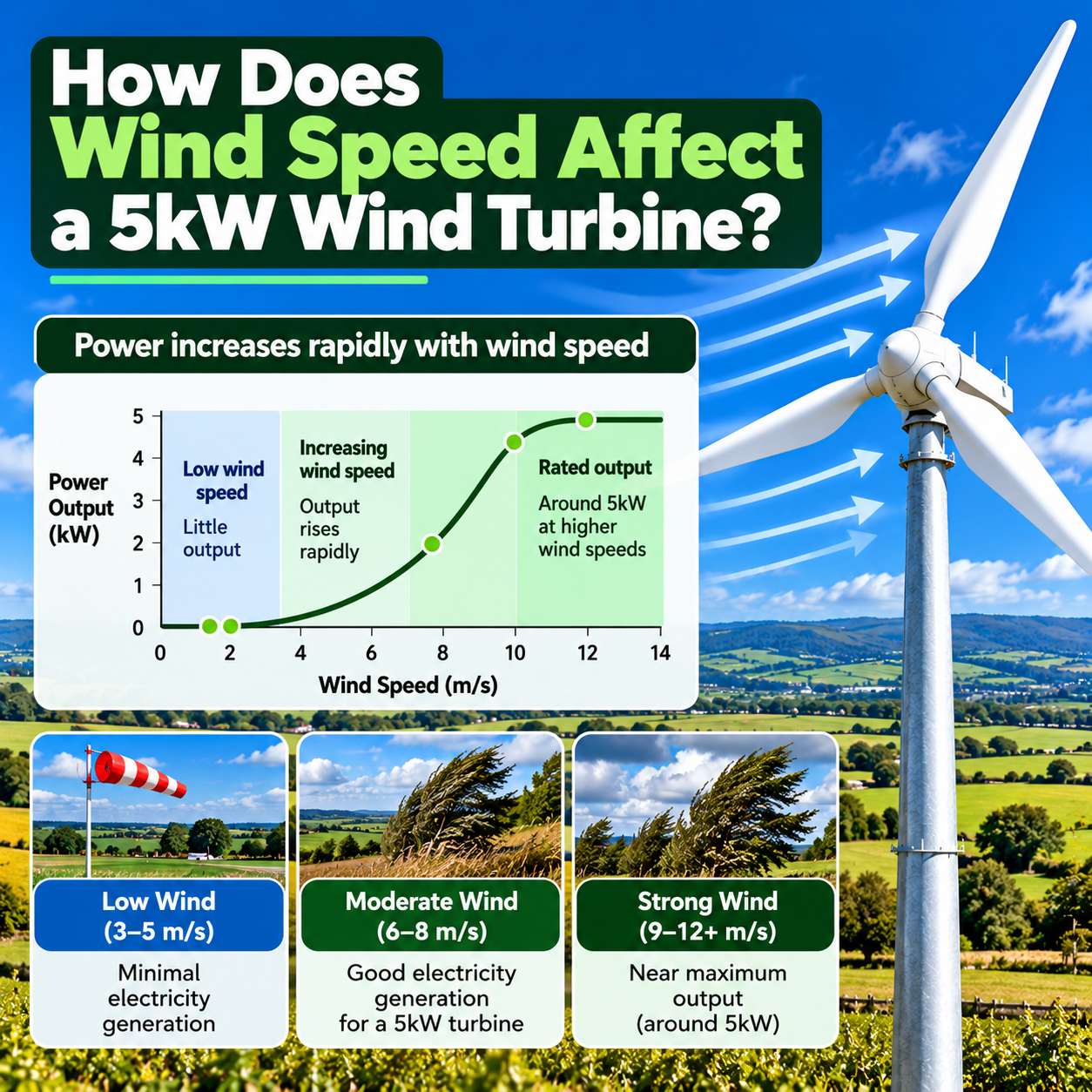
Wind speed has an outsized effect on electricity generation. The energy available in wind rises approximately with the cube of wind speed: doubling the wind speed increases the available wind power eightfold. The turbine cannot capture all of that energy, and its real output follows the manufacturer’s power curve.
- Below cut-in speed: The turbine typically produces no usable electricity.
- Above cut-in speed: Output rises as wind strengthens.
- Near rated speed: The machine can approach its advertised 5kW output.
- Very high winds: Braking or shutdown controls protect the equipment.
Two turbines both advertised as 5kW can produce very different annual totals. Rotor diameter, generator design, tower height and local turbulence matter. The US Department of Energy’s small wind systems guide explains why site wind conditions and turbine characteristics must be assessed together.
3. How Much Electricity Does a 5kW Wind Turbine Produce Per Day?
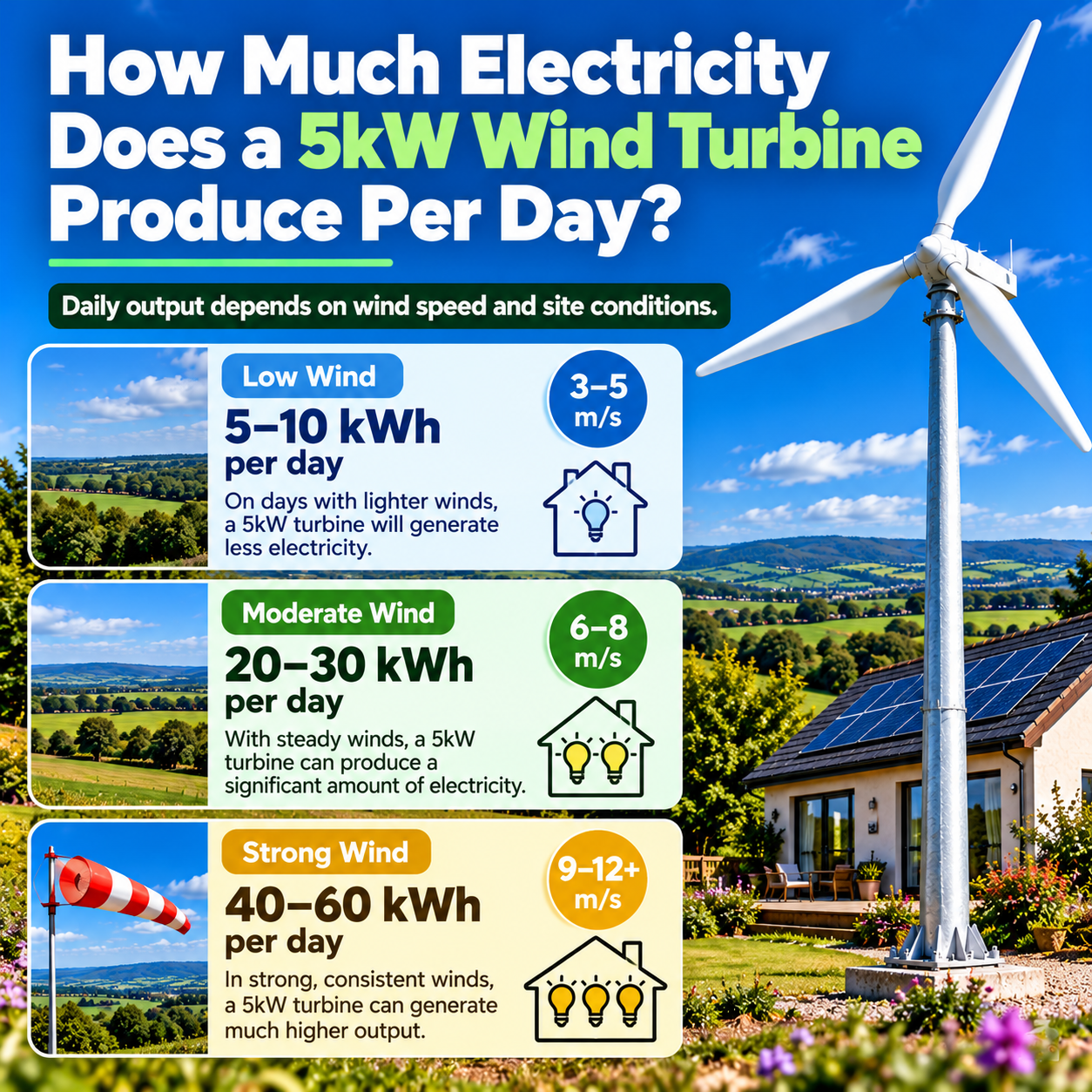
On a calm day a 5kW turbine may generate almost nothing. On a windy day, it could produce substantially more than its long-term average. The figures below are daily averages calculated from annual capacity factors, not promises of what any one day will deliver.
| Capacity factor | Average output per day |
|---|---|
| 10% | 12 kWh |
| 15% | 18 kWh |
| 20% | 24 kWh |
| 25% | 30 kWh |
| 30% | 36 kWh |
A 20% capacity factor is equivalent to averaging 1kW of output across the year—not running at 5kW for 20% of the time. Wind conditions change from hour to hour, so storage or grid backup may be necessary even where annual generation looks impressive.
4. How Much Electricity Can a 5kW Turbine Generate Per Month and Year?
Annual production is the most useful number for estimating energy savings and comparing a 5kW turbine with solar panels or other household energy investments.
At 20%: 5 × 8,760 × 0.20 = 8,760 kWh/year
| Capacity factor | Daily average | Monthly average | Annual output |
|---|---|---|---|
| 10% | 12 kWh | 365 kWh | 4,380 kWh |
| 15% | 18 kWh | 548 kWh | 6,570 kWh |
| 20% | 24 kWh | 730 kWh | 8,760 kWh |
| 25% | 30 kWh | 913 kWh | 10,950 kWh |
| 30% | 36 kWh | 1,095 kWh | 13,140 kWh |
| 40% | 48 kWh | 1,460 kWh | 17,520 kWh |
The monthly column is an annual average divided by twelve, rounded to the nearest kWh. Actual months differ with local wind conditions, and a 40% capacity factor is a particularly strong illustrative case that should not be assumed for a typical home site.
Does a 5kW wind turbine generate more electricity in winter?
Many regions experience stronger winds during winter, which can help a turbine complement rooftop solar panels. However, this pattern is not universal. Local wind records, seasonal turbulence, icing and storm shutdowns can all affect monthly production.
5. Can a 5kW Wind Turbine Power an Entire House?
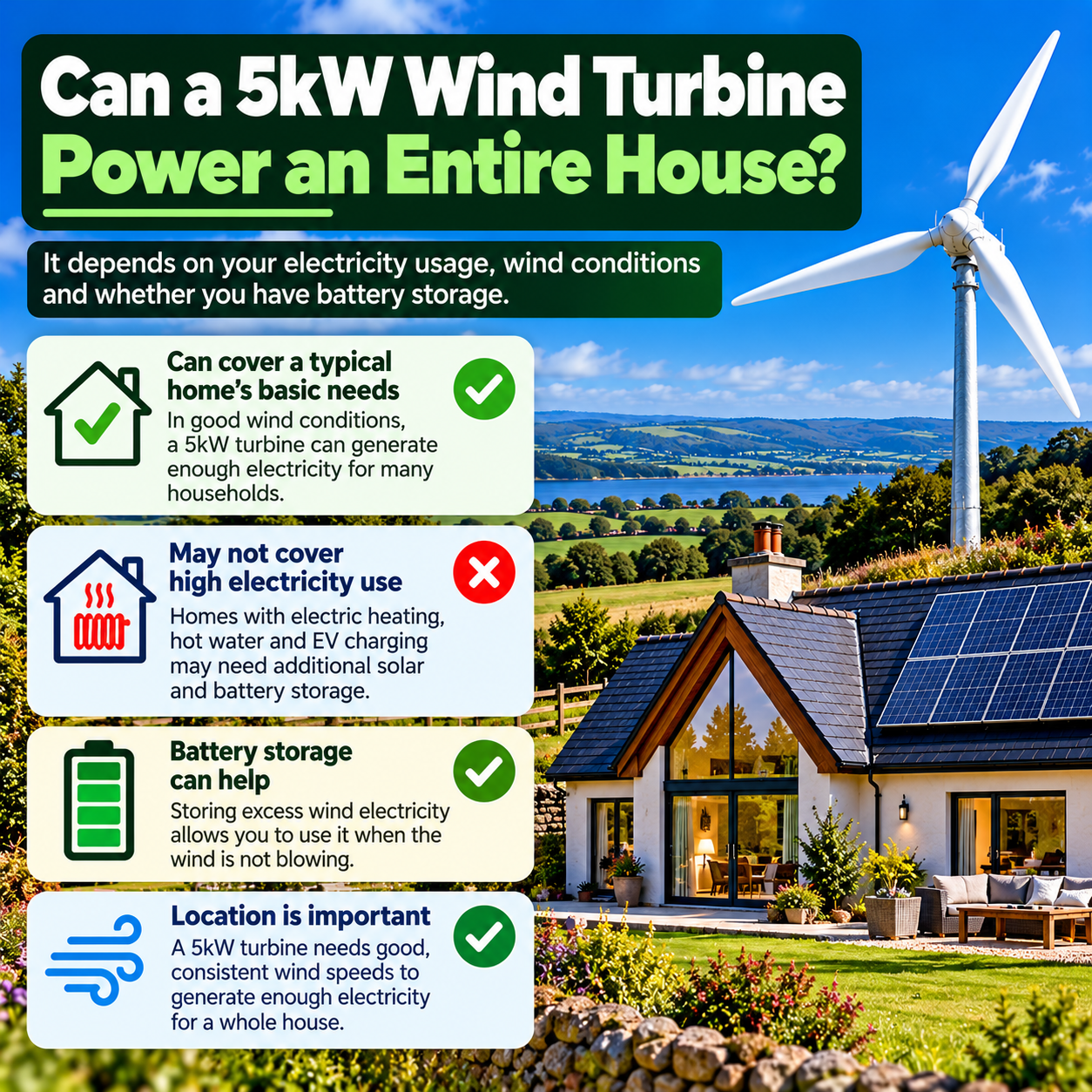
At a sufficiently windy site, a 5kW turbine could produce as much electricity over a year as some households consume. For example, a home using 6,000kWh annually averages about 16.4kWh per day. A turbine generating 8,760kWh annually exceeds that total on paper.
But annual energy balance is not the same as continuous power supply. A calm week may produce very little electricity even when the annual total is high. Households using electric heating, heat pumps or EV charging also have higher or more concentrated demands.
Would you need batteries?
Battery storage can save surplus wind electricity for later use. For off-grid systems, batteries alone may not bridge long low-wind periods; backup generation or another energy source may still be needed. Grid-connected homes can draw electricity from the grid when production falls.
A combined wind, solar and battery system may make sense where the resources complement each other, but compatible controllers, inverters and electrical protection must be selected for the specific equipment.
6. How Much Money Could a 5kW Wind Turbine Save?
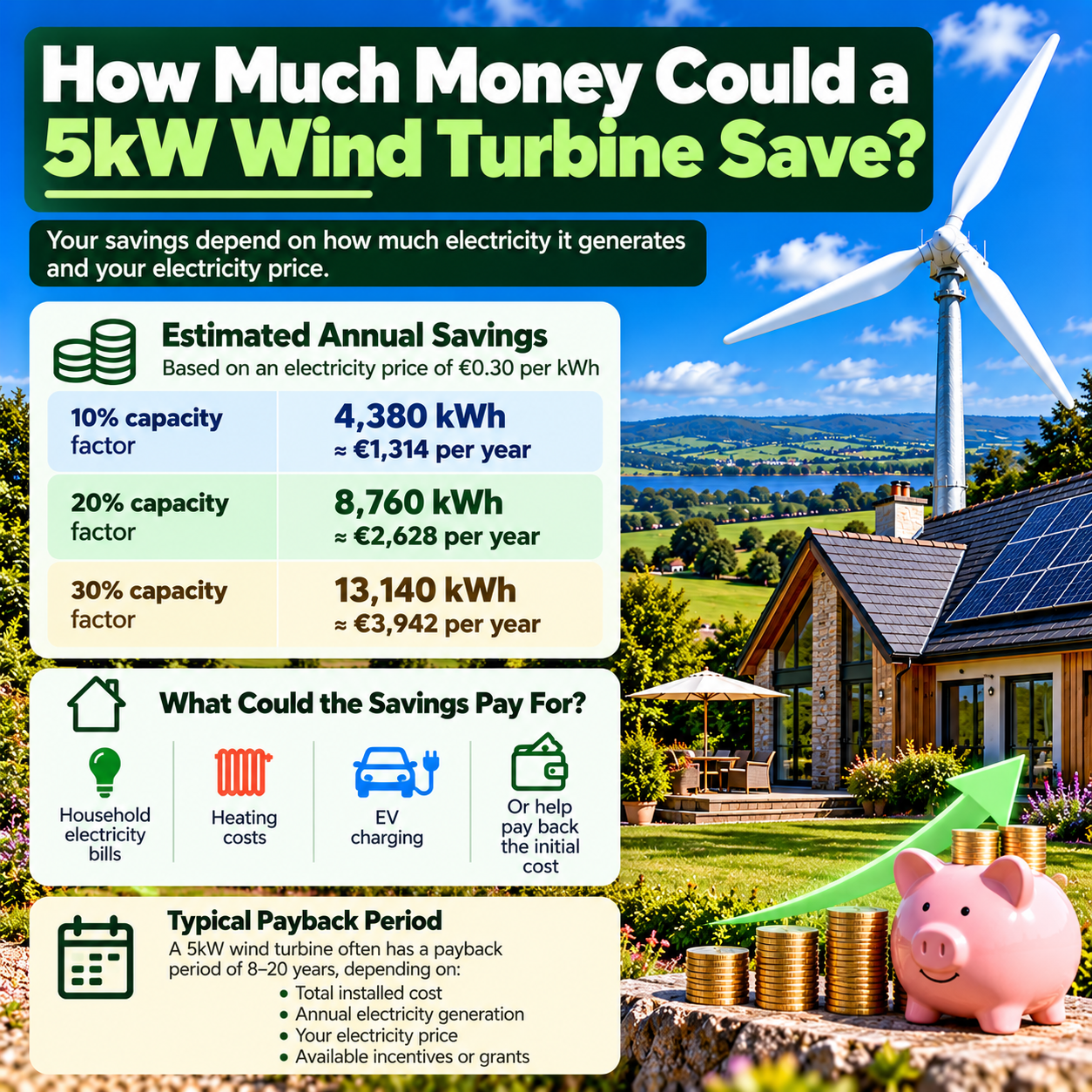
The value of electricity generated depends on the amount used in your home, the retail price of electricity and any payment received for exported power. To illustrate the arithmetic, suppose each kWh is worth €0.30.
| Annual output | Maximum illustrative annual value |
|---|---|
| 4,380 kWh | €1,314 |
| 8,760 kWh | €2,628 |
| 13,140 kWh | €3,942 |
These figures assume every generated kWh has the full stated value. They are not guaranteed savings: exported electricity may earn less than the retail tariff, some generation may be curtailed, and system losses and maintenance costs affect the result. Prices and export arrangements vary by country.
What about installation cost and payback?
Calculate payback from the complete installed cost, including turbine, tower, foundation, electrical equipment, permits, installation, maintenance and possible component replacement. Divide that cost by realistic annual net savings—not by the highest number in an advertising brochure.
7. What Reduces the Electricity Output of a 5kW Wind Turbine?
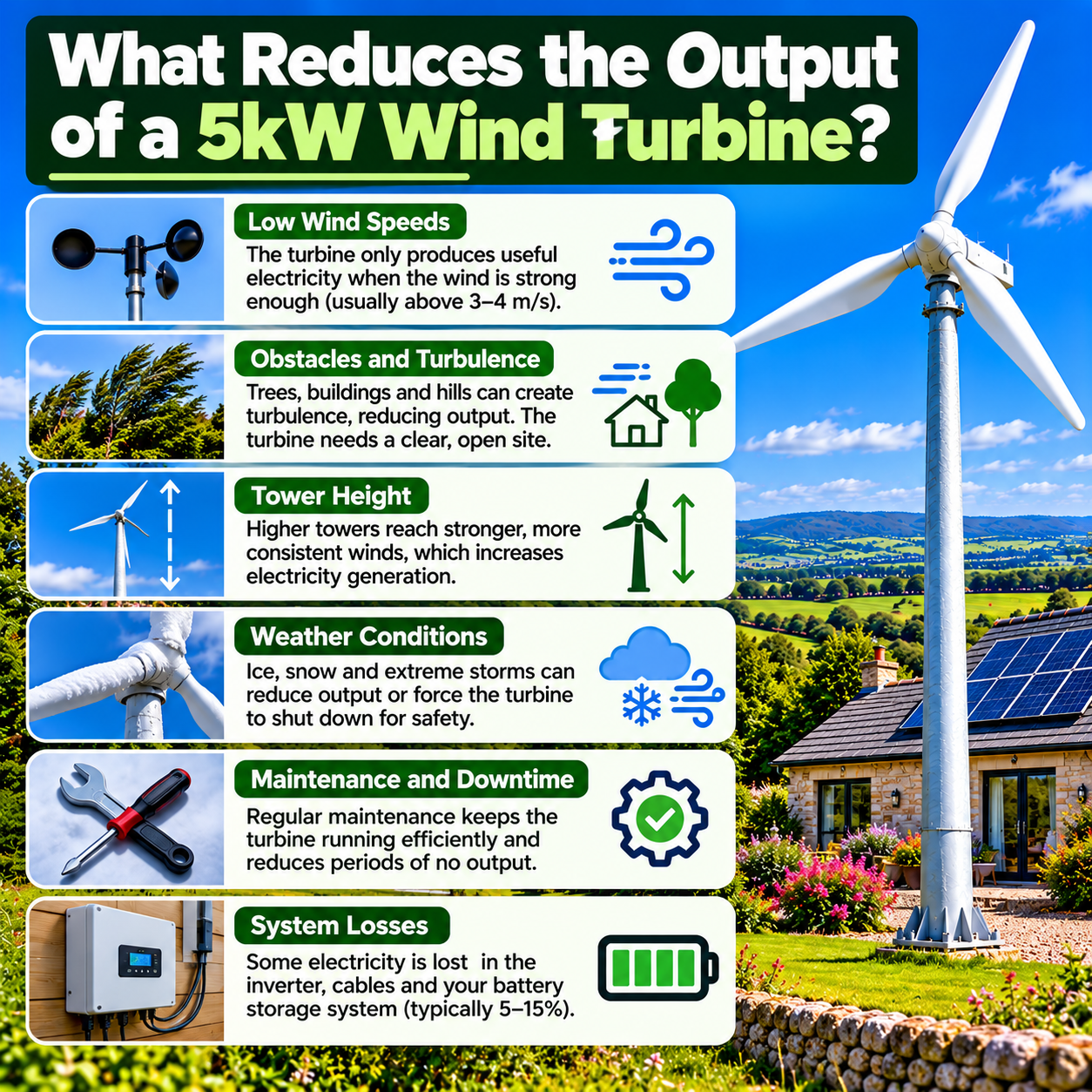
- Low average wind speed: A site with weak winds may produce little energy even with a 5kW-rated turbine.
- Turbulence: Trees, buildings and ridges can create disturbed airflow and increase wear.
- Insufficient tower height: Higher towers often reach faster, less turbulent winds.
- Turbine design: Rotor size, controls and power curve determine output at different speeds.
- Weather: Icing, severe storms and safety shutdowns can interrupt production.
- Maintenance: Faults and downtime reduce annual generation.
- Electrical losses: Inverters, controllers, cables and battery cycling can reduce usable electricity.
Before committing to a turbine, compare tower options and site requirements in our home wind turbine installation guide. Check that the published page uses this exact address before adding the link to your live site.
8. Is a 5kW Home Wind Turbine Worth It?
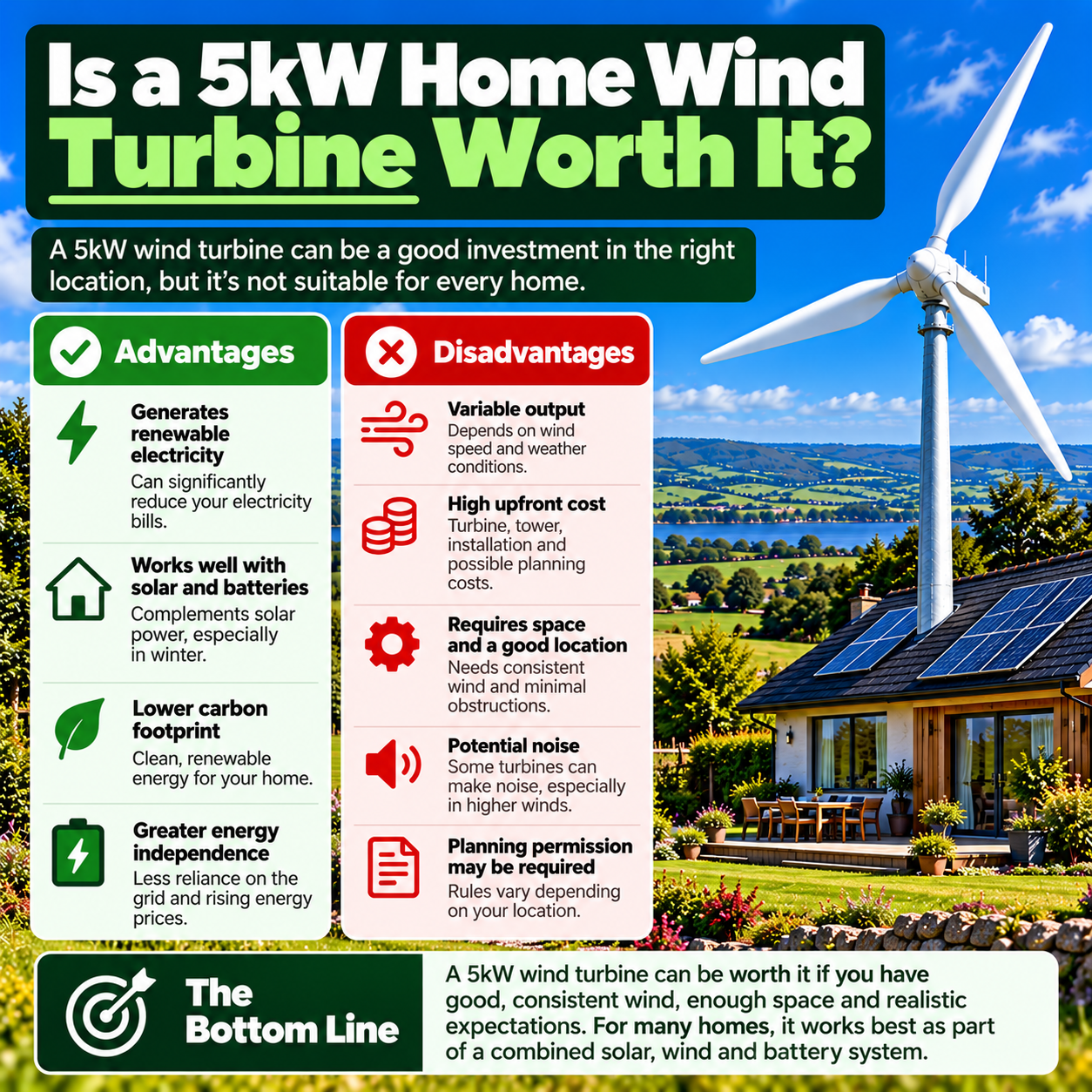
A 5kW turbine can be worthwhile where there is strong, consistent wind, adequate land for a safe tower, acceptable planning requirements and enough electricity demand to use the generation. At a sheltered site, the same turbine may offer poor value.
Signs your property may be suitable
- Open, exposed land with a good wind resource at proposed hub height.
- Space to install and maintain an appropriately engineered tower.
- Acceptable local permissions, setback distances and safety requirements.
- A credible annual production estimate based on a real turbine power curve.
- An installed-cost quotation that supports reasonable lifetime economics.
When another solution may be better
If your home is surrounded by trees or buildings, has limited space, or receives poor winds, rooftop solar or energy-efficiency upgrades may provide a better return. Wind and solar should be compared on expected annual usable kWh and total lifetime cost—not just rated system size.
For more guidance on siting, tower heights and annual energy estimates, consult the US Department of Energy Small Wind Guidebook.
5kW Wind Turbine Electricity Generation Calculator
Enter an assumed annual capacity factor and a value per kWh to see how output changes. This is a simple illustration, not a substitute for a wind assessment.
Daily average: 24 kWh
Monthly average: 730 kWh
Annual output: 8,760 kWh
Illustrative gross electricity value: €2,628/year
Assumes a 5kW rated turbine and a non-leap year. The gross electricity value excludes export discounts, costs and losses.
Frequently Asked Questions
How much electricity can a 5kW wind turbine generate per day?
At an illustrative 20% capacity factor, a 5kW turbine averages 24kWh a day. Individual days can be much lower or higher depending on wind conditions.
How many kWh can a 5kW wind turbine generate in a year?
A 5kW turbine generates 4,380kWh at a 10% capacity factor, 8,760kWh at 20%, and 13,140kWh at 30%. These are calculated scenarios, not guaranteed site-specific forecasts.
Does a 5kW wind turbine produce 5kW continuously?
No. Its 5kW rating applies at specified wind conditions. Actual power varies with wind speed and the manufacturer’s power curve.
Can a 5kW wind turbine power an entire home?
It can match the annual electricity consumption of some homes at a good site, but reliable electricity during calm periods may require grid backup, batteries or another source of generation.
What wind speed does a 5kW turbine need?
Cut-in and rated speeds vary by model. Some small turbines start generating around 3–4m/s, but meaningful annual energy production requires evaluating the full wind-speed distribution and turbine power curve.
Can a 5kW wind turbine work with solar panels?
Yes. A properly engineered hybrid system can combine wind generation, solar panels and batteries, provided all electrical equipment and protection are compatible.
Is a 5kW wind turbine worth installing in 2026?
It may be worthwhile at a consistently windy site with suitable tower space and realistic installation costs. A site-specific generation estimate and full cost comparison should come first.
Explore More Home Wind Energy Guides
Before purchasing a 5kW wind turbine, compare power curves, check wind conditions at your property and calculate total installed costs.
Read more independent renewable energy advice at Home-Energy-Systems.COM.
Bottom line: How much electricity can a 5kW wind turbine generate? A worked example at 20% capacity factor gives 8,760kWh annually, but a real turbine’s performance is determined by the wind resource, power curve, tower height and system losses. Start with the site assessment—not the nameplate rating.
Updated October 2026. Figures are educational estimates, not guaranteed generation, bill savings or financial returns.