How Long Will a 10kWh Battery Power a House?
How long will a 10kWh battery power a house during the night or a power outage? The answer depends on how much electricity your household uses, the battery’s usable capacity and the appliances you want to run.
In this practical 2026 guide, we’ll calculate realistic backup times, examine household appliances, explain solar charging and help you decide whether a 10kWh home battery is the right size.
1. How Long Will a 10kWh Battery Power a House?
A 10kWh battery stores a nominal 10 kilowatt-hours of electrical energy. This is a measure of energy, not the maximum amount of power it can deliver at one moment.
For example, if your house consumes 1kW continuously, it uses 1kWh of electricity every hour. A 10kWh battery could theoretically support that load for 10 hours.
However, real home battery systems have several limitations:
- Usable capacity: Some energy may be reserved to protect the battery.
- Inverter efficiency: Converting battery DC electricity to household AC electricity involves losses.
- Battery age: Available capacity can decline over time.
- Household demand: Heating, cooking and other appliances may increase consumption substantially.
- Standby consumption: The inverter and associated equipment can use electricity even when household demand is low.
For our calculations, we’ll use 8–9kWh of energy delivered to household appliances from a fully charged nominal 10kWh system. This is an example range, not a guaranteed specification for every battery.
2. What Can a 10kWh Home Battery Run?
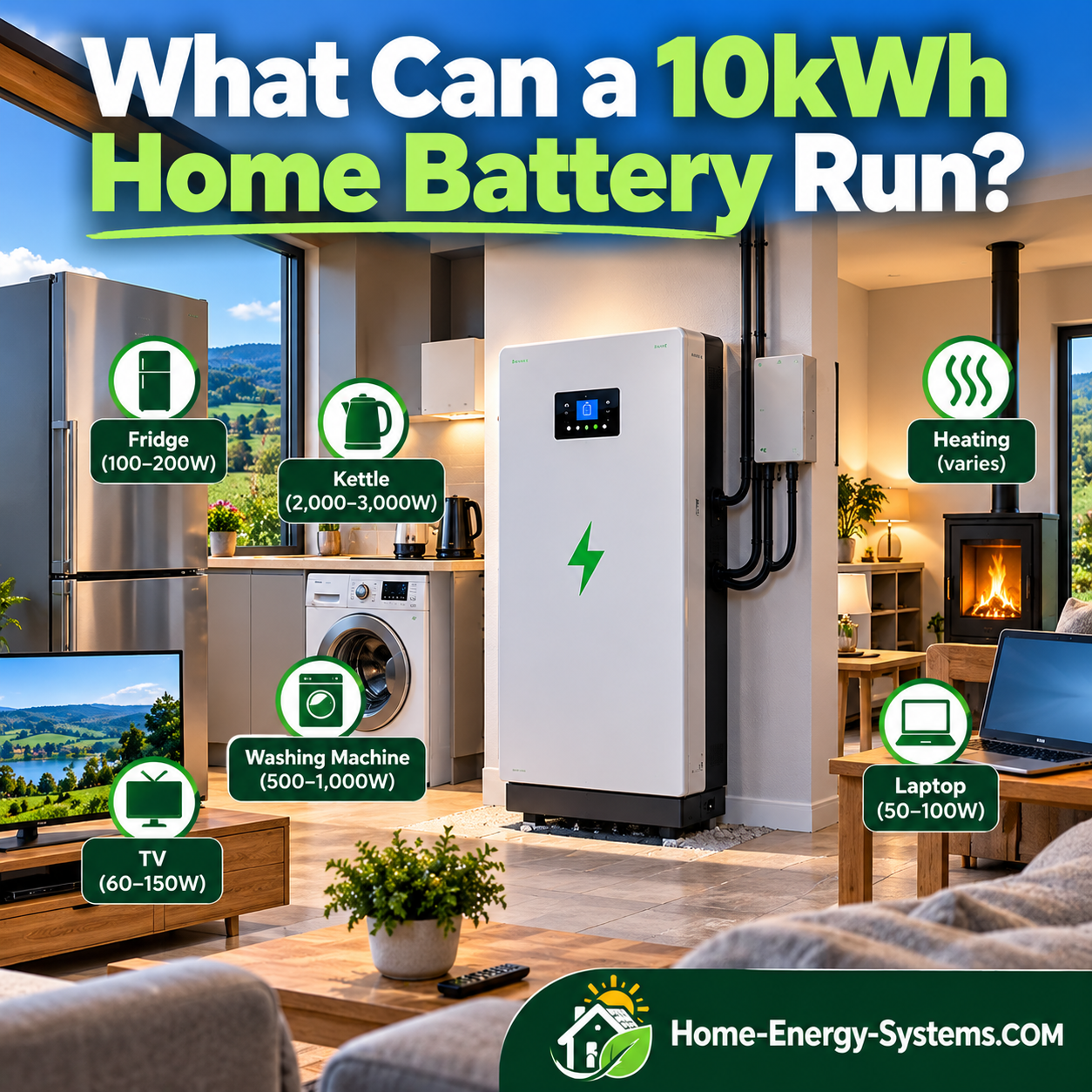
A 10kWh home battery can supply many common household appliances, provided their combined power requirements stay within the inverter’s continuous and surge ratings.
Typical appliance power ratings vary considerably by model and operating cycle.
| Appliance | Illustrative power draw |
|---|---|
| LED lighting | 5–15W per bulb |
| Wi-Fi router | 5–20W |
| Laptop | 30–100W |
| Television | 60–150W |
| Fridge while compressor runs | 100–200W |
| Washing machine | Highly variable; heating cycles can exceed 2,000W |
| Electric kettle | 2,000–3,000W |
| Heat pump | Variable; often 1–4kW electrical input while operating |
These are illustrative instantaneous power draws, not continuous average consumption figures. Refrigerators cycle on and off, while washing machines use very different amounts of power during washing, heating and spinning.
What about running several appliances together?
Suppose your essential circuits have an average combined load of 400W, including refrigeration, lighting, internet, television and occasional laptop use.
With 8.5kWh available, the theoretical calculation gives approximately 21 hours of operation.
But if an electric heater increases the average load to 2,000W, the same battery may last only around four hours.
3. 10kWh Battery Backup Time Calculator
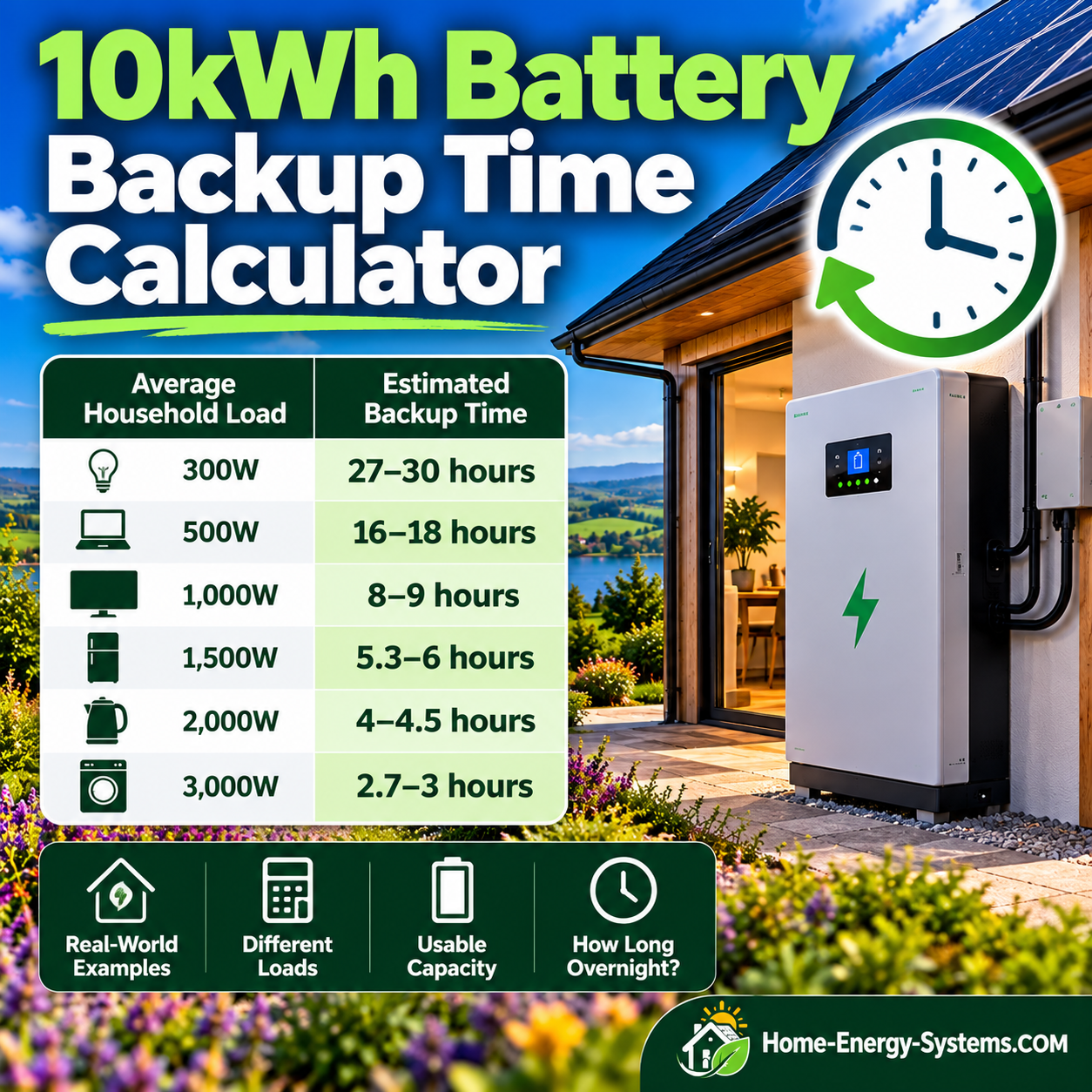
Calculating battery backup duration is straightforward once you know the usable energy available and your average household load.
| Average household load | Estimated backup time |
|---|---|
| 300W | 27–30 hours |
| 500W | 16–18 hours |
| 1,000W | 8–9 hours |
| 1,500W | 5.3–6 hours |
| 2,000W | 4–4.5 hours |
| 3,000W | 2.7–3 hours |
Assumes 8–9kWh of deliverable AC energy, constant loads, no additional charging and no extra allowance for unusually high standby losses.
How to estimate your household’s actual load
- Check your smart meter, monitoring app or energy monitor for hourly consumption.
- Identify which appliances would operate during the period you’re planning for.
- Calculate average demand in kW, rather than simply adding every appliance’s maximum rating.
- Divide the battery’s available energy by that average demand.
- Allow additional margin for cold weather, inverter losses and unexpected usage.
For outage planning, check both the battery’s capacity and the inverter’s ability to start motors or handle short power surges.
4. How Long Will a 10kWh Battery Last Overnight?
For many households, overnight electricity consumption is lower than daytime consumption. Lighting is reduced, televisions are switched off and some appliances remain on standby.
Consider an eight-hour overnight period with the following example average loads:
| Overnight scenario | Average load | Energy used in 8 hours |
|---|---|---|
| Low-consumption essentials | 250W | 2kWh |
| Moderate background demand | 500W | 4kWh |
| Higher household demand | 1,000W | 8kWh |
| Heating and other large loads | 2,000W | 16kWh |
A fully charged 10kWh battery may comfortably cover the first two examples. At an average load of 1,000W, the battery could be almost depleted by morning. A sustained 2,000W load would require considerably more energy than the battery contains.
Charging overnight on a cheaper electricity tariff
A battery can also be charged during low-cost electricity periods and discharged when prices rise.
This approach does not require solar panels, although solar generation can provide an additional charging source.
The financial benefit depends on the difference between tariff rates, charging and discharging losses, export payments and battery costs.
5. Can a 10kWh Battery Run a Heat Pump?
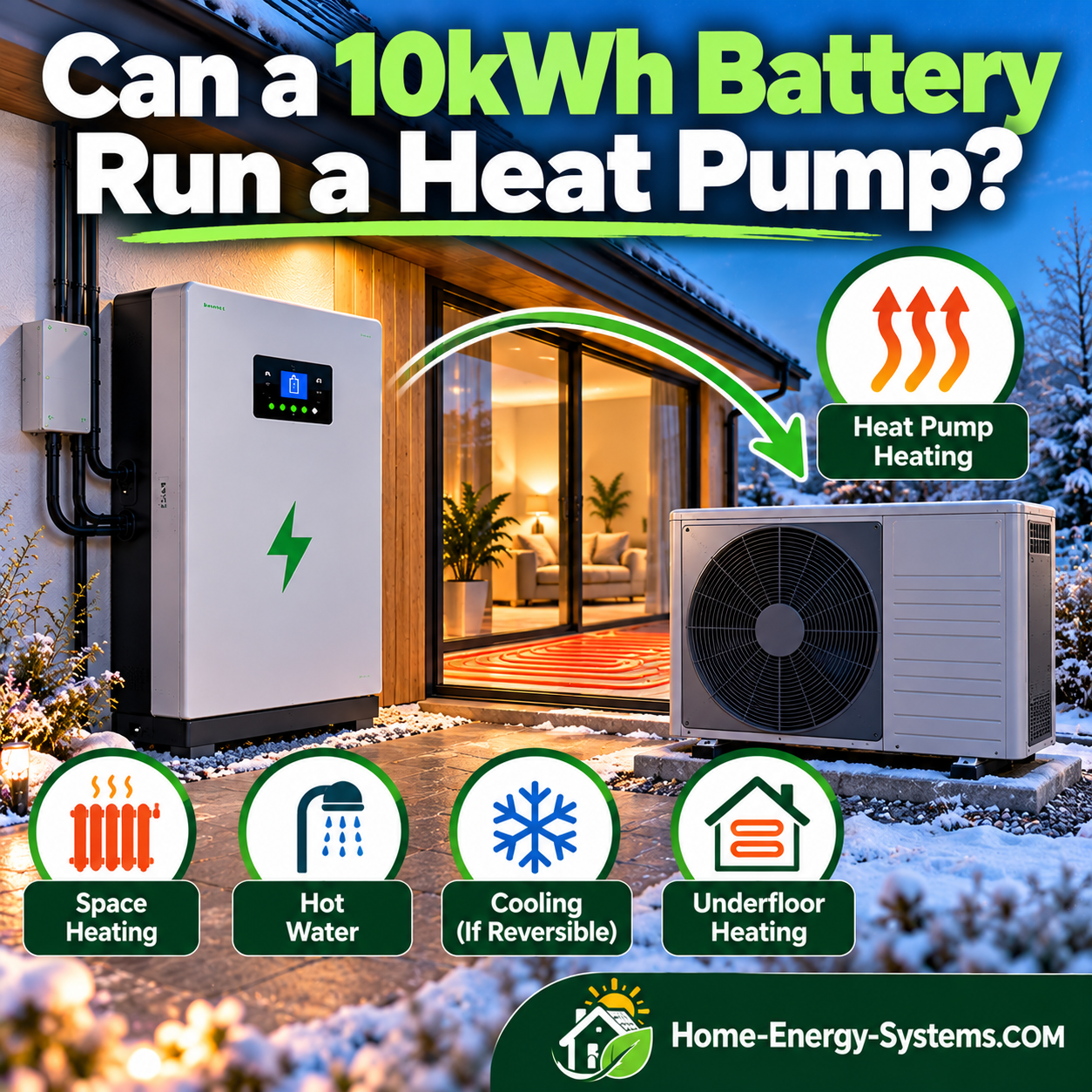
Yes, a 10kWh battery can run a compatible heat pump, but the duration depends on the heat pump’s electrical consumption rather than its advertised heating output.
For example, a heat pump delivering 9kW of heat may use considerably less than 9kW of electricity because it transfers heat from the environment.
However, electrical consumption rises when heating demand increases, efficiency falls or auxiliary electric heating operates.
| Average heat pump electrical input | Approximate duration |
|---|---|
| 1kW | 8–9 hours |
| 1.5kW | 5.3–6 hours |
| 2kW | 4–4.5 hours |
| 3kW | 2.7–3 hours |
These calculations assume the heat pump is the only electrical load. Other household consumption reduces the available running time.
Electrical resistance backup heaters and high startup loads also need to be considered when specifying the inverter.
For more information about low-temperature heating, read our underfloor heating for heat pumps guide.
6. Can Solar Panels Recharge a 10kWh Battery?
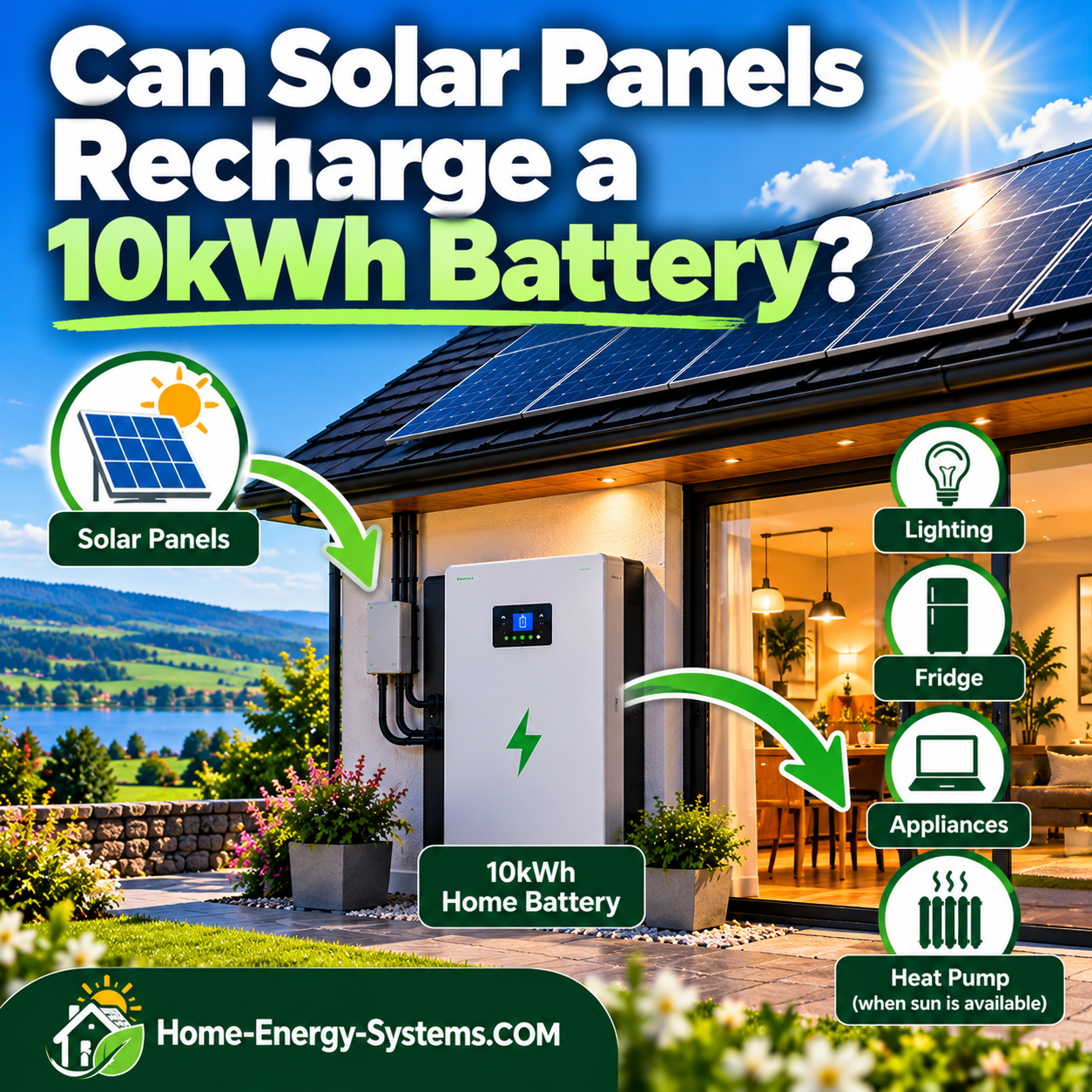
Yes. Solar panels can recharge a 10kWh home battery when their generation exceeds the electricity being consumed by the house, assuming the system is configured to store that surplus.
The charging time depends on solar output, available sunlight, household demand, charging efficiency and the battery’s maximum charging power.
Example: a 5kW solar panel system
Imagine a 5kW rooftop solar array producing 4kW at a particular moment.
If the house is consuming 1kW, approximately 3kW remains available before accounting for charging losses.
At that sustained surplus, replacing 9kWh of stored energy would take a little over three hours once losses are considered, provided the battery can accept that charging rate.
Real solar production changes throughout the day, so this is an illustration rather than a daily charging guarantee.
What happens in winter?
Shorter daylight hours, cloud cover, shading and low sun angles can reduce winter solar generation.
Consequently, a battery that regularly reaches full charge in summer might only receive a partial charge on some winter days.
Some households combine solar charging with overnight grid charging to improve reliability and manage electricity costs.
7. 5kWh vs 10kWh vs 15kWh Home Batteries
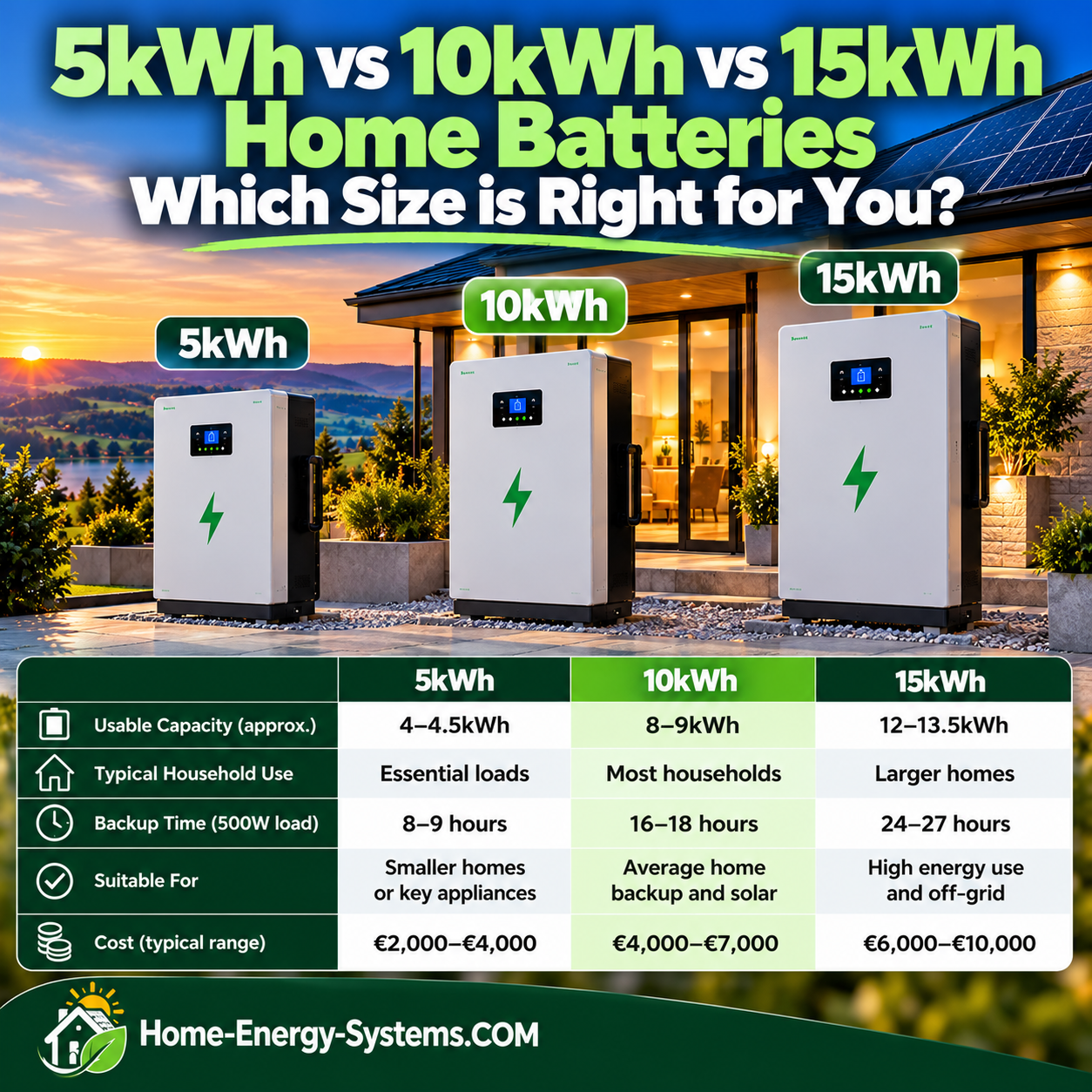
Choosing the right home battery involves balancing installation cost, daily electricity consumption, solar generation and backup requirements.
| Battery capacity | Example delivered energy | Duration at 500W |
|---|---|---|
| 5kWh | 4–4.5kWh | 8–9 hours |
| 10kWh | 8–9kWh | 16–18 hours |
| 15kWh | 12–13.5kWh | 24–27 hours |
These estimates assume a similar proportion of delivered AC energy for each system. Actual usable capacities vary by product.
5kWh Battery
Potentially suitable for modest evening electricity use, smaller solar installations and selected essential appliances.
10kWh Battery
A practical capacity to investigate for households seeking greater overnight coverage and increased use of stored solar electricity.
15kWh Battery
Worth considering where household consumption is higher or longer backup duration is important.
Expandable Storage
Modular batteries may allow additional capacity later, provided expansion is supported by the manufacturer and installer.
A larger battery is not automatically a better investment. If it rarely receives enough surplus solar electricity or low-cost grid charging to fill, some of its capacity may remain underused.
Likewise, a small battery that regularly empties before the expensive electricity period ends may not provide the savings or backup duration expected.
8. Is a 10kWh Home Battery Worth It in 2026?
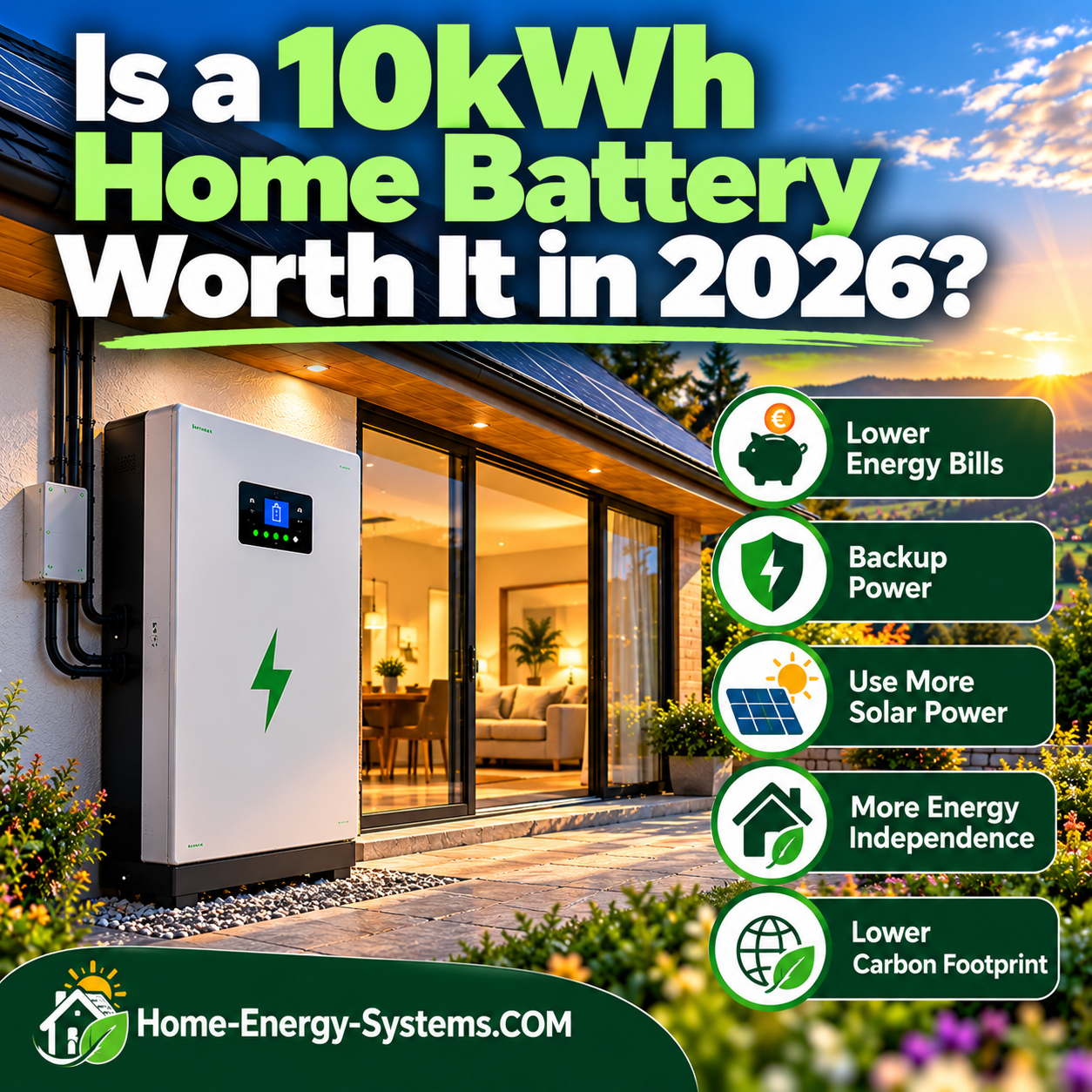
A 10kWh home battery can be worthwhile, but the financial outcome depends heavily on the household and local electricity market.
Potential advantages include:
- Using more electricity generated by your own solar panels.
- Charging during cheaper electricity periods.
- Reducing electricity purchased during expensive peak periods.
- Providing backup electricity where the system supports it.
- Reducing dependence on grid electricity at certain times.
When might a battery be less worthwhile?
A battery may offer a weaker financial return when electricity consumption is low, tariff differences are small, export payments are attractive or the installation cost is high.
Battery ageing, warranties, financing costs and eventual replacement should also be considered.
A simple savings example
Suppose a household can buy 10kWh of electricity at an off-peak rate of €0.12 per kWh and deliver 8.5kWh later when electricity costs €0.30 per kWh.
The electricity purchased costs €1.20. The delivered electricity avoids approximately €2.55 of peak-rate purchases, giving a gross saving of €1.35 for that cycle.
If this occurred 300 times in a year, the illustrative gross saving would be €405.
That is not net profit. It excludes battery installation costs, degradation, financing, maintenance, fixed charges and any alternative export income. Electricity tariffs also differ by country and provider.
For independent guidance, see Energy Saving Trust’s battery storage advice.
Choosing a battery supplier
When comparing systems, examine the usable capacity, inverter compatibility, maximum charge and discharge rates, warranty terms, monitoring features and backup capabilities.
Availability and electrical certification requirements vary internationally, so check products and installation requirements in your own market.
Explore Home Energy Storage Options
Compare home energy equipment from our affiliate partners and check which systems are suitable for your region, budget and electricity requirements.
Where to Buy Energy Equipment →Affiliate disclosure: Some supplier links may earn us a commission at no additional cost to you. Product suitability and availability must be checked before purchase.
How to choose the right 10kWh battery
Before purchasing, ask an installer to confirm:
- The battery’s nominal and usable capacity.
- Continuous and peak inverter output.
- Whether backup power is supported.
- Which household circuits can operate during an outage.
- Compatibility with existing solar panels and inverters.
- Battery chemistry, warranty and expected capacity retention.
- Installation, safety and local grid-connection requirements.
Frequently Asked Questions
Can a 10kWh battery power a whole house?
Yes, for a limited period, if the battery and inverter can support the home’s electrical loads. High-demand appliances may significantly reduce backup duration or exceed the inverter’s output rating.
How long will a 10kWh battery last with no solar panels?
It depends on household consumption. With approximately 8–9kWh of deliverable energy, a constant 500W load could run for around 16–18 hours. Solar panels are not necessary if the battery can charge from the grid.
Will a 10kWh battery last all night?
It may last all night if average electricity demand is moderate. At 500W, an eight-hour night uses 4kWh. Continuous electric heating or other high loads can substantially increase consumption.
Can a 10kWh battery run an electric oven?
Potentially, if the inverter supports the oven’s electrical demand. However, ovens can use considerable electricity, reducing the energy available for other appliances.
Can a 10kWh battery charge an electric car?
Some compatible systems can transfer stored electricity to an EV charger. However, 10kWh is relatively small compared with many EV batteries, and conversion losses further reduce the energy reaching the vehicle.
How many solar panels are needed to charge a 10kWh battery?
There is no fixed number. It depends on panel output, location, weather, household consumption and charging losses. The total surplus energy produced matters more than the panel count alone.
Does a 10kWh battery automatically work during a power cut?
No. The installation must include appropriate backup-capable equipment and electrical protection. Some grid-connected battery systems stop supplying the house during an outage.
How long does a home battery last before replacement?
Many residential batteries are designed for roughly a decade or longer, but lifespan depends on chemistry, temperature, usage, installation and warranty conditions. Capacity usually declines gradually rather than disappearing suddenly.
Editorial note: Figures are illustrative and are not product guarantees. Home battery installation and grid connections should be carried out by appropriately qualified professionals in accordance with local requirements.