Solar Driveway Alarms for Farms: Complete Guide 2026
Discover how solar driveway alarms work, which types suit long rural entrances, and how to choose reliable early-warning protection for your farm.
Protecting a farm entrance can be difficult when the driveway stretches hundreds of metres from the public road to the farmhouse. Unexpected visitors, deliveries and unfamiliar vehicles may reach your buildings before anybody notices them.
Solar driveway alarms for farms provide an early-warning solution without requiring mains electricity at the entrance. An outdoor sensor detects movement and sends a wireless signal to a receiver inside your farmhouse, workshop or another building.
However, not every driveway alarm is suitable for rural conditions. Long distances, trees, livestock, wildlife and limited winter sunlight can all affect performance.
Quick Answer
The best solar driveway alarm for a farm combines sufficient wireless range, reliable movement detection, adjustable sensitivity and adequate battery capacity for cloudy weather.
For long driveways, prioritise communication range. For entrances with frequent animal activity, consider adjustable PIR detection, a carefully positioned beam or a vehicle-specific detector.
Remember: A solar-powered outdoor sensor does not necessarily mean the indoor receiver is solar-powered.
1. Why Farm Driveways Need Different Security Alarms
A typical suburban driveway may be only a few metres long. A rural farm entrance can be several hundred metres from the nearest occupied building.
This creates several challenges:
- Distance: Wireless signals must reach the farmhouse or yard.
- Wildlife: Deer, foxes and other animals may trigger movement sensors.
- Livestock: Cattle, horses and sheep may move near the entrance.
- Electricity: Remote gates frequently have no mains power.
- Weather: Rain, frost and low winter sunlight can affect exposed equipment.
Solar driveway alarms for farms help address these problems by combining battery-powered outdoor detection with solar charging.
They are not a substitute for physical security, but they can give occupants valuable warning before a vehicle reaches the yard.
For wider protection, read our farm security cameras guide.
2. How Do Solar Driveway Alarms Work?
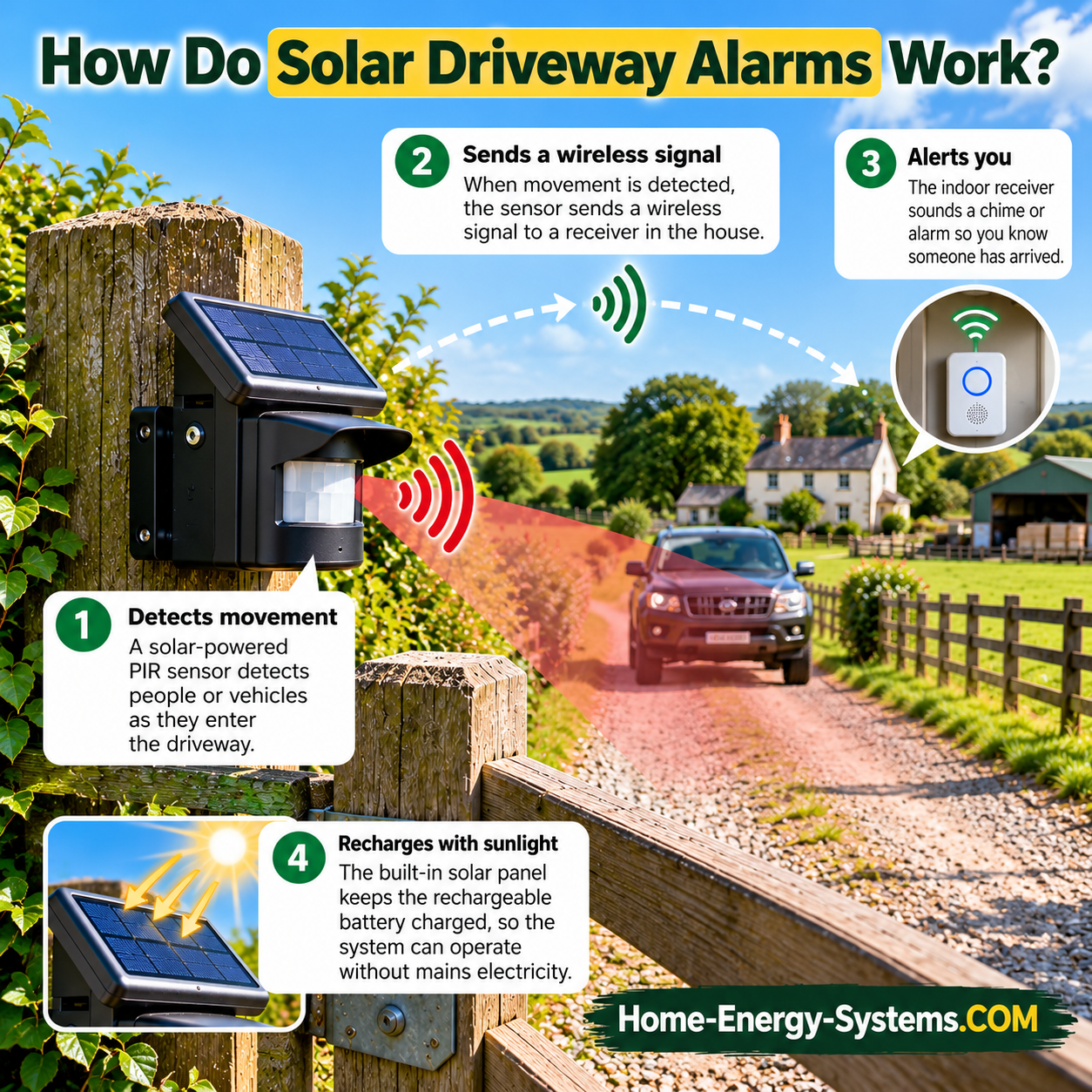
Most solar driveway alarms use a rechargeable battery supported by a small photovoltaic panel. The system generally includes an outdoor detector, a wireless transmitter and an indoor receiver.
Step 1: Detecting Movement
A passive infrared sensor, usually called a PIR sensor, detects changes in infrared radiation as people or vehicles move across its detection area.
Step 2: Sending the Signal
When movement is detected, the outdoor unit sends a radio signal to the receiver.
Step 3: Alerting the Property Owner
The receiver produces a chime, alarm or visual notification. Some advanced systems offer additional outputs or remote notifications.
Step 4: Recharging the Battery
During daylight hours, the solar panel replenishes the outdoor battery, reducing the need for manual charging or battery replacement.
3. Best Types of Solar Driveway Alarms for Farms
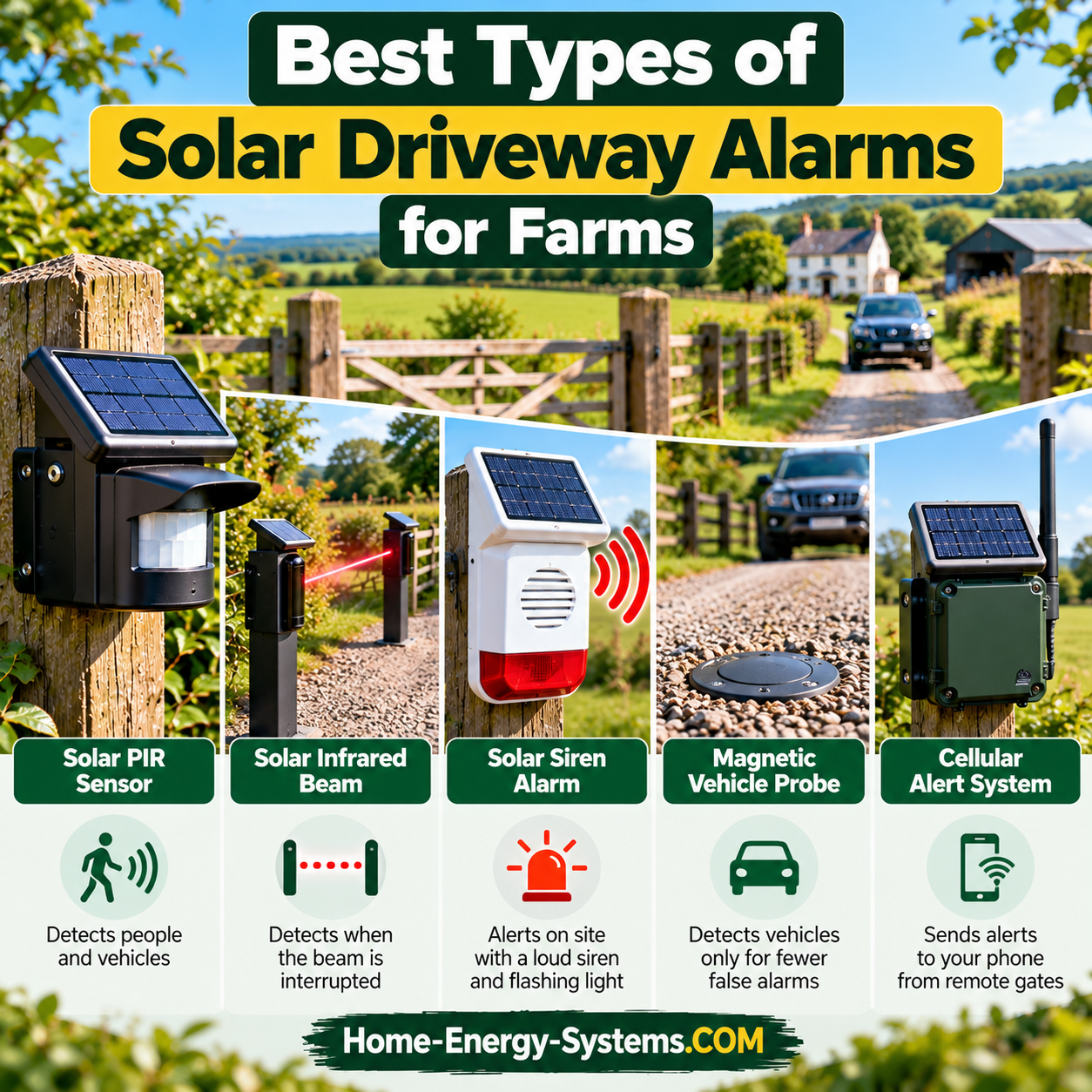
Not every alarm detects movement in the same way. Before buying, decide whether you need to detect vehicles, people or both.
| Alarm type | Best application | Main consideration |
|---|---|---|
| Solar PIR sensor | General driveway monitoring | May detect animals |
| Solar infrared beam | Defined entrance or gateway | Requires accurate alignment |
| Solar siren alarm | Local audible deterrent | May not alert the farmhouse |
| Magnetic vehicle probe | Vehicle-only detection | Often battery-powered rather than solar |
| Cellular alert system | Remote notifications | Requires cellular coverage and possibly a subscription |
Solar PIR Driveway Alarms
Solar PIR systems are suitable for many farm entrances because they are relatively straightforward to install and do not require underground power cables.
Some systems offer adjustable sensitivity, multiple receivers and different alert tones for separate entrances.
Solar Infrared Beam Alarms
Infrared beam systems create a defined detection line across a gateway. When an object interrupts the beam, the system activates an alert.
They can be useful where a precisely defined entrance needs monitoring, although animals crossing the beam may still cause alerts.
Magnetic Vehicle Detectors
Magnetic probes detect disturbances associated with nearby vehicles. They can be particularly useful where wildlife frequently crosses the driveway.
However, many magnetic detectors use conventional batteries rather than solar charging.
Cellular Driveway Alerts
Some systems can send notifications to a mobile phone through a cellular connection. These may suit remote properties, provided there is reliable network coverage.
4. Wireless Range for Long Farm Driveways
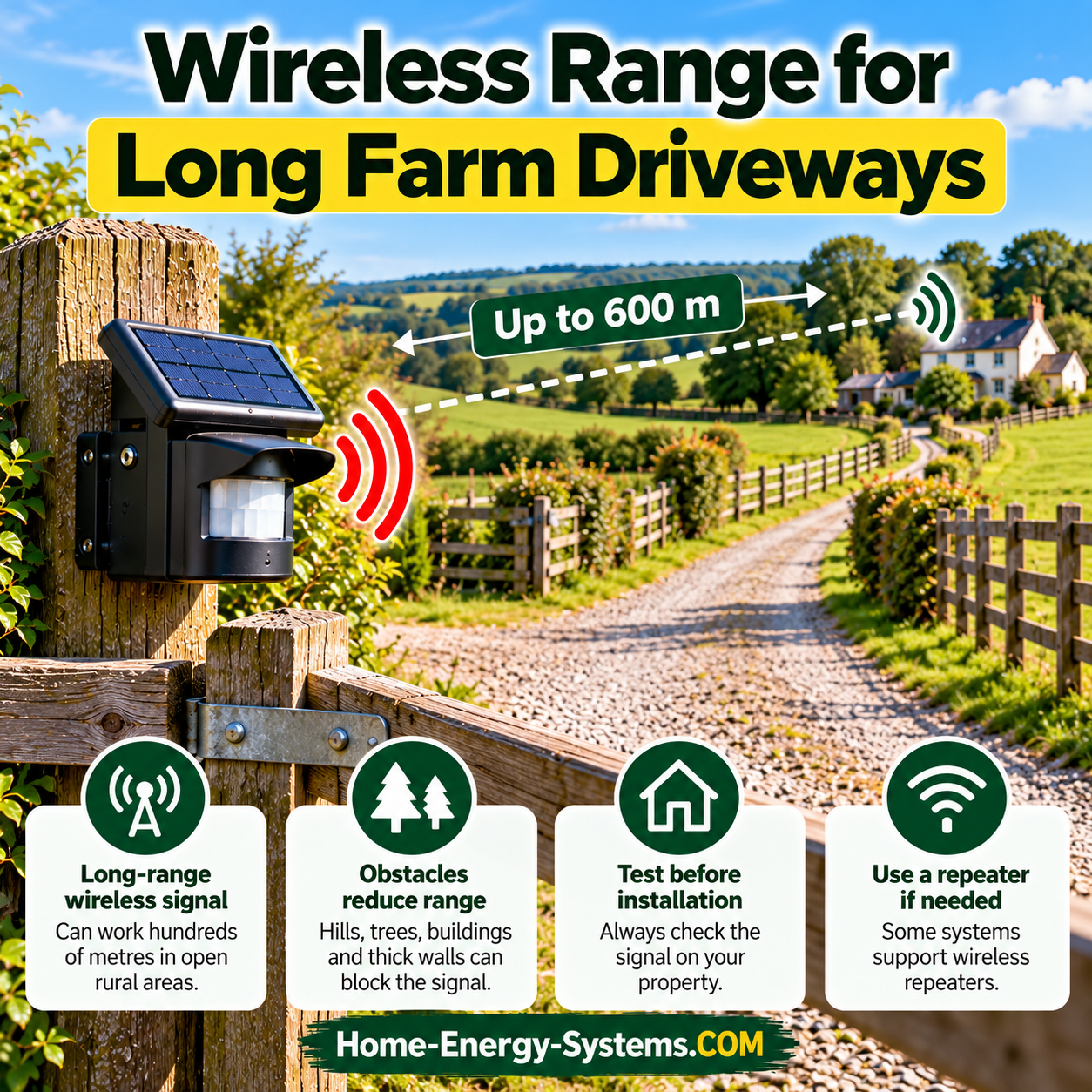
Wireless range is one of the most important specifications when selecting solar driveway alarms for farms.
Manufacturers often advertise maximum transmission distances measured under clear line-of-sight conditions. Actual range may be considerably lower when signals encounter hills, trees, metal sheds or thick farmhouse walls.
Some long-range driveway systems advertise maximum communication distances of several hundred metres. These figures should always be treated as model-specific rather than guaranteed performance.
How to Improve Wireless Reliability
- Mount transmitters where the signal path is as clear as possible.
- Avoid placing equipment directly against large metal surfaces.
- Test communication before permanently mounting the sensor.
- Consider a compatible repeater where the manufacturer supports one.
- Test the receiver with farmhouse doors and windows closed.
For particularly long entrances, a specialist long-range system may be more appropriate than an inexpensive household driveway alarm.
5. How to Reduce False Driveway Alarms
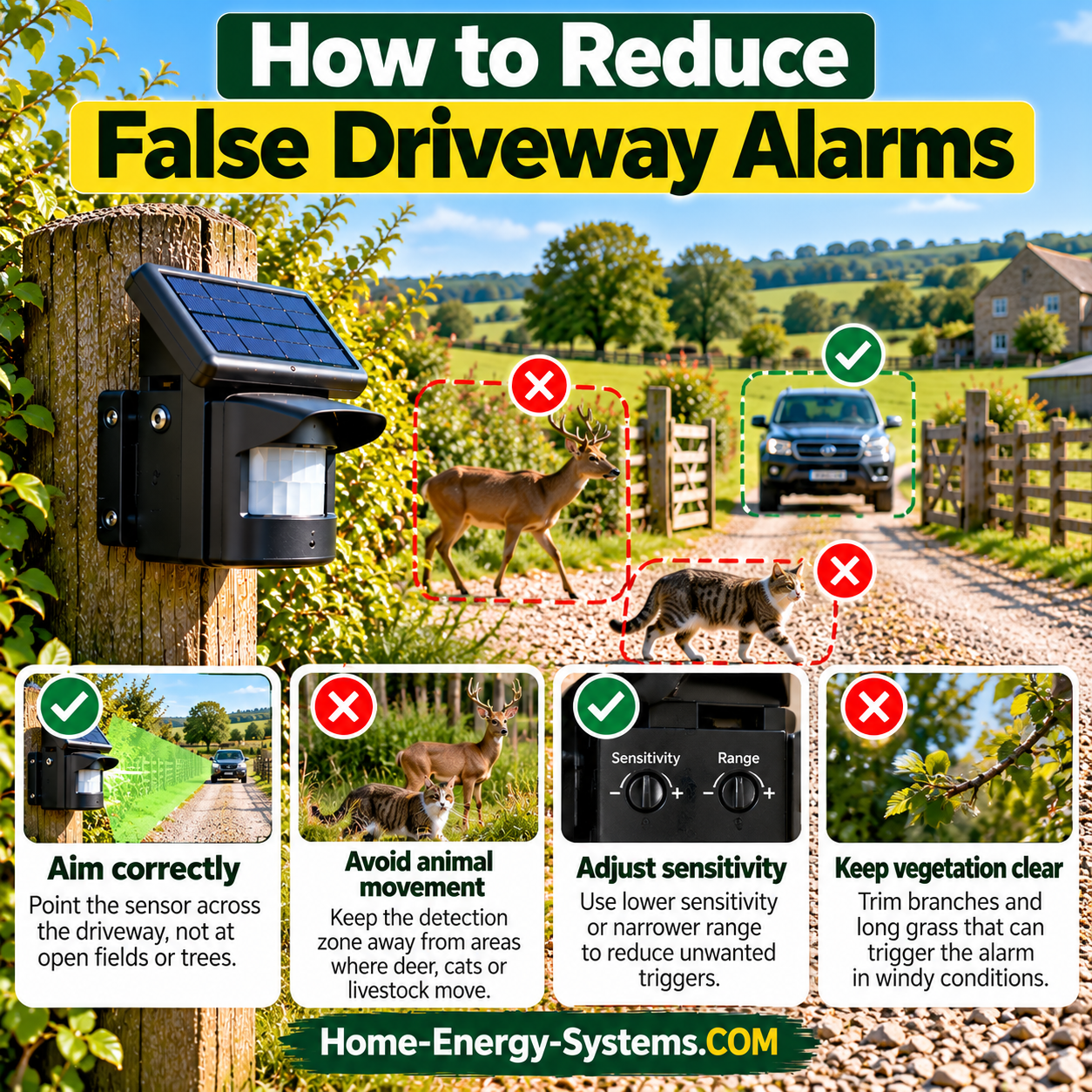
Unnecessary alerts are particularly frustrating on farms where animals regularly move near gates, fields and access tracks.
A poorly positioned sensor may repeatedly detect deer, livestock, moving vegetation or activity outside the intended entrance.
Practical Ways to Reduce False Alerts
- Position PIR sensors across the expected direction of movement.
- Use adjustable sensitivity where available.
- Avoid aiming detectors towards public roads or busy footpaths.
- Keep branches and vegetation clear of the detection zone.
- Follow the manufacturer’s recommended mounting height.
- Consider vehicle-specific detection where animals are a frequent problem.
6. Do Solar Driveway Alarms Work in Winter?
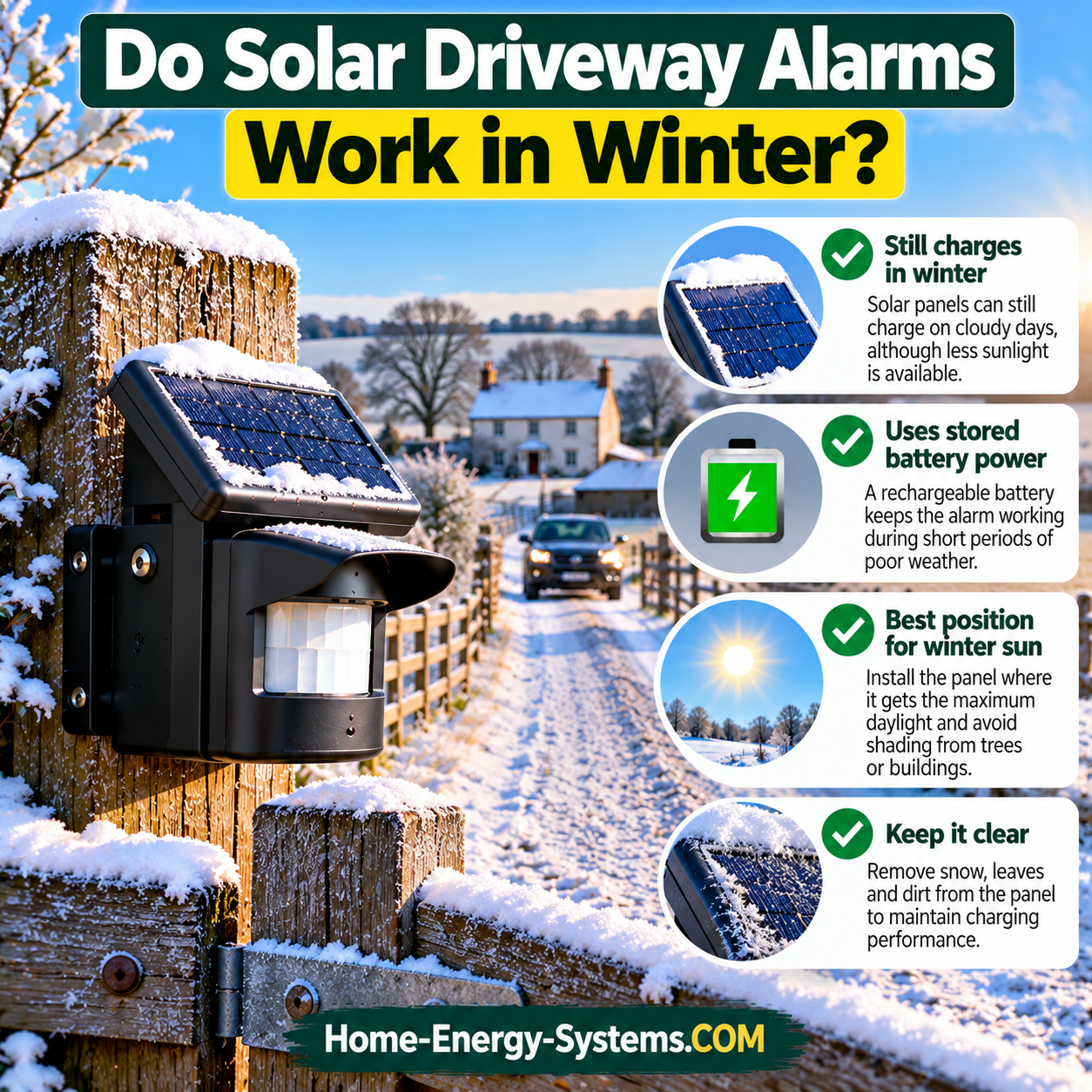
Solar driveway alarms can operate through winter, but performance depends on available daylight, battery capacity, energy consumption and local weather conditions.
Short winter days and prolonged cloud cover reduce the energy available for charging. Snow covering the panel can also prevent useful charging.
Improving Winter Reliability
- Position the panel where it receives good daylight exposure.
- Keep panels clear of leaves, dirt and snow.
- Check whether the system supports an external solar panel.
- Choose equipment rated for local winter temperatures.
- Monitor battery condition where the system provides this information.
- Inspect the system after prolonged poor weather.
7. How to Install a Solar Driveway Alarm on a Farm
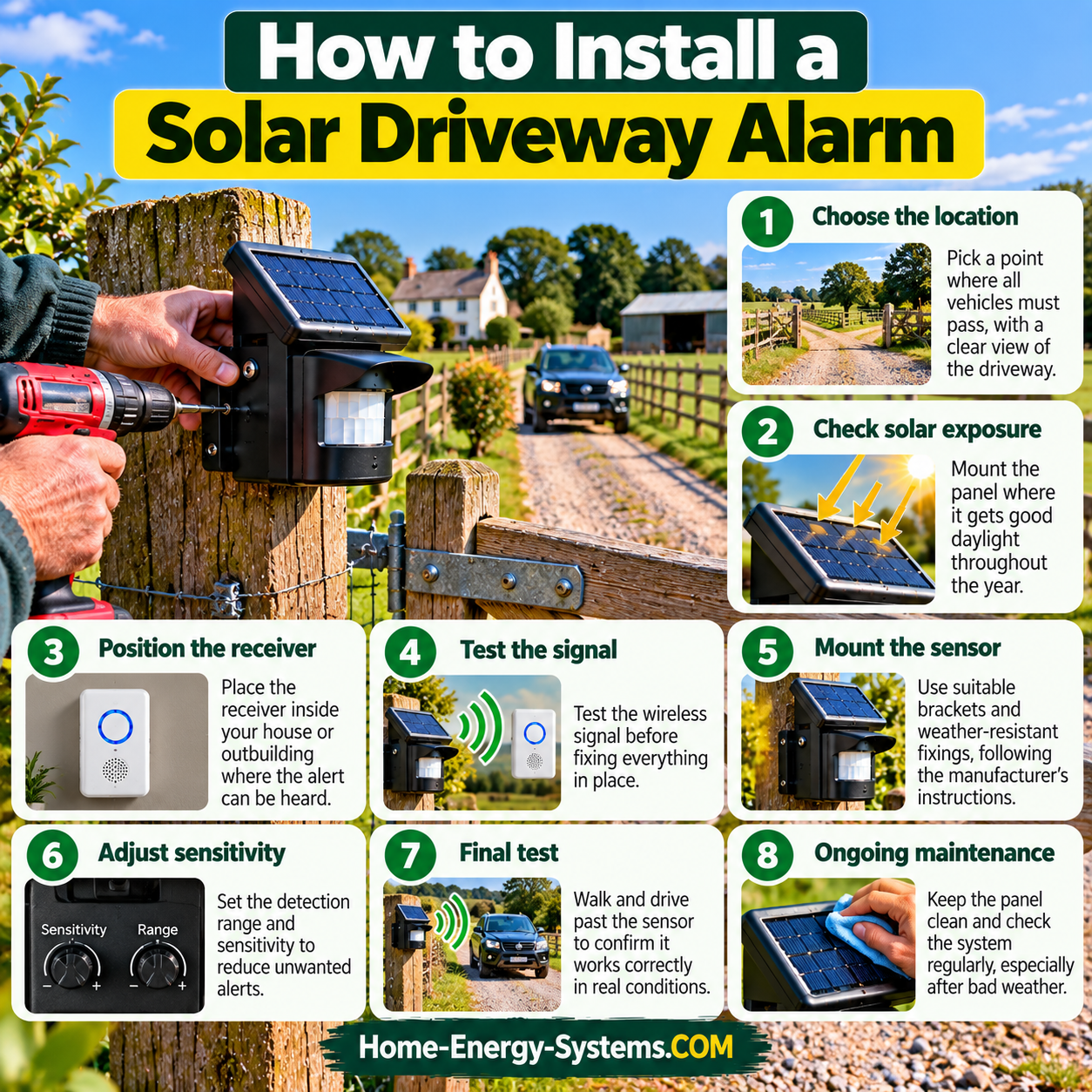
Most self-contained solar driveway alarms are designed for relatively straightforward installation, although the process varies between manufacturers.
Step 1: Select the Detection Location
Choose a point where approaching vehicles or visitors must pass. Avoid areas with unnecessary movement from livestock or public traffic.
Step 2: Check Solar Exposure
Ensure the charging panel receives sufficient daylight throughout the year. Winter shading is particularly important.
Step 3: Position the Receiver
Place the receiver where the alert can be heard or seen. Farmhouses with thick walls may require additional receivers.
Step 4: Test Wireless Communication
Temporarily position the sensor and test several activations before mounting it permanently.
Step 5: Mount the Equipment
Use suitable brackets and weather-resistant fixings, following the manufacturer’s mounting-height and alignment instructions.
Step 6: Adjust Sensitivity
Configure the detection area to reduce unwanted alerts without missing approaching vehicles.
Step 7: Test and Maintain
Repeat tests in different weather conditions. Inspect mounting hardware, solar panels and nearby vegetation periodically.
For additional entrance protection, see our farm gate security systems guide.
8. Choosing the Right Solar Driveway Alarm
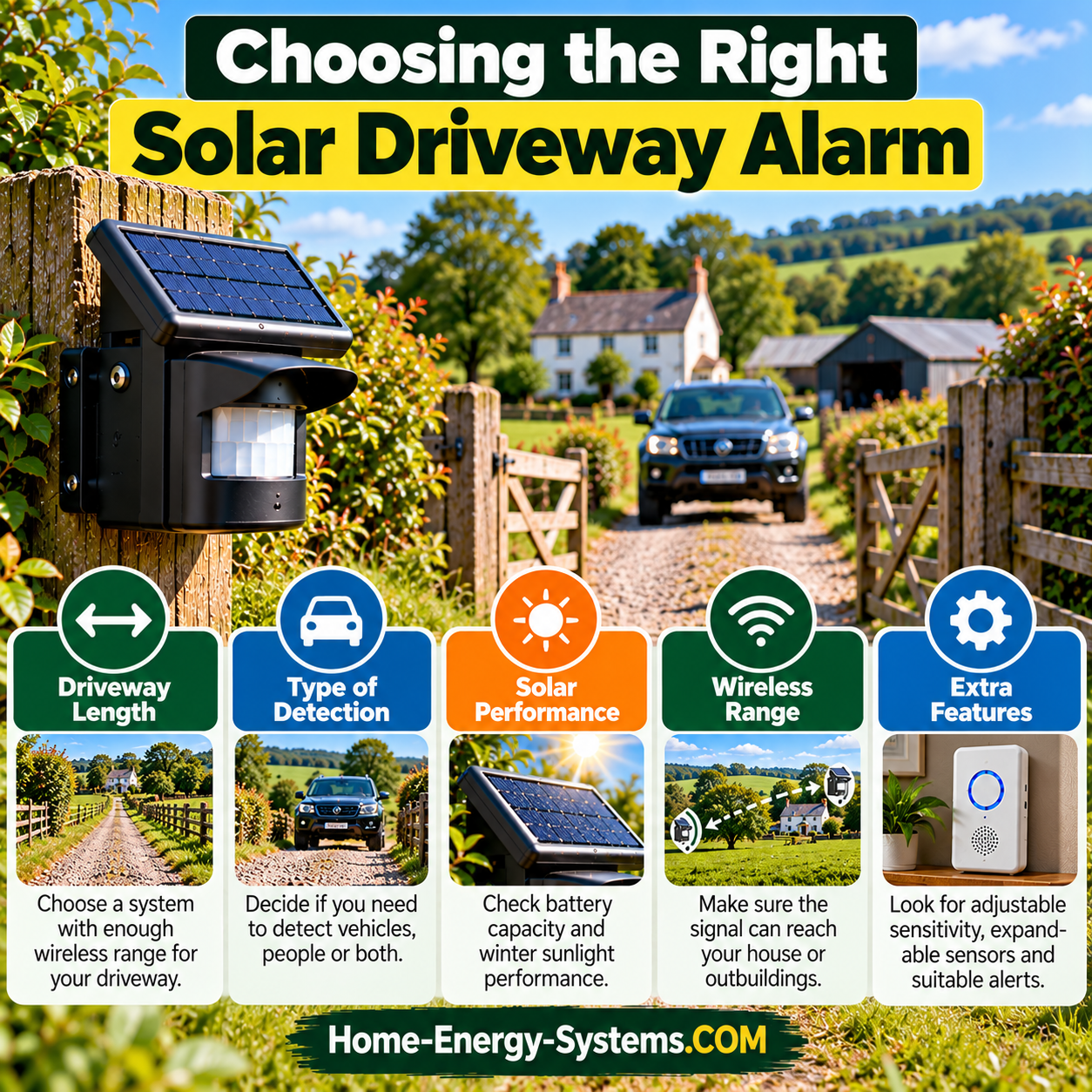
The most suitable alarm depends on the length of your driveway, surrounding landscape, available power and the type of activity you need to detect.
| Farm situation | Recommended approach |
|---|---|
| Short rural entrance | Solar PIR sensor with indoor receiver |
| Long farm driveway | Long-range wireless sensor or beam system |
| Frequent wildlife movement | Adjustable narrow-zone sensor or vehicle probe |
| Remote entrance without electricity | Solar-powered outdoor detector |
| Several gates or entrances | Expandable multi-sensor alarm system |
| Unoccupied remote property | System with compatible remote notifications |
Questions to Ask Before Buying
- What is the realistic wireless range on my property?
- Does the alarm detect vehicles, people or both?
- How much winter daylight does the solar panel require?
- Can the system operate during several cloudy days?
- Is the receiver mains-powered or battery-powered?
- Can additional sensors or receivers be connected?
- Is the equipment suitable for year-round outdoor use?
- Will the alarm work without Wi-Fi or cellular coverage?
9. Add a Solar Security Camera for Visual Verification
A driveway alarm can tell you that something has entered your property, but it usually cannot show you who or what triggered the alert.
Adding a solar security camera near the entrance can provide useful visual information. You may be able to check whether the movement came from a visitor, delivery vehicle, livestock or an unfamiliar person.
These cameras are complementary security products, not replacements for dedicated long-range driveway alarms. Camera detection distances are generally much shorter than the radio communication distances advertised by specialist driveway alarms.
ieGeek S11 4G Solar Security Camera
The ieGeek S11 is designed for locations where conventional Wi-Fi is unavailable but a compatible mobile network is accessible.
- 4G LTE connectivity using a SIM card
- Solar panel and rechargeable battery
- 2K video recording
- PIR motion detection and person alerts
- Pan-and-tilt camera coverage
- Mobile viewing through the ieGeek app
Best suited to: Remote farm gates, tracks, sheds and entrances with reliable cellular coverage.
Check before buying: Network compatibility, mobile data charges, detection distance and available sunlight. This is not a long-range driveway receiver system.
View ieGeek 4G Solar Cameras →ieGeek S1 Pro Solar Security Camera
The ieGeek S1 Pro combines an integrated solar panel with rechargeable battery power, high-resolution video and configurable motion alerts.
- 5MP video resolution
- Integrated solar charging
- 2.4GHz Wi-Fi connectivity
- PIR and configurable motion detection
- Colour night vision
- Two-way audio and spotlight
Best suited to: Farmhouse entrances, nearby gates, workshops and outbuildings within reliable Wi-Fi coverage.
Check before buying: Wi-Fi signal strength at the installation point, battery performance and whether particular AI detection features require payment.
View ieGeek Solar Wi-Fi Cameras →Product availability, mobile network requirements and delivery regions can vary. The affiliate link above leads to the ieGeek EU store; readers outside Europe should check availability in their country.
For more options, see our best 4G security cameras for farms guide.
Frequently Asked Questions
Are solar driveway alarms suitable for farms?
Yes. They can provide early warning at remote entrances without requiring mains electricity at the sensor location. Choose a system designed for the property’s distance and environmental conditions.
Do solar driveway alarms need Wi-Fi?
Many do not. Traditional wireless driveway alarms use direct radio communication between the outdoor sensor and indoor receiver. App-connected systems may require additional connectivity.
Can deer or livestock trigger a driveway alarm?
Yes. PIR sensors can respond to moving animals. Correct positioning, sensitivity adjustment and alternative detection technologies can help reduce unwanted alerts.
How far can a wireless driveway alarm transmit?
Range varies significantly by model. Some long-range products advertise communication distances of hundreds of metres or more, but obstacles can substantially reduce actual performance.
Will a solar driveway alarm work during cloudy weather?
It may continue operating using stored battery energy. Reliability depends on battery capacity, energy consumption, available daylight and the system’s charging design.
Can several driveway sensors connect to one receiver?
Some systems support multiple sensors and separate alert tones. Check the manufacturer’s compatibility information before buying additional equipment.
Is a solar security camera the same as a driveway alarm?
No. A dedicated driveway alarm is primarily designed to detect approaching activity and provide an early warning. A solar security camera captures images or video and may send motion alerts. Using both can provide more complete entrance monitoring.
Can a solar security camera work without Wi-Fi?
Yes, some 4G LTE solar cameras can use a cellular data connection instead of Wi-Fi. They require compatible network coverage and may involve ongoing data costs.
Final Thoughts: Are Solar Driveway Alarms Worth It?
For many farms and rural properties, solar driveway alarms provide a practical way to improve awareness of approaching vehicles and visitors.
The key is choosing equipment suited to the actual property rather than relying only on advertised wireless range.
Long driveways require dependable communication. Farms with livestock need carefully controlled detection areas. Remote locations also benefit from solar charging and suitable battery reserves.
A driveway alarm works best as one part of a wider security plan that may include gates, lighting, cameras and regular property checks.
Where visual confirmation is useful, a compatible solar security camera can provide another layer of protection without requiring a mains electricity supply at the entrance.
Protect Your Farm Entrance
Explore our practical guides to rural security cameras, remote monitoring and farm gate protection.
Editorial note: Product capabilities, availability and prices vary by market. Verify specifications, local compatibility and warranty terms before purchase. This article provides general buying and installation guidance and does not claim hands-on product testing.