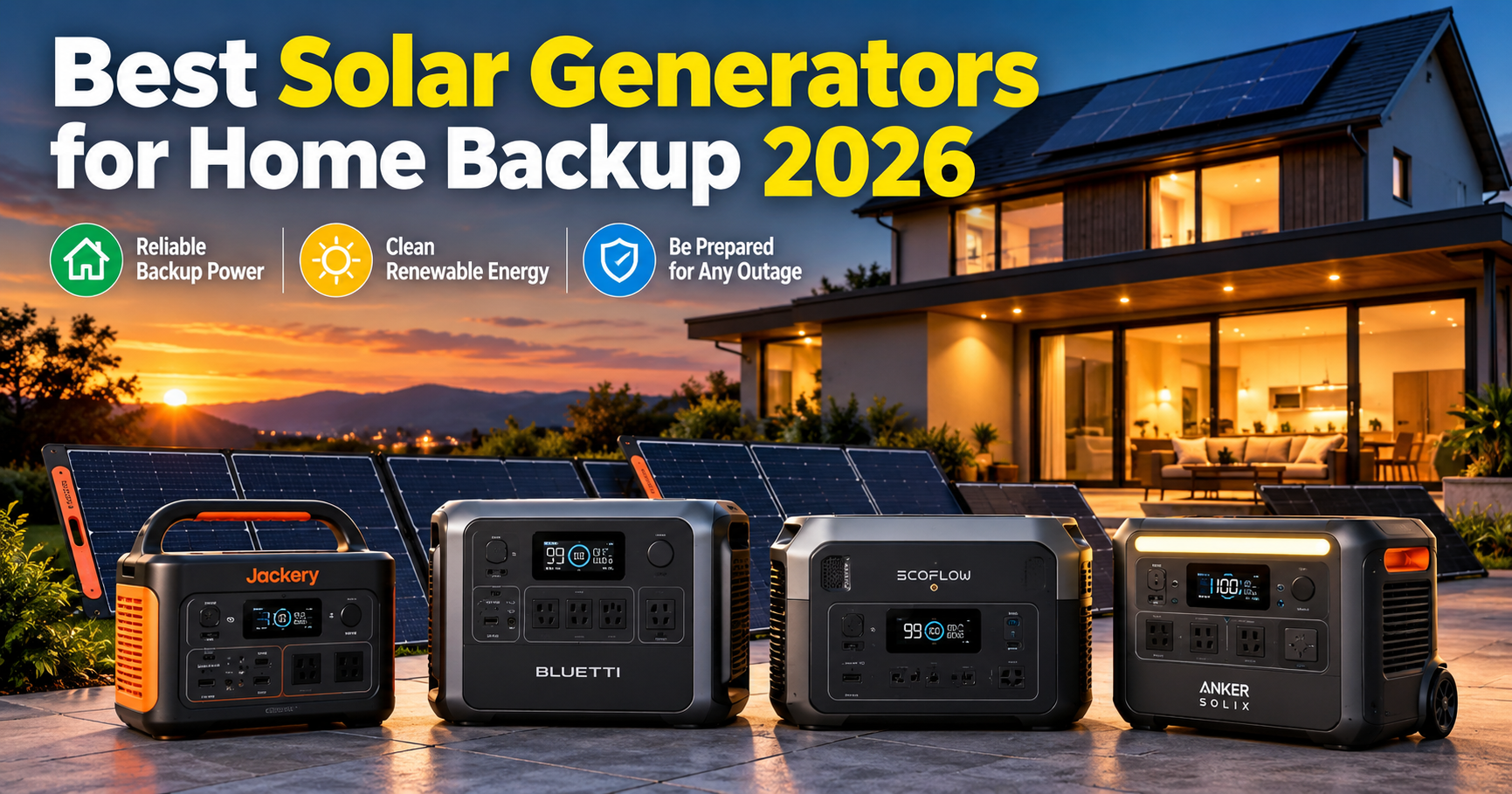
Best Solar Generators for Home Backup 2026: Complete Buying Guide
The best solar generators for home backup can keep essential appliances running during a power cut without relying on a petrol or diesel generator. A rechargeable battery, inverter and compatible solar panels can provide useful emergency electricity for refrigeration, lighting, internet equipment and other selected loads.
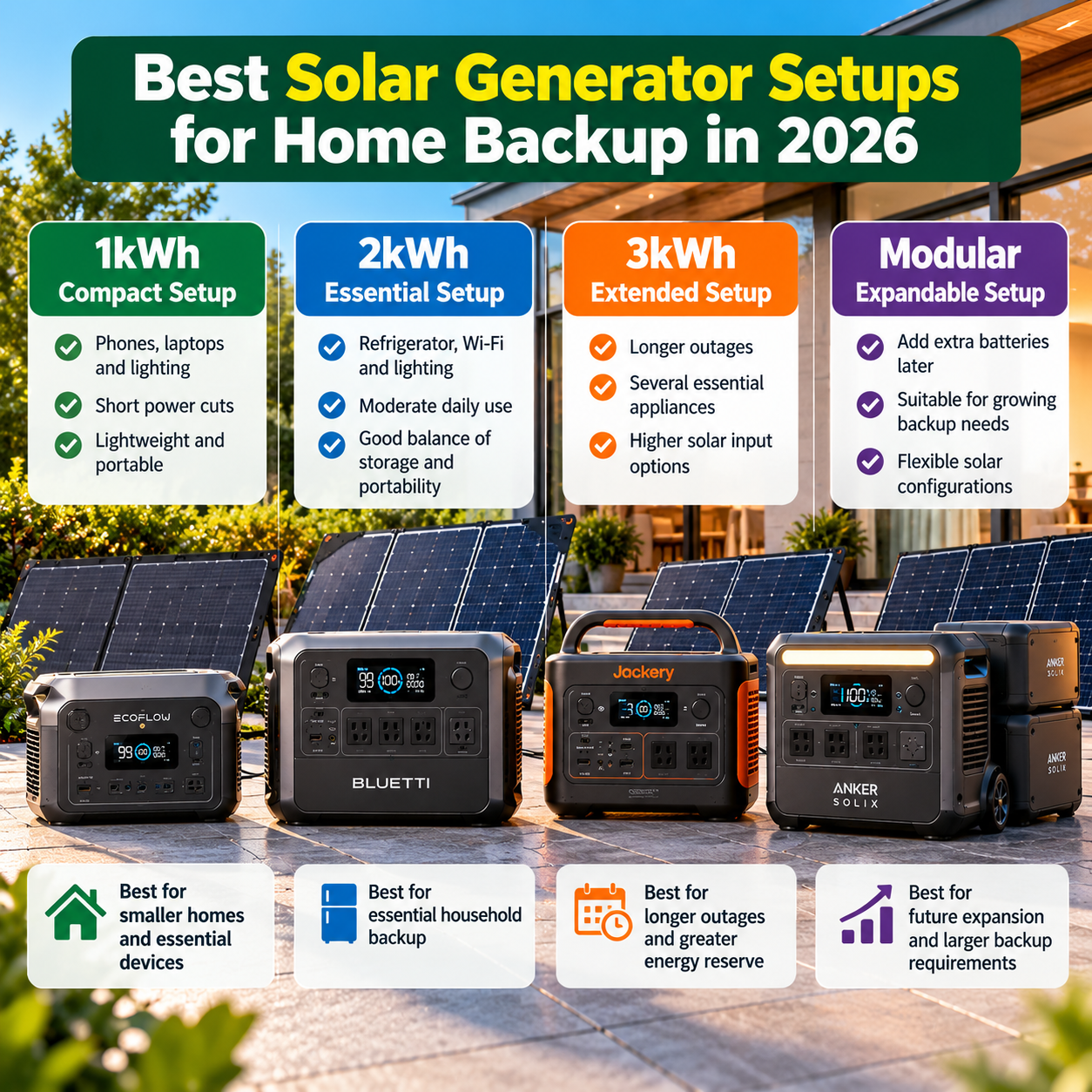
But not every solar generator is suitable for every household. A compact 1kWh model may cover communications and lights, while larger 3–4kWh systems can support more demanding equipment or longer outages. Solar input, regional electrical compatibility and safe connection methods matter just as much as battery size.
This 2026 guide explains how to compare solar-ready backup systems, estimate realistic runtimes, size solar panels and decide whether a portable system or a permanently installed home battery is the better choice.
1. What Is a Solar Generator for Home Backup?
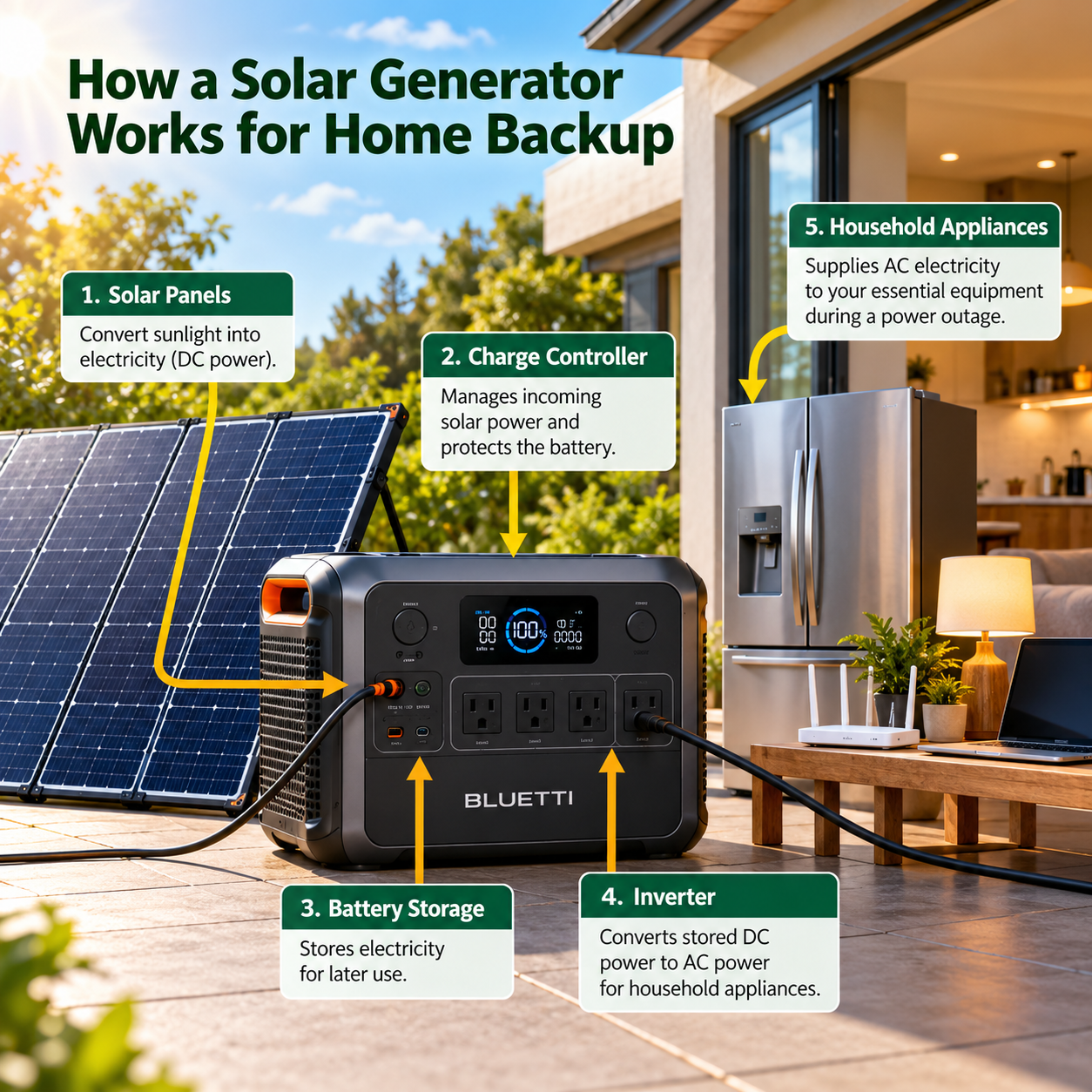
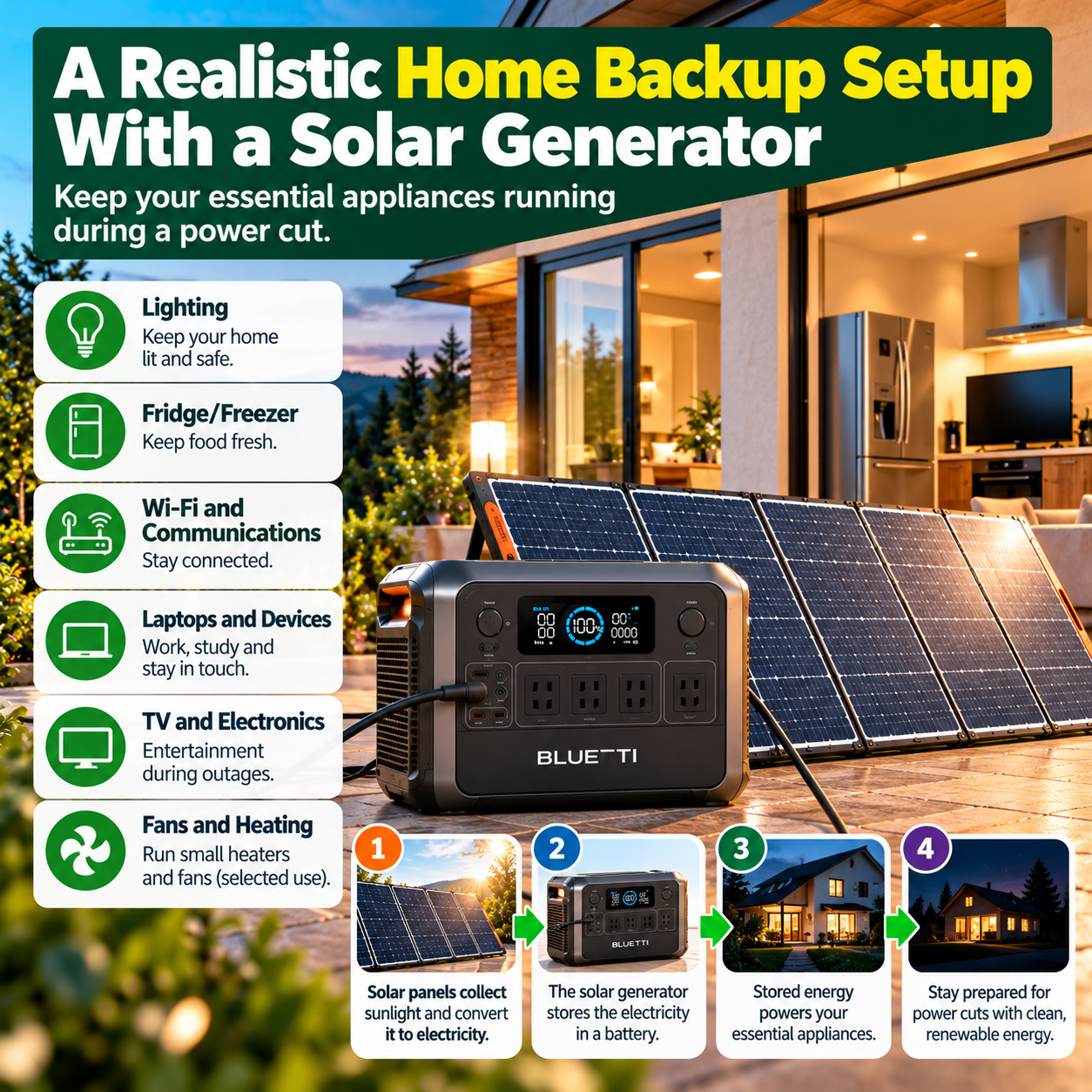
A solar generator is usually a portable power station paired with compatible solar panels. The panels produce direct-current electricity in sunlight. A built-in charge controller manages battery charging, while an inverter converts stored energy into alternating-current electricity for compatible household appliances.
Unlike a fuel generator, the battery system produces no combustion exhaust at the point of use. However, it cannot create electricity at night or in poor sunlight: once the battery is depleted, it must be recharged from solar panels, the grid or another approved source.
Important distinction: Battery capacity, measured in watt-hours (Wh), determines stored energy. Inverter output, measured in watts (W), determines the amount of power that can be supplied at once. Both must suit your appliances.
2. Best Solar Generators for Home Backup Compared
| Model | Battery capacity | AC output | Solar input |
|---|---|---|---|
| BLUETTI AC200L | 2,048Wh | 2,400W | Up to 1,200W |
| Anker SOLIX F3000 | 3,072Wh | 3,600W | Up to 2,400W combined PV inputs |
| EcoFlow DELTA Pro 3 | 4,096Wh | 4,000W | Up to 2,600W |
Figures are manufacturer-published specifications for the referenced configurations, not independently measured performance. Socket types, AC voltage, transfer accessories and availability differ by market. In particular, the referenced Anker F3000 configuration is a North American model.
Manufacturer references: BLUETTI AC200L, Anker SOLIX F3000 and EcoFlow DELTA Pro 3.
3. Which Solar Generator Should You Choose?
BLUETTI AC200L — Useful for Essential Loads
The BLUETTI AC200L has a 2,048Wh LFP battery, 2,400W continuous AC output and a maximum published solar input of 1,200W. It is a practical specification range for keeping selected appliances operating without moving to a much larger battery system.
Best suited to: Refrigeration, lighting, routers, laptop charging and other essential loads within the unit’s output limits. The AC200L may be unavailable in some stores, so check stock and compare current alternatives rather than assuming it can be ordered.
Check BLUETTI USACheck BLUETTI UKAffiliate links to regional stores; availability of this exact model is not guaranteed.
Anker SOLIX F3000 — For More Stored Energy
The published North American F3000 configuration offers 3,072Wh of LFP battery storage, 3,600W AC output and two solar input channels with a combined rated maximum of 2,400W. It offers more stored energy than a typical 2kWh-class system and supports compatible expansion equipment.
Best suited to: US households wanting a larger emergency backup system with solar charging. Buyers elsewhere should verify whether a locally compatible alternative is available.
EcoFlow DELTA Pro 3 — For Extended Essential Backup
The EcoFlow DELTA Pro 3 has 4,096Wh of LFP storage, 4,000W rated AC output and up to 2,600W of solar charging input on the referenced European specification. Compatible extra batteries can increase total stored energy.
Best suited to: Households that prioritise longer runtimes and larger electrical loads, provided they have the budget and space for a heavier unit. A high inverter rating does not mean every high-demand appliance can be operated indefinitely.
4. How Much Solar Generator Battery Capacity Do You Need?
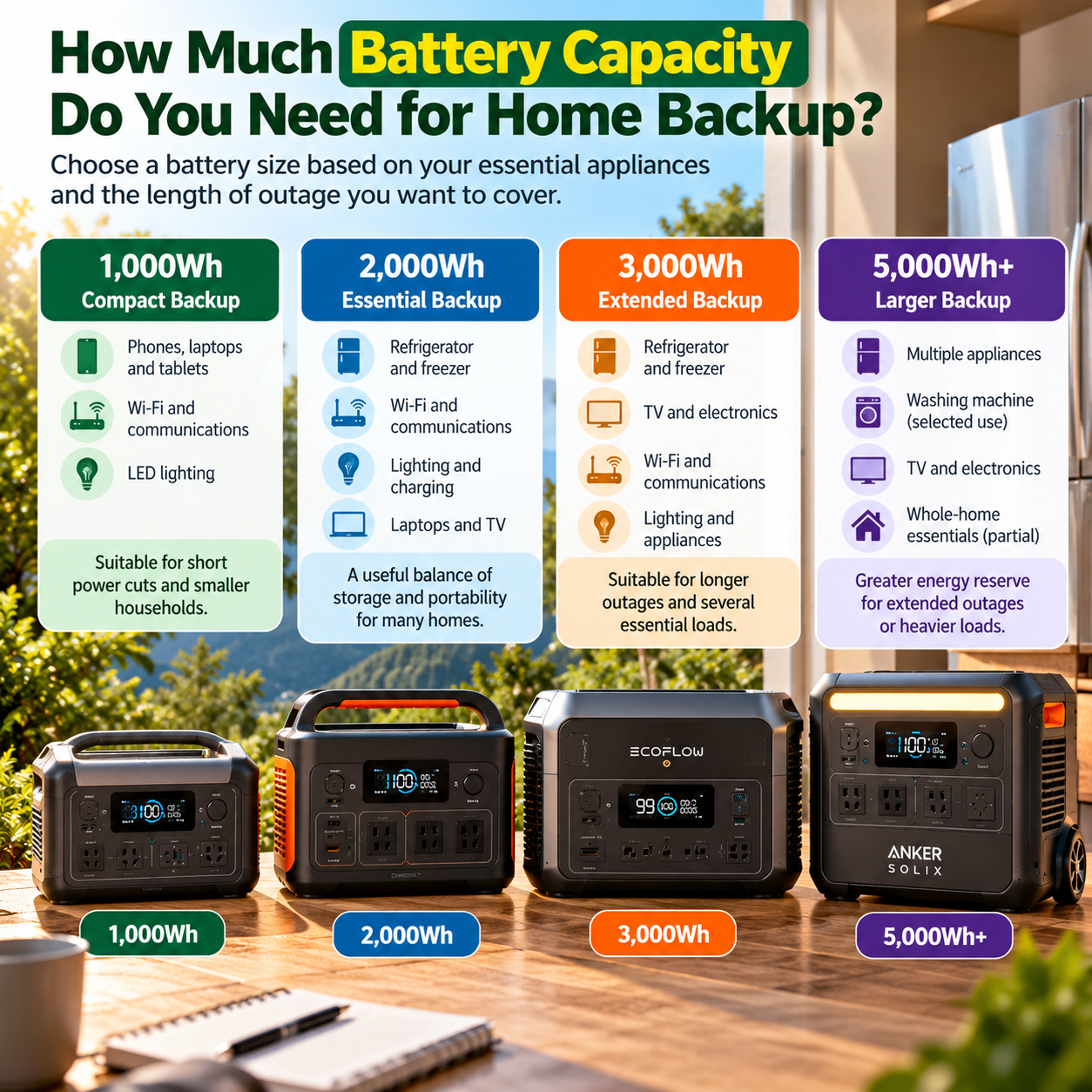
Start by listing only the appliances you truly need during an outage. Note their running power in watts and estimate how many hours each will operate. Refrigerators and freezers cycle on and off, so their average power over a day may be lower than their instantaneous running power.
| Battery size | Potential use | Trade-off |
|---|---|---|
| Around 1kWh | Internet, phones, lights and small electronics | Limited energy reserve |
| Around 2kWh | Selected refrigeration and multiple essential devices | Moderate outage duration |
| 3–4kWh | More simultaneous essentials or longer runtimes | Greater weight and cost |
| Expandable or installed system | Multi-day plans and selected home circuits | More complex design and installation |
For a deeper explanation of battery storage, see our home battery storage systems guide.
5. How Long Will a Solar Generator Power Your Home?
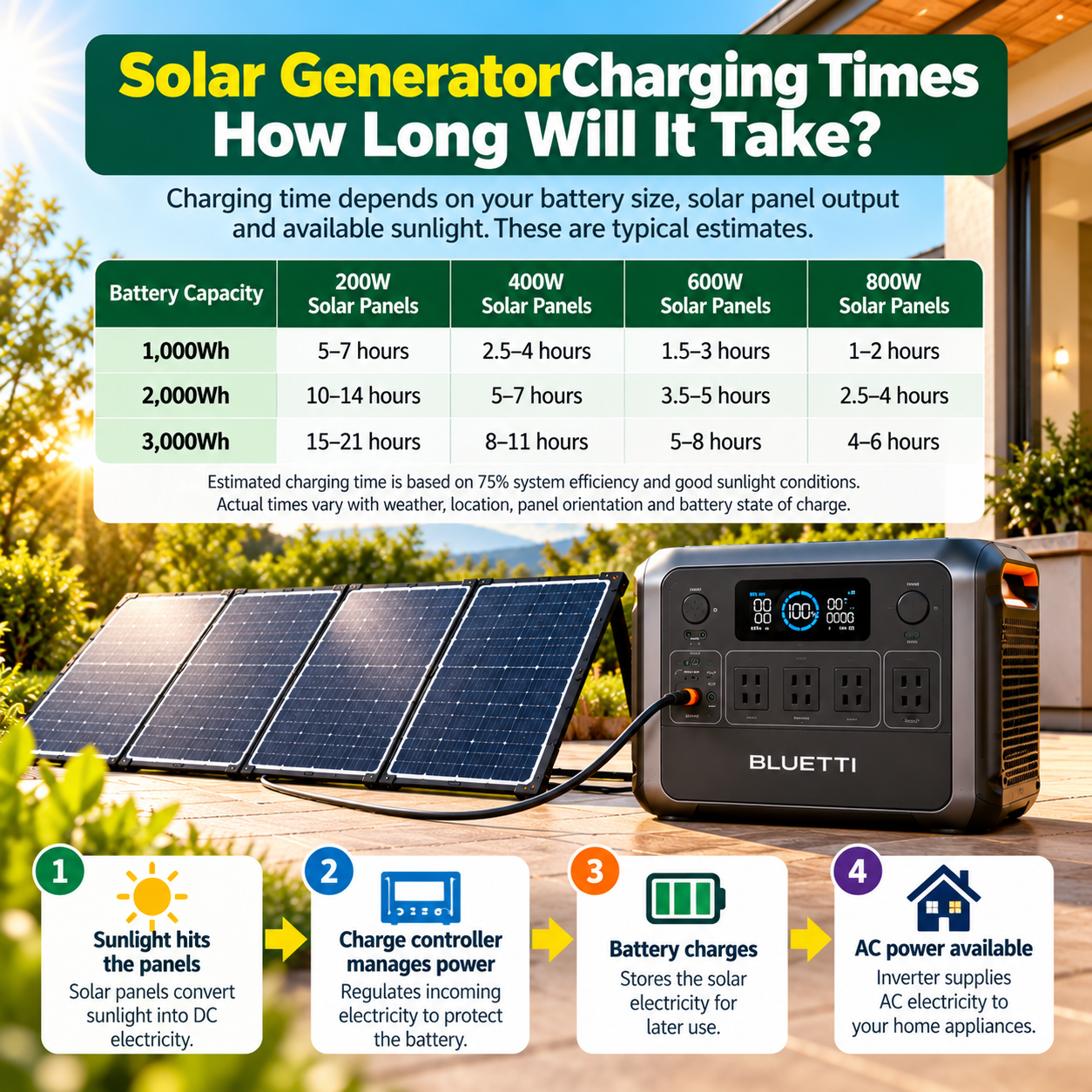
Runtime depends on usable battery energy and the average connected load. For an illustrative estimate, allow 85% of the advertised battery capacity for AC-powered equipment. Actual usable energy can be higher or lower.
Estimated hours = Battery capacity (Wh) × 0.85 ÷ average load (W).
Example: 2,048Wh × 0.85 ÷ 100W = approximately 17.4 hours.
| Average load | 2,048Wh battery | 3,072Wh battery | 4,096Wh battery |
|---|---|---|---|
| 50W | 34.8 hours | 52.2 hours | 69.6 hours |
| 100W | 17.4 hours | 26.1 hours | 34.8 hours |
| 200W | 8.7 hours | 13.1 hours | 17.4 hours |
| 500W | 3.5 hours | 5.2 hours | 7.0 hours |
These are calculations, not tested manufacturer runtimes. Inverter standby losses, temperature, battery ageing and compressor startup behaviour all affect real-world results.
Will a Solar Generator Run a Fridge Overnight?
Often, yes, if the inverter can handle the compressor startup surge and the battery has sufficient usable energy. Measure the refrigerator’s actual daily energy consumption for a more reliable estimate.
Can It Run a Heat Pump or Electric Heater?
Some larger units may power certain appliances for limited periods, but electric heating can exhaust even a substantial battery quickly. Check startup demands and avoid treating a portable solar generator as a whole-home heating solution.
6. How Many Solar Panels Do You Need to Recharge a Solar Generator?
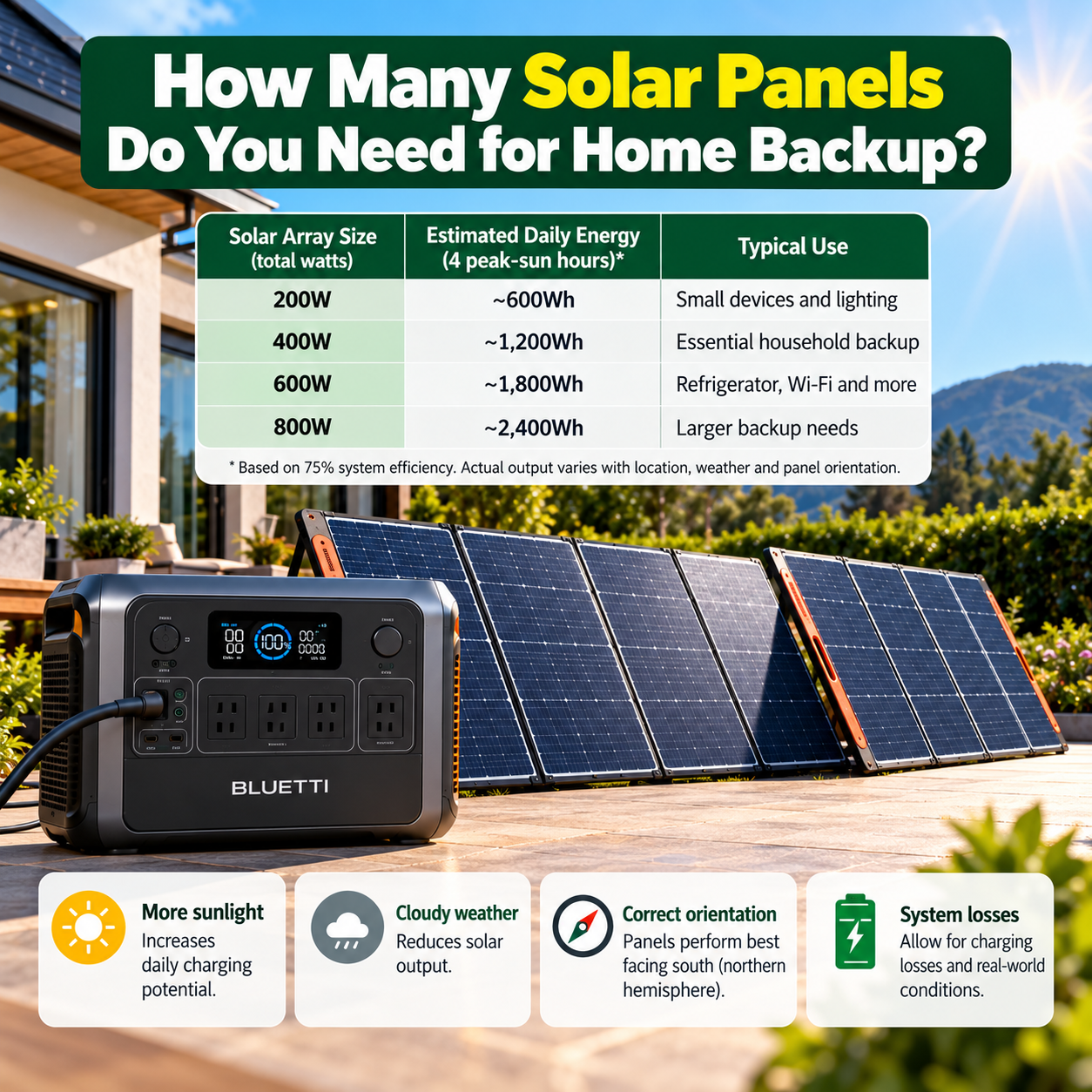
The number of panels depends on battery size, permitted solar input voltage and current, local sunlight and daily energy consumption. Solar panel wattage is a laboratory rating, not a promise of continuous production.
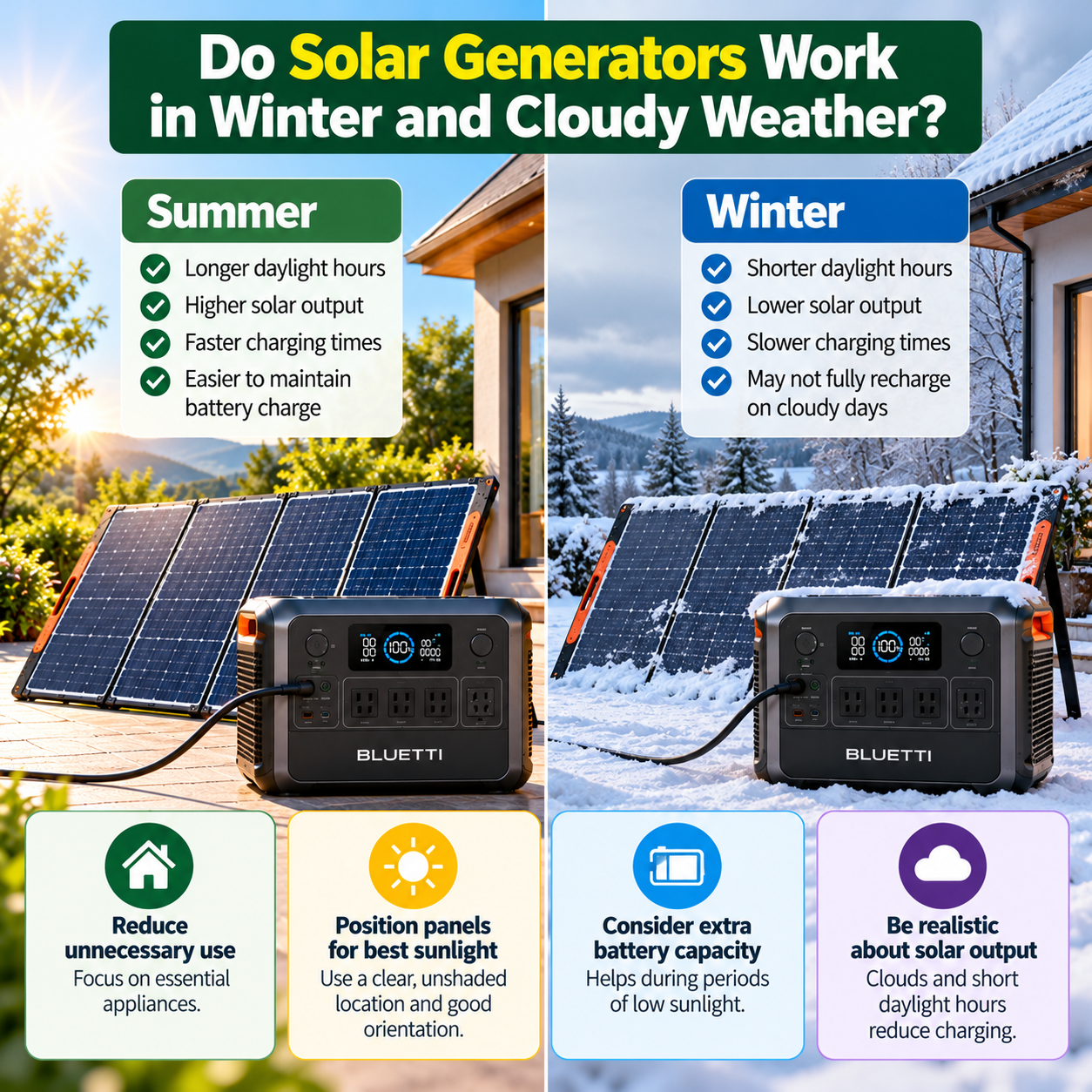
For example, a 400W array receiving four equivalent peak-sun hours would produce a theoretical 1,600Wh before real-world losses. At an illustrative 75% overall yield, that becomes approximately 1,200Wh reaching the battery. Winter clouds, shade and poor panel orientation can reduce production significantly.
Solar Panel Sizing Checklist
- Calculate how much electricity your essential appliances use each day.
- Check the power station’s solar voltage range, current limit and maximum input power.
- Use compatible connectors and suitable cable ratings.
- Estimate local winter sunlight, not just ideal summer conditions.
- Allow extra generating capacity where practical, without exceeding manufacturer limits.
For more information about selecting panels, read our solar panel installation guide.
7. How to Set Up a Solar Generator Safely for Home Backup
- Identify your essentials. List the devices that must work during an outage.
- Check electrical requirements. Confirm the correct regional AC voltage, frequency, sockets and appliance startup loads.
- Choose a suitable location. Follow manufacturer requirements for ventilation, moisture protection and operating temperature.
- Match solar panels carefully. Verify voltage, current, connectors and permitted input power.
- Charge and test before an outage. Confirm actual appliance operation and observe battery consumption.
- Plan recharging. Decide how you will replenish the battery if poor weather continues for several days.
Plugging suitable appliances directly into the power station is different from connecting it to household wiring. Never backfeed a building through a normal wall socket. Supplying fixed home circuits requires an approved transfer arrangement designed and installed by a qualified electrician.
Solar generators do not emit combustion exhaust during battery operation, but they still require proper ventilation and adherence to the manufacturer’s electrical and fire-safety instructions. Read Ready.gov’s power outage guidance for additional emergency preparedness advice.
8. What to Check Before Buying a Solar Generator in 2026
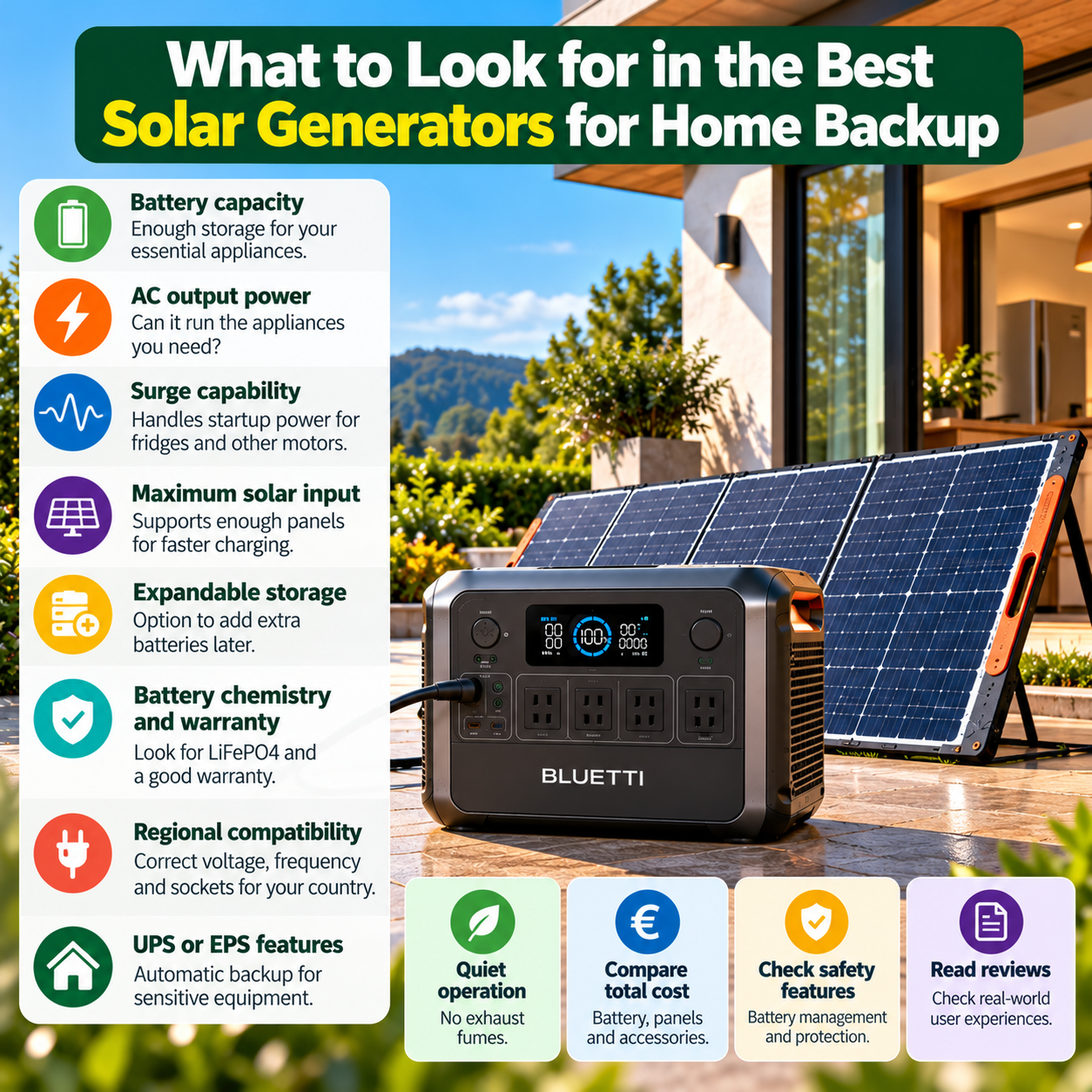
Battery Chemistry and Cycle Life
Many modern home-backup stations use lithium iron phosphate (LFP) batteries. Compare published cycle-life figures, warranties and storage instructions rather than assuming all LFP products last equally long.
AC Output and Startup Surge
Make sure the continuous output supports your combined running appliances and the surge capability can start motors such as refrigerator compressors and pumps.
Solar Charging and Expansion
Compare real solar input limits and compatible expansion batteries. A large battery with very little solar input may take longer than expected to recharge during an extended outage.
UPS and Transfer Features
Some systems automatically switch to battery power after grid failure, but transfer times and compatibility vary. For critical medical or computing equipment, verify the manufacturer’s guidance and use purpose-designed backup where necessary.
Regional Support and Total Cost
Check the cost of panels, cables, expansion batteries, transfer equipment, delivery and warranty support. A solar-ready power station does not always include solar panels in the advertised price.
Where to Compare Solar Backup Suppliers
BLUETTI offers a range of portable and expandable battery systems. PECRON is another supplier to compare for portable power and compatible charging equipment. These links are supplier referrals, not a claim that every model is suitable for every home.
BLUETTI USABLUETTI UKExplore PECRONAffiliate referral links. Verify local stock and electrical compatibility.
Solar Generator vs Permanently Installed Home Battery
A portable solar generator is convenient for selected appliances and occasional outages. A professionally designed home battery may be better for automatic household-circuit backup, higher energy demand and permanent solar integration. See our home backup power systems comparison for more options.
You can also explore regional suppliers in our Where to Buy Solar Energy Products
Frequently Asked Questions About Solar Generators for Home Backup
What is the best solar generator for home backup in 2026?
There is no universal winner. The BLUETTI AC200L offers a 2kWh-class specification, the Anker SOLIX F3000 offers a larger 3kWh-class North American configuration, and the EcoFlow DELTA Pro 3 offers 4kWh-class storage. Choose according to your load, runtime needs and regional compatibility.
Can a solar generator power an entire house?
Most portable units are better suited to essential loads. Whole-house backup requires sufficient inverter power, much larger stored energy in many cases and safe integration with household wiring.
How long will a 2kWh solar generator last?
At a steady 100W average load, a 2,000Wh battery might provide around 17 hours using an illustrative 85% usable-energy assumption. Actual performance varies.
Do solar generators work during a power outage?
Yes, when charged and used with compatible appliances. Solar panels can recharge the battery during daylight, but production depends on weather and the panels’ installation.
Will a solar generator charge on cloudy days?
Usually yes, with compatible panels, but at a reduced rate. Extended poor weather may prevent the battery from recovering all the energy used each day.
Are solar panels included with a solar generator?
Not necessarily. Some packages include panels, while others sell the battery power station separately. Check the exact contents before ordering.
Can I connect a solar generator to my home fuse board?
Only through a properly designed, approved electrical arrangement installed by a qualified electrician. Never connect a generator or battery inverter to household wiring using an ordinary socket.
Are solar generators better than petrol generators?
Battery-based systems are quiet and have no combustion exhaust at the point of use, but their runtime depends on stored energy and recharging. Fuel generators may suit sustained high loads when fuel is available, but must never be operated indoors or near openings.
Is a 1kWh solar generator enough for home backup?
It may be sufficient for communications, lighting and small devices during shorter outages. Refrigeration or longer backup periods usually call for a careful energy calculation and potentially more capacity.
How much solar power is needed to recharge a 2kWh battery?
That depends on available sunlight and charging losses. A 400W array might deliver around 1.2kWh in a favourable four-peak-sun-hour day under an illustrative 75% yield, so a full recharge could take more than one day.
Final Verdict: Best Solar Generators for Home Backup 2026
The best solar generator is not simply the one with the largest battery. It is the system that can safely start your essential appliances, sustain them for the required time and recharge reliably from compatible solar panels.
For selected essential loads, a 2kWh-class unit is a reasonable starting point. For longer outages, look at 3–4kWh or expandable systems and calculate your daily energy needs before purchasing.
Compare BLUETTI USACompare BLUETTI UKAffiliate links; model availability and prices vary.
For more independent solar, battery and backup advice, visit Home Energy Systems dot com.