Best Portable Power Stations 2026: Top Picks for Home Backup
The best portable power stations in 2026 depend on which appliances you need during an outage, how long they must run and where you live. A 1kWh unit may cover communications and lighting; a 2–3kWh system can support refrigeration and several essentials for longer. Start with your household’s watt-hour requirements—not a brand ranking.
Below, we compare four models using published manufacturer specifications, calculate realistic household backup scenarios and explain where regional voltage, weight, expansion and charging limits change the buying decision.
How Did We Compare These Portable Power Stations?
We compared published battery capacity, continuous AC output, weight, solar input, expansion capability, electrical configuration and suitability for essential household loads. We did not assign an artificial numerical score: prices change frequently, and a product that wins on capacity may lose on portability or regional suitability.
- Capacity: stored watt-hours, which determine the starting point for runtime.
- Output: continuous AC watts and motor startup requirements.
- Portability: weight, handling and whether a unit can realistically be moved during an outage.
- Charging: solar-input limits and the difference between rated input and real-world production.
- Expandability: whether compatible extra batteries are supported.
- Region: voltage, frequency, sockets, local warranty and availability.
Source note: Manufacturer specifications are linked within the individual product sections. These sources establish advertised capabilities, not independent performance.
Which Portable Power Stations Are We Comparing?
| Model | Capacity | AC output | Key trade-off |
|---|---|---|---|
| BLUETTI Elite 200 V2 | 2,073.6Wh | 2,600W | 24.2kg; no battery expansion |
| Jackery HomePower 3000 | 3,072Wh | 3,600W | 27kg; US 120V/60Hz model |
| Anker SOLIX F3000 | 3,072Wh | 3,600W | 41.5kg; expandable; check region |
| EcoFlow DELTA 3 Plus | 1,024Wh | 1,800W | Compact; less initial stored energy |
Capacity is not the same as delivered AC energy. Also, the Jackery and Anker have identical stated starting capacities, so neither has an inherent runtime advantage at the same load under the same efficiency assumption.
BLUETTI Elite 200 V2: A Balanced 2kWh-Class Option
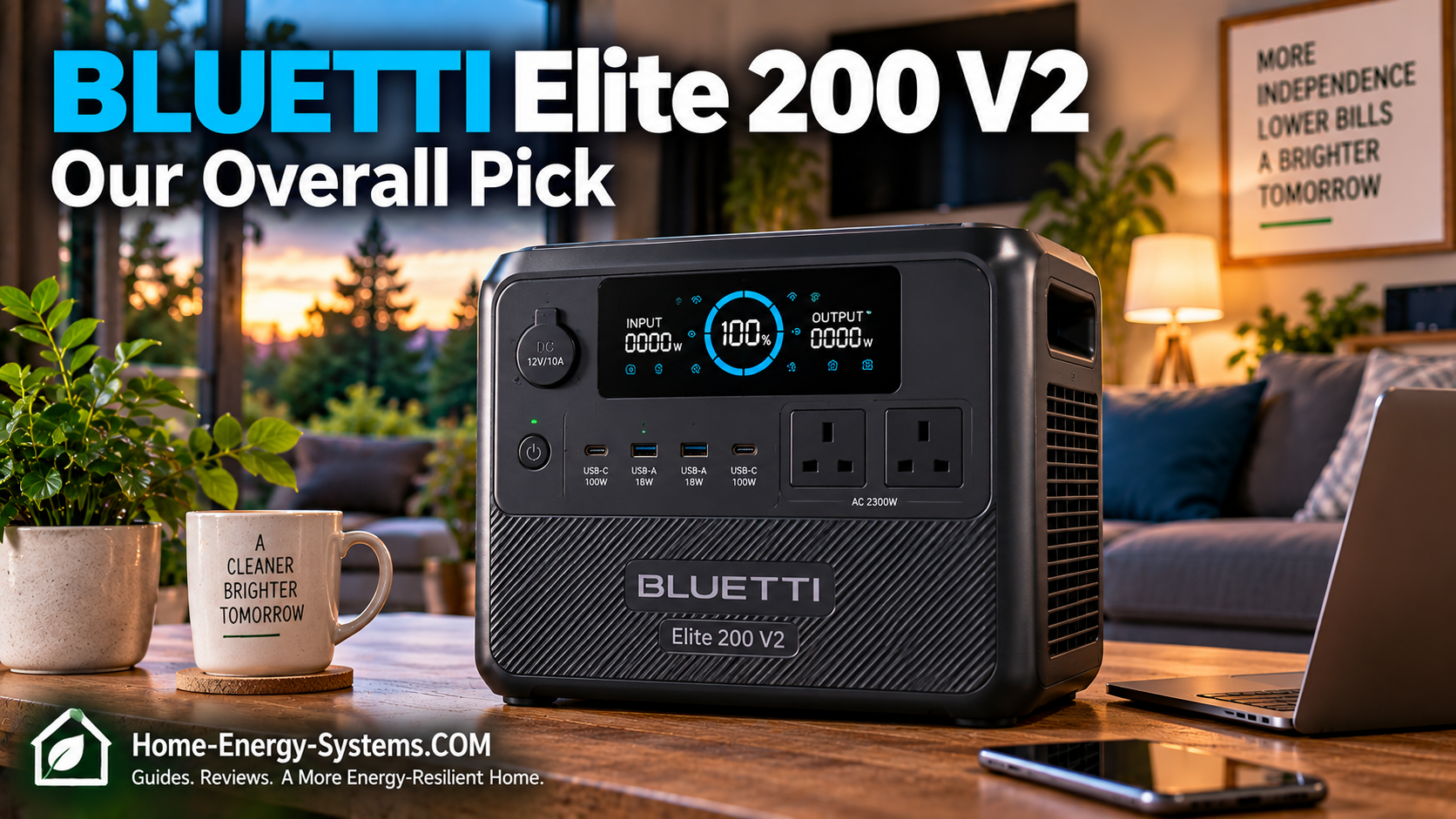
The Elite 200 V2 has 2,073.6Wh nominal capacity and 2,600W continuous AC output. BLUETTI specifies a 1,000W maximum solar input, 24.2kg weight and a five-year warranty on its US product page. It does not support expansion batteries.
Why it makes the shortlist: It offers substantially more stored energy than a 1kWh model without moving into the heaviest 3kWh-class equipment. The trade-off is that you cannot add a matching expansion battery later.
Important for low-power loads: Manufacturer guidance warns that ECO mode may switch off outputs under some conditions. Disable inappropriate automatic shutoff settings when supporting a refrigerator or other essential appliance, following the manual.
Who should avoid it? Households expecting to expand storage substantially, or anyone needing to run a high average load for multiple days without recharging.
Manufacturer sources: BLUETTI specifications and EU user manual.
BLUETTI Store — USABLUETTI Store — UKAffiliate links. Verify the exact model and regional sockets before purchasing.
Jackery HomePower 3000: More Initial Storage for US Households
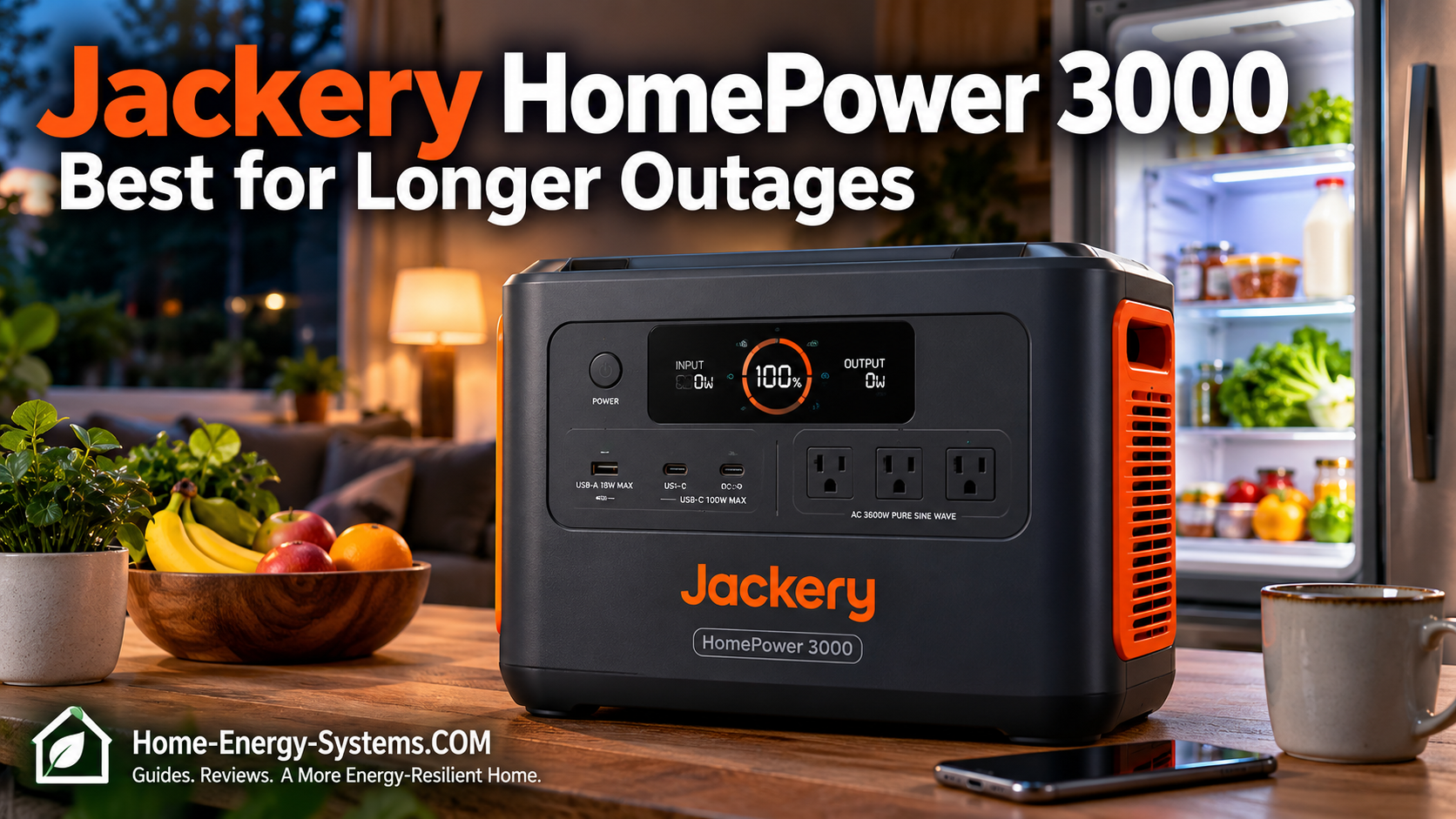
Jackery lists 3,072Wh storage, 3,600W total continuous AC output and 7,200W peak surge output for the HomePower 3000. The listed unit weighs approximately 27kg.
Why it makes the shortlist: Its larger initial battery is useful when a household wants more hours between recharges. Under equal assumptions it offers about 48% more starting capacity than the BLUETTI, but not more than the Anker F3000.
Important limitation: The documented HomePower 3000 is a 120V/60Hz US configuration. We would not recommend that version as a plug-and-play purchase for Irish, UK or other 230V households.
Who should avoid it? Buyers requiring 230V equipment support, or those who need confirmed expansion options that this particular model does not clearly offer.
Manufacturer source: Jackery HomePower 3000 specifications.
Anker SOLIX F3000: A Larger Expandable Backup Option
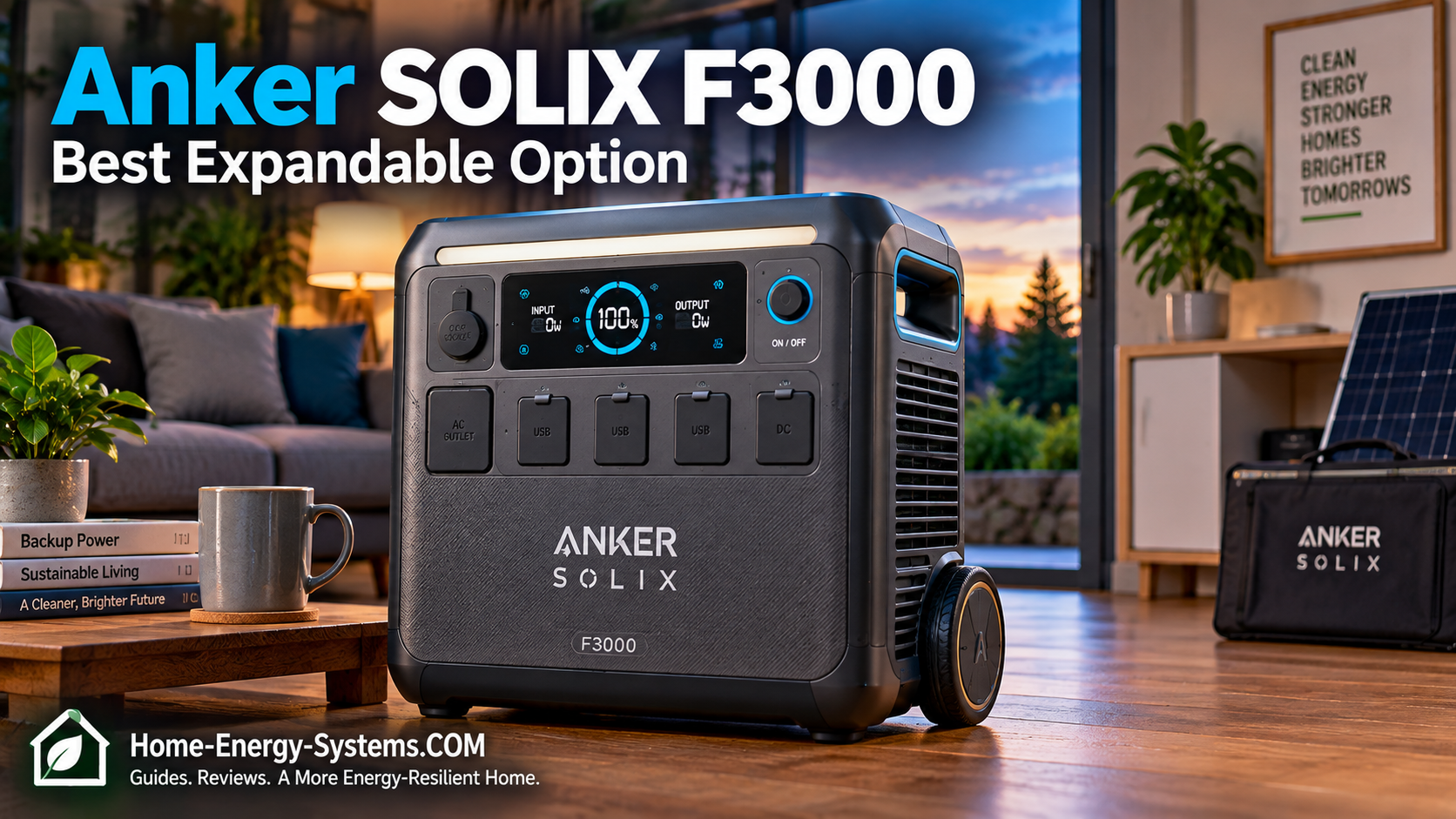
The F3000 starts at 3,072Wh and 3,600W continuous AC output. Anker lists compatible 3,072Wh BP3000 expansion batteries and up to 2,400W of solar input across two PV inputs for its US model.
Why it makes the shortlist: Unlike the non-expandable BLUETTI Elite 200 V2, this is designed around adding storage. That may matter more than the starting capacity if you want to extend outage coverage later.
Trade-off: Anker lists the base F3000 at about 41.5kg, considerably heavier than the Jackery HomePower 3000. A US F3000 produces 120V on its own; Anker specifies additional hardware and a second unit for certain 240V configurations.
Who should avoid it? Anyone needing an easily carried battery, or a buyer who has not confirmed a locally supported voltage configuration.
Manufacturer source: Anker SOLIX F3000 specifications.
EcoFlow DELTA 3 Plus: Compact Backup for Smaller Loads
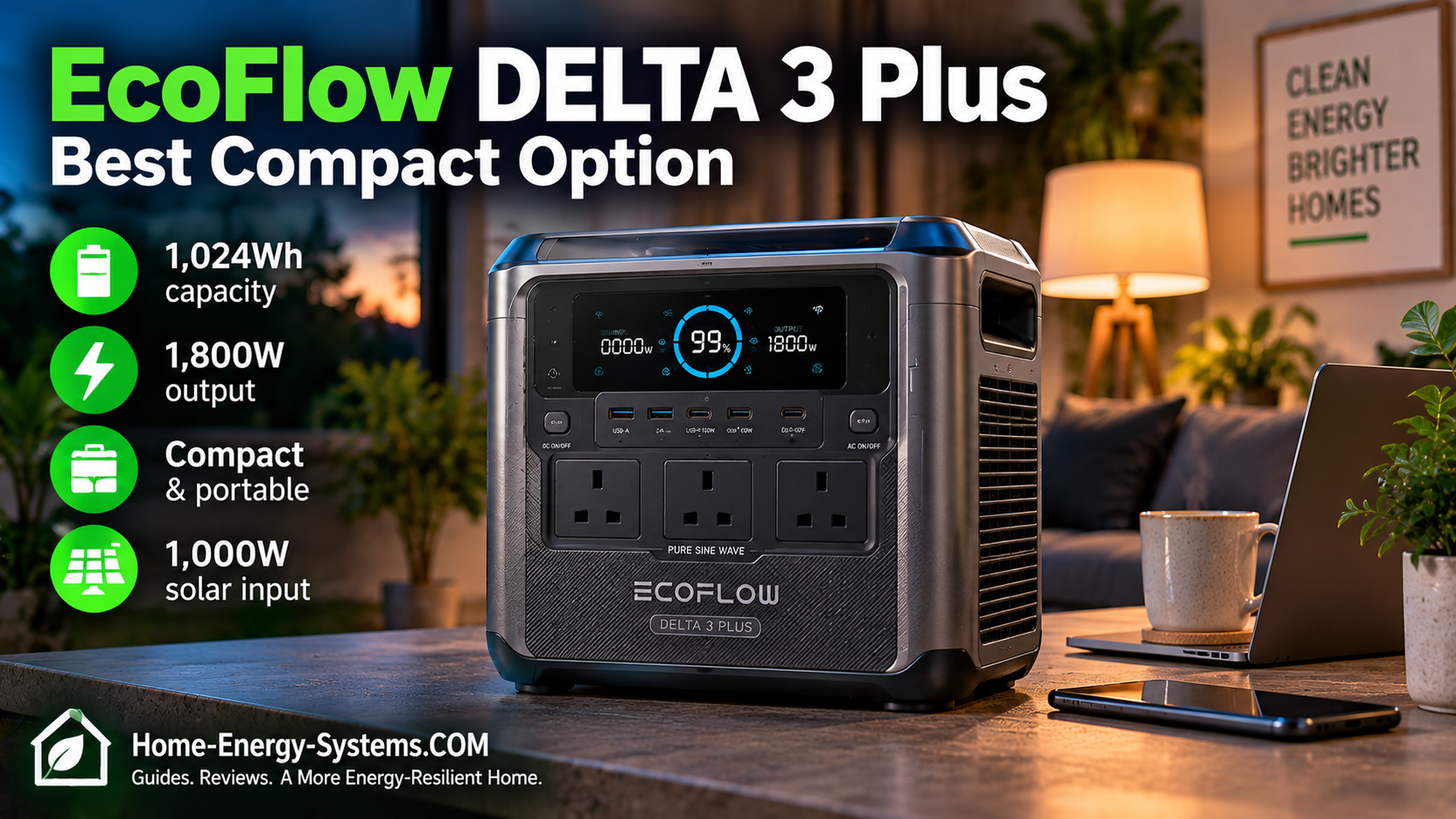
The DELTA 3 Plus combines a 1,024Wh battery with 1,800W continuous AC output. It can be appropriate for routers, lighting, laptops and shorter refrigeration backup when the appliance’s startup demand is compatible.
Why it makes the shortlist: You may not need a 3kWh battery for a few hours of communications and lighting. Choosing a smaller model can reduce the weight and cost of keeping essential devices running.
Trade-off: Its initial stored energy is roughly half that of the BLUETTI and one-third that of the Jackery and Anker. A high output rating does not change that limitation.
Who should avoid it? Households expecting a full day of refrigeration plus multiple other loads without a recharge. Check the locally sold DELTA 3 Plus model’s electrical configuration and compatible expansion options.
Manufacturer: EcoFlow product information; verify current regional specifications with the seller.
How Much Battery Capacity Does Your Household Actually Need?
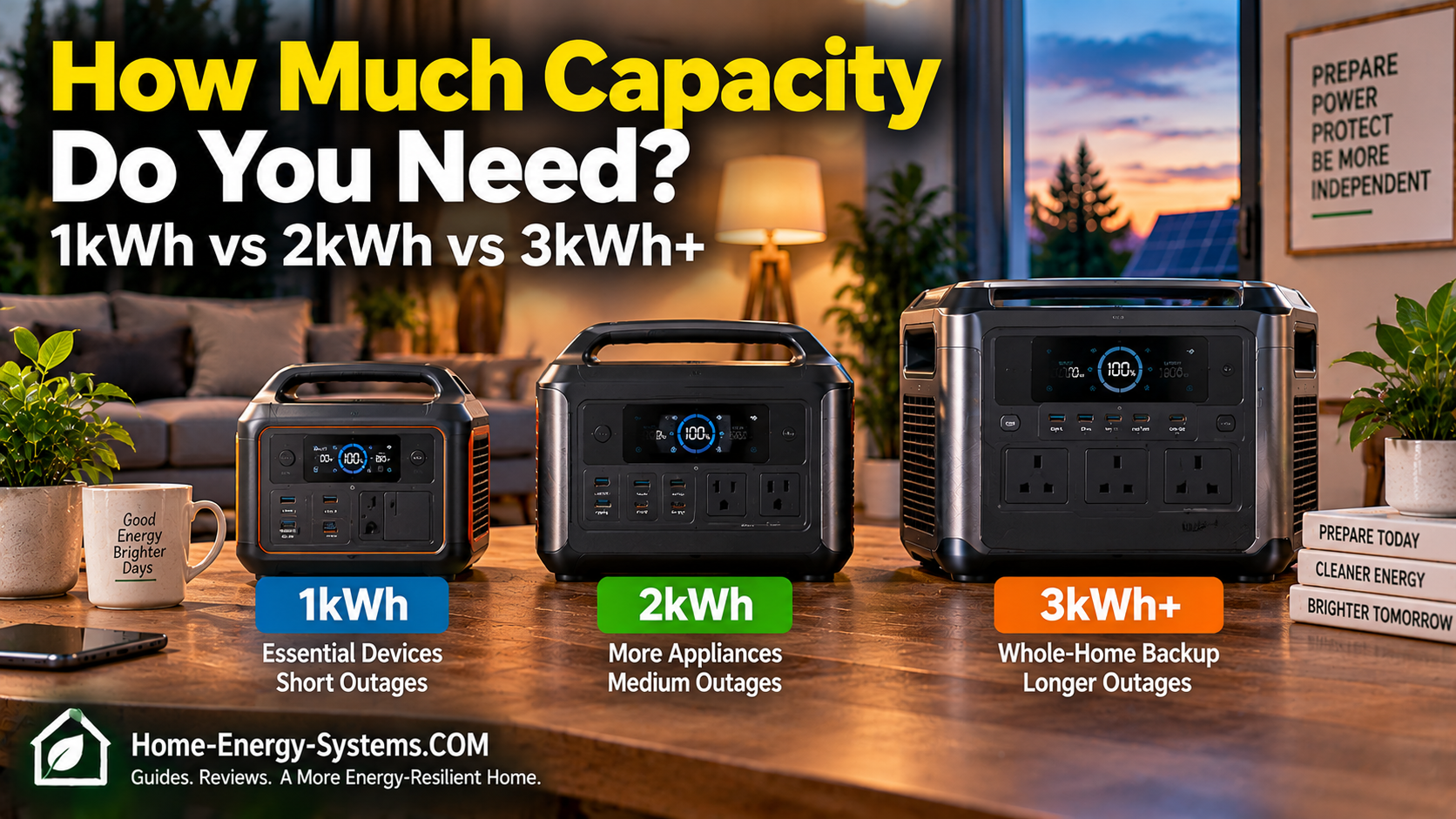
Start by identifying essential appliances, measuring or estimating their average wattage and multiplying by the hours they must run. Refrigerator nameplate wattage is not the same as average energy consumption because compressors cycle.
Required nominal battery capacity (Wh) ≈ average load (W) × backup hours ÷ assumed usable fraction.
For initial planning we use an illustrative 85% usable fraction. Real performance varies with inverter standby use, load, temperature and battery condition; small continuous loads may be especially affected by fixed overhead.
Example: What Would a 12-Hour Outage Require?
Consider a household using a fridge averaging 60W, a Wi-Fi router at 12W, two LED lights drawing 16W together and a laptop averaging 45W. The combined illustrative load is 133W. Over 12 hours it uses 1,596Wh at the appliances. Dividing by 0.85 suggests a nominal battery of approximately 1,878Wh before allowing an additional safety margin.
This is a reproducible example, not a claim that every fridge or laptop consumes these amounts. Measure your own appliances with a suitable energy monitor where practical.
| Appliance | Illustrative average | 12-hour energy |
|---|---|---|
| Refrigerator | 60W | 720Wh |
| Router | 12W | 144Wh |
| Two LED lights | 16W total | 192Wh |
| Laptop | 45W | 540Wh |
| Total | 133W | 1,596Wh |
If the laptop is used for only three hours, rather than all 12, the total falls by 405Wh. Scheduling loads can therefore be as valuable as buying a bigger battery.
How Long Could Each Portable Power Station Run Essential Appliances?
The figures below are calculated estimates using nominal capacity × 0.85 ÷ average AC load. They are not independently tested product runtimes. The assumption is identical for all four models so readers can compare capacity fairly.
| Battery | 50W load | 133W household | 300W load |
|---|---|---|---|
| EcoFlow 1,024Wh | 17.4h | 6.5h | 2.9h |
| BLUETTI 2,073.6Wh | 35.3h | 13.3h | 5.9h |
| Jackery 3,072Wh | 52.2h | 19.6h | 8.7h |
| Anker 3,072Wh | 52.2h | 19.6h | 8.7h |
Can a Portable Power Station Run a Refrigerator or Freezer?
Often yes, provided the inverter supports the compressor’s startup surge. A refrigerator averaging 60W is different from a refrigerator drawing several hundred watts while its compressor runs. Check the actual energy consumption and surge requirements of your appliance, and keep doors closed during outages.
Can a Portable Power Station Run an Entire House?
Usually not in the way a permanently installed whole-home backup system can. Electric showers, ovens, resistance heating and large heat pumps may exceed either the inverter rating or practical battery capacity. Portable units are generally most useful for a carefully chosen set of essentials.
Which Power Stations Are Suitable for Ireland, the UK, Europe and the USA?
US and Canadian buyers can evaluate the 120V versions of the Jackery HomePower 3000 and Anker SOLIX F3000 alongside suitable BLUETTI and EcoFlow models. Check 120V outlet ratings and whether a transfer accessory is approved for your installation.
Irish, UK and European buyers should prioritise confirmed 230V/50Hz variants with the correct local plugs, support and warranty. BLUETTI publishes documentation for an EU/UK Elite 200 V2 configuration. Do not assume a US-only model has an equivalent local version.
Australian and New Zealand buyers should likewise verify local 230V/50Hz versions and approved sockets. A seller shipping internationally does not by itself establish electrical compatibility.
Before checkout, confirm the precise model designation, input and output voltage, frequency, socket types, warranty territory, return arrangements and applicable local certification.
What Else Matters Before You Buy?
Continuous Output and Startup Surge
Stored watt-hours determine how long a load can run; continuous inverter watts determine whether it can run at all. Refrigerators, pumps and other motors may need additional power at startup. Check the manufacturer’s surge rating and the appliance’s actual requirements.
Solar Charging in Real Weather
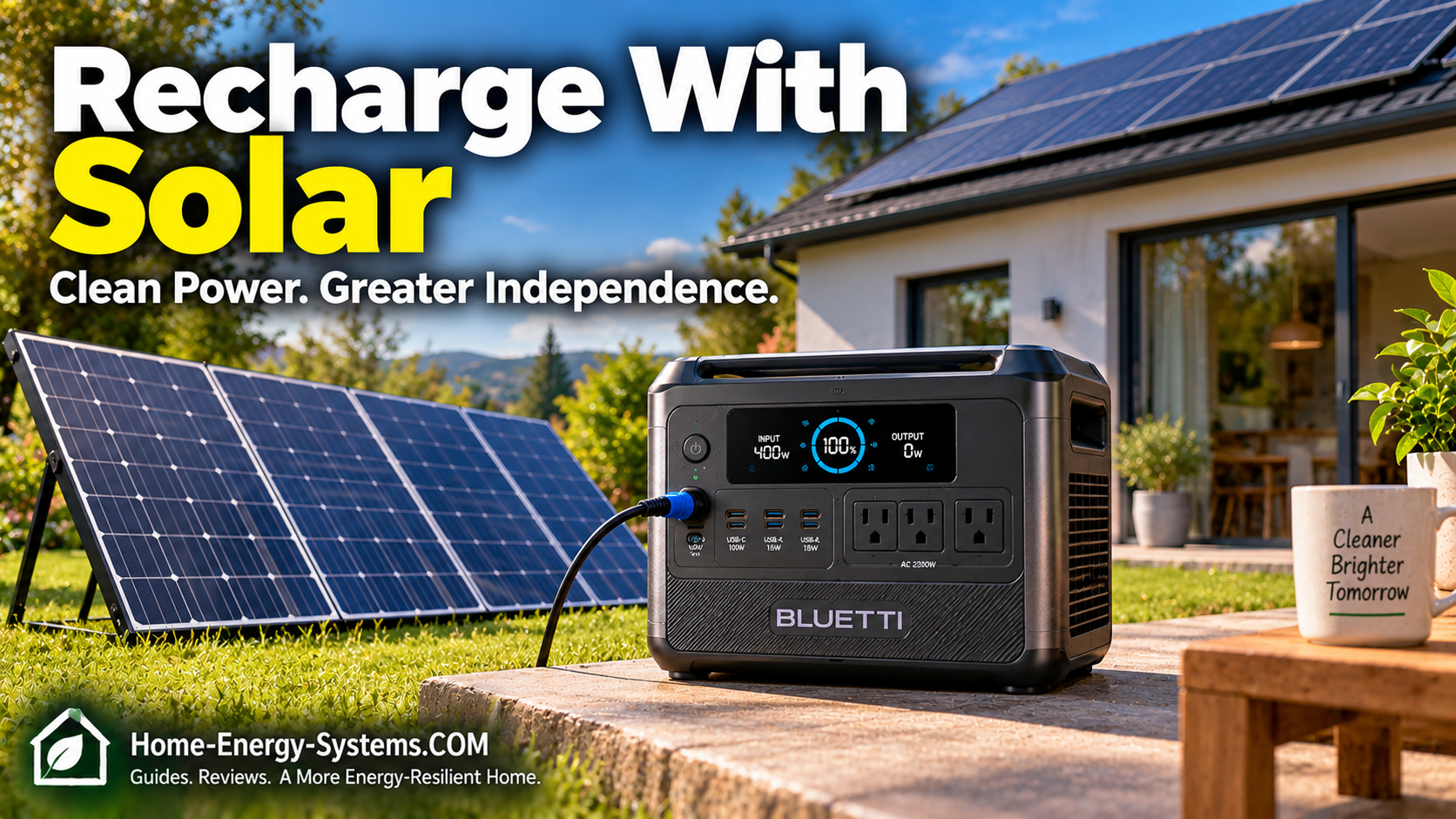
A 400W array receiving four equivalent peak-sun hours produces a theoretical 1,600Wh before losses. Real delivery is lower and may be much worse in winter or prolonged cloud. Match solar panel voltage, current, connectors and total input to the exact power station specification.
UPS and Automatic Switchover
Some stations offer fast transfer to battery power, but transfer times and bypass limits vary. A marketed UPS feature does not guarantee compatibility with every sensitive computer or medical device. Follow the equipment maker’s requirements and use a purpose-built UPS where uninterrupted operation is critical.
Battery Chemistry and Long-Term Storage
These products use lithium battery technology, with LFP common in modern models. Cycle-life figures are laboratory ratings under specified conditions, not a guarantee of calendar lifespan. Follow the maker’s storage charge and temperature guidance.
Weight, Warranty and Actual Cost
Think about stairs, storage location and whether one person can move the unit safely. Compare total delivered price, compatible solar panels, expansion batteries, transfer equipment and local warranty coverage—not just headline battery capacity.
Portable Power Station vs Solar Generator: What’s the Difference?
A portable power station is the rechargeable battery and power electronics. A “solar generator” generally means a compatible power station bundled or used with solar panels. Solar charging can extend outage coverage, but panels cannot guarantee a daily full recharge, particularly in poor weather.
If a 133W essential-load setup runs continuously, it uses approximately 3.19kWh per day at the appliances. A small solar array may replace only part of that during winter. For longer outages, plan both stored energy and realistic daily recharge rather than relying on the battery’s capacity alone.
Portable Power Station vs Home Battery or Fuel Generator
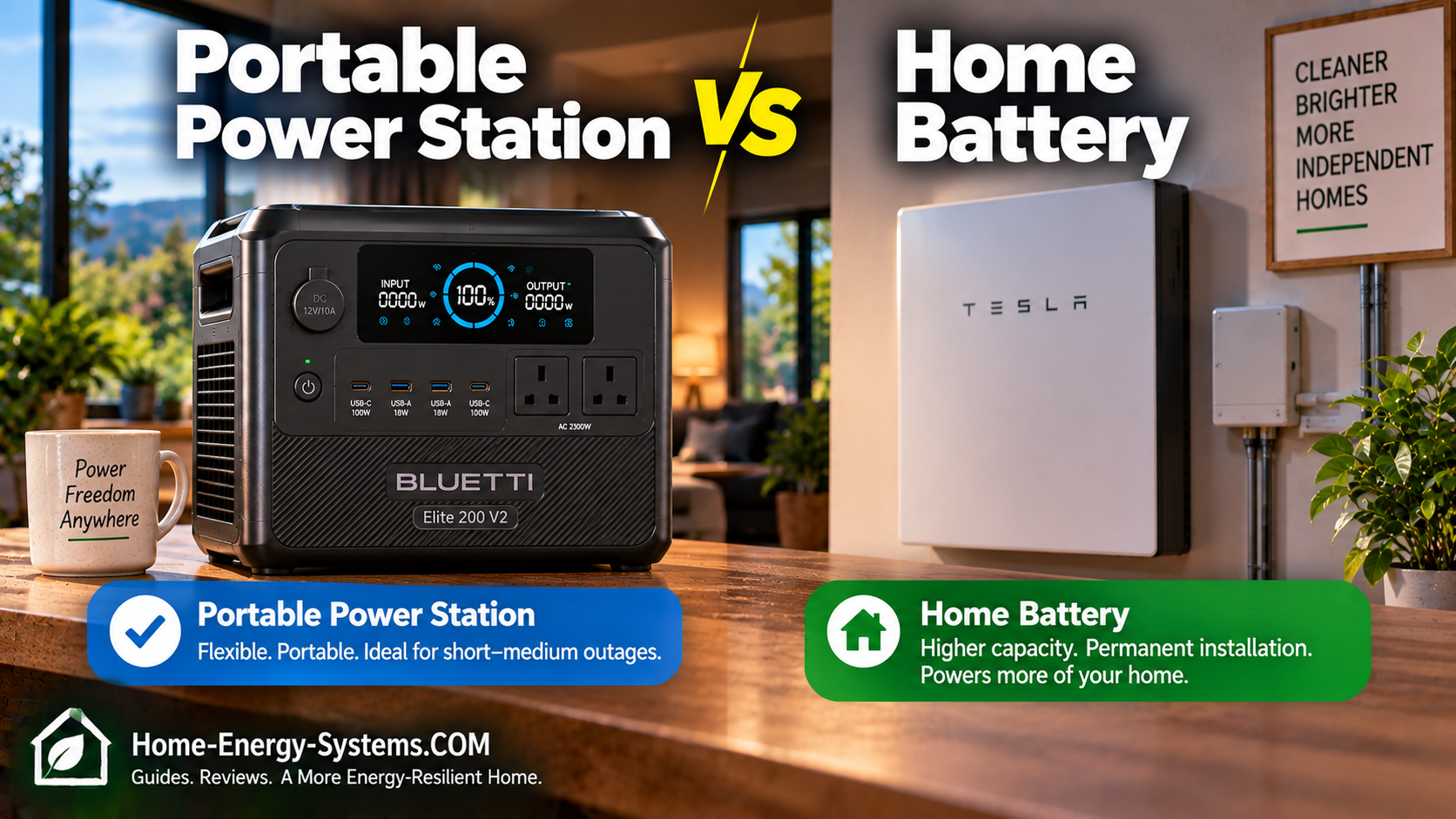
A portable station is flexible and usually powers selected plug-in appliances. A permanently installed home battery may support integrated household circuits, solar systems and larger energy reserves when professionally designed. See our home battery storage guide and home backup systems comparison.
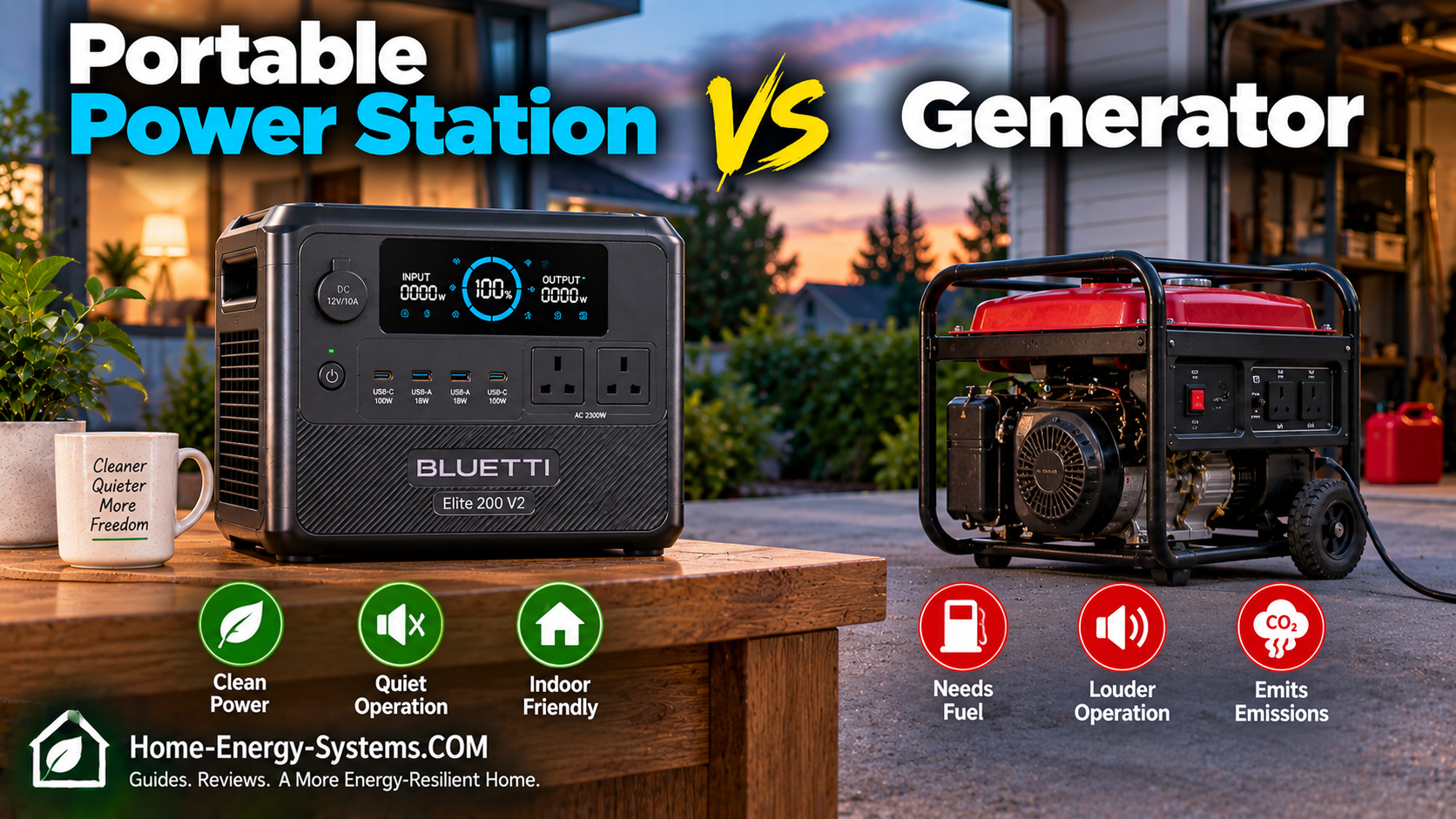
A fuel generator can provide sustained output while fuel remains available, but it creates noise and hazardous exhaust. Battery stations produce no combustion exhaust at the point of use, although they need a charging source.
What Other Suppliers Are Worth Considering?
Nature’s Generator offers modular backup products, while PECRON supplies alternative portable battery systems. Compare exact capacities, inverter ratings, chemistry, local voltage, solar limits and expansion support rather than treating a brand’s entire range as equivalent.
PECRON Portable Power Stations
Useful to compare where regional specifications and warranty support meet your needs.
Explore PECRON Power StationsAffiliate referral link; confirm tracking and destination in your affiliate dashboard.
Baseus Charging Accessories
Baseus offers charging accessories and selected portable products. Check whether a specific item provides AC power-station output or is a smaller USB-only power bank.
Explore Baseus Power ProductsAffiliate link.
For more suppliers, see our Where to Buy Solar Energy Products guide.
Which Portable Power Station Should You Choose?
Short outage and smaller loads: EcoFlow DELTA 3 Plus, if its local version suits your electrical system.
Balanced 2kWh-class backup: BLUETTI Elite 200 V2, provided you do not need expandable storage.
Longer initial runtime for US essentials: Jackery HomePower 3000, with the caveat that it shares the Anker’s starting capacity.
Planned expansion: Anker SOLIX F3000, if its weight, compatible batteries and local electrical configuration suit you.
These are conditional editorial choices, not lab-test winners. If your essential loads are only 30–50W, buying a 3kWh system may be unnecessary; if they exceed 500W continuously, even a 3kWh battery may last only a few hours.
Frequently Asked Questions
What is the best portable power station for home backup in 2026?
There is no universal winner. The BLUETTI Elite 200 V2 is a practical middle-ground option; EcoFlow’s DELTA 3 Plus suits smaller loads, while the 3kWh Jackery and Anker models offer longer calculated runtimes where their regional versions are suitable.
Is 2,000Wh enough for a house?
It can support selected essentials, not normally an entire house. At an illustrative 133W average load, a 2,000Wh battery gives about 12.8 hours using the 85% planning assumption.
Can a portable power station run a fridge overnight?
Often yes, if the battery stores sufficient energy and the inverter handles the compressor startup surge. Measure average consumption rather than relying solely on running wattage.
Can a portable power station be charged by solar panels?
Many can, but the panels must match the manufacturer’s input voltage, current, power and connector requirements. Poor weather can substantially reduce charging.
Can you leave a power station plugged in?
Some support continuous connection and automatic backup. Consult the exact model’s manual for bypass operation, ECO settings, battery care and compatibility with sensitive loads.
Can a portable power station replace a whole-home battery?
Usually not for integrated whole-home operation. Portable units excel at selected loads; installed systems are designed for larger capacities and dedicated electrical integration.
How long will the battery last over the years?
Cycle-life claims differ by product and by the capacity-retention threshold used. Actual service life also depends on age, temperature, storage and charging patterns; check each model’s warranty terms.
Final Verdict: Match the Battery to Your Outage Plan
Our preferred starting point for many households is a carefully sized 2kWh-class battery such as the BLUETTI Elite 200 V2, but that is not a universal recommendation. A smaller unit may be sufficient for communications, while 3kWh and expandable systems make more sense when essential loads and outage duration justify them.
Use the household calculations above, confirm regional electrical compatibility, and compare the complete cost before buying. The most useful backup system is one that safely powers what you actually need.
Explore BLUETTI — USAExplore BLUETTI — UKAffiliate links. Product availability and regional specifications vary.
More practical guides at Home Energy Systems.com.