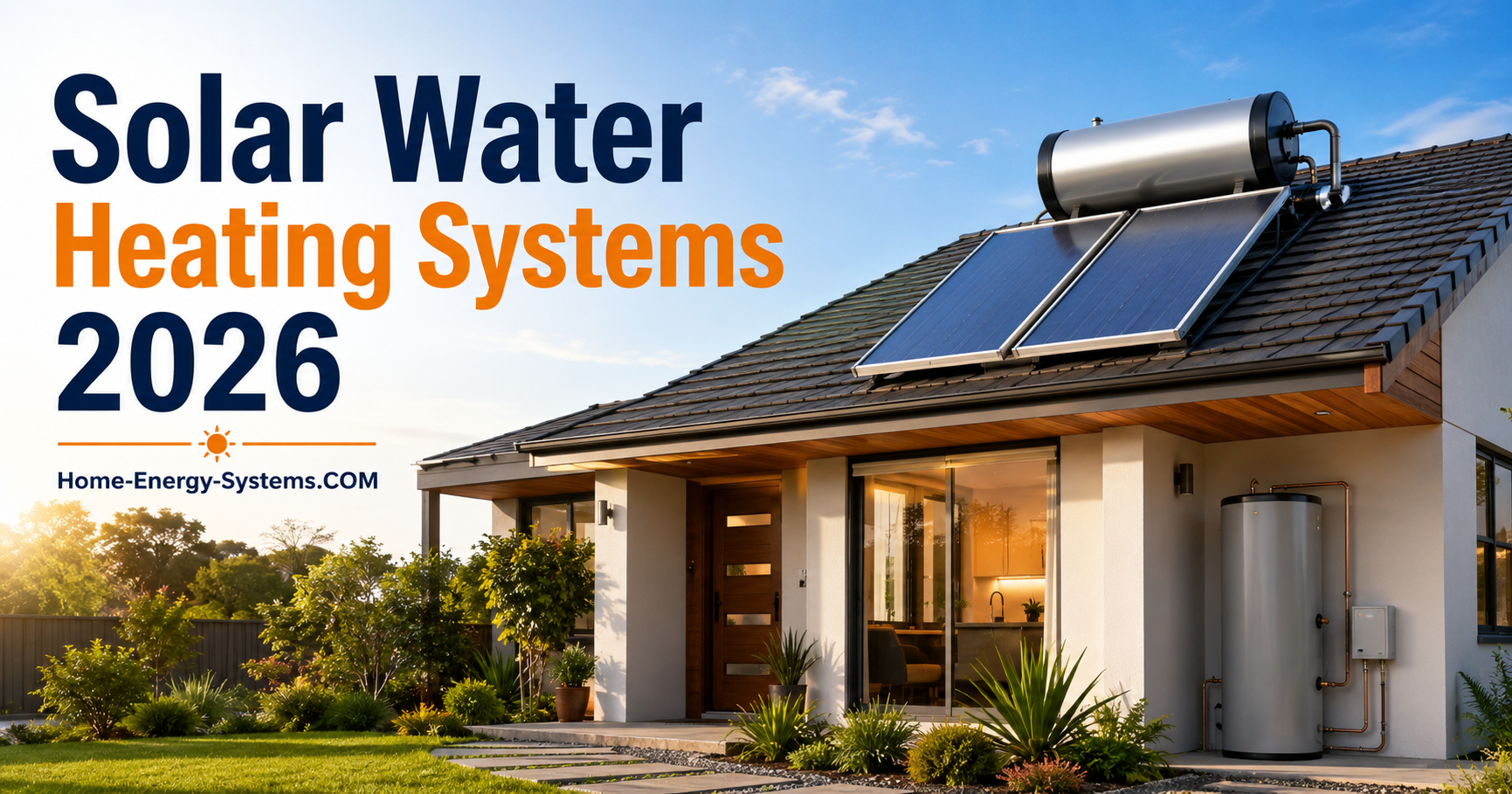
Solar Water Heating Systems: Costs, Types & How They Work in 2026
Solar water heating systems use free energy from the sun to produce hot water for showers, baths and household taps. Also known as solar hot water systems, solar thermal systems or solar hot water panels, they can reduce the amount of electricity, gas or oil required to heat water throughout the year.
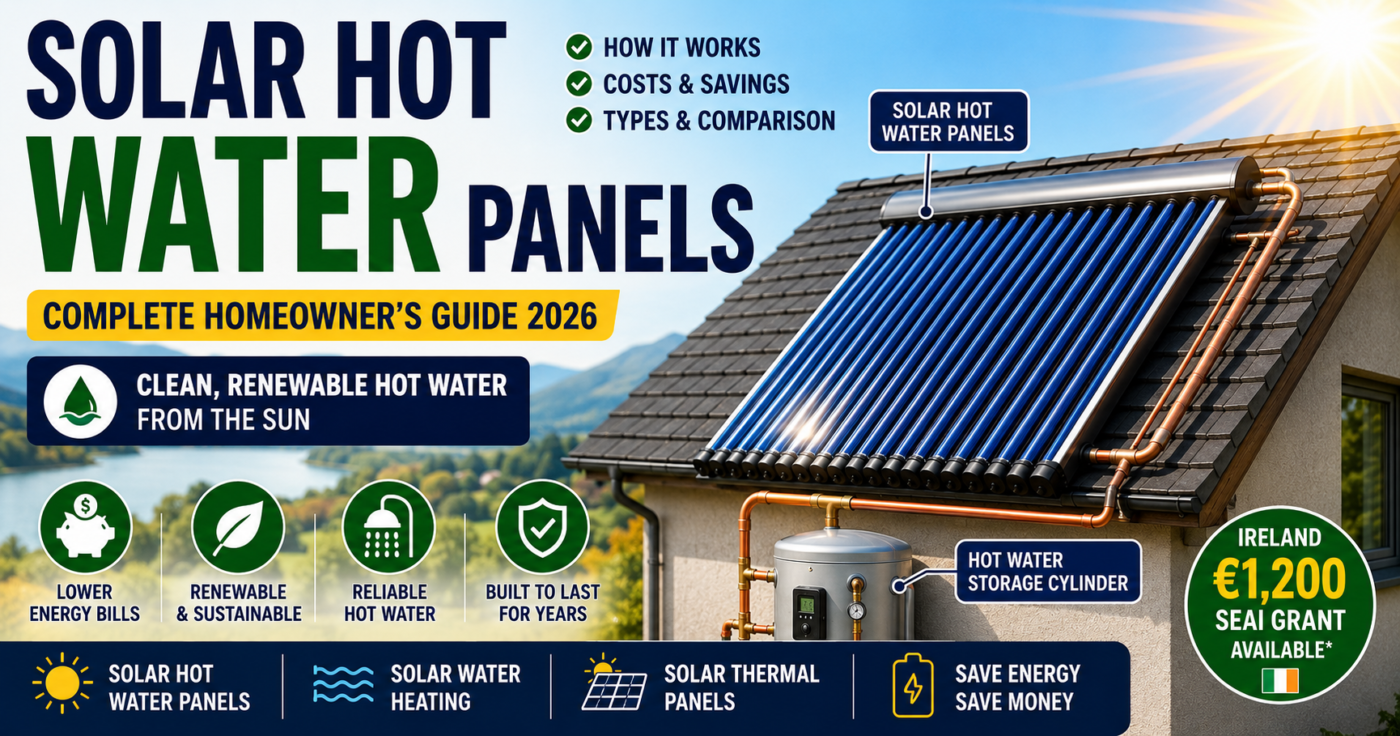
Solar energy does not have to mean generating electricity. Photovoltaic solar panels convert sunlight into electricity, while solar water heating systems capture solar heat and use it directly for domestic hot water.
The roof-mounted collectors used in these systems are commonly called solar hot water panels, solar thermal collectors or solar water heating panels.
The technology has been used successfully around the world for decades and can operate in everything from cooler northern European climates to sunnier regions of the United States, Australia, Asia and southern Europe.
This guide explains how solar water heating systems work, what equipment they need, their typical costs, system types, potential savings, grants and incentives, maintenance requirements and how to decide whether solar thermal is the right choice for your home in 2026.
What Is a Solar Water Heating System?
A solar water heating system captures heat from sunlight and transfers that heat into household water stored inside a cylinder or tank.
Unlike photovoltaic panels, solar thermal collectors do not generate household electricity. Their primary purpose is heating water efficiently using renewable solar energy.
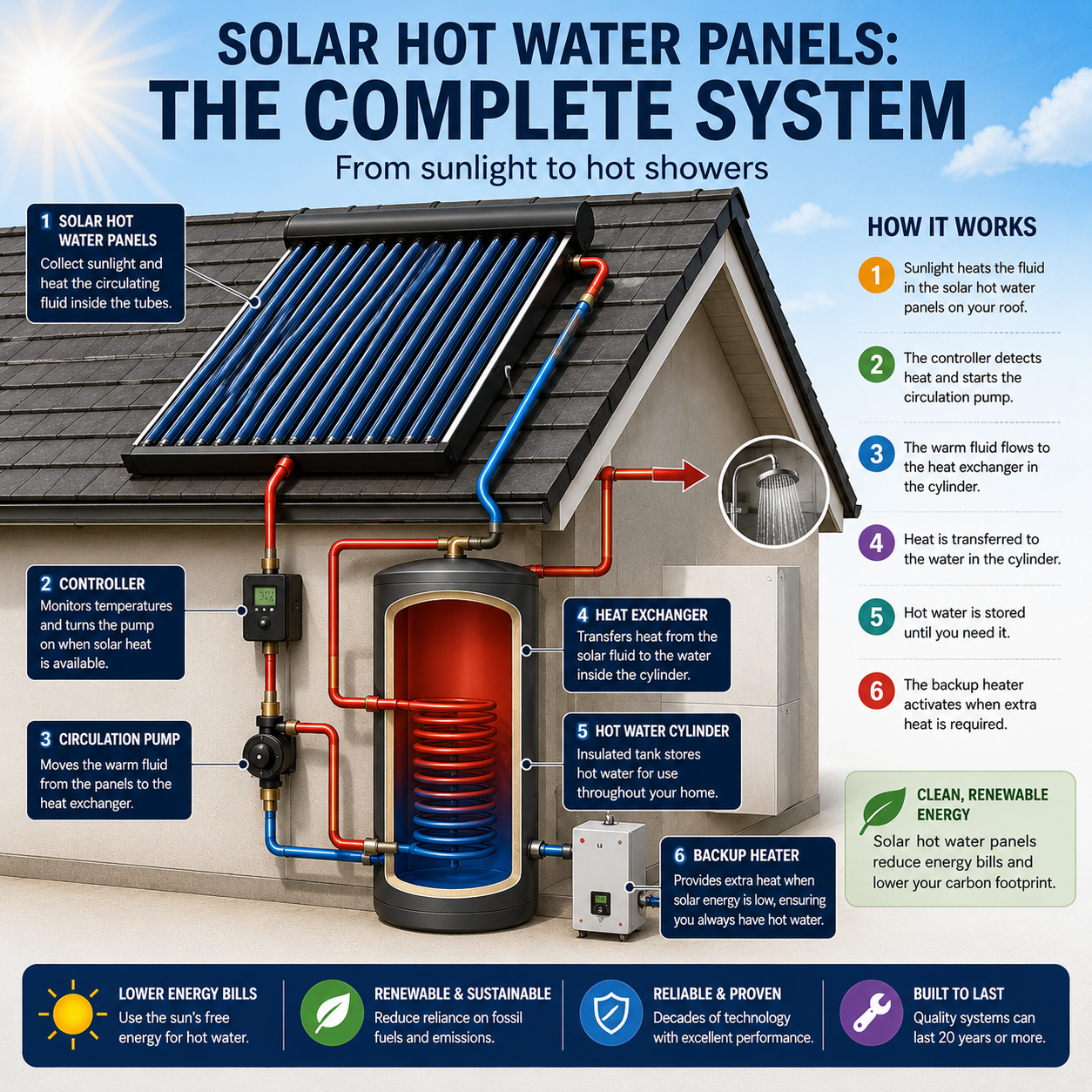
A complete solar water heating system will normally contain:
- Solar hot water panels or solar thermal collectors
- A solar-compatible hot-water cylinder or storage tank
- Insulated pipework
- A circulation pump on active systems
- A solar controller
- A heat exchanger
- Heat-transfer fluid
- A boiler, immersion heater, heat pump or other backup heat source
For most households, solar water heating supplements conventional water heating rather than replacing it completely.
How Do Solar Water Heating Systems Work?
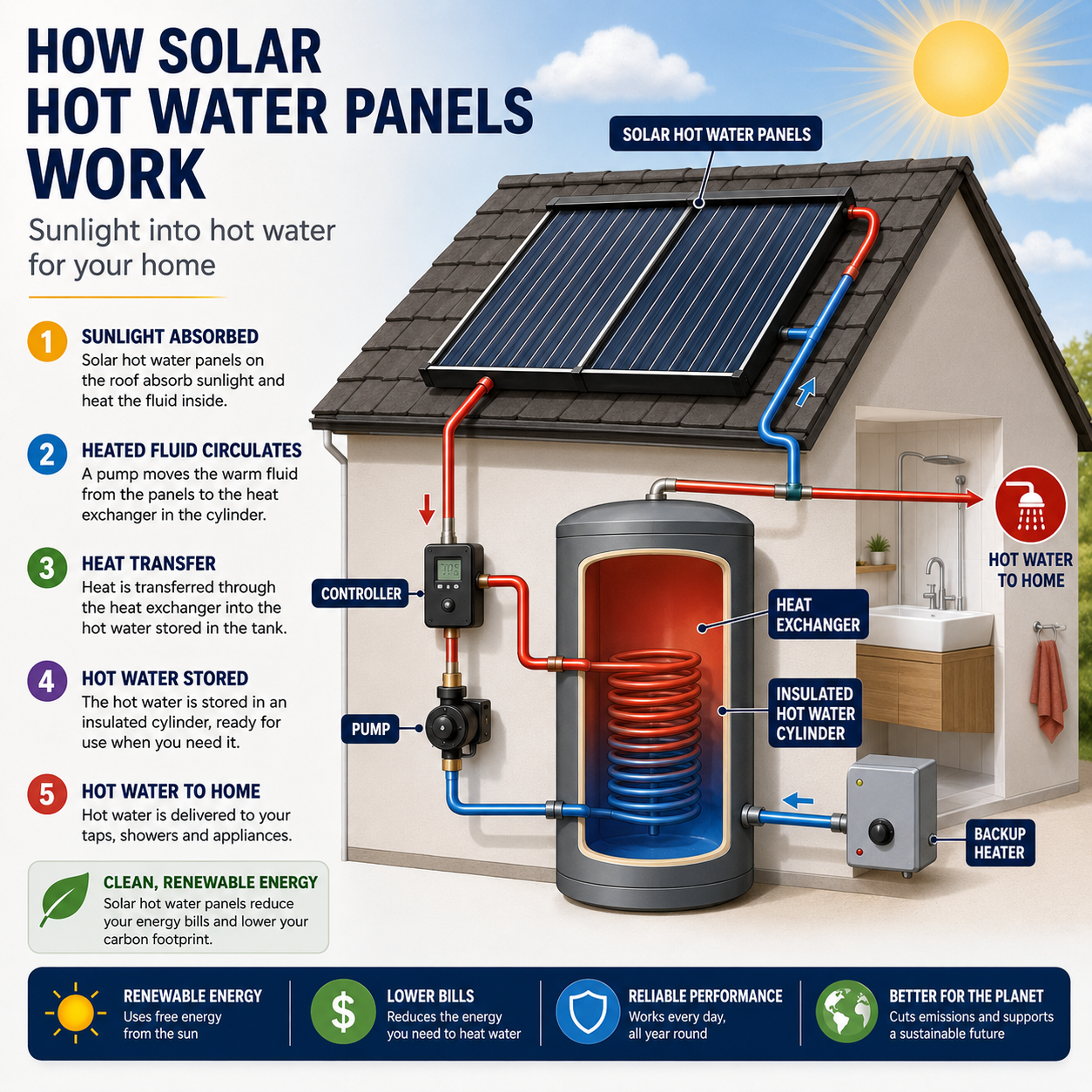
The principle is fairly simple. Solar collectors absorb energy from sunlight and use it to warm a fluid circulating through the solar thermal circuit.
The heated fluid travels from the roof towards the hot-water cylinder. Inside the cylinder, a heat exchanger transfers the captured solar heat into the domestic water without the two fluids mixing.
The cooler solar fluid then returns to the collectors and the process begins again.
A controller monitors temperatures within the collectors and the cylinder. When useful solar heat is available, it activates the circulation pump.
What Does a Complete Solar Water Heating System Include?
The collectors on the roof are only one part of a complete solar water heating system.
A typical installation combines the collectors with insulated pipework, a circulation pump, temperature sensors, a controller, heat exchanger and hot-water storage cylinder.
When the collector temperature rises sufficiently above the temperature inside the storage cylinder, the controller activates the pump and circulates the solar fluid through the system.
If solar energy cannot bring the water to the required temperature, a conventional boiler, immersion heater, heat pump or another compatible heat source provides the additional heat.
Types of Solar Water Heating Systems
Several different solar water heating system designs are available. Climate, freezing risk, household water demand and the design of the property all affect which arrangement is most suitable.
Active Solar Water Heating Systems
Active systems use an electrically powered circulation pump and controller to move heat-transfer fluid between the solar collectors and the hot-water storage cylinder.
This provides accurate control over when heat is transferred and is widely used in residential solar thermal installations.
Passive Solar Water Heating Systems
Passive systems avoid an electrically powered circulation pump and instead use natural circulation or system design to move heated water or fluid.
They can be simpler, although suitability depends greatly on climate and installation layout.
Direct Systems
Direct solar water heating systems circulate household water itself through the collectors.
They are normally more suitable for locations where freezing temperatures are rare.
Indirect Systems
Indirect or closed-loop systems circulate a separate heat-transfer fluid through the collectors.
The collected heat passes into household water through a heat exchanger. These systems can be designed for colder climates where frost protection is important.
Flat Plate vs Evacuated Tube Solar Hot Water Panels
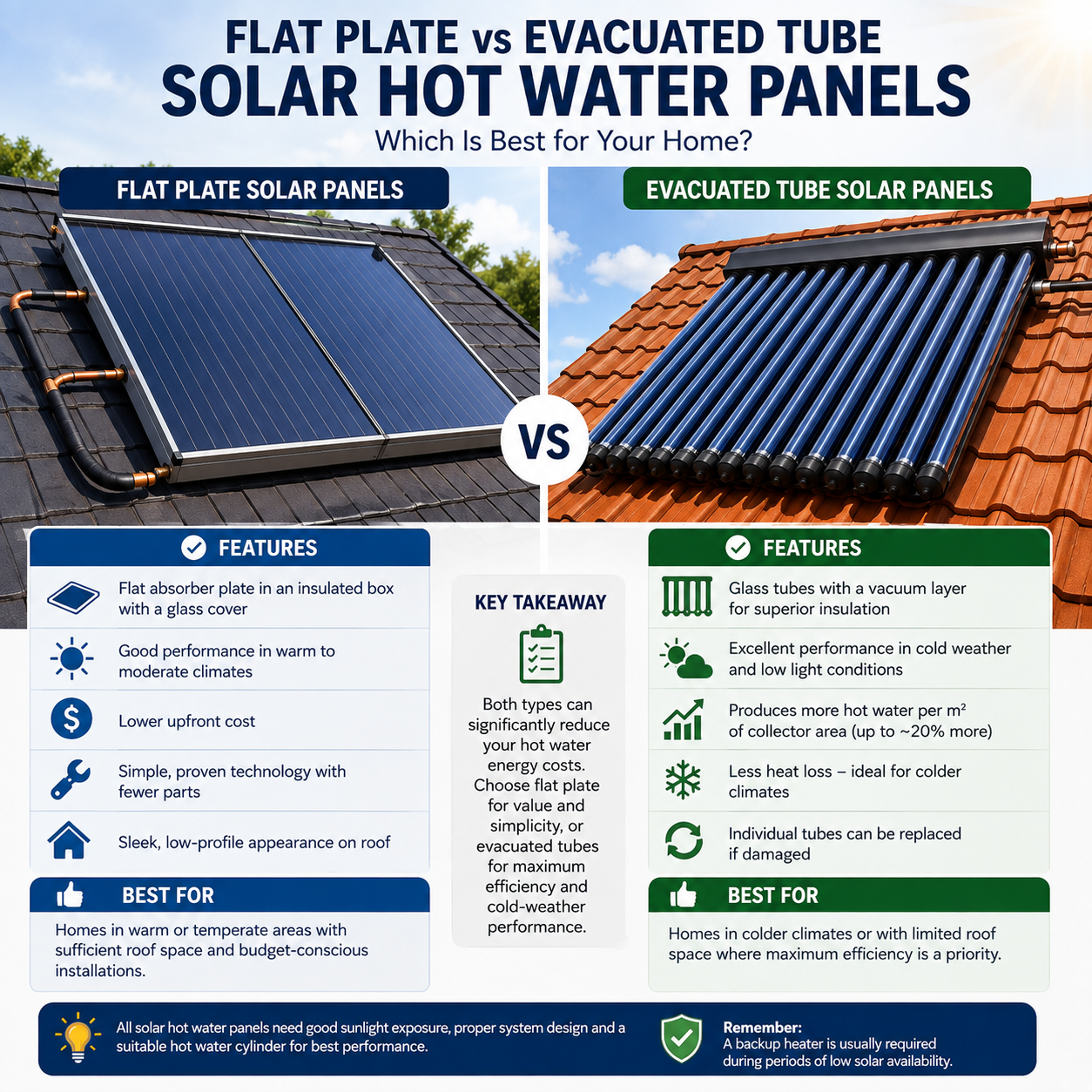
The two collector technologies homeowners are most likely to encounter are flat plate collectors and evacuated tube collectors.
Flat Plate Collectors
A flat plate collector normally contains a dark absorber plate and pipework enclosed inside an insulated glazed panel.
- Simple, well-established technology
- Neat roof appearance
- Often lower initial cost
- Good performance in suitable climates
- Relatively straightforward installation
Evacuated Tube Collectors
Evacuated tube collectors use rows of insulated glass tubes designed to reduce heat loss from the absorber.
- Excellent heat retention
- Strong cold-weather performance
- Useful where collector space is limited
- Individual tubes can often be replaced
- Good performance during weaker solar conditions
How Much Hot Water Can Solar Water Heating Systems Provide?
Solar thermal output varies according to location, climate, collector area, roof orientation, shading, storage capacity, household demand and weather.
The UK Energy Saving Trust says solar water heating systems normally provide roughly half of household hot-water requirements on average, with much higher contributions possible during summer.
In Ireland, SEAI says properly designed solar thermal systems are designed to meet approximately 50% to 60% of annual hot-water needs.
Performance in sunnier climates can be different, which is why system sizing should always be based on the location and the household’s actual hot-water demand.
SEAI Solar Water Heating Information →
Energy Saving Trust Solar Water Heating Guide →
Solar Water Heating Systems Cost in 2026
There is no single worldwide price for a solar water heating system.
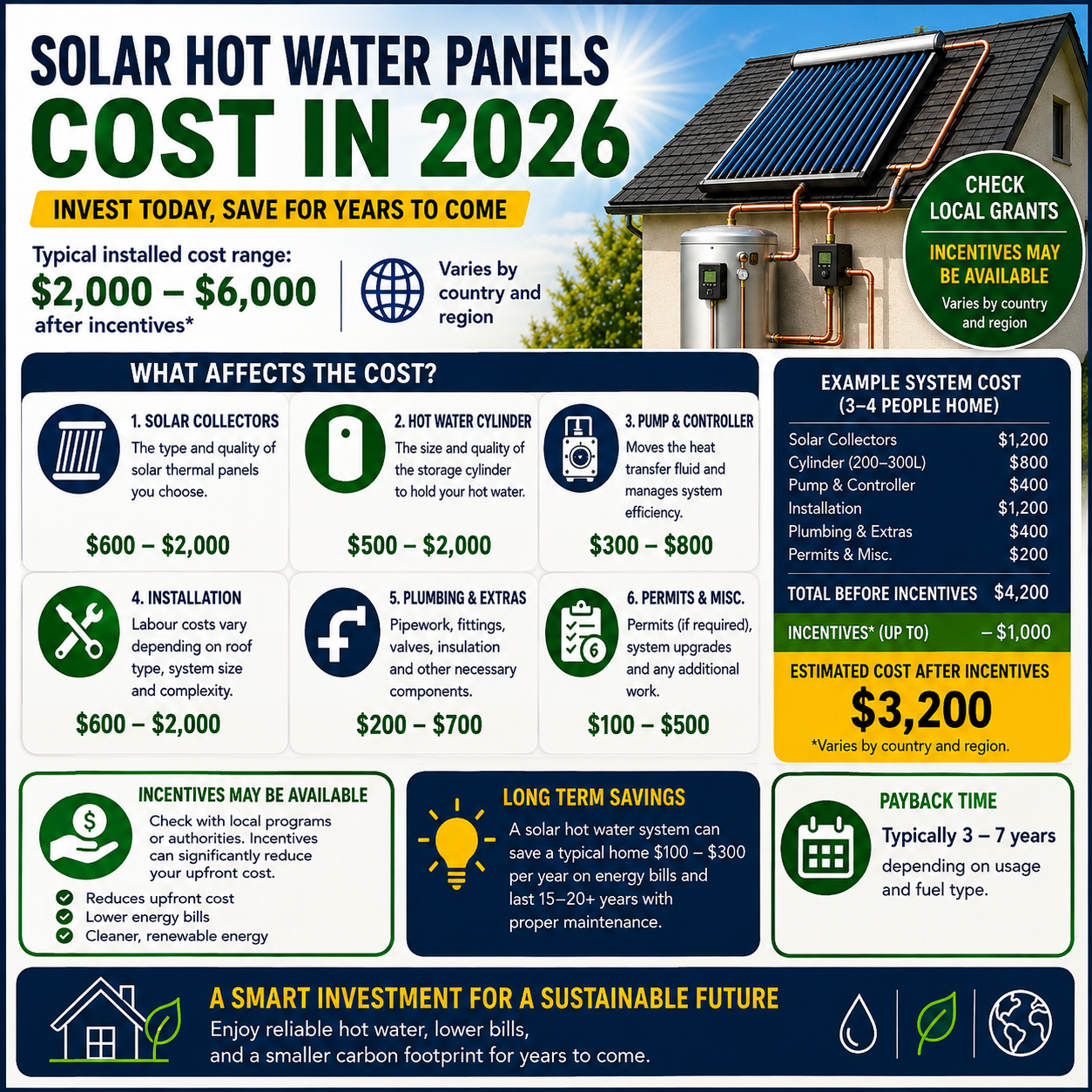
The final installed cost depends on the country, collector technology, system size, labour costs, storage cylinder, roof access and the amount of plumbing work required.
As a current UK benchmark, the Energy Saving Trust estimates that installing a typical solar water heating system costs around £5,300.
Costs in Ireland, continental Europe, the United States, Australia, New Zealand, Asia and other regions can vary considerably.
Important cost factors include:
- Flat plate or evacuated tube collectors
- Number and size of collectors
- Hot-water cylinder or storage tank size
- Whether the existing cylinder requires replacement
- Circulation pump and solar controller
- Roof access and scaffolding
- Length of pipe runs
- Plumbing alterations
- Local labour costs
- Permits or inspections where required
- Available grants, rebates or renewable-energy incentives
Solar Water Heating Grants and Incentives
Government support for solar water heating systems differs considerably around the world and can change over time.
🇮🇪 Ireland
SEAI currently provides a €1,200 solar water heating grant for qualifying installations.
For homeowners using the individual grant route, grant approval must be received before work begins and other scheme requirements apply.
Check the current SEAI grant →🇬🇧 United Kingdom
The former Domestic Renewable Heat Incentive is closed to new applications.
Homeowners should check current national, devolved-government, council and local energy-efficiency schemes before installing.
UK Government information →🇺🇸 United States
Federal incentives have changed, so homeowners should check the latest IRS information together with any state, utility or local solar thermal incentives available in their area.
Check current IRS information →🇦🇺 Australia
Eligible solar water heaters can qualify for Small-scale Technology Certificates under Australia’s Small-scale Renewable Energy Scheme.
The effective benefit varies according to the approved system, location and certificate arrangements.
Clean Energy Regulator information →Europe, New Zealand, Asia and Other Regions
Support may be available nationally or through regional governments, states, provinces, municipalities and utility companies. Check current government or energy-agency information in your area before purchasing a system.
How Much Money Can Solar Water Heating Save?
The financial savings from a solar water heating system depend heavily on what currently heats your water.
Replacing part of the energy used by expensive electric resistance heating can produce a different financial result from reducing the amount of gas used by an efficient boiler.
Your savings are influenced by:
- Local electricity, gas or oil prices
- Household size
- Daily hot-water consumption
- Solar exposure
- Collector efficiency and size
- Existing water-heating system
- Storage-cylinder efficiency
- Maintenance costs
- Available grants or incentives
Homes with high and consistent hot-water demand generally have more opportunity to make use of solar heat than properties where very little hot water is consumed.
Solar Water Heating Systems vs Solar PV Panels
Solar thermal and photovoltaic solar both use sunlight, but they perform completely different jobs.
Solar Water Heating
- Designed specifically to heat water
- Uses solar thermal collectors
- Requires hot-water storage
- Does not generate household electricity
- Can provide strong summer hot-water output
Solar PV
- Generates usable electricity
- Can power an electric water heater
- Can run household appliances
- Can charge battery storage
- May export surplus electricity to the grid
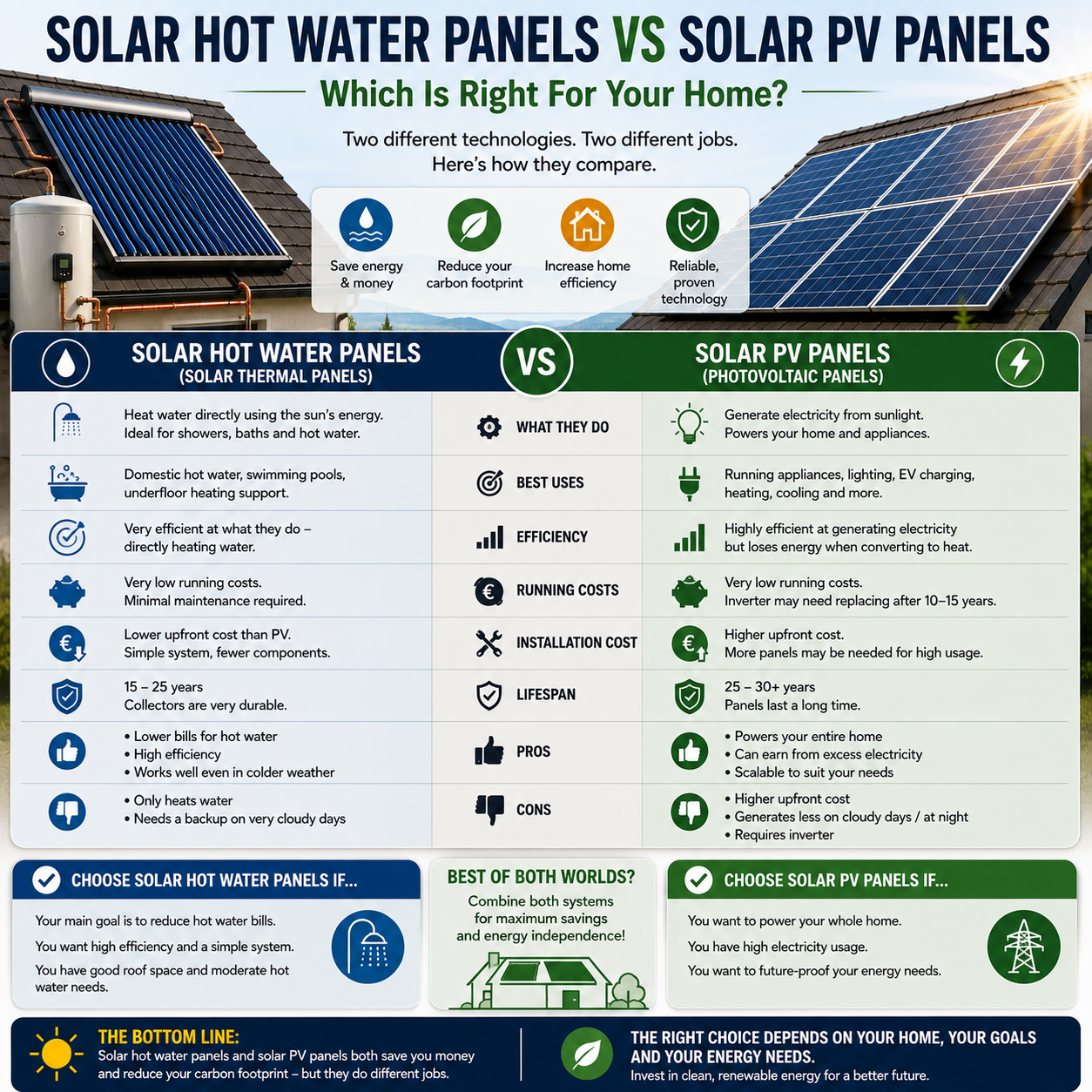
Solar thermal can be particularly attractive where the main objective is renewable hot-water production.
Solar PV offers more flexibility because the electricity it generates can be used throughout the home, stored in a battery or directed to an immersion heater.
For more information about storing surplus energy as heat, see our thermal energy storage solutions guide.
Using Solar PV for Water Heating
Some homeowners researching solar water heating systems may eventually decide that photovoltaic solar provides greater overall flexibility.
Surplus PV generation can be sent to a compatible immersion heater or electric water heater using appropriate controls, effectively storing excess solar electricity as hot water.
If you are comparing solar equipment and suppliers, our Where to Buy Solar Energy Products guide covers the suppliers and affiliate partners currently featured by Home-Energy-Systems.COM.
Solar Water Heating vs Heat Pump Water Heating
A heat pump is another highly efficient way to produce domestic hot water.
Rather than producing heat through electrical resistance, a heat pump transfers heat from the surrounding air, ground or another source into the water.
Homeowners considering a new water-heating system might therefore compare:
- Solar thermal with a boiler
- Solar thermal with an immersion heater
- Solar PV with an immersion diverter
- Solar PV with heat-pump water heating
- Heat pumps combined with suitable energy storage
For more information about how this technology is developing, read our Heat Pump Technology 2026 guide.
Do Solar Water Heating Systems Work in Winter?
Yes. Solar water heating systems continue collecting energy during winter, although their output normally falls compared with summer.
Shorter days, a lower sun angle and weaker solar radiation reduce the amount of available heat.
Even when the solar collectors only partially heat the stored water, the backup heating system may have less work to do.
Evacuated tube collectors can be particularly useful in cooler conditions because their construction helps limit heat loss.
Homes in locations where freezing occurs should use a system specifically designed for frost protection.
Do Solar Hot Water Panels Work on Cloudy Days?
Yes, although output falls when solar radiation is weaker.
Solar thermal collectors do not always require intense direct sunshine to collect useful heat. However, prolonged cloudy periods will reduce production, which is one reason most systems retain a backup heat source.
The storage cylinder is also important because solar heat collected earlier in the day can remain available when hot water is required later.
How Many Solar Hot Water Panels Do You Need?
The correct collector area should be based on expected hot-water demand rather than simply covering every available section of roof.
A professional system design should consider:
- Expected household occupancy
- Daily hot-water demand
- Collector performance
- Roof orientation
- Roof pitch
- Shading
- Local climate
- Storage-cylinder capacity
Oversizing is not automatically beneficial. A system that is much larger than household demand can produce excess heat during sunny periods when relatively little hot water is being used.
What Size Hot-Water Cylinder Do You Need?
Solar water heating systems normally require a cylinder or storage tank designed to receive heat from the solar circuit.
Many installations use a twin-coil cylinder. One coil receives heat from the solar collectors, while another allows a boiler or compatible secondary heat source to provide backup heating.
The cylinder needs enough capacity to store useful solar heat until household demand occurs later in the day.
How to Choose the Best Solar Water Heating System for Your Home
Choosing the best solar water heating system involves much more than deciding between flat plate and evacuated tube collectors.
Start with the amount of hot water your household actually uses and then assess how well your property can collect and store solar heat.
Check Your Solar Exposure
Look at roof orientation, pitch, available collector area and shading from trees, chimneys or neighbouring buildings.
Calculate Hot-Water Demand
A larger household with regular showers, baths and daily hot-water use may benefit more from solar thermal than a property with very low demand.
Check Your Existing Cylinder
Find out whether your current hot-water storage can integrate with solar thermal or whether a replacement solar-compatible cylinder will be required.
Compare Collector Types
Compare flat plate and evacuated tube collectors according to climate, roof area, appearance, installation cost and expected performance.
Consider Your Backup Heating
Confirm how the system will work alongside your boiler, immersion heater, heat pump or other backup source.
Compare the Complete Installed Cost
Compare equipment, storage, controls, pipework, installation, warranties and servicing rather than focusing only on the price of the collectors.
It is sensible to obtain several quotations and ask each installer for an estimate of expected annual solar contribution based on your actual property and household requirements.
How Long Do Solar Water Heating Systems Last?
Good-quality solar thermal collectors can remain useful for many years because the collectors themselves contain relatively few moving parts.
However, the complete system contains components that may require servicing or replacement during its lifetime, including pumps, sensors, controllers, valves, expansion vessels, heat-transfer fluid and storage cylinders.
When comparing installations, look at the warranties covering the complete system rather than the collector warranty alone.
Solar Water Heating System Maintenance
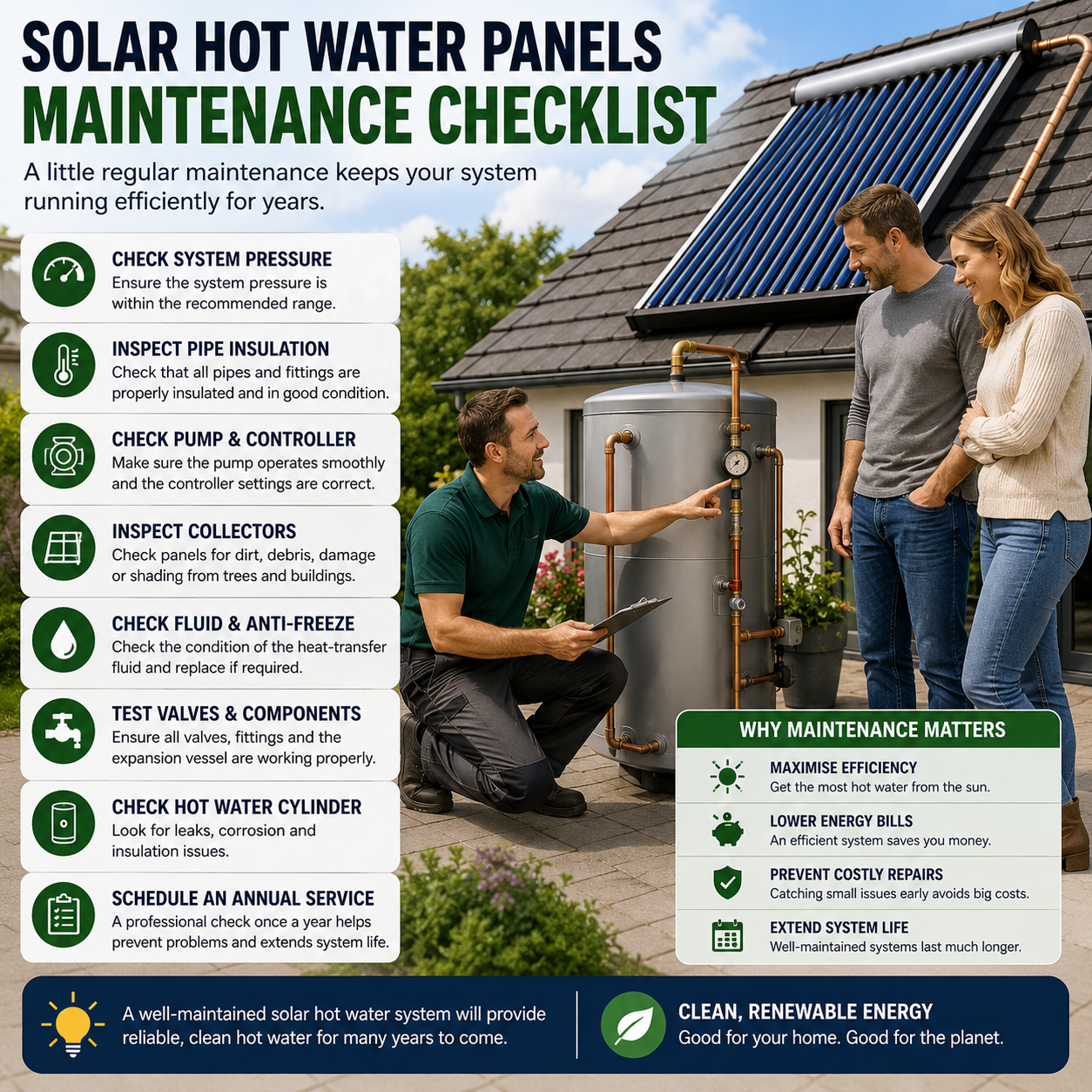
Solar water heating systems usually require relatively little day-to-day attention, but they should not simply be installed and forgotten.
Routine checks may include:
- Checking system pressure
- Inspecting pipe insulation
- Checking the circulation pump
- Checking controller operation
- Inspecting collectors for damage or debris
- Checking valves and expansion equipment
- Checking heat-transfer fluid
- Inspecting the hot-water cylinder
- Checking for leaks
Common Solar Water Heating Problems
Low Hot-Water Production
Reduced output can result from shading, circulation problems, pump failure, incorrect controller settings or problems within the collector circuit.
Loss of System Pressure
Pressure loss in a sealed circuit can indicate a leak or another system fault and should be investigated.
Air in the Circuit
Air trapped in the pipework can interfere with circulation and reduce effective heat transfer.
Scaling
Hard-water areas can experience mineral build-up in parts of the water-heating system.
Overheating
During periods of strong sunshine and low hot-water consumption, the system must be designed to manage excess solar heat safely.
Can Solar PV Panels Heat an Electric Water Heater?
Yes, but solar PV and solar water heating operate differently.
Photovoltaic panels generate electricity. That electricity can then power an immersion heater, electric water heater or heat-pump water heater.
Some properties use a solar diverter that detects surplus photovoltaic generation and sends excess electricity into the water heater instead of exporting it.
This effectively turns the hot-water cylinder into a form of thermal energy storage.
PV electricity that is not required for water heating can instead be used elsewhere in the home, exported where suitable arrangements exist or stored in a home battery storage system.
Is Your Home Suitable for Solar Water Heating?
Your property may be a good candidate if:
- You have a suitable unshaded roof or mounting area
- Your household uses hot water consistently
- There is sufficient space for an appropriate storage cylinder
- Your existing heating system can integrate with solar thermal
- You expect to remain in the property long enough to benefit
- You can obtain a competitive professional installation quotation
Perfect roof orientation is not always necessary, but orientation, pitch and shading all influence performance.
A competent installer should estimate expected annual solar contribution using the actual roof direction, collector type, local climate and household hot-water requirements.
Are Solar Water Heating Systems Worth It in 2026?
Solar water heating systems can absolutely still be worth considering in 2026.
They are not, however, automatically the best renewable-energy investment for every homeowner.
The rapid expansion of solar PV, heat pumps, smart immersion controllers and battery storage means households now have several ways to produce hot water using renewable or low-carbon energy.
The strongest case for solar thermal normally exists where:
- The household has substantial regular hot-water demand
- The property has good solar exposure
- A suitable cylinder is already installed or easily accommodated
- The existing water-heating fuel is relatively expensive
- A useful local grant or incentive is available
- The household expects to remain in the property for many years
The financial argument may be weaker where extensive plumbing alterations are required, household hot-water use is very low or the available roof space could deliver greater overall value through photovoltaic solar.

Solar water heating vs solar PV vs heat-pump water heating — which gives your particular home the greatest overall benefit?
Frequently Asked Questions About Solar Water Heating Systems
How does a solar water heating system work?
Solar collectors absorb heat from sunlight. Heat-transfer fluid carries this energy to a heat exchanger inside a hot-water cylinder, where the heat is transferred into household water.
Are solar water heating systems the same as solar hot water panels?
Solar hot water panels are the roof-mounted collectors within a solar water heating system. The complete system also includes storage, pipework, controls, heat-exchange equipment and usually a backup heat source.
How much does a solar water heating system cost?
Prices vary significantly by country and property. The UK Energy Saving Trust currently estimates around £5,300 for a typical installation, but actual costs depend on collector type, storage, plumbing, roof access and labour.
Do solar water heating systems work in winter?
Yes. They continue collecting solar energy during winter, although production is normally lower because of shorter days and weaker solar radiation.
Do solar hot water panels work on cloudy days?
Yes, but their output is reduced. Useful heat can still be collected during weaker sunlight, depending on collector technology and weather conditions.
Do I still need a backup water heater?
Usually yes. Most systems retain a boiler, immersion heater, heat pump or another heat source because solar energy alone may not provide all the hot water required throughout the year.
Are evacuated tubes better than flat plate collectors?
Evacuated tubes can retain heat extremely well and may perform strongly in colder conditions. Flat plate collectors are simpler and can offer excellent value. The best choice depends on climate, roof area, budget and system design.
Is solar water heating better than solar PV?
Neither technology is automatically better. Solar thermal specialises in producing hot water, while solar PV produces electricity that can power appliances, heat water, charge batteries and serve many other household uses.
How much hot water can solar thermal provide?
A well-designed system can provide a substantial proportion of annual domestic hot-water demand. The exact contribution depends on climate, collector area, storage capacity, household usage and system design.
Are grants available for solar water heating?
Yes in some locations. Ireland currently provides a qualifying €1,200 SEAI solar water heating grant, while incentives elsewhere vary by country, state and region.
Final Thoughts
Solar water heating systems remain one of the most direct ways to use renewable solar energy around the home.
Instead of generating electricity first, solar thermal collectors capture heat from sunlight and use it to reduce the conventional energy needed for household hot water.
For homes with substantial hot-water demand, suitable roof space and a well-designed installation, solar water heating can make a meaningful contribution for many years.
However, solar PV, heat pumps and modern energy-storage technologies give homeowners more alternatives than ever before.
Before choosing a system, compare the complete installation cost, available incentives, expected annual solar contribution, local climate, existing heating equipment and what else could be achieved with the same roof space and budget.
For some households, solar thermal will remain an excellent choice. For others, photovoltaic solar combined with efficient electric or heat-pump water heating may provide greater flexibility.
Continue Exploring Home Energy Systems
Planning a wider renewable-energy upgrade? Continue with these guides:
Affiliate Disclosure: Home-Energy-Systems.COM may earn a commission from qualifying purchases made through selected links on this page. This does not increase the price you pay and helps support our independent home-energy guides.