The best thermal energy storage solution in 2026 depends on what you actually want to store heat for. A household wanting simple hot-water storage may need nothing more complicated than a well-insulated cylinder, while homes with limited space, solar PV, heat pumps or time-of-use electricity tariffs may benefit from newer thermal-battery technology.
This guide compares practical thermal energy storage systems available today rather than concentrating on experimental technology.
We look at conventional hot-water storage, phase-change-material heat batteries, smart cylinders, heat-pump storage and high-heat-retention space heating.
If you want to understand the science first, read our separate Thermal Energy Storage Systems guide. This page focuses on comparing the options before you buy.
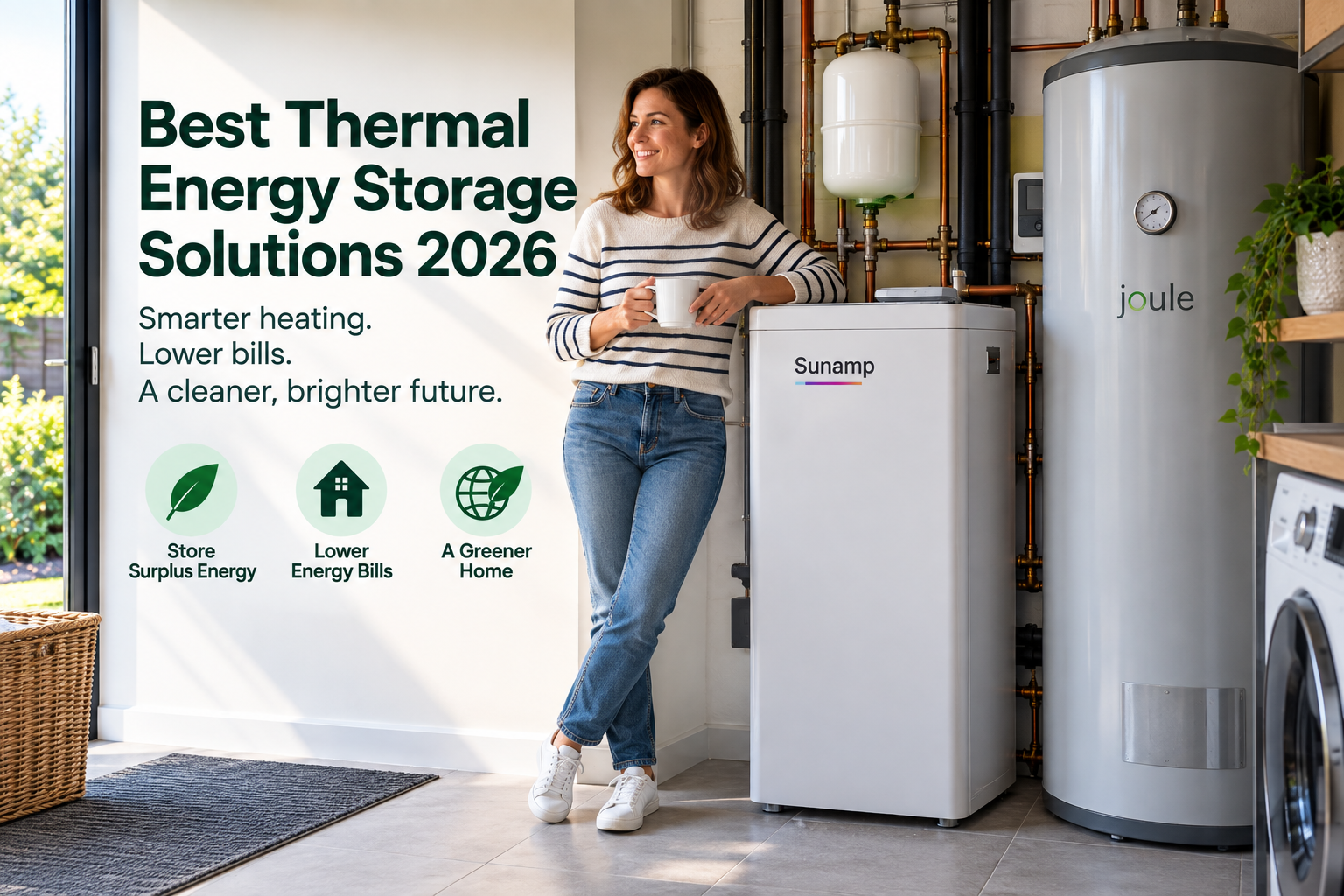
Best Thermal Energy Storage Solutions 2026: Quick Picks
These options solve different problems, so the most suitable system depends on your heating source, available space and how you buy electricity.
We consider what type of energy is stored, physical space required, compatibility with solar PV and heat pumps, ability to use off-peak electricity, installation complexity, controls and the job the system is designed to perform.
Product availability and specifications vary by country. Always verify the exact model and compatibility with your installer before purchasing.
Top Thermal Energy Storage Options to Compare in 2026
Sunamp Thermino ePlus
Storage medium: Phase-change material
Main energy source: Grid electricity
Solar PV: Compatible through the appropriate PV control option
Sizes: 70, 150, 210 and 300 litre-equivalent models
The Thermino ePlus stores heat in Sunamp’s phase-change material rather than keeping a large volume of water permanently hot.
Its main attraction is space saving. Sunamp states that the Thermino can be considerably smaller than an equivalent conventional hot-water cylinder because its phase-change material has a higher thermal energy density than water.
The system can also shift electric heating into off-peak periods and can be configured to make use of surplus solar PV.
Best suited to: Homes where cupboard space is restricted, all-electric homes and households wanting compact thermal storage alongside variable electricity tariffs or solar PV.
Sunamp Thermino xPlus
Storage medium: Phase-change material
Heat sources: Compatible boilers and heat pumps
Solar PV: Optional integration
Sizes: 150, 210 and 300 litre-equivalent models
The Thermino xPlus extends the PCM concept to homes using indirect heating sources.
With the appropriate Sunamp control configuration, the system can work with compatible boilers or heat pumps, and solar PV capability can also be added.
This makes it particularly interesting for homeowners who want to move from a boiler toward a heat pump later without necessarily replacing the thermal storage unit itself.
Best suited to: Heat-pump homes, boiler replacements and properties where a conventional large hot-water cylinder would consume too much space.
Mixergy Solar X
Storage medium: Water
Solar integration: Built-in solar-diversion capability
Controls: Connected smart controls and monitoring
Tariffs: Designed to work with smart energy scheduling
Mixergy takes a different approach from PCM heat batteries.
Solar X remains a hot-water cylinder, but intelligent controls and top-down heating allow the system to heat the amount of water required instead of always heating the entire cylinder.
The Solar X version can prioritise available surplus solar electricity, making stored hot water another destination for electricity that might otherwise be exported.
Best suited to: Solar-PV homes that want smart hot-water control while retaining the familiar advantages of water-based storage.
Mixergy iHP X
Storage medium: Water
Heat source: Integrated air-to-water heat pump
Smart control: Yes
Solar compatibility: Supported
The iHP X combines the hot-water cylinder with a small integrated heat pump.
This is different from connecting a conventional cylinder to a whole-house air-to-water heat pump. The product is specifically designed around producing domestic hot water.
It is particularly relevant to all-electric homes and developments where an efficient dedicated hot-water system is required.
Best suited to: All-electric homes, apartments and properties where efficient domestic hot-water production is required without relying on a conventional boiler.
Joule Cyclone Plus High Gain
Storage medium: Water
Designed for: Air-to-water heat pumps
Sizes: 150–300 litres
Construction: Stainless-steel unvented cylinder
There is still a strong case for conventional water storage when sufficient plant-room or cupboard space is available.
Joule’s Cyclone Plus High Gain is designed for air-to-water heat pumps and uses a high-efficiency coil to transfer energy from the heat-pump circuit into stored domestic hot water.
Traditional cylinders also benefit from a large network of heating professionals already familiar with installation and servicing.
Best suited to: Homes with sufficient space that want a conventional, straightforward hot-water cylinder matched to an air-to-water heat pump.
Dimplex Quantum
Storage type: High-heat-retention space heater
Energy source: Electricity
Charging: Designed around off-peak electricity
Smart controls: Adaptive charging and scheduling
Not all thermal storage is about hot water.
Dimplex Quantum stores electricity as heat within an insulated core and releases that heat into the room when required.
The concept is particularly relevant to homes already using electric storage heating or properties without a wet central-heating system.
Modern controls allow the heater to estimate how much heat will be required rather than simply charging fully every night.
Best suited to: Electrically heated homes, storage-heater replacements and households able to take advantage of suitable off-peak tariffs.
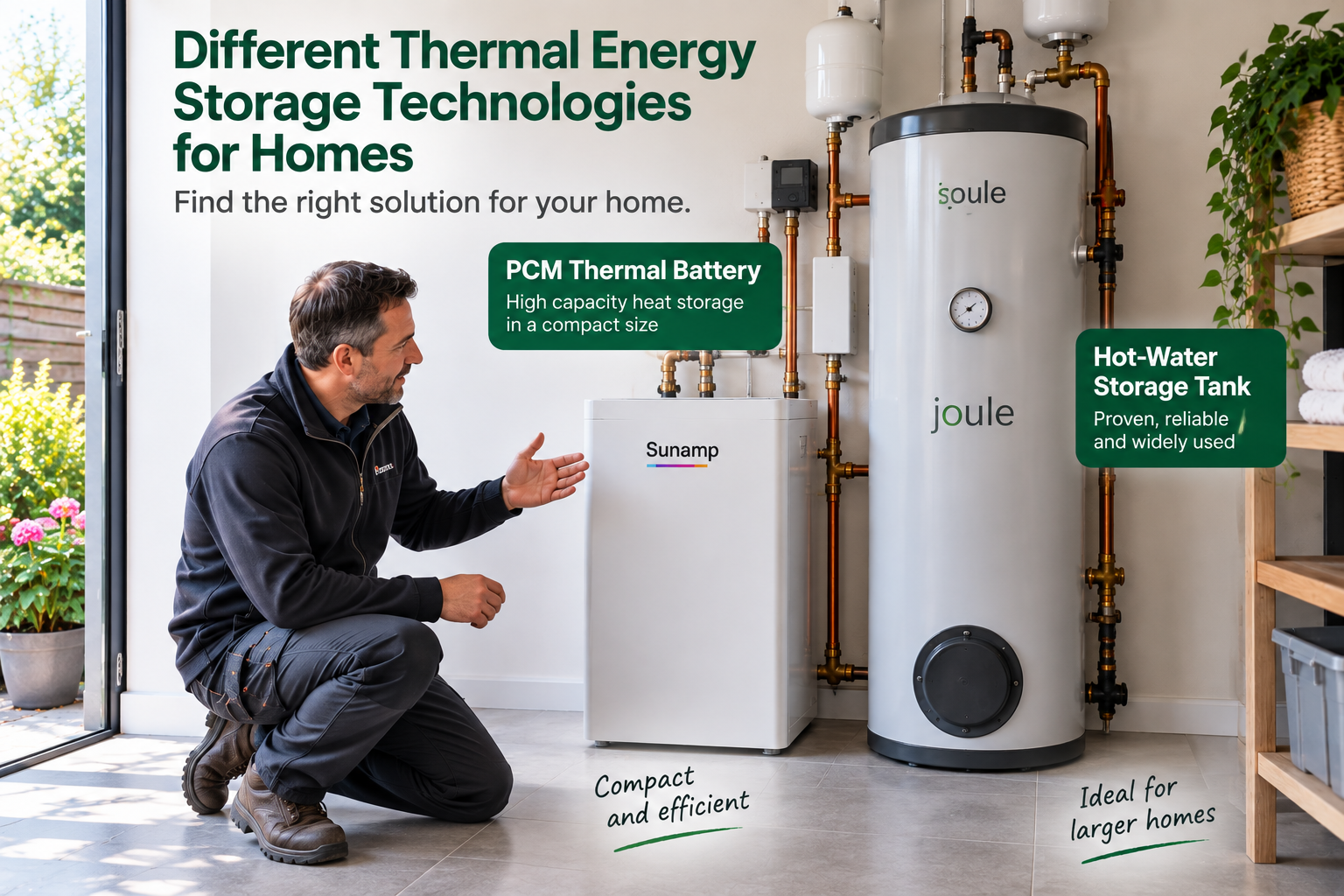
Which Thermal Storage Technology Is Best for Your Home?
PCM Thermal Battery vs Hot-Water Cylinder
One of the most useful comparisons in 2026 is between phase-change-material storage and conventional water storage.
PCM Thermal Battery
PCM storage uses latent heat. Energy is absorbed when the storage material changes phase and released as it changes back again.
The main attraction is energy density, allowing a smaller unit to store a useful quantity of heat.
This can make PCM particularly valuable in apartments, smaller homes and retrofit projects where installing a large cylinder is difficult.
Hot-Water Cylinder
A cylinder stores heat in a volume of water surrounded by insulation.
It is simple, well understood and compatible with many boilers, immersion heaters, solar systems and heat pumps when the correct cylinder is selected.
The disadvantage is physical size and standing heat loss.
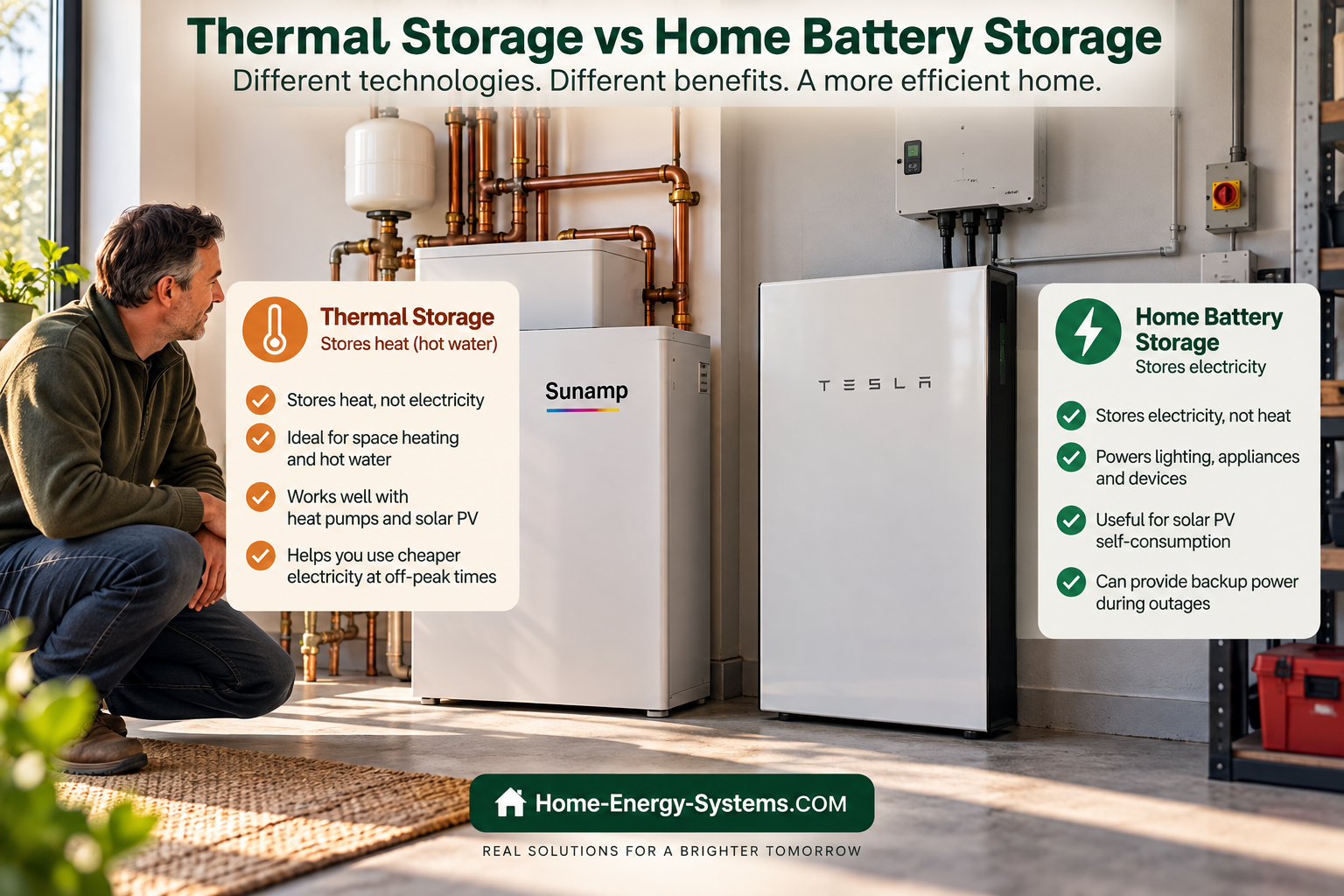
Thermal Storage vs Home Battery Storage
Thermal storage and lithium battery storage solve different problems.
A home battery stores electricity. That stored electricity can later power lighting, appliances, electronics and other electrical equipment.
A thermal store stores heat that will later be used for hot water or space heating.
Because heating water with stored electricity requires another energy conversion, storing surplus solar electricity directly as heat can sometimes make sense when the energy is definitely going to be used for hot water.
However, electrical batteries are far more flexible because the stored electricity can be used for many different purposes.
Read our Home Battery Storage Systems guide to compare electrical storage in more detail.
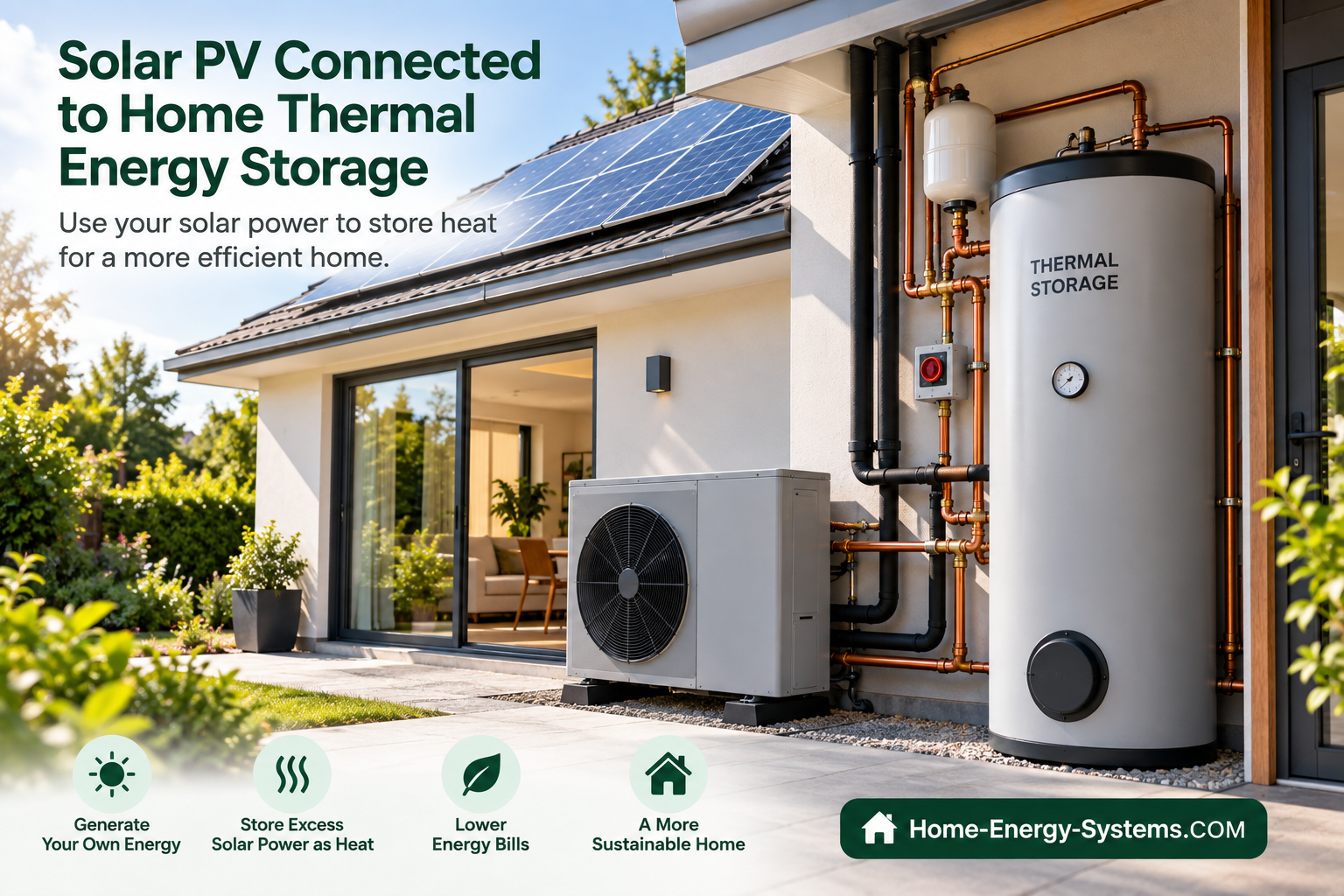
Best Thermal Storage for Solar PV
Solar PV often produces its strongest output around the middle of the day, when household hot-water demand may be relatively low.
Thermal storage can absorb some of that surplus electricity and retain it until hot water is required later.
There are several ways to do this:
- Use an immersion-heater solar diverter with a suitable hot-water cylinder.
- Use a smart cylinder with integrated solar-PV control.
- Use a PCM thermal battery configured for surplus solar electricity.
- Use solar alongside a compatible heat-pump hot-water system.
The value of diverting solar into heat depends partly on what you would otherwise receive for exporting electricity to the grid.
If export payments are attractive, storing every spare unit of solar as heat may not always produce the best financial result.
Best Thermal Storage for Heat Pumps
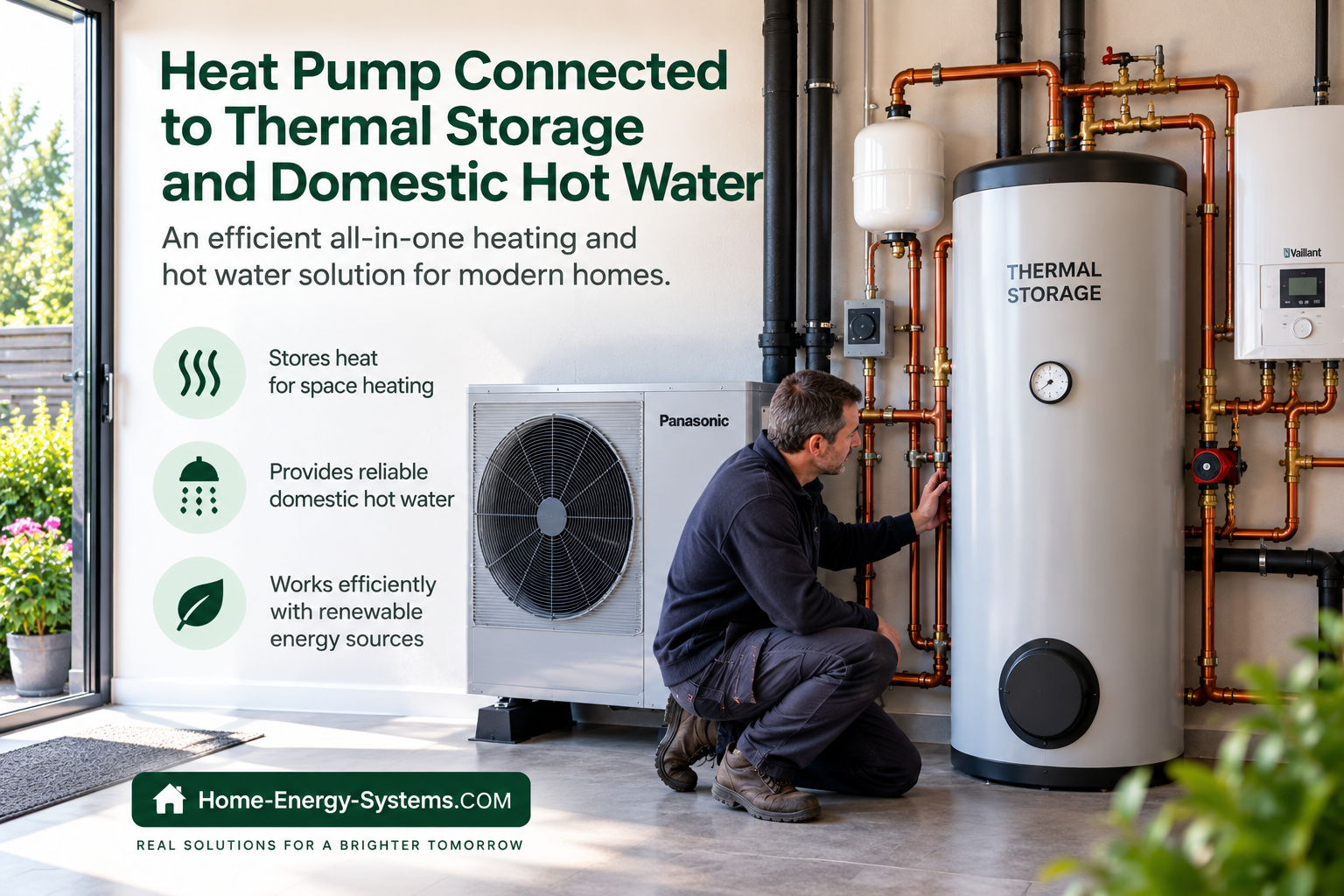
Heat pumps and thermal storage can work very effectively together, but adding a bigger tank does not automatically make a heat pump perform better.
The system should be designed around:
- The heat pump’s output.
- Domestic hot-water requirement.
- Heating-system water volume.
- Radiators or underfloor heating.
- Flow temperatures.
- Number of heating zones.
- Defrost requirements.
- Controls.
A domestic hot-water cylinder stores usable hot water, while a buffer vessel performs a different job within the space-heating circuit.
Some systems need a buffer; others may not.
For more detail, see our Best Heat Pump Systems guide.
Best Thermal Storage for Smart Electricity Tariffs
One of the strongest reasons to consider thermal storage is the growing availability of time-of-use electricity pricing.
If electricity costs significantly less at certain times, a controllable thermal store can charge during those cheaper periods and release heat later.
This can apply to:
- Electrically heated hot-water cylinders.
- PCM thermal batteries.
- Heat-pump hot-water systems.
- High-heat-retention storage heaters.
But the tariff difference must be large enough to justify storing energy after allowing for heat losses and equipment costs.
What Size Thermal Store Do You Need?
Bigger is not automatically better.
A correctly sized system should reflect actual demand.
Consider:
- Number of people in the household.
- Number of showers or baths used each day.
- Peak hot-water demand.
- Available space.
- Heat source.
- Heat-pump output where applicable.
- Solar-PV generation.
- Off-peak charging window.
- Expected future household changes.
Oversizing increases purchase cost and potentially increases standing losses. Undersizing may leave the household without enough usable hot water or stored heat.
How Much Does Thermal Energy Storage Cost?
There is no meaningful universal price because these products are very different.
A conventional replacement cylinder, a smart solar cylinder, a PCM thermal battery and a complete heat-pump hot-water system involve different equipment and installation work.
When obtaining quotations, compare:
- Storage unit price.
- Plumbing work.
- Electrical work.
- Controls and solar diversion equipment.
- Heat-pump integration.
- Changes to existing pipework.
- Warranty.
- Maintenance requirements.
- Expected standing heat loss.
- Installer support.
The cheapest storage product is not necessarily the cheapest complete installation.
What Specifications Matter Most?
Usable Thermal Capacity
Make sure quoted storage capacity reflects the usable amount of heat or hot water rather than relying solely on the physical size of the product.
Standing Heat Loss
Stored heat gradually escapes through insulation. Lower heat loss means more of the energy remains available when you need it.
Recovery or Charging Time
A household with heavy hot-water demand needs a system that can recover quickly enough for its normal usage pattern.
Heat-Source Compatibility
A product described as heat-pump compatible should still be checked against the exact heat-pump manufacturer and model being installed.
Controls
Smart controls are particularly useful when electricity tariffs change throughout the day or when solar PV is available.
Warranty and Installer Support
Thermal storage is part of a plumbing and heating system that may remain in service for many years. Local serviceability matters as much as clever technology.
Common Thermal Storage Buying Mistakes
- Buying the largest system without calculating household demand.
- Confusing a buffer tank with domestic hot-water storage.
- Assuming every thermal battery can work with every heat pump.
- Ignoring standing heat losses.
- Installing solar diversion without comparing the value of electricity export.
- Ignoring off-peak electricity tariff availability.
- Choosing unfamiliar technology without checking installer support.
- Assuming thermal storage can provide electrical blackout backup.
- Failing to allow for future heating-system changes.
- Comparing equipment prices without comparing installation costs.
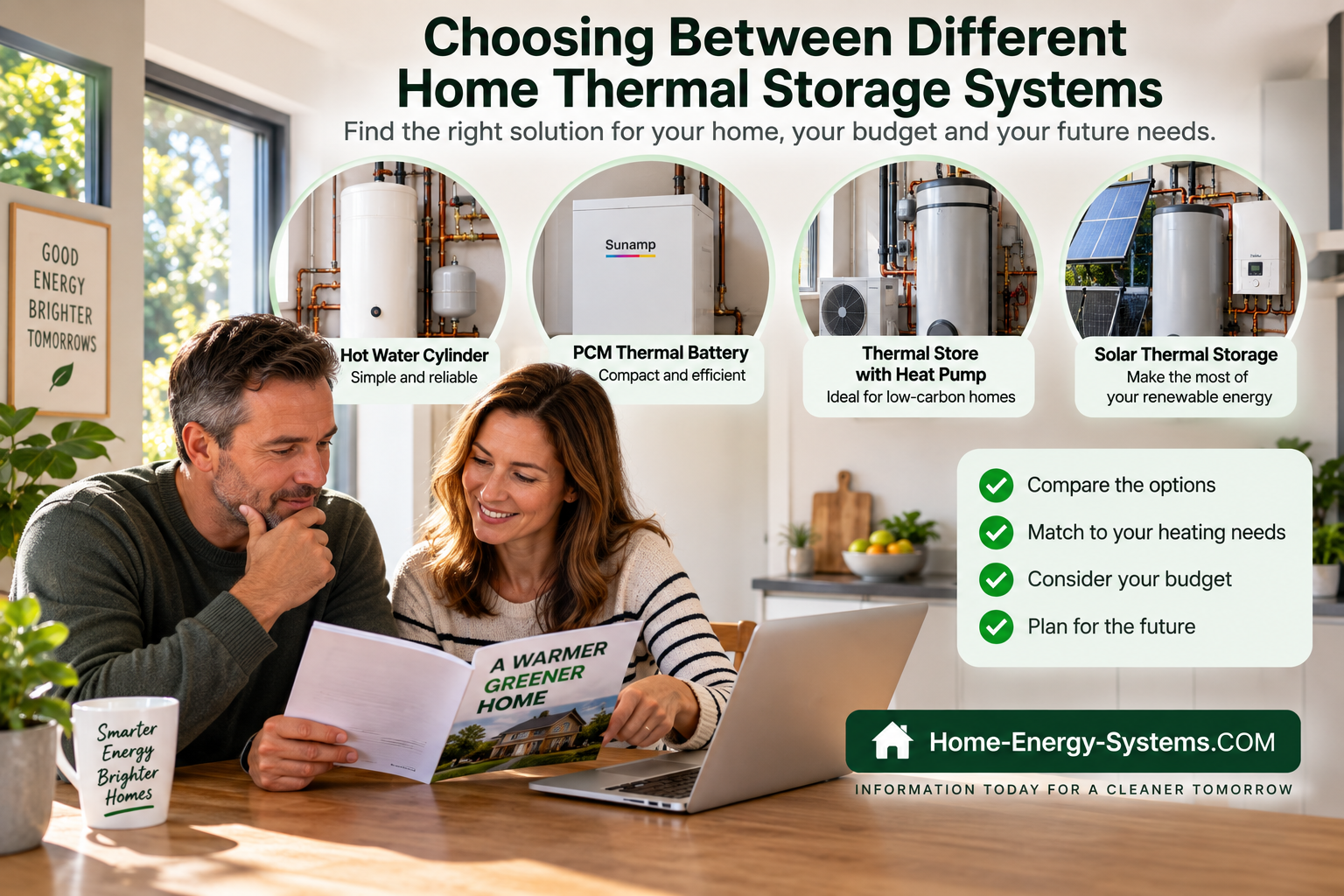
Should You Choose a Thermal Battery or a Conventional Cylinder?
For many households, the answer is determined as much by the building as by the technology.
A conventional cylinder may be the logical choice if:
- You already have suitable space.
- Your installer is familiar with the equipment.
- You want a straightforward heat-pump or boiler installation.
- Purchase cost is a major consideration.
A compact thermal battery becomes particularly interesting if:
- Space is extremely limited.
- You want to replace a bulky cylinder.
- You want to use off-peak electricity.
- You have or plan to install solar PV.
- You need a system capable of adapting to future heating changes.
Frequently Asked Questions
What is the best thermal energy storage system for a home?
For many homes, a modern insulated hot-water cylinder remains the simplest option. PCM thermal batteries become especially attractive where space is limited, while smart cylinders can be useful for homes combining solar PV, heat pumps and variable electricity tariffs.
What is a PCM thermal battery?
A phase-change-material thermal battery stores heat as its internal material changes physical state. This allows substantial thermal energy to be stored within a relatively compact unit.
Is Sunamp Thermino a battery?
It is a thermal battery rather than an electrical battery. It stores energy as heat using phase-change material and releases that heat to provide hot water.
Can thermal storage work with solar panels?
Yes. Surplus solar PV electricity can be diverted into suitable hot-water cylinders or compatible thermal batteries. Solar thermal collectors can also store captured solar heat directly in water.
Can a thermal battery replace a hot-water cylinder?
Some thermal batteries are specifically designed as alternatives to conventional hot-water cylinders. Compatibility with the home’s plumbing, heat source and hot-water demand still needs to be confirmed.
Can thermal storage work with a heat pump?
Yes. Conventional heat-pump cylinders and some PCM thermal batteries are designed for heat-pump applications. Correct sizing and compatibility are important.
Is thermal storage cheaper than a lithium home battery?
The technologies perform different jobs, so direct price comparison can be misleading. Thermal storage only supplies heat, while a lithium battery stores electricity that can be used throughout the home.
Can thermal energy storage power my home during a blackout?
No. Thermal storage retains heat rather than general-purpose electricity. Electrical backup requires a battery, inverter or other backup-power system.
Does thermal storage save money?
It can where stored heat replaces more expensive energy later, increases useful solar self-consumption or makes better use of lower-cost electricity tariffs. Savings depend on the tariff, equipment, losses and household usage.
Final Thoughts
The best thermal energy storage solutions in 2026 cover several very different technologies.
Sunamp Thermino demonstrates how phase-change materials can dramatically reduce the space required for hot-water storage. Mixergy adds intelligent control to water-based storage, while products such as Joule’s heat-pump cylinders show that conventional water storage remains highly relevant.
Dimplex Quantum illustrates another side of thermal storage entirely: storing off-peak electricity as heat for later space heating.
There is therefore no reason to look for one universal winner.
Start by deciding whether you need to store energy for hot water, space heating or both. Then consider your available space, heat source, solar generation and electricity tariff.
The best thermal storage system is the one that matches how your home actually produces and uses heat.
Product & Technical Sources
Thermal-storage ranges change over time. Check the current manufacturer’s specifications for the exact product available in your country.
- Sunamp — Thermino ePlus
- Sunamp — Thermino xPlus
- Mixergy — Smart Hot Water Systems
- Joule — Cyclone Plus High Gain
- Dimplex — Quantum High Heat Retention Storage Heater
- U.S. Department of Energy — Thermal Energy Storage
- International Energy Agency — Heat Pumps
Important: Heating, hot-water and electrical equipment should be specified and installed by appropriately qualified professionals. Product compatibility, tariffs, regulations and available models vary by location.
Return to the Home Energy Systems homepage .