Home Energy Storage Guide
Thermal Energy Storage Systems: Complete Home Guide
Thermal energy storage systems store heat or cooling energy so it can be used later. For homeowners, this can mean heating water when electricity is cheaper, storing surplus solar energy or helping a heating system meet demand at different times of day.
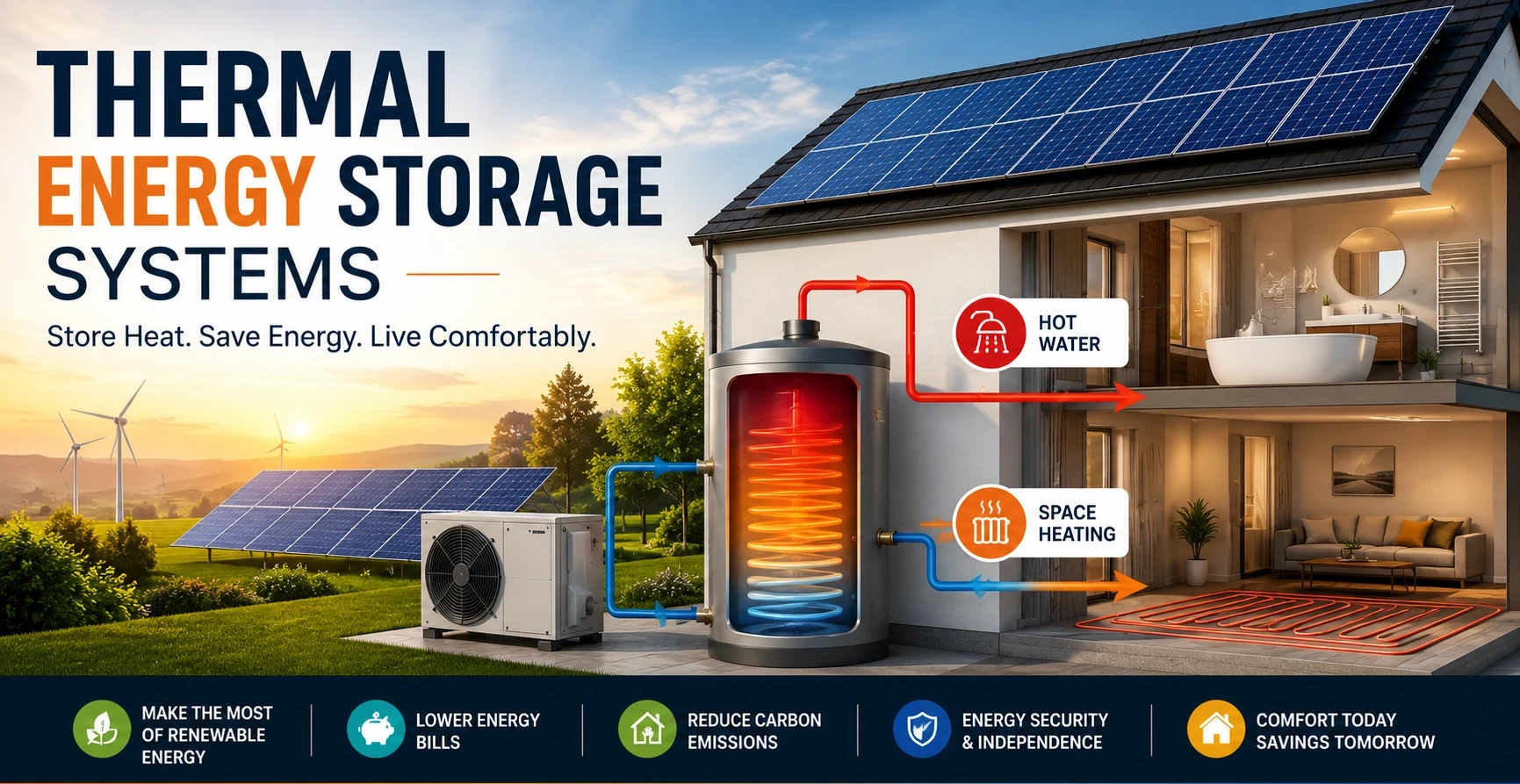
For most homes, the most familiar thermal storage device is an insulated hot-water cylinder. Other options include heating buffer tanks, phase-change heat batteries and specialised thermal stores.
The right choice depends on whether you need domestic hot water, space heating, solar energy storage or electricity tariff flexibility.
Important: Thermal storage does not create energy. It shifts when heat is available, and some energy is lost during storage.
What Are Thermal Energy Storage Systems?
Thermal energy storage systems absorb thermal energy, retain it in a storage medium and release it when required. Depending on the design, they can store heat for domestic hot water, building heating or industrial processes. Some systems store cooling energy instead.
Unlike a household battery, which stores electrical energy, thermal storage retains energy as heat or cold. A hot-water cylinder, for example, stores heat in water rather than electricity that can later power household appliances.
Thermal storage can be charged using solar thermal collectors, electric immersion heaters, heat pumps, boilers and recovered waste heat.
For an introduction to the wider technologies involved, explore our Home Energy Systems guides.
How Do Thermal Energy Storage Systems Work?
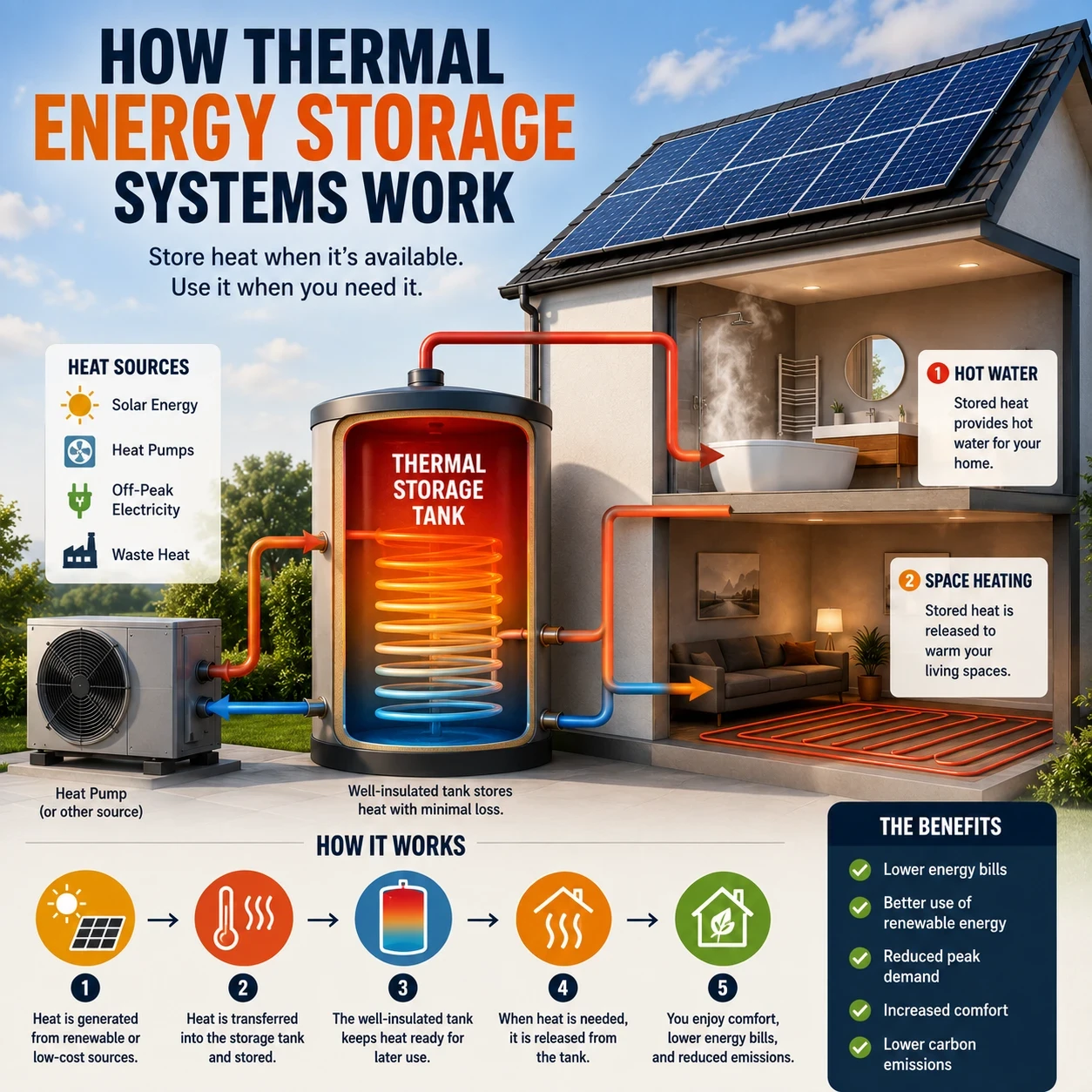
Most thermal energy storage systems involve three main stages:
- Charging: A heat source transfers energy into water or another storage material.
- Storage: Insulation and system design reduce unwanted heat loss.
- Discharging: Stored heat is transferred to domestic hot water, radiators, underfloor heating or another load.
For example, a household might use electricity during an off-peak tariff period to heat an insulated cylinder. The stored hot water can then be used in the morning without reheating the entire cylinder at peak electricity prices.
However, the cylinder gradually loses heat to its surroundings. Its actual performance depends on insulation, temperature, size and how frequently hot water is used.
Types of Thermal Energy Storage Systems
Sensible Heat Storage
Stores energy by increasing the temperature of a material without changing its physical state.
Examples include hot-water cylinders, heating buffer tanks and large insulated water reservoirs.
Latent Heat Storage
Uses phase-change materials that absorb or release energy as they melt or solidify.
Some commercial heat batteries use this approach to provide compact thermal storage.
Thermochemical Storage
Uses reversible chemical or sorption processes to store and release thermal energy.
It offers potential for longer-duration storage but remains less common in ordinary homes.
Cooling Energy Storage
Stores cooling capacity using chilled water, ice or other materials.
It is particularly useful in commercial buildings with significant air-conditioning demand.
Which Thermal Storage System Is Best for a Home?
| System | Typical Purpose | Main Consideration |
|---|---|---|
| Hot-water cylinder | Domestic hot water | Proven technology but requires space |
| Heating buffer tank | Heating-system hydraulics and limited heat storage | Not automatically beneficial for every heat pump |
| Phase-change heat battery | Compact hot-water or thermal storage | Check usable capacity, output and temperature requirements |
| Large insulated thermal tank | Higher-capacity heat storage | Space, insulation and installation complexity |
There is no single best system for every household. A conventional hot-water cylinder may be the most straightforward solution for domestic hot water, while a purpose-designed heat battery may be attractive where space is restricted.
How Much Energy Can a Hot-Water Cylinder Store?
A useful way to understand thermal storage is to calculate how much energy can be held in a tank of water.
Assume a cylinder contains approximately 200 kg of water and its average temperature increases from 40°C to 60°C.
Stored heat = mass × specific heat capacity × temperature rise
200 × 4.186 × 20 ÷ 3,600 = approximately 4.65 kWh of thermal energy.
This is the theoretical increase in stored heat. Actual usable energy depends on the minimum acceptable delivery temperature, mixing, heat losses and system design.
| Water Volume | Temperature Rise | Approximate Stored Heat |
|---|---|---|
| 100 litres | 20°C | 2.33 kWh |
| 200 litres | 20°C | 4.65 kWh |
| 300 litres | 20°C | 6.98 kWh |
These figures describe thermal energy, not electricity available to household sockets. They also do not indicate how many litres of usable hot water a cylinder will deliver.
Thermal Energy Storage Costs and Potential Savings
Installation costs vary substantially depending on the country, equipment, capacity and whether thermal storage is being added to an existing system or installed alongside a new heating system.
A replacement hot-water cylinder is a different project from installing a specialised heat battery or a large thermal storage tank. Plumbing changes, electrical controls, insulation and commissioning can also affect the total price.
Example of Electricity Tariff Savings
Suppose a household can shift 4 kWh of electrical heating consumption from a peak tariff of €0.30/kWh to an off-peak tariff of €0.15/kWh.
Peak electricity cost: 4 × €0.30 = €1.20.
Off-peak electricity cost: 4 × €0.15 = €0.60.
Potential saving: €0.60 per day before storage losses and additional equipment costs.
Across 250 qualifying days, that would equal €150 before those adjustments.
This example assumes the same 4 kWh of electricity consumption in both periods. Real savings depend on the heating technology, tariff structure, available storage capacity, standing losses and how much demand can genuinely be shifted.
With heat pumps, electricity consumption may also change when the system operates at different outdoor temperatures or requires different water temperatures.
Thermal Energy Storage and Solar Power
Thermal storage can work alongside both solar photovoltaic panels and solar thermal collectors, but these systems produce different forms of energy.
Solar PV and Water Heating
Solar PV panels produce electricity. A compatible immersion controller can divert surplus electricity into a hot-water cylinder, while a heat pump may also be scheduled to use solar generation.
Whether this is financially attractive depends partly on the value of exported electricity compared with the cost of heating water by another method.
Solar Thermal Collectors
Solar thermal collectors heat a fluid that transfers energy into a hot-water cylinder through a heat exchanger. They produce heat directly rather than generating electricity.
Our Home Solar Systems guide explains the broader role of solar energy in household energy planning.
Thermal Energy Storage and Heat Pumps
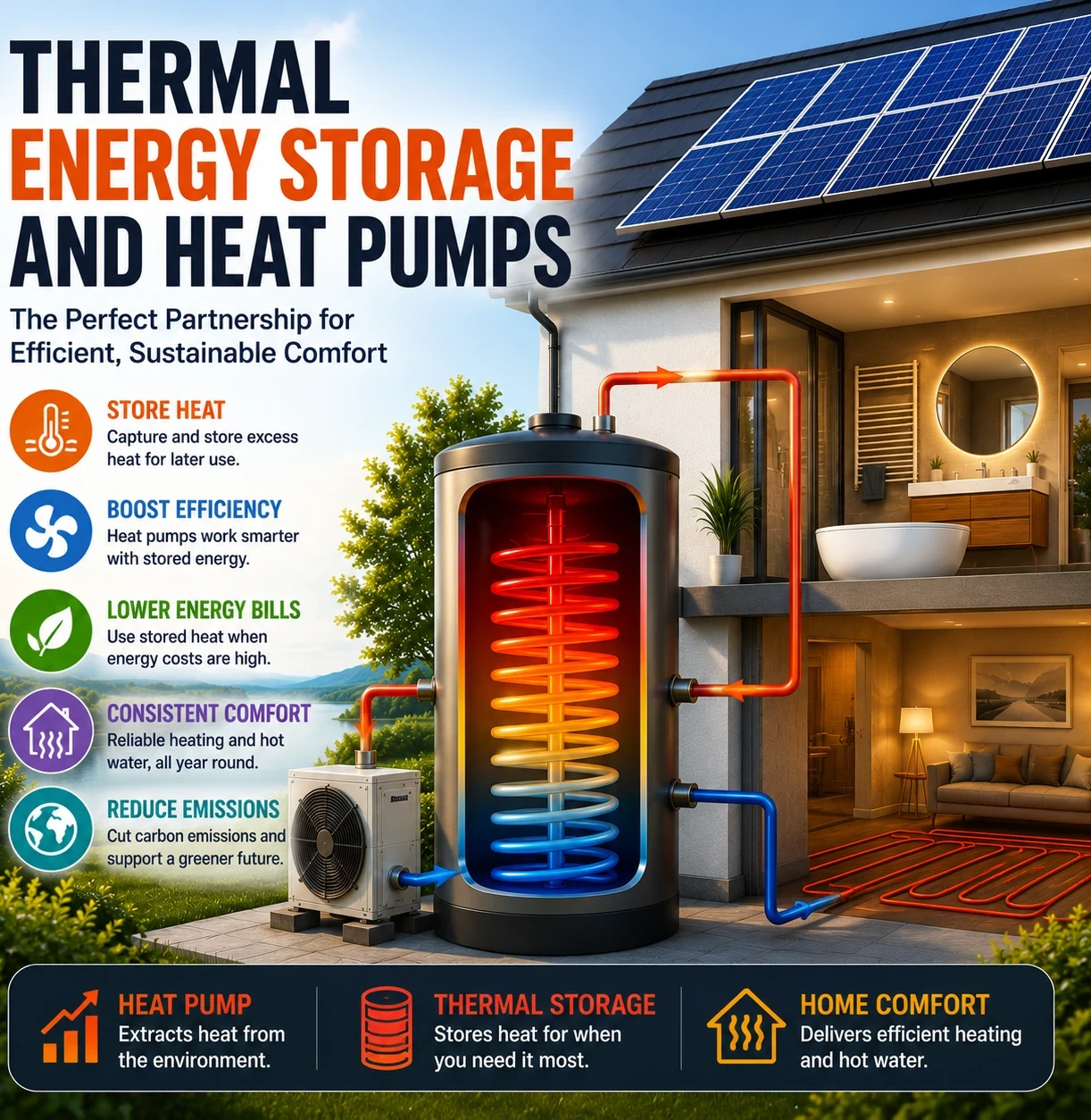
Heat pumps can use thermal storage to provide domestic hot water or shift some heating demand to different periods.
However, adding a buffer tank or thermal store does not automatically improve heat-pump efficiency. Extra storage can introduce heat losses, and unnecessarily high water temperatures can reduce heat-pump performance.
In some installations, a buffer tank is useful for hydraulic separation, minimum system volume or defrost management. In others, a correctly designed direct heating circuit may be more efficient.
For heat-pump systems, the important questions are:
- What flow temperature does the property require?
- Does the heat pump manufacturer specify minimum system water volume?
- Is storage needed for domestic hot water, space heating or both?
- Can heating be shifted without sacrificing comfort or efficiency?
- How much additional standing heat loss will storage introduce?
See our Heat Pump Technology guide for more on heating-system design and performance.
Benefits and Limitations of Thermal Energy Storage
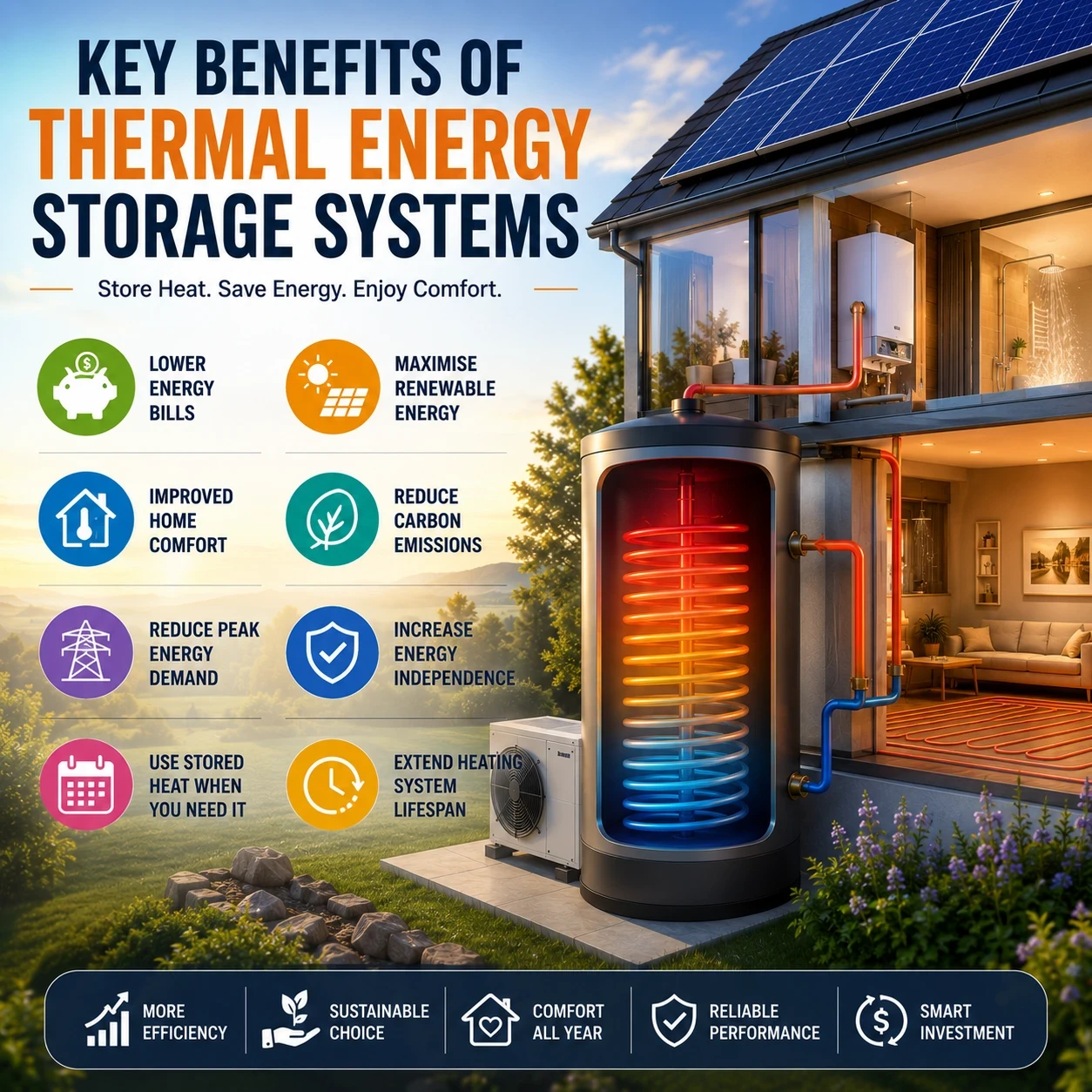
Potential Benefits
- Shift some heating demand to lower-cost periods
- Use surplus renewable energy
- Improve flexibility in hot-water production
- Reduce peak electricity demand in suitable installations
- Provide useful heat after the original heat source stops operating
Potential Limitations
- Heat is gradually lost during storage
- Equipment and installation cost money
- Larger tanks require space
- Stored heat cannot directly power electrical appliances
- Some configurations reduce rather than improve efficiency
Environmental benefits also depend on how the heat is generated, what energy source is displaced and the overall performance of the system.
Residential and Commercial Applications
Domestic hot-water cylinders are common examples of thermal storage in residential buildings. Larger systems are also used in hotels, hospitals, factories, district heating networks and commercial cooling installations.
Industrial and district-scale projects may use much larger water reservoirs, molten salts or other specialised materials. These applications should not be confused with the equipment typically installed in an ordinary home.
How to Choose the Right Thermal Storage System
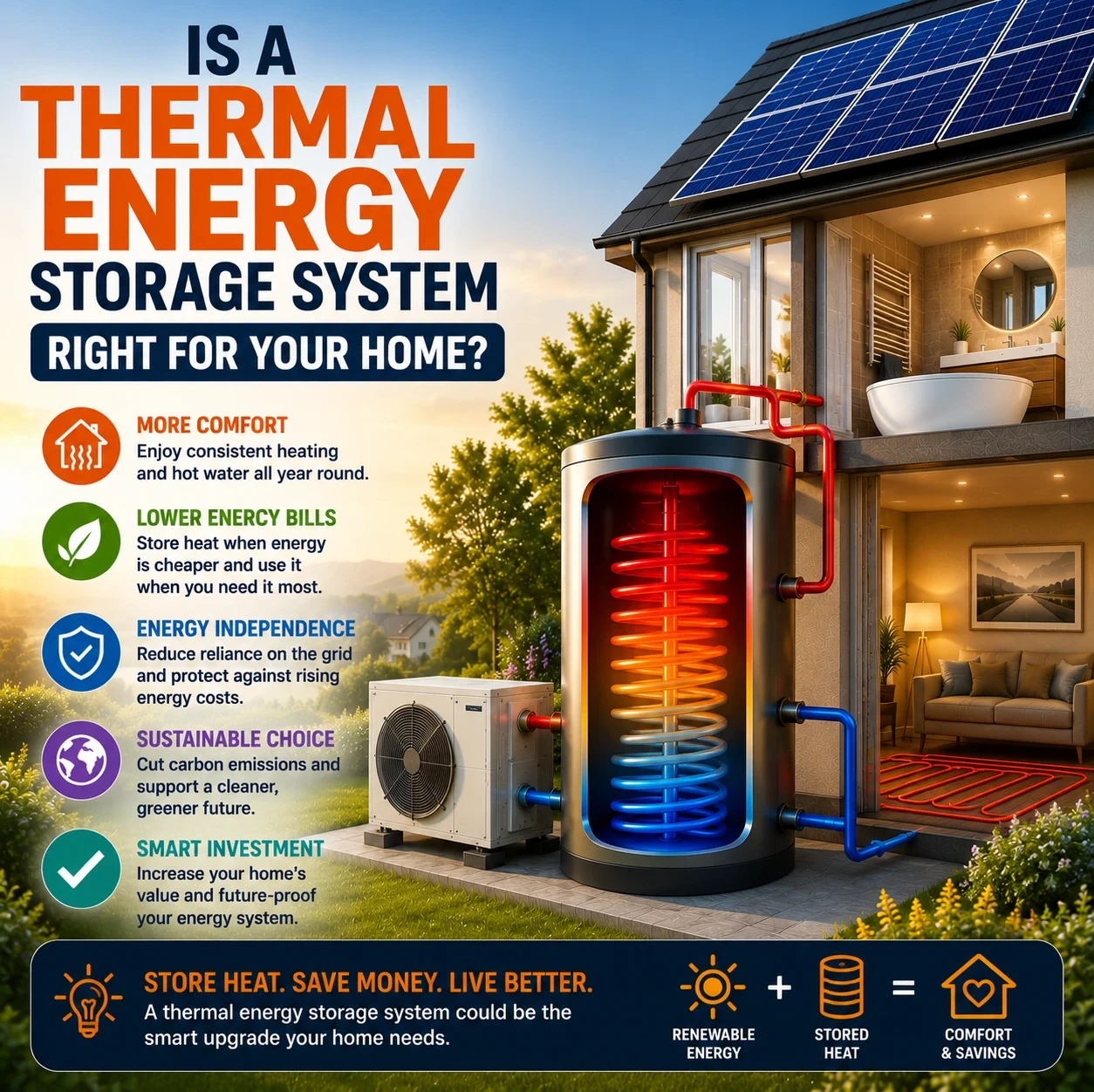
Before purchasing thermal storage equipment, identify the problem you want it to solve.
- Define the purpose: Domestic hot water, space heating, solar surplus storage or tariff shifting.
- Estimate daily demand: Determine when heating or hot water is needed and how much energy it requires.
- Check the temperature range: Stored energy is only useful if it can be delivered at the required temperature.
- Assess available space: Include access, weight, maintenance clearances and pipework.
- Compare total costs: Include controls, installation, insulation and potential maintenance.
- Check compatibility: Follow the heating equipment manufacturer’s requirements and local regulations.
For related electrical storage options, read our Home Battery Storage Systems guide.
Planning a More Efficient Home Energy System?
Explore our guides to solar power, heating and energy storage before deciding which technologies suit your property.
Frequently Asked Questions
Do thermal energy storage systems store electricity?
No. They store thermal energy rather than electrical energy. Some systems use electricity to produce the heat they store, but the stored heat cannot ordinarily be converted back into household electricity.
Can thermal energy storage work without solar panels?
Yes. Heat can come from heat pumps, boilers, immersion heaters, district heating systems or other suitable sources.
How long can thermal energy be stored?
It depends on the storage material, temperature difference, insulation and system design. Domestic hot-water cylinders commonly retain useful heat for hours and sometimes longer, while specialised large-scale systems may be designed for extended storage periods.
Are heat batteries better than hot-water cylinders?
Not necessarily. Some heat batteries provide compact storage, but cost, usable capacity, heat output, efficiency and installation requirements differ. Compare the complete system rather than storage volume alone.
Does thermal storage always reduce energy bills?
No. Savings depend on tariff differences, the heating source, heat losses, equipment costs and whether the household can shift meaningful energy demand.
Do heat pumps need buffer tanks?
Not always. Some installations require them for hydraulic or operational reasons, while others work effectively without them. The design should follow manufacturer requirements and the property’s heating needs.
Conclusion: Is Thermal Energy Storage Worth It?
Thermal energy storage systems can be valuable when a household needs to shift heat production, make better use of renewable energy or manage domestic hot-water demand.
For many homeowners, an appropriately sized hot-water cylinder is the simplest starting point. More specialised storage technologies may be useful where space, heating demand or tariff arrangements justify them.
The strongest financial case comes from a properly designed system with a clear purpose, rather than installing additional storage simply because the technology is available.
Further Reading and Technical References
- US Department of Energy — Thermal Energy Storage
- International Energy Agency — Energy Efficiency and Demand
Editorial note: Savings examples are illustrative, not supplier quotations or predictions of household savings. Equipment selection should be based on site-specific design and qualified installation advice.