Home EV Charging
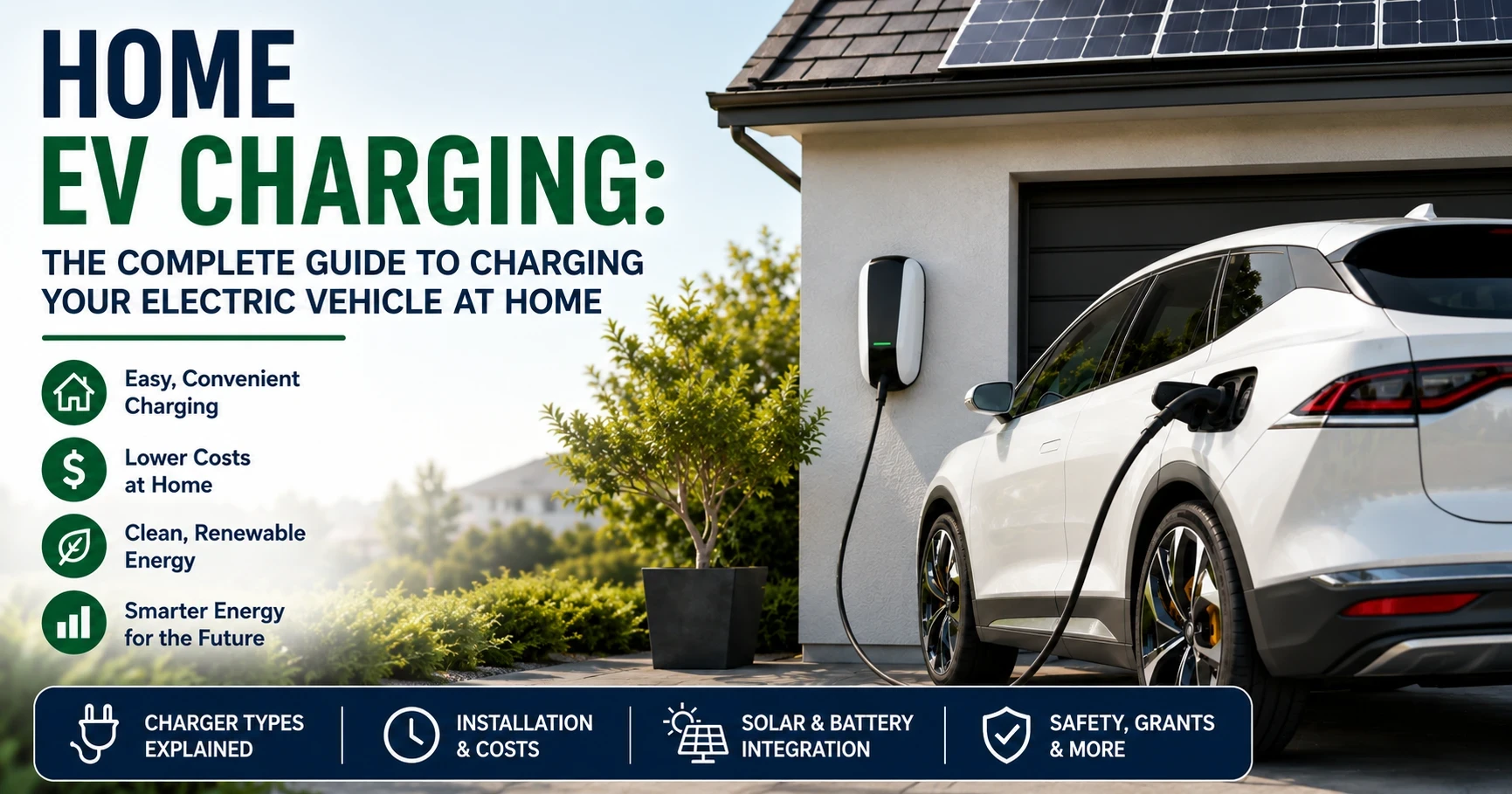
Home EV charging is rapidly becoming the preferred way for electric vehicle owners to keep their cars fully charged, reduce running costs, and enjoy the convenience of starting every journey with a full battery. As electric vehicles become more common worldwide, installing a home EV charger has become one of the most practical home energy upgrades available.
Whether you already own an electric vehicle or you’re planning to buy one soon, understanding how home EV charging works can help you choose the right charger, reduce electricity costs, and even combine your charging system with solar panels and home battery storage for maximum savings.
In this comprehensive guide, we’ll explain everything you need to know about charging an electric vehicle at home, from the different charger types to installation requirements, charging speeds, costs, and the latest smart charging technology.
What Is Home EV Charging?
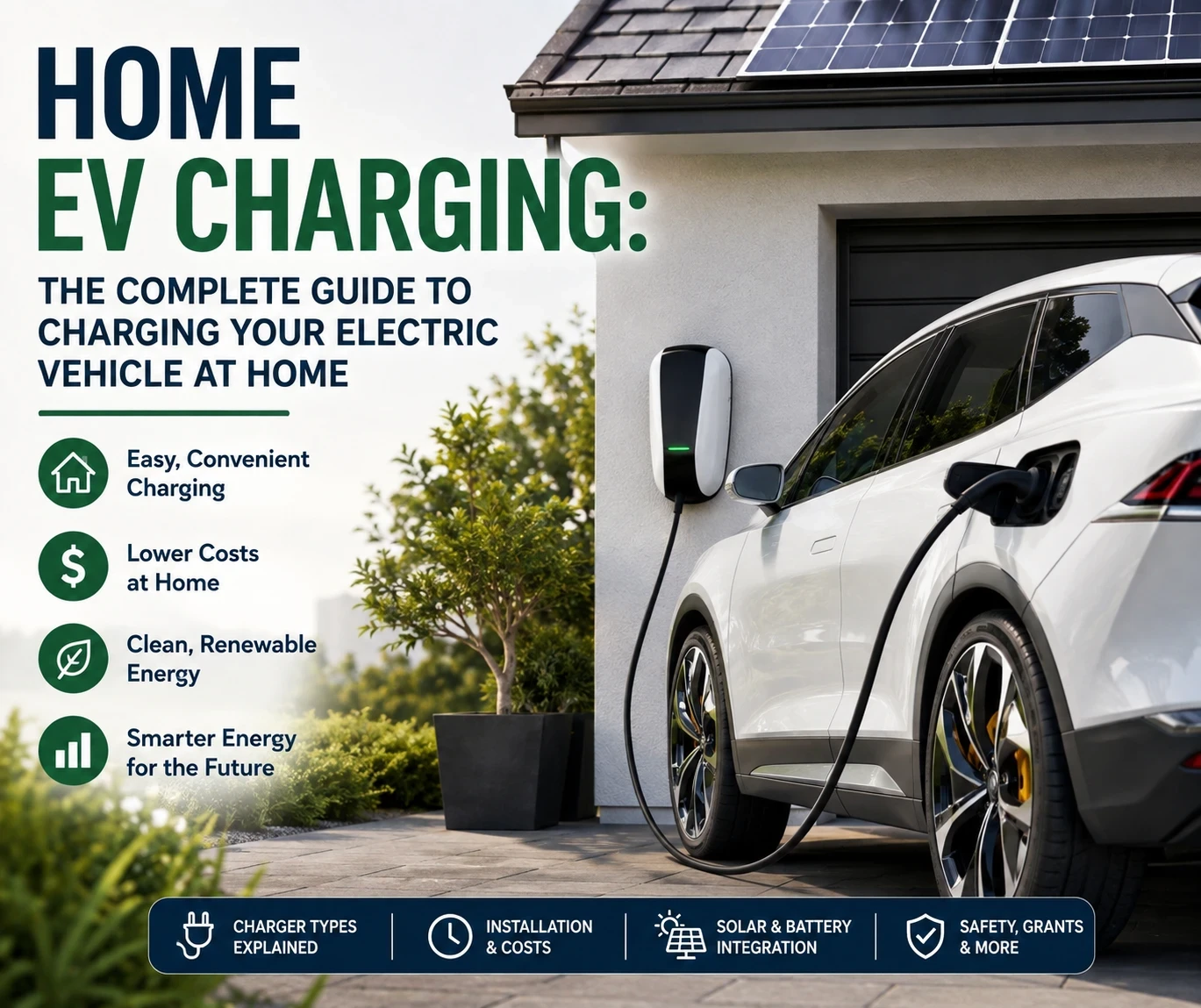
Home EV charging allows electric vehicle owners to recharge their vehicle’s battery from their own property instead of relying on public charging stations. Most drivers simply plug in their vehicle overnight, allowing the battery to recharge while electricity demand is lower.
A dedicated home EV charger is installed on an exterior wall or inside a garage and connects directly to your home’s electrical system. Unlike a standard household socket, a purpose-built EV charger is designed to deliver electricity safely, efficiently, and much faster.
For many households, home charging quickly becomes the most convenient and cost-effective way to own an electric vehicle.
Why More Homeowners Are Installing EV Chargers
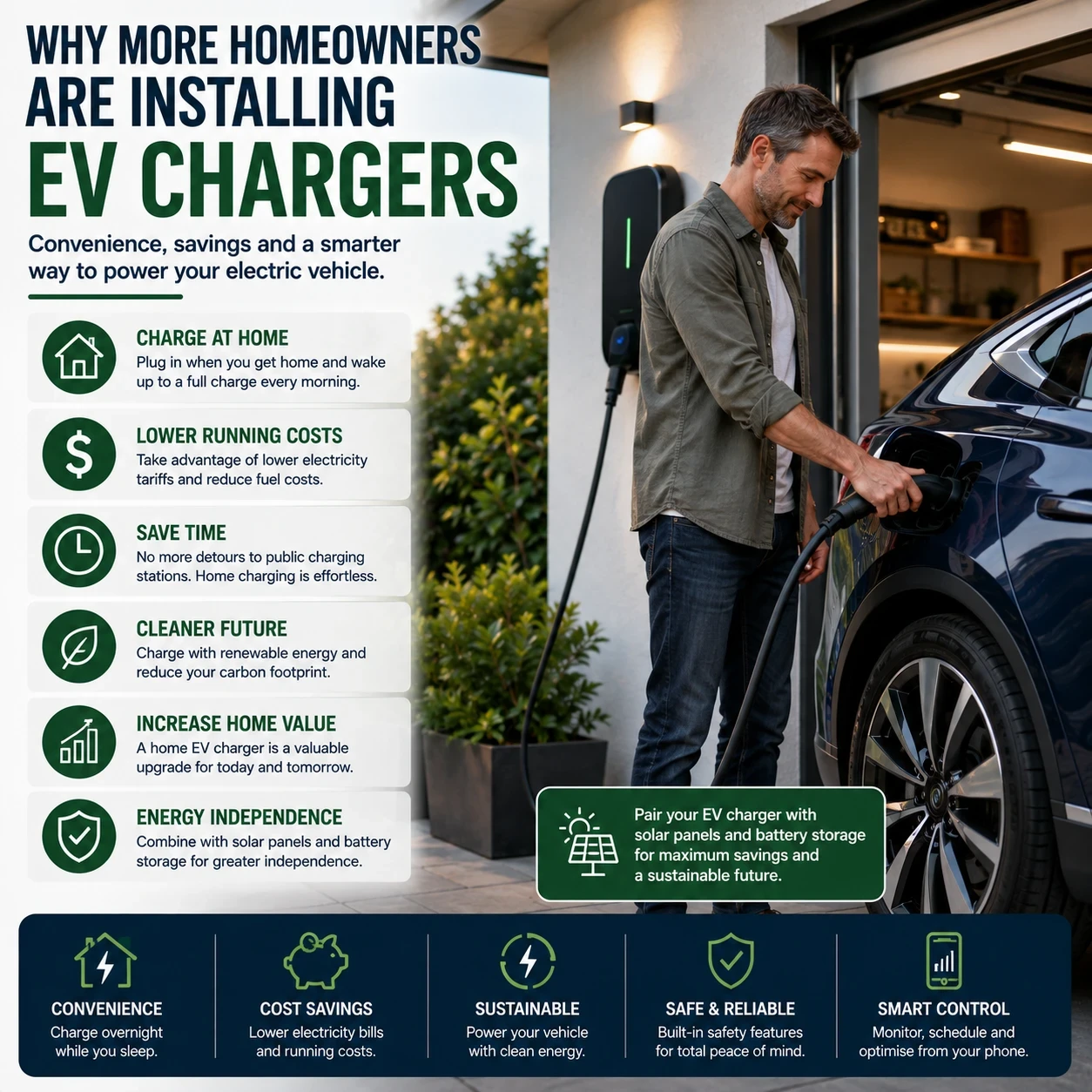
Electric vehicle ownership continues to grow every year, and with it comes the demand for convenient charging solutions.
Home charging offers several major advantages:
- Charge your vehicle overnight while you sleep.
- Reduce reliance on public charging stations.
- Take advantage of lower overnight electricity tariffs.
- Improve convenience and save time.
- Increase property appeal for future buyers.
- Combine charging with solar panels for lower running costs.
- Charge directly from home battery storage where available.
Instead of planning journeys around charging stations, homeowners can simply plug in when they arrive home and wake up to a fully charged vehicle every morning.
How Home EV Charging Works
Although the technology behind electric vehicle charging is sophisticated, the process itself is remarkably simple.
Electricity flows from your home’s electrical supply through the EV charger and into the vehicle’s onboard charging system. The vehicle automatically controls how quickly the battery charges while monitoring battery temperature, voltage, and charging safety.
Modern EV chargers also communicate directly with your vehicle to optimise charging performance and protect battery life.
Many smart chargers can even delay charging until electricity prices are lowest or until excess electricity is available from rooftop solar panels.
Types of Home EV Chargers
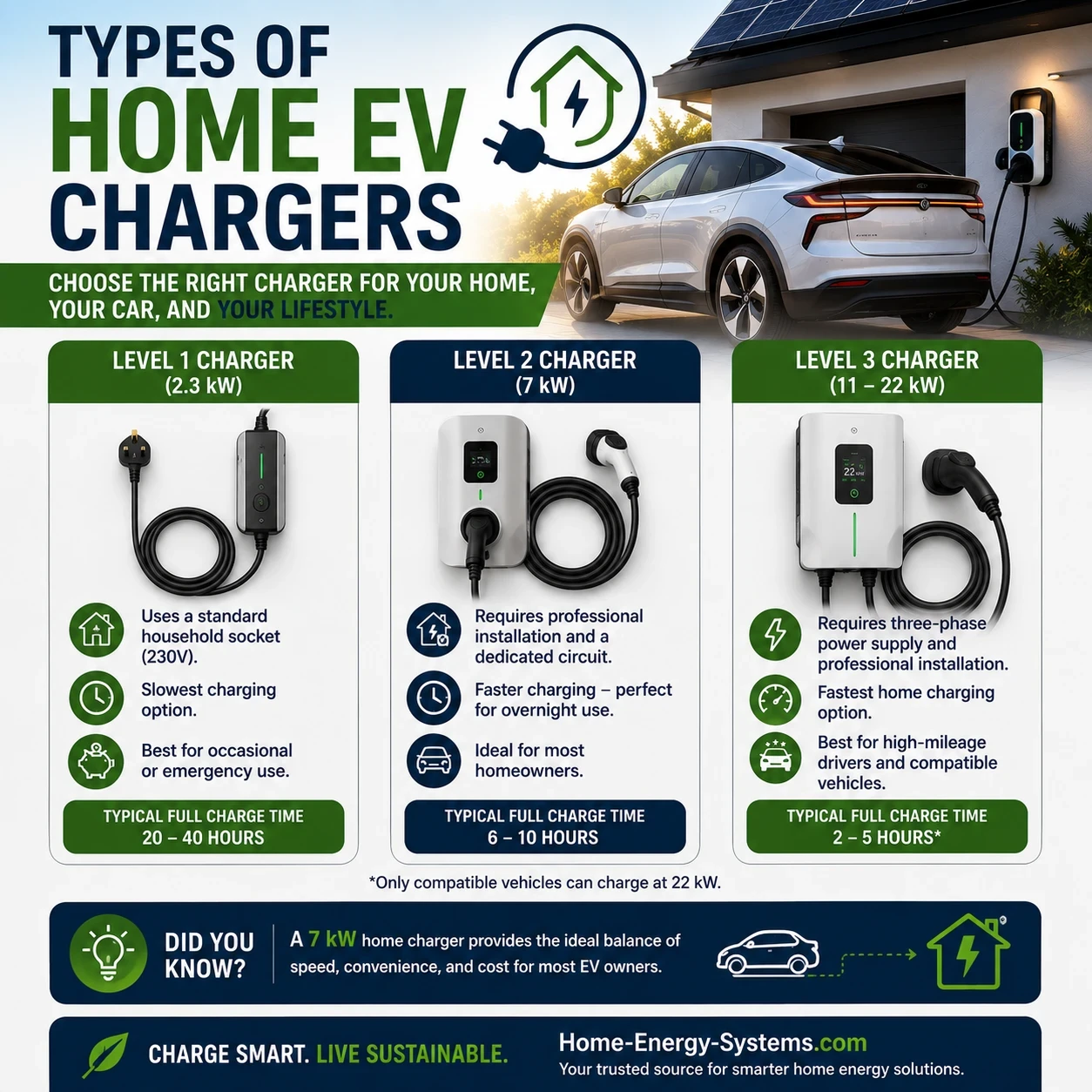
Not all EV chargers are the same. Understanding the different charging levels will help you choose the right solution for your property and driving habits.
Level 1 Charging
Level 1 charging uses a standard household electrical socket. It requires no specialist installation but charges very slowly, making it suitable only for drivers with short daily journeys.
Typical charging speed:
- 2–3 kW
- Approximately 5–8 km (3–5 miles) of driving range per hour.
Level 2 Charging
Level 2 chargers are the most popular option for homeowners. They require professional installation but provide significantly faster charging speeds.
Typical charging speed:
- 7–22 kW (depending on country and electrical supply)
- Approximately 30–100 km of driving range per hour.
Most homeowners choose Level 2 chargers because they comfortably recharge an electric vehicle overnight.
DC Fast Charging
DC fast chargers are generally found at motorway service stations and commercial charging hubs rather than private homes.
These systems bypass the vehicle’s onboard charger and deliver extremely high charging speeds.
Typical charging speed:
- 50–350 kW
- Recharge many vehicles from 20% to 80% in around 20–40 minutes.
Due to their high power requirements, DC fast chargers are rarely installed in residential properties.
Charging Times Explained
Charging time depends on several factors, including battery size, charger power, your vehicle’s charging capability, and the battery’s current state of charge.
2.3 kW (Level 1)
- Typical charging time: 20–40 hours
- Best for: Occasional charging using a standard household socket.
7 kW
- Typical charging time: 6–10 hours
- Best for: Overnight home charging for most EV owners.
11 kW
- Typical charging time: 4–8 hours
- Best for: Homes with compatible electrical supplies and vehicles.
22 kW
- Typical charging time: 2–5 hours*
- Best for: Compatible vehicles with three-phase electrical supplies.
*Only compatible vehicles can charge at 22 kW.
For most homeowners, a 7 kW charger provides more than enough charging capacity. Simply plug your vehicle in overnight and wake up to a fully charged battery ready for the day ahead.
Choosing the Right Home EV Charger
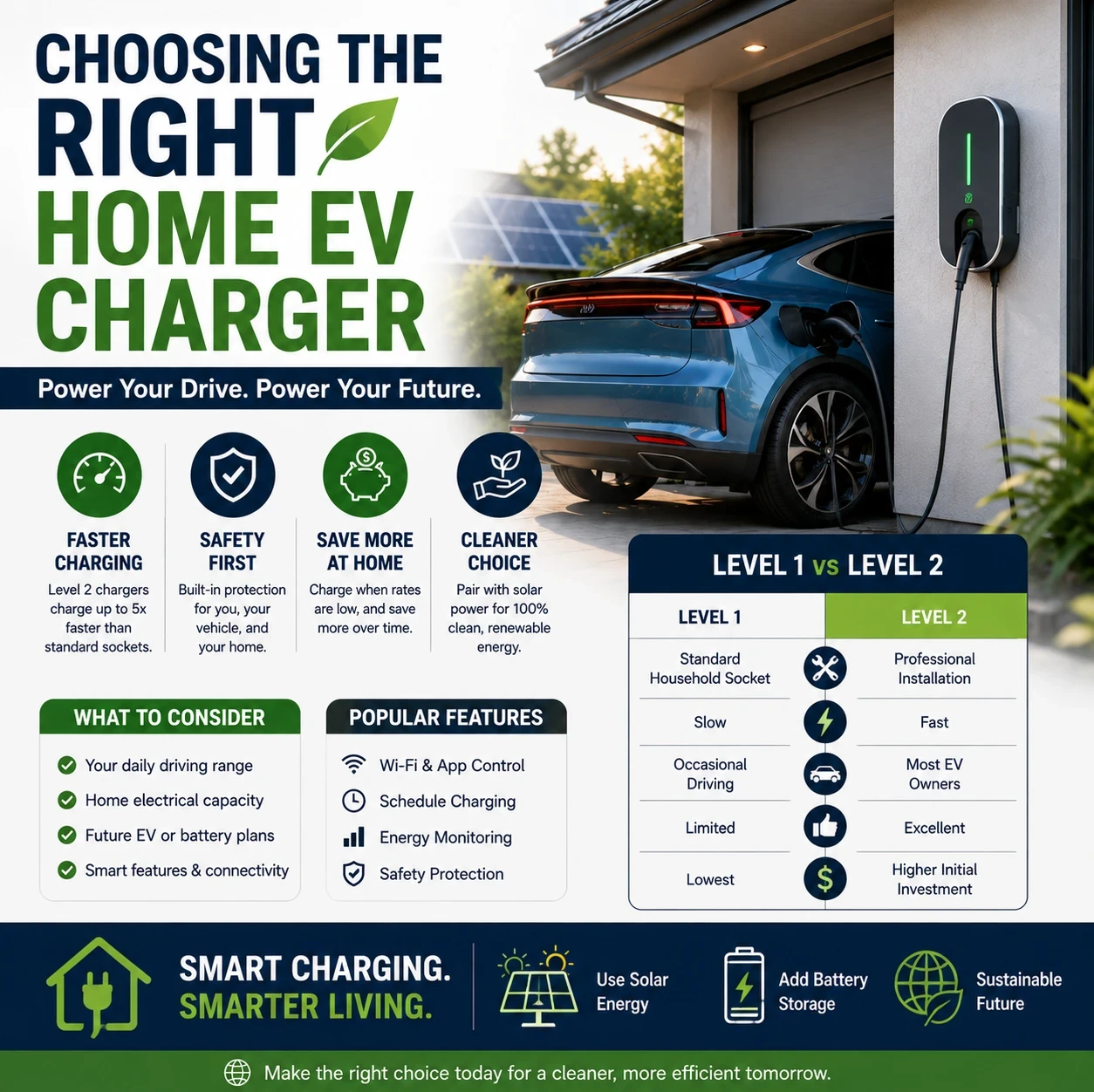
Selecting the best charger depends on several important factors including your vehicle, daily mileage, electrical supply, available installation space, and future energy plans.
Many homeowners also consider whether they intend to install:
- Solar panels
- Home battery storage
- Smart home energy management systems
- Additional electric vehicles
Choosing a charger that can integrate with future renewable energy upgrades may provide greater long-term value.
In the next section, we’ll look at installation requirements, charging costs, smart charging technology, solar integration, and how battery storage can make home EV charging even more effective.
Continue Reading
You’re almost there!
In Part 3, you’ll discover how to protect your investment, save even more money, and avoid costly mistakes that many first-time EV owners make.
Coming up:
✅ Essential home EV charging safety tips
✅ Government grants and financial incentives
✅ The most common installation mistakes to avoid
✅ Answers to frequently asked questions
✅ Our final recommendations for choosing the right charger
✅ Helpful guides to build your complete home energy system with solar panels, battery storage, heat pumps, and smart energy technology
Don’t miss Part 3—it’s where everything comes together to help you make the best long-term decision for your home and your electric vehicle.
Where Should You Install a Home EV Charger?
Choosing the right location for your home EV charger is almost as important as selecting the charger itself. A well-positioned charger makes daily charging easier, improves safety, and can reduce installation costs.
Most chargers are installed:
- Inside a garage.
- On an external wall beside a driveway.
- In a dedicated parking space.
- Under a carport.
- In secure apartment parking where permitted.
Ideally, the charging cable should comfortably reach your vehicle without creating a trip hazard. Many homeowners also install protective cable management systems to keep charging cables tidy and protected from weather damage.
Electrical Requirements
A dedicated EV charger requires sufficient electrical capacity within your home’s consumer unit (fuse board). Before installation, a qualified electrician will inspect your existing electrical system to ensure it can safely support the charger.
The installation normally includes:
- A dedicated electrical circuit.
- Appropriate circuit breakers.
- Residual Current Device (RCD) protection.
- Weatherproof outdoor fittings where required.
- Professional safety testing.
Older homes may require an electrical upgrade before installing a higher-powered charger, while newer properties are often already suitable.
Smart EV Chargers
Today’s smart EV chargers offer far more than simple battery charging. Connected through Wi-Fi or Bluetooth, they allow homeowners to monitor and control charging directly from a smartphone.
Popular smart charging features include:
- Remote start and stop.
- Charging schedules.
- Electricity usage monitoring.
- Integration with off-peak electricity tariffs.
- Solar charging compatibility.
- Automatic software updates.
- Charging history and energy reports.
Many smart chargers can automatically begin charging when electricity prices are lowest, helping reduce long-term running costs.
How Much Does Home EV Charging Cost?
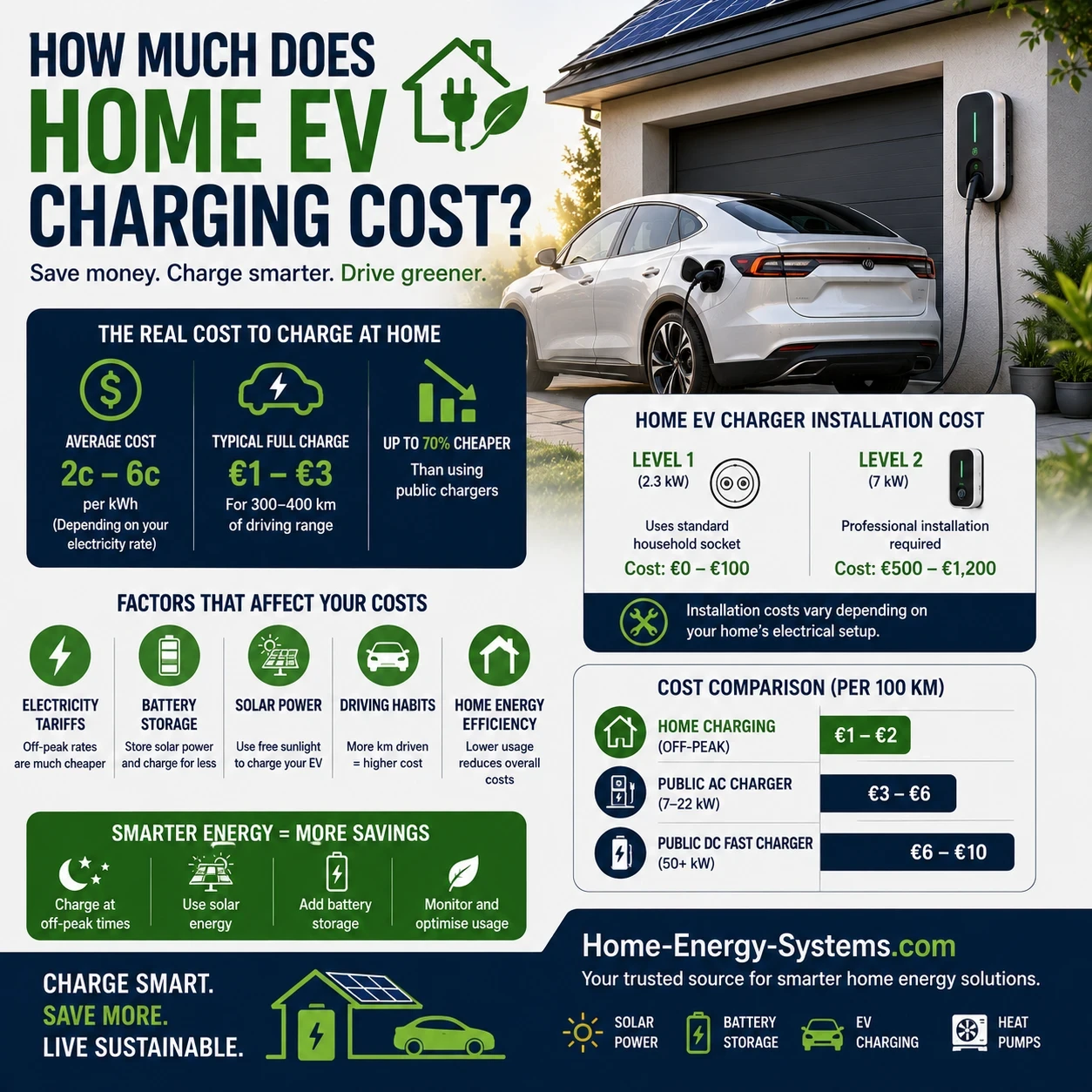
The cost of charging an electric vehicle at home depends on electricity prices, battery size, and how often you drive.
Charging at home is usually considerably cheaper than relying exclusively on public rapid chargers, particularly when using off-peak electricity tariffs.
Many electricity suppliers now offer special overnight tariffs designed specifically for EV owners, making home charging even more affordable.
Additional savings become possible when charging directly from solar panels during daylight hours.
Can Solar Panels Charge an Electric Vehicle?
Absolutely. Combining solar panels with home EV charging is one of the fastest-growing trends in renewable energy.
Instead of purchasing all your electricity from the grid, rooftop solar panels generate clean electricity that can charge your vehicle during the day.
The benefits include:
- Lower electricity bills.
- Reduced charging costs.
- Lower carbon emissions.
- Greater energy independence.
- Better use of excess solar production.
Many homeowners schedule vehicle charging during periods of peak solar generation to maximise the use of free renewable electricity.
Using Home Battery Storage with EV Charging
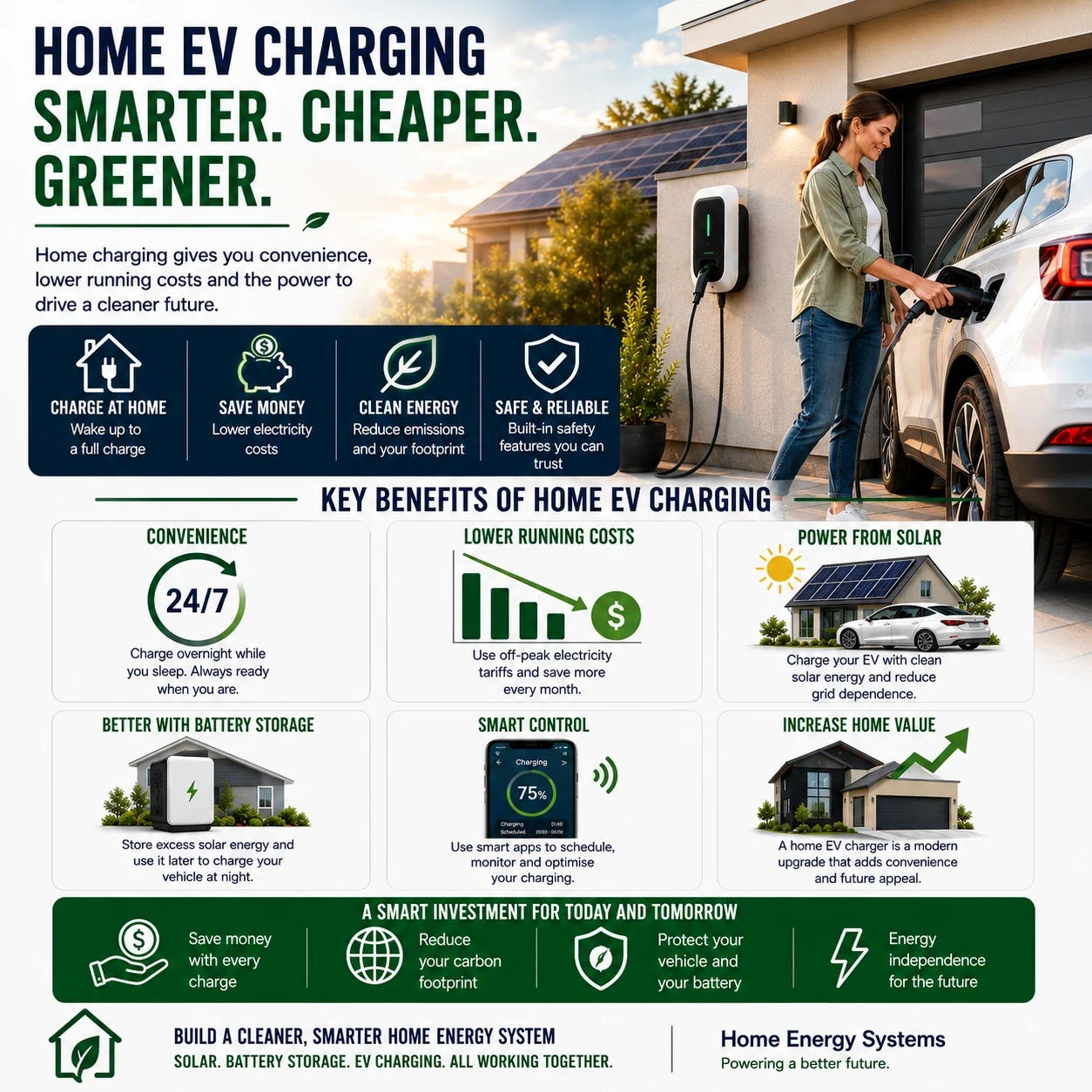
Adding battery storage creates an even more efficient home energy system.
Instead of exporting unused solar electricity back to the grid, the battery stores excess energy for later use. That stored electricity can then be used to charge your vehicle overnight when the sun has gone down.
A complete renewable energy system may include:
- Solar panels.
- Home battery storage.
- Smart energy management.
- Home EV charger.
- Time-of-use electricity tariffs.
Together these technologies can significantly reduce dependence on the electricity grid while improving energy security.
Planning for Future Expansion
Many families now own more than one electric vehicle. When installing your first charger, it’s worth considering future requirements.
Some homeowners choose chargers that support:
- Load balancing.
- Dual vehicle charging.
- Additional solar panels.
- Larger battery storage systems.
- Future smart home integration.
Choosing equipment that can grow with your household may avoid costly upgrades later.
Continue Reading You’re almost there! In Part 3, you’ll discover how to protect your investment, save even more money, and avoid costly mistakes that many first-time EV owners make. Coming up: ✅ Essential home EV charging safety tips ✅ Government grants and financial incentives ✅ The most common installation mistakes to avoid ✅ Answers to frequently asked questions ✅ Our final recommendations for choosing the right charger ✅ Helpful guides to build your complete home energy system with solar panels, battery storage, heat pumps, and smart energy technology Don’t miss Part 3—it’s where everything comes together to help you make the best long-term decision for your home and your electric vehicle.

Home EV Charging Safety Considerations
Safety should always be the highest priority when installing and using a home EV charger. Modern charging equipment includes multiple built-in safety features, but professional installation remains essential.
To ensure safe operation:
- Always use a qualified electrician for installation.
- Choose a charger certified for your country.
- Avoid using extension leads for regular charging.
- Inspect charging cables regularly for damage.
- Keep charging connectors clean and dry.
- Follow the manufacturer’s operating instructions.
- Schedule periodic inspections if recommended.
Modern EV chargers continuously monitor voltage, current, and temperature, automatically stopping charging if a fault is detected.
Government Grants and Incentives
Many countries continue to encourage electric vehicle adoption through grants, tax incentives, or financial support for home charging equipment.
Depending on where you live, incentives may include:
- Reduced installation costs.
- Tax credits.
- Utility company rebates.
- Discounted electricity tariffs.
- Renewable energy incentives.
Because these schemes change regularly, it’s worth checking with your local government or electricity provider before purchasing a charger.
Common Home EV Charging Mistakes to Avoid
Many first-time EV owners make simple mistakes that can reduce charging efficiency or increase installation costs.
1. Choosing the Cheapest Charger
Price is important, but reliability, safety features, warranty, and smart charging capabilities often provide much better long-term value.
2. Ignoring Future Requirements
Your household may eventually own two electric vehicles, install solar panels, or add battery storage. Planning ahead can save money later.
3. Installing the Charger in the Wrong Location
A poorly positioned charger may require longer cables or make daily charging inconvenient.
4. Not Using Off-Peak Electricity
Scheduling charging overnight can significantly reduce electricity costs in many areas.
5. Forgetting Solar Integration
If you’re planning rooftop solar, choosing a charger that supports solar charging can maximise your renewable energy savings.
Frequently Asked Questions
Can I charge an electric vehicle from a normal household socket?
Yes, but it is much slower than using a dedicated home EV charger and is generally best suited for occasional charging.
How long does it take to charge an EV at home?
Most homeowners using a 7 kW charger can fully recharge their vehicle overnight, depending on battery size.
Can solar panels fully charge my electric vehicle?
Yes, provided your solar system produces enough electricity and your driving habits match your energy generation.
Should I install battery storage as well?
Battery storage isn’t essential, but it allows excess solar electricity to be stored and used later, improving energy independence and reducing electricity purchases.
Can smart chargers reduce charging costs?
Yes. Smart chargers can automatically charge during cheaper off-peak periods or when excess solar electricity is available.
Final Thoughts
Home EV charging is one of the most practical investments electric vehicle owners can make. Charging at home is usually more convenient, more affordable, and far easier than relying exclusively on public charging stations.
By combining a home EV charger with solar panels, battery storage, and smart energy management, homeowners can create an efficient renewable energy system that lowers running costs while reducing dependence on the electricity grid.
As electric vehicles become increasingly common, investing in reliable home charging infrastructure today can provide convenience, long-term savings, and greater energy independence for years to come.
Related Guides on Home Energy Systems
- Best Home Energy Systems 2026
- Solar Panels: The Complete Homeowner’s Guide
- Home Battery Storage Systems
- Top-Rated Solar Inverters
- Best Heat Pump Systems
- Energy Efficiency Home Upgrades
External Resources
Home EV charging continues to evolve alongside advances in solar power, battery storage, and smart home technology.
Whether you’re purchasing your first electric vehicle or upgrading your existing charging setup, understanding your options today will help you build a cleaner, smarter, and more energy-efficient home for the future.
The planning-for-future-expansion point resonates with me as a homeowner who likes to think in systems rather than one-off upgrades. I have found that choosing technology with room to grow can prevent costly rework later, especially when solar, battery storage, or a second EV may eventually enter the picture.
For home EV charging, I would prioritize the electrical assessment over chasing the highest charging speed. A licensed electrician can confirm whether the panel and wiring can safely handle a Level 2 unit, and selecting a safety-certified charger adds welcome peace of mind.
Hi Aly,
Thanks for sharing your thoughts. I completely agree that thinking about future expansion rather than one-off upgrades is the smarter long-term approach. Planning ahead for solar panels, battery storage, or even a second EV can save both money and disruption later. And you’re absolutely right—having a qualified electrician assess your electrical system before installing a Level 2 charger is one of the most important steps for ensuring a safe and reliable installation. Thanks for adding such a valuable perspective!
Thanks for sharing this guide! I don’t own an EV yet, but I’ve been thinking about getting one in the future, so learning about home charging is really helpful. I didn’t realize there were so many things to consider before installing a charger. Your article made the topic much easier to understand.
Hi Monica,
An EV vehicle is very versatile and great for the environment. Hope that you will own one sometime. All the best Fintan
This was such a helpful read! My brother has been thinking about switching to an electric vehicle, but he’s still unsure if it’s really worth it, especially when it comes to charging at home versus relying on public stations. I didn’t realize how much convenience and savings a home EV charger could actually bring, especially with options like overnight charging, smart scheduling, and even pairing with solar panels for lower costs.
I’ll definitely share this with him; it makes the whole idea feel more practical and less intimidating. From your experience, do you think starting with a standard 7 kW home charger is enough for most families, or is it better to plan ahead and invest in a higher-capacity setup right away?
Hi Alice
Thanks so much for your thoughtful comment. I’m glad you found the guide useful! For most households, a 7 kW home charger is the ideal choice. It provides plenty of overnight charging for the vast majority of EVs and offers an excellent balance of charging speed, installation cost, and everyday convenience.
If your brother is considering solar panels or a home battery in the future, it’s worth choosing a smart charger that’s compatible with those systems. That way, he can take advantage of cheaper electricity and even charge using excess solar energy. For most families, a quality 7 kW smart charger is more than enough and leaves plenty of room for future energy upgrades. Thanks again for sharing the article with him! All the best Fintan