Solar panels without a battery can still be a very effective way to lower electricity bills in 2026. In fact, for many homeowners, leaving battery storage out of the initial installation can make solar considerably more affordable.
Your panels generate electricity during daylight hours, your home uses that electricity first, and any surplus may be exported to the electricity grid. When solar generation falls below your household demand, electricity is drawn from the grid as normal.
The real question is therefore not whether solar panels work without a battery. They do. The question is whether a battery would provide enough additional savings, backup capability or convenience to justify the extra cost for your particular home.
Watch: Are Solar Panels Without a Battery Worth It?
How Solar Panels Work Without a Battery
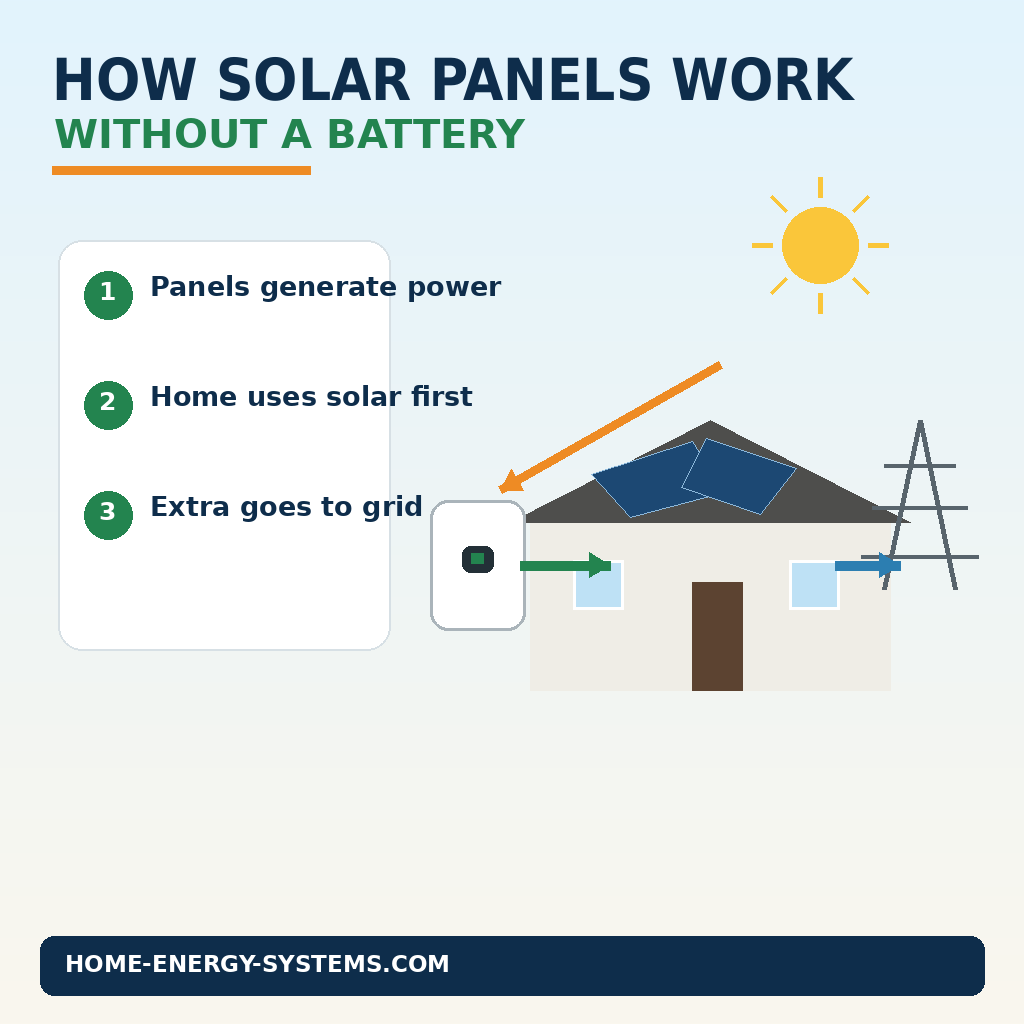
A grid-connected solar system does not require a battery to operate.
Solar photovoltaic panels generate direct-current electricity when sunlight reaches the cells. A solar inverter then converts that DC electricity into alternating-current electricity that can be used by your household appliances.
The U.S. Department of Energy explains that inverters are central to this process because they convert the DC electricity generated by solar panels into the AC electricity used by homes and electricity grids.
For more detail on the equipment itself, see our Best Solar Inverters 2026 guide .
The Biggest Advantage: Lower Upfront Cost
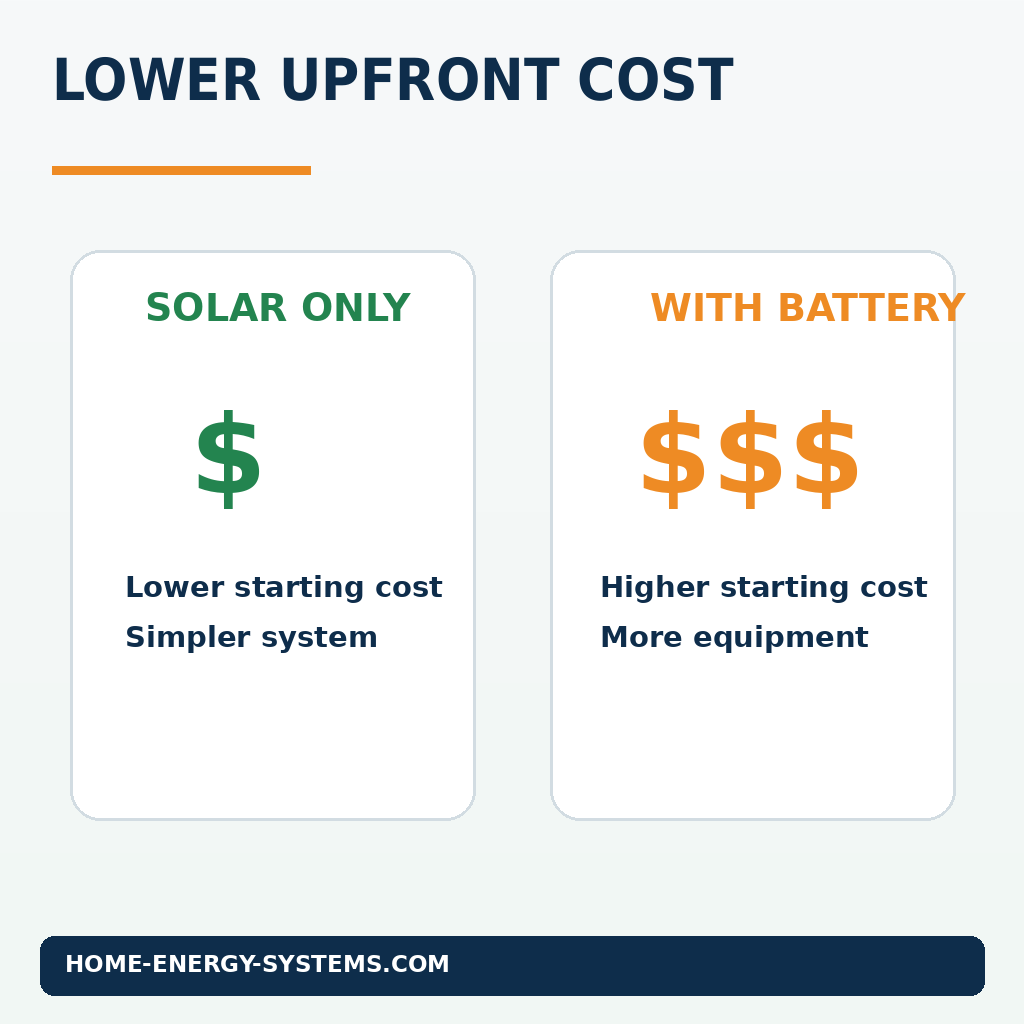
The most obvious reason to install solar panels without battery storage is cost.
A battery adds another major component to the system. You are paying not only for the battery cells but also for controls, electrical equipment, installation and potentially changes to the inverter or wiring.
Starting with solar panels alone reduces the initial investment and can make solar accessible to homeowners who do not want to commit to the cost of storage immediately.
Fewer components.
Simpler installation.
Start using solar electricity immediately.
Battery storage may be added later if the system is designed appropriately.
Stores surplus solar electricity.
Can increase solar self-consumption.
Useful when household demand is high after sunset.
Can provide backup power when the system is specifically designed for it.
What Happens to Excess Solar Electricity?
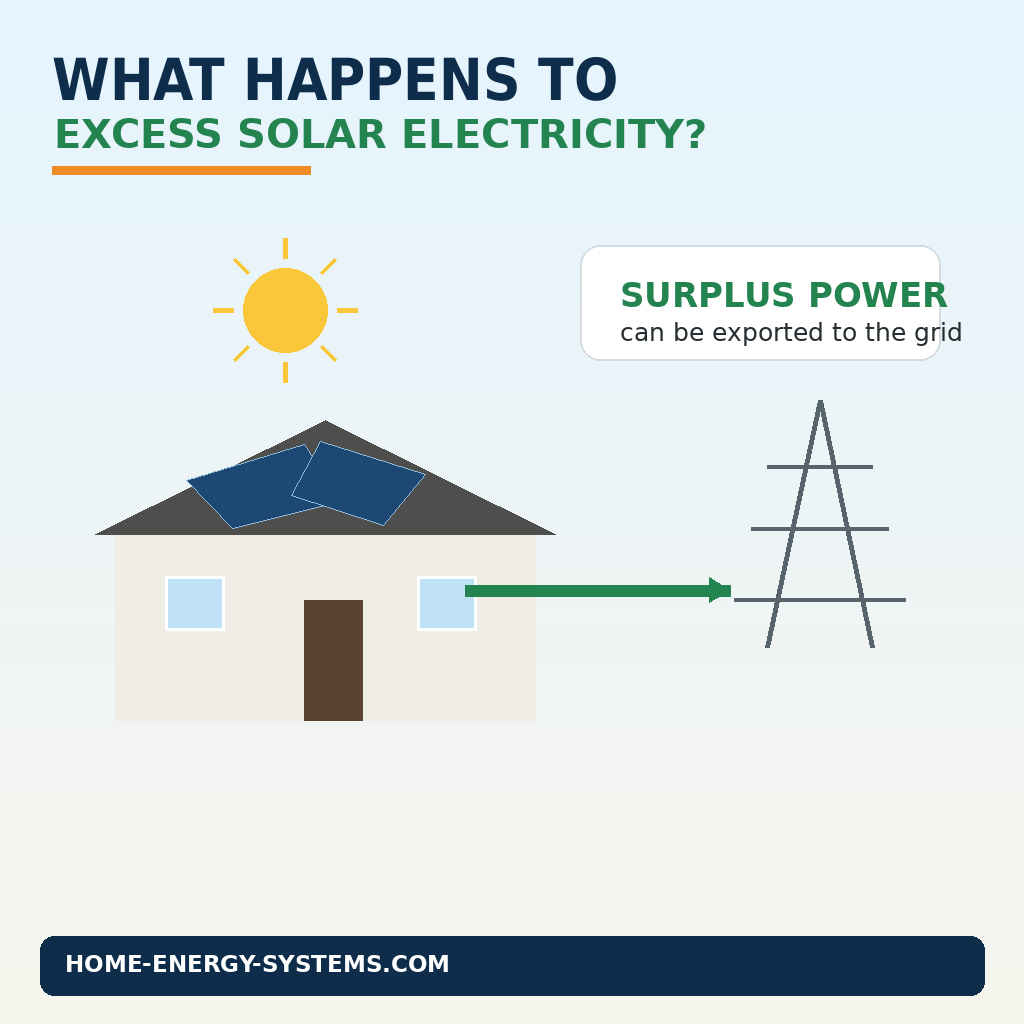
Without battery storage, surplus electricity cannot simply remain in the solar panels until you want it later.
If your panels are producing more electricity than the home is consuming, that excess electricity can normally be exported through your electricity connection to the grid.
What happens financially then depends on where you live.
Some households receive an export payment or credit for surplus solar electricity. The amount varies considerably between countries, electricity suppliers and tariffs.
This matters because electricity you export may be worth less than electricity you later purchase from the grid.
For example, if your panels produce surplus electricity around midday but you then buy electricity from the grid in the evening, the difference between the export price and import price will affect your overall solar savings.
Use More Electricity During Daylight Hours
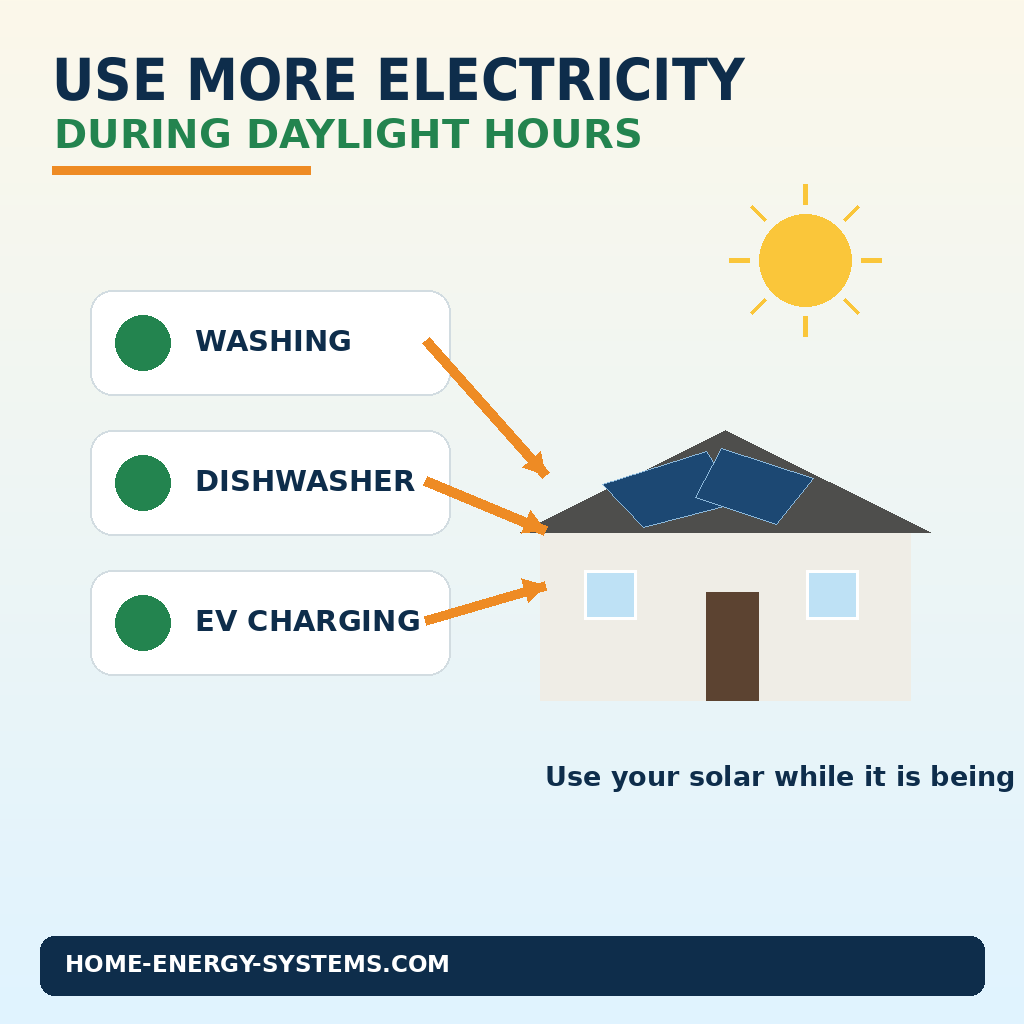
This is where households without batteries can make a significant difference to their own solar economics.
Instead of exporting large amounts of electricity and then buying electricity back later, try to use more of the solar electricity while your panels are actually producing it.
- Run the washing machine during daylight hours.
- Use the dishwasher when solar output is strong.
- Charge an electric vehicle during the day where practical.
- Heat water when surplus solar electricity is available.
- Use timers or smart plugs to move flexible loads into the solar-generating period.
- Run home-office equipment while your panels are producing electricity.
Every kilowatt-hour of solar electricity used directly by your household is a kilowatt-hour you do not need to purchase from your electricity supplier at that moment.
This idea of shifting flexible electricity demand into periods when generation is plentiful is becoming increasingly important as solar, electric vehicles and heat pumps become more common.
Who Is Solar Without a Battery Best For?
There is no single solar configuration that is perfect for every household. Solar without battery storage tends to suit certain electricity-use patterns particularly well.
What Are the Disadvantages of Solar Without a Battery?
There are genuine disadvantages, and they should be understood before deciding against battery storage.
You Cannot Store Daytime Solar for the Evening
Solar production normally starts falling as the evening approaches, but household electricity consumption often moves in the opposite direction.
People return home, begin cooking, turn on lights and televisions, charge devices and use heating or cooling equipment.
Without battery storage, electricity generated earlier in the day cannot be saved for this evening demand.
The U.S. Department of Energy explains that energy storage allows electricity generated at one time to be captured and released later, helping solar contribute when sunlight is no longer available.
You Still Depend on the Grid at Night
A grid-connected solar home without a battery normally returns to grid electricity whenever solar generation falls below household demand.
That means solar panels can dramatically reduce electricity purchased from the grid without necessarily eliminating grid dependence.
Normal Solar Panels Do Not Automatically Provide Backup Power
This is one of the most misunderstood parts of residential solar.
Many homeowners assume that if they have solar panels on the roof, their home will still have electricity during a power cut while the sun is shining.
Most conventional grid-connected systems do not work that way.
For safety reasons, standard grid-connected solar systems generally disconnect when grid electricity fails.
The U.S. Department of Energy explains that residential solar panels alone are generally not enough to keep a home operating during a grid outage. A correctly configured inverter and suitable storage system are normally required for independent backup operation.
If power cuts are an important consideration for your home, see our Best Home Backup Power Systems 2026 guide.
Solar Without a Battery vs Solar With a Battery
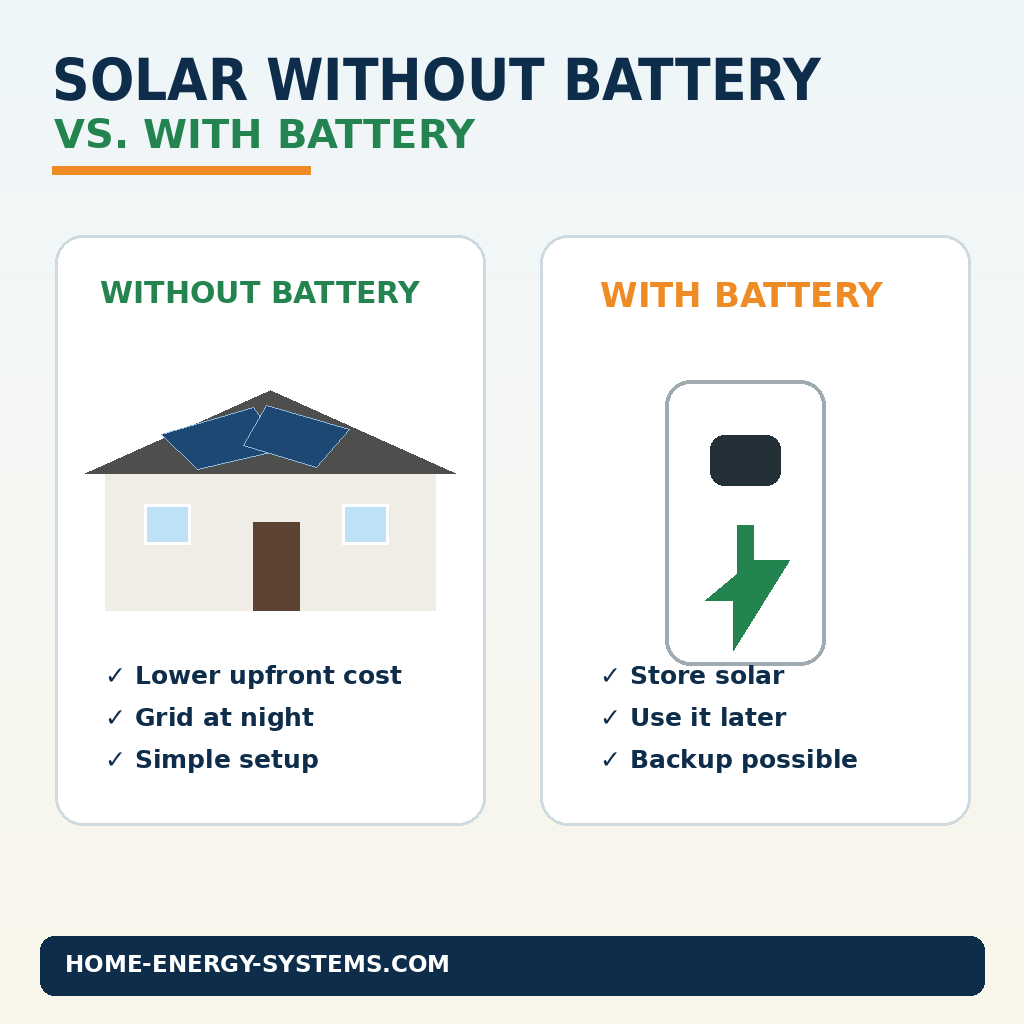
You use plenty of electricity during daylight hours.
Your electricity supplier offers a reasonable export arrangement.
Backup power is not particularly important.
You are comfortable considering storage later.
Electricity purchased from the grid is expensive compared with your export payment.
You want to increase the amount of your own solar electricity you consume.
Backup during power cuts is important.
You want greater control over when solar electricity is used.
Would Adding a Battery Save More Money?
Possibly, but battery storage does not automatically produce a better financial return.
A battery allows you to capture surplus solar generation and use it later, which can reduce electricity purchases from the grid.
But the battery itself represents an additional investment.
The financial result depends on several factors.
- The purchase and installation cost of the battery.
- Your daytime electricity consumption.
- Your evening and overnight electricity consumption.
- The price you pay for grid electricity.
- The payment you receive for exported solar electricity.
- Time-of-use electricity tariffs.
- Battery efficiency and usable storage capacity.
- Expected battery life.
- The value you personally place on backup power.
For a household that already consumes a high proportion of its solar electricity during the day, adding a battery purely to increase self-consumption may take longer to justify financially.
For another household with heavy evening demand and expensive peak electricity, storage may be considerably more attractive.
Can You Add a Battery Later?
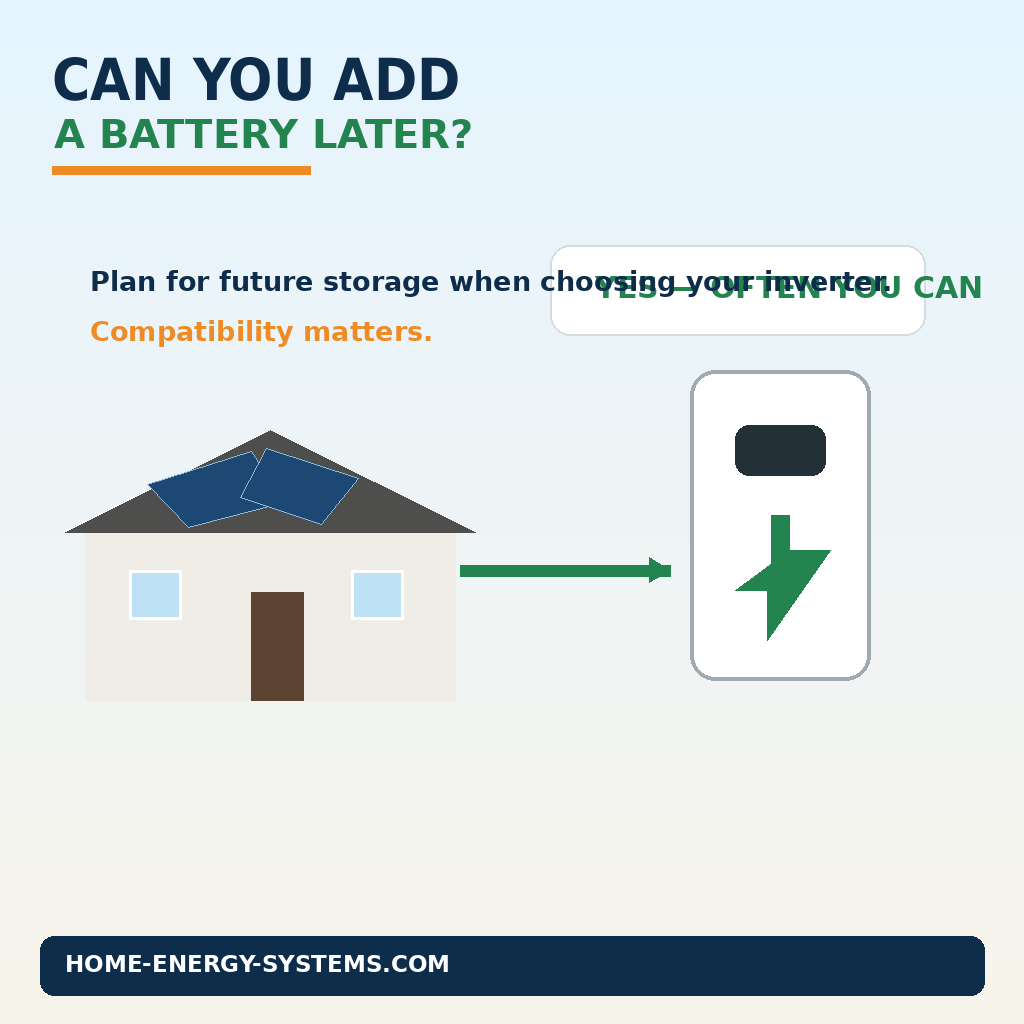
In many cases, yes.
This can be a sensible strategy.
Install the solar panels first, then spend time observing how much electricity your system generates, how much your household consumes directly and how much is exported.
After several months of real-world data, you may be in a much better position to decide whether battery storage would provide enough additional benefit.
However, future storage should ideally be discussed when the original solar system is being designed.
The inverter, electrical configuration and chosen equipment can affect how simple or expensive adding a battery later will be.
If battery storage is likely to be part of your future plans, see our Home Battery Storage Systems guide before choosing your solar equipment.
Should You Choose a Hybrid Inverter?
If you believe there is a reasonable chance that you will add battery storage later, a battery-compatible or hybrid inverter may be worth discussing with your installer.
The exact configuration depends on the equipment being used, but modern inverters can perform far more than simple DC-to-AC conversion.
The U.S. Department of Energy notes that advanced inverters can monitor and control electricity flows and can form an important part of solar-plus-storage systems.
You can compare the different inverter options in our Best Solar Inverters 2026 guide.
How Many Solar Panels Do You Need Without a Battery?
Whether you install battery storage or not, the size of your solar array should be based on your actual electricity requirements and the characteristics of your property.
Important factors include:
- Your annual electricity consumption.
- How much electricity you use during daylight hours.
- Available roof area.
- Roof orientation and pitch.
- Shading from trees, chimneys or neighbouring buildings.
- Local solar conditions.
- Electricity export arrangements.
- Future changes to household electricity use.
Future demand is particularly easy to overlook.
Adding an electric vehicle, heat pump, electric water heating or other major load can substantially increase household electricity consumption.
The largest solar array that physically fits on a roof is not automatically the best financial choice. System design should reflect the way the property actually uses electricity.
For panel technology, efficiency and system-sizing considerations, continue with our Best Solar Panels 2026 guide.
Can Solar Without a Battery Have a Faster Payback?
It can.
The reason is straightforward: the initial investment is lower.
If a household can use a good proportion of its solar electricity directly, a straightforward solar system can begin reducing electricity purchases without the additional capital cost of battery storage.
That does not mean every battery reduces financial returns. Electricity prices, export rates, battery prices and usage patterns vary substantially.
There is no universal payback period that applies to every property.
Ask the installer to show the assumptions used for annual solar generation, electricity prices, export rates, household self-consumption, system degradation and future electricity-price increases.
Why Batteries Are Becoming More Important
Although this guide explains why homeowners do not necessarily need a battery, storage is becoming increasingly important within the wider electricity system.
The International Energy Agency’s 2026 electricity analysis highlights the rapid growth of battery storage and the increasing need for flexibility as more solar, wind, electric vehicles, heat pumps and other electrical loads are connected to power systems.
For individual homeowners, falling battery costs and changing electricity tariffs may also alter the financial case for adding storage in the future.
That is another reason why a solar-first, battery-later strategy can make sense for some households.
Frequently Asked Questions
Do solar panels need a battery?
No. Many residential grid-connected solar systems operate perfectly well without battery storage.
Where does solar electricity go without a battery?
Your home normally uses the electricity first. Surplus electricity may then be exported to the electricity grid, depending on your local system and connection arrangements.
What happens at night?
Once solar generation is no longer sufficient, a grid-connected property without storage normally purchases electricity from the grid.
Will solar panels work during a power cut?
Standard grid-connected solar systems normally shut down during a grid failure for safety reasons. Backup operation requires equipment specifically designed for that purpose.
Is it cheaper to install solar without a battery?
Normally yes. You avoid the cost of the battery itself and the associated storage equipment and installation.
Can I install panels now and a battery later?
Often yes. However, choosing compatible equipment when the solar system is first installed can make a future battery upgrade easier.
Is battery storage always worth the extra money?
No. Its value depends on electricity use, electricity tariffs, export payments, battery cost and whether backup power is important to you.
Are Solar Panels Without a Battery Worth It in 2026?
For many homeowners, the answer is yes.
Solar panels without battery storage offer a simpler and less expensive route into renewable electricity.
They can work especially well where a household already uses substantial electricity during daylight hours.
The key is to use as much of your solar generation directly as reasonably possible.
A battery becomes more attractive when evening electricity consumption is high, grid electricity is expensive, export payments are relatively low, or backup power is important.
But you do not necessarily have to make that decision on day one.
A well-designed solar system can allow you to start generating electricity now, learn how your household actually uses solar power, and consider compatible battery storage later.
Independent Research & Further Reading
Continue Your Research
Best Solar Panels 2026
Compare solar panel technology, performance, sizing and long-term value.
Home Battery Storage Systems
Learn about battery capacity, power output, backup operation and storage options.
Best Solar Inverters 2026
Compare inverter technologies and battery-compatible options.
Best Home Backup Power Systems 2026
Explore batteries, portable power stations and other outage solutions.
Where to Buy Solar Energy Products
Find solar and home-energy suppliers by region.
Choose the Solar System That Fits Your Home
Battery or no battery, the best solar installation is the one designed around your actual electricity use, budget and future plans.
Compare Solar Panels Explore Battery Storage