Emergency Home Preparedness Guide 2026
How to Prepare for a Power Outage: Complete Home Emergency Guide 2026
Knowing how to prepare for a power outage before the electricity disappears can make a major difference to your comfort, safety and ability to keep essential equipment running. A blackout lasting a few minutes may be little more than an inconvenience. An outage lasting several hours or days can affect lighting, communications, refrigeration, heating, cooling, water supplies and medical equipment.
The best time to prepare is long before the lights go out.
This guide explains what to include in a power outage emergency kit, how to stay safe during a power outage, how to protect food and essential electronics, and when batteries, portable power stations or generators may make sense.
Watch: How to Prepare for a Power Outage — Home-Energy-Systems.COM
Our Power Outage Solutions guide explains UPS systems, portable power stations, battery storage, solar backup and generators in more detail.
Why Prepare for a Power Outage?
Electricity outages can happen for many reasons, including severe weather, storms, flooding, equipment failure, wildfires, extreme temperatures, grid faults and planned maintenance.
Most short outages are manageable. The difficulties begin when households are unprepared for an interruption that lasts considerably longer than expected.
Electricity may be required for:
- Refrigerators and freezers
- Home internet equipment
- Mobile-phone charging
- Lighting
- Heating and boiler controls
- Air conditioning and fans
- Electric cooking
- Home security systems
- Well and water pumps
- Computers and home-office equipment
- Medical and accessibility equipment
Preparing for an outage does not necessarily mean installing an expensive whole-home backup system. A sensible plan starts with the essentials and builds from there.
How to Prepare for a Power Outage Before It Happens
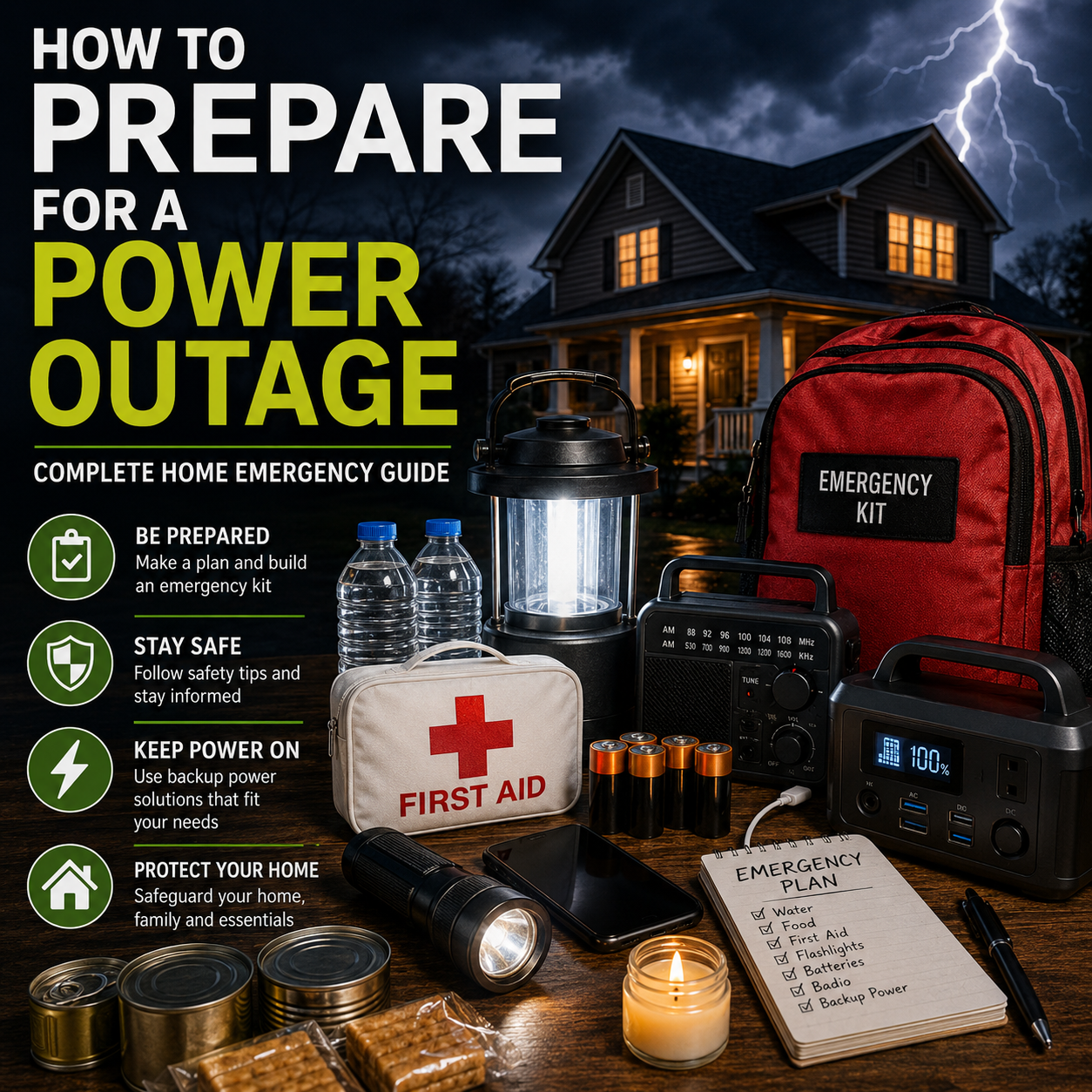
The easiest way to prepare for a power outage is to imagine that your electricity has just disappeared and may not return until tomorrow.
Ask yourself:
- How will we see after dark?
- How will we charge our phones?
- How will we receive emergency information?
- Which food needs refrigeration?
- Does our heating system require electricity?
- Does our water supply rely on an electric pump?
- Does anyone in the household depend on electrically powered medical equipment?
- Which appliances genuinely need backup electricity?
The answers become your household outage plan.
Power Outage Emergency Kit: What Should You Include?
A well-prepared power outage emergency kit does not need to be complicated. Keep essential items together somewhere that can be reached easily in the dark.
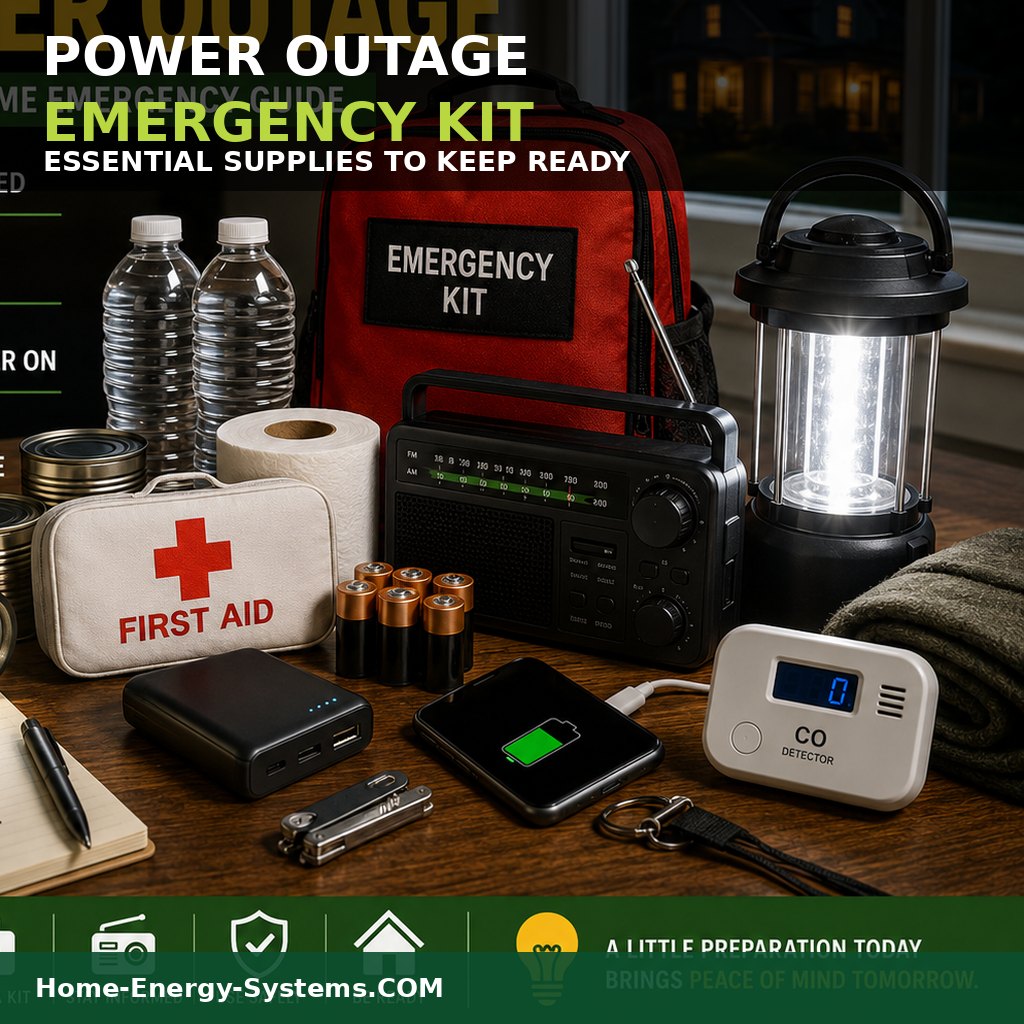
Do Not Forget Household-Specific Needs
A generic emergency kit may not cover everything your household requires.
Consider additional supplies for babies, older family members, pets and anyone who relies on prescription medicines, mobility equipment or electrically powered medical devices.
If electricity is essential for medical equipment, develop a specific backup plan with the equipment supplier and appropriate healthcare professionals rather than relying on a general household power station alone.
Keep Phones and Communications Working
Communication becomes particularly important during storms and widespread grid failures.
Charge phones, tablets, power banks and rechargeable lighting when severe weather or another potential disruption is forecast.
During an outage:
- Reduce screen brightness.
- Use battery-saving mode.
- Close unnecessary apps.
- Turn off Bluetooth or other features when not required.
- Avoid unnecessary video streaming.
- Use text messages where practical.
A charged power bank may provide several additional phone charges without requiring a larger backup system.
For routers, computers and home-office equipment, a UPS can help bridge shorter interruptions. Our guide to choosing the best UPS for a home office explains how to calculate the required capacity.
Protect Your Refrigerator and Freezer
One of the simplest things you can do during a blackout is keep refrigerator and freezer doors closed.
According to the U.S. Centers for Disease Control and Prevention, an unopened refrigerator can generally keep food safe for about four hours. A full unopened freezer can maintain a safe temperature for around 48 hours, while a half-full freezer may provide around 24 hours.
Do not rely on appearance or smell alone to decide whether perishable food is safe. If you are uncertain, follow your national or local food-safety authority’s guidance.
For longer outages, a sufficiently sized portable power station, home battery or generator may keep refrigeration operating, although actual runtime depends on appliance consumption, battery capacity and how often the compressor runs.
How to Stay Safe During a Power Outage
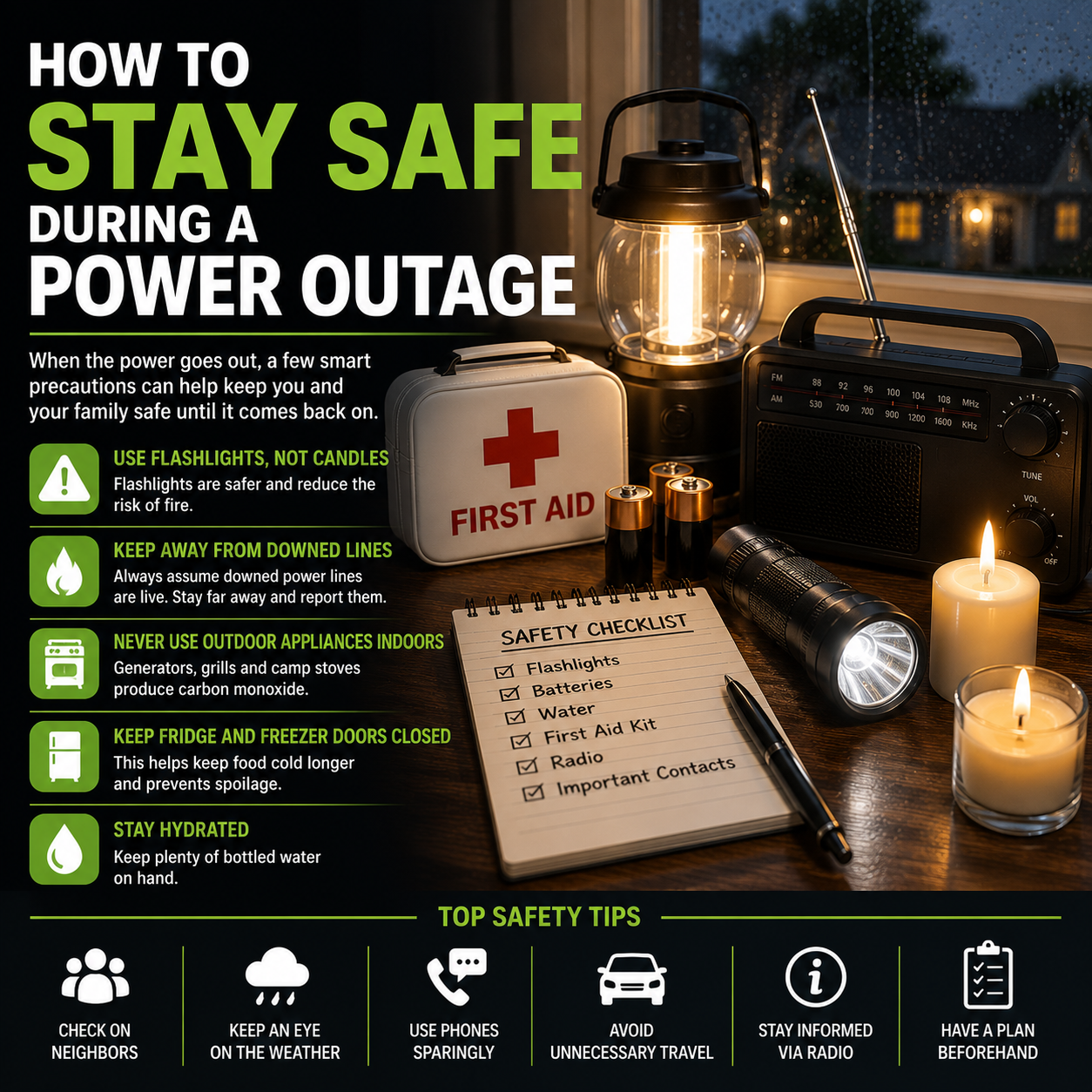
Knowing how to stay safe during a power outage is more important than keeping every appliance running.
Use Flashlights Instead of Candles
Battery-powered or rechargeable flashlights and lanterns are generally safer than open flames.
If candles are used, keep them well away from curtains, furniture, children, pets and anything else that could catch fire, and never leave them unattended.
Stay Away From Fallen Power Lines
Never approach or touch a fallen electrical cable. A line that appears inactive may still be energised.
Keep other people away and report fallen lines to the appropriate electricity network operator or emergency service.
Be Careful Around Floodwater
Do not enter floodwater where electrical equipment, wiring or fallen power lines may be present.
If a property has experienced significant flooding or electrical damage, electrical equipment should be inspected appropriately before being returned to service.
Generator Safety: Carbon Monoxide Can Kill
Fuel-powered generators can provide substantial backup electricity, but they must be operated correctly.
Generators produce carbon monoxide, an invisible and potentially deadly gas.
The CDC recommends keeping portable generators at least 20 feet — approximately 6 metres — from windows, doors and vents and using a battery-powered or battery-backup carbon monoxide detector inside the home.
Never use a barbecue, charcoal grill, camping stove or similar fuel-burning appliance inside your home as an alternative source of heat or electricity.
Generators should also be protected from unsuitable weather conditions and operated according to the manufacturer’s instructions.
Read the CDC’s current power outage safety guidance before using combustion-powered emergency equipment.
Never Backfeed Electricity Into Your Home
A portable generator should never be connected to household wiring using an improvised cable or by plugging the generator into an ordinary wall outlet.
This dangerous practice can send electricity back through household wiring and potentially onto utility lines, creating a serious electrocution risk.
If you want a generator or battery system to supply household circuits, use suitable approved transfer equipment and have the installation carried out according to local electrical regulations by an appropriately qualified professional.
Heating and Cooling During a Power Outage
Extreme temperatures can turn a long electricity outage into a serious safety issue.
Cold Weather
Close doors to unused rooms, reduce drafts where practical and use layers of clothing, blankets and sleeping bags to conserve warmth.
Never use an oven or gas cooking appliance as an improvised home heater.
If indoor temperatures become unsafe, relocating to a heated location may be safer than remaining in the property.
Hot Weather
During extreme heat, stay hydrated and reduce strenuous activity. If the home becomes dangerously hot and air conditioning cannot operate, consider relocating to a cooler public building, community facility or other safe location.
People who are older, very young or particularly vulnerable to extreme temperatures may require additional planning.
Decide What Really Needs Backup Power
One of the biggest mistakes people make when preparing for an outage is assuming they need enough backup electricity to run the entire house.
Start with an essential-load list instead.
Priority 1: Communications
Phones, router, emergency radio and essential communication equipment.
Priority 2: Lighting
LED lamps and rechargeable emergency lighting require relatively little electricity.
Priority 3: Refrigeration
A refrigerator or freezer may become increasingly important as an outage continues.
Priority 4: Essential Systems
Heating controls, water pumps, medical equipment, security systems or other household-specific requirements.
Large electrical loads such as electric showers, immersion heaters, electric ovens, EV chargers, air conditioning and some heating systems can dramatically increase the size and cost of the backup system required.
Backup Power Options for an Emergency
Power Banks
Power banks are inexpensive, portable and ideal for phones and small USB equipment. Every household can benefit from keeping one or more charged.
UPS Systems
An uninterruptible power supply is designed primarily to protect computers and other electronics from sudden power interruptions.
A UPS usually provides relatively limited runtime but can keep a router operating or provide enough time to save work and shut a computer down safely.
Portable Power Stations
Modern portable power stations combine rechargeable batteries, an inverter and multiple output connections in one unit.
Depending on capacity, they may operate lights, phones, routers, televisions, laptops, refrigerators and other essential appliances.
Many can also be recharged from compatible solar panels, which can be particularly useful during a prolonged outage.
Home Battery Storage
A permanently installed home battery can provide considerably more convenient backup when designed with suitable emergency-power capability.
However, not every solar battery automatically powers a house when the grid fails. The inverter, wiring and backup configuration must support this function.
Our Home Battery Storage Systems guide explains the different configurations in more detail.
Fuel Generators
Traditional generators remain useful for long-duration outages because electricity can continue to be generated while suitable fuel remains available.
The disadvantages include noise, maintenance, fuel storage and the carbon-monoxide risk associated with combustion engines.
Best Generators for Power Outages: What Should You Look For?
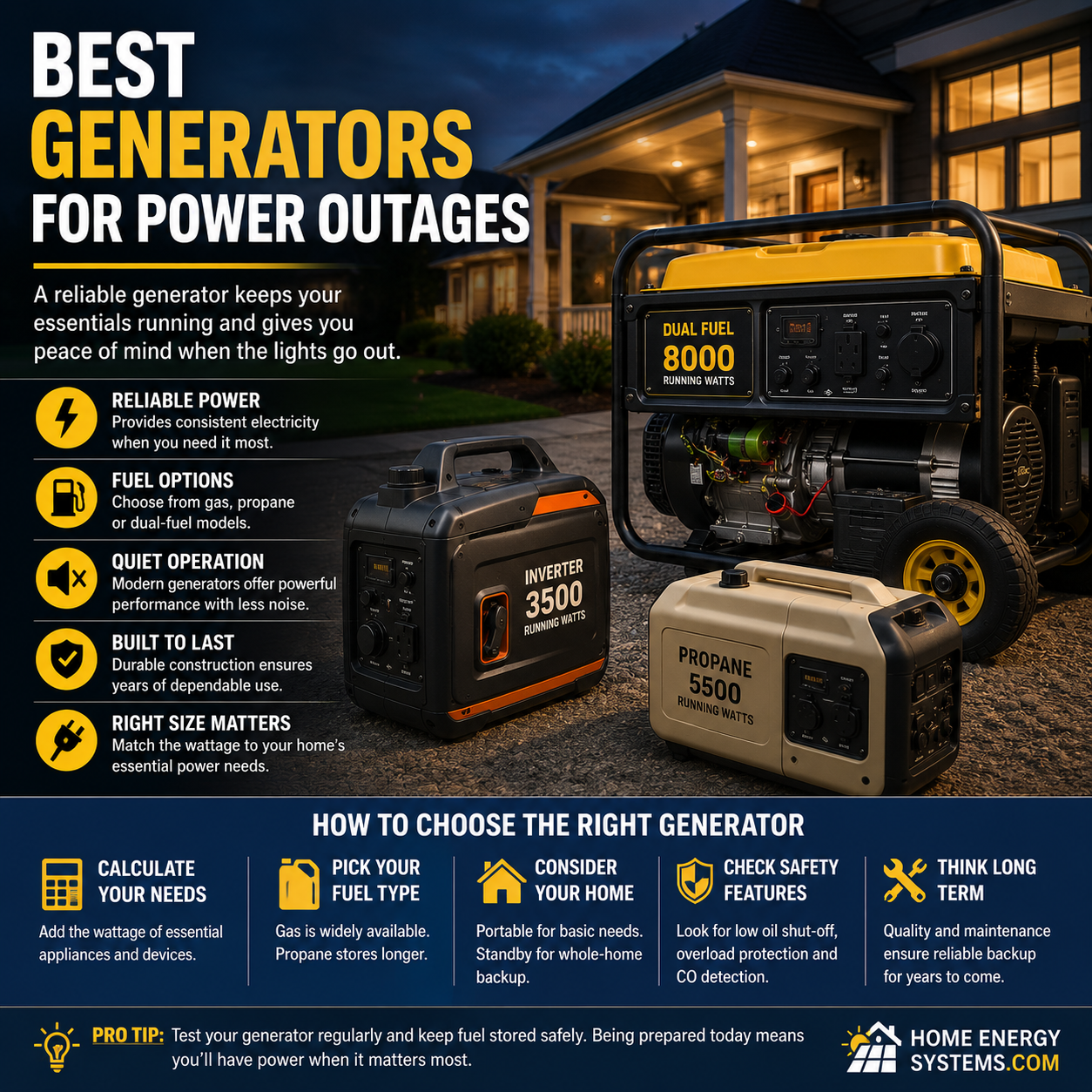
The best generators for power outages are not necessarily the largest models available.
The right generator should match the appliances you actually intend to operate.
- Continuous rated output
- Starting or surge output
- Fuel type and local fuel availability
- Expected runtime
- Noise levels
- Fuel consumption
- Outdoor positioning
- Carbon-monoxide safety features
- Maintenance requirements
- Electrical connection method
- Whether professional transfer equipment is required
Battery Backup vs Generator During a Power Outage
Battery Backup
- Quiet operation
- No exhaust during battery use
- Can be kept charged in advance
- Some models support solar charging
- Little routine operation required during an outage
Fuel Generator
- Can provide power as long as fuel remains available
- Useful for longer outages
- Available in many power ratings
- Requires safe outdoor operation
- Requires fuel and maintenance
Top-Rated Power Outage Backup Systems
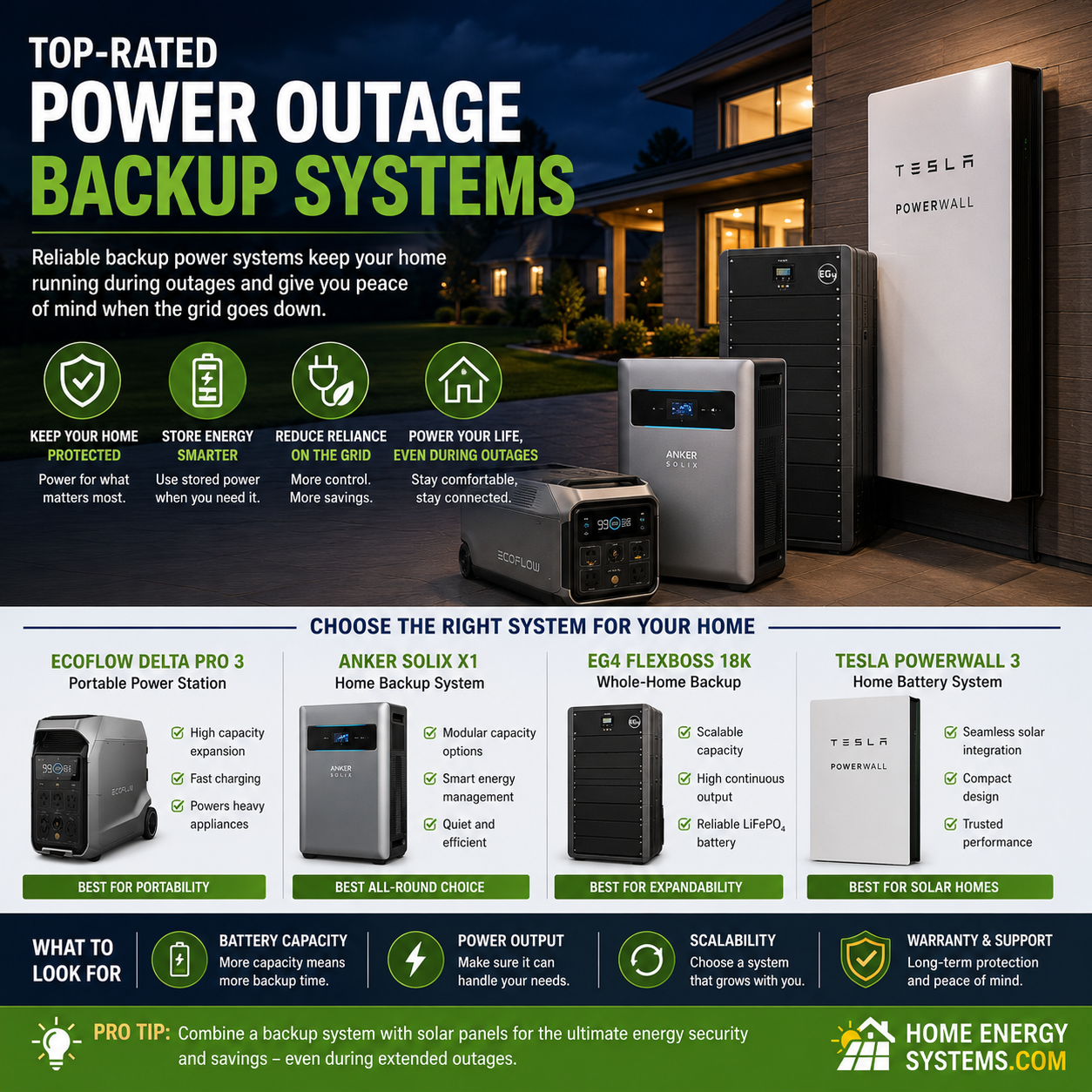
There is no single list of top-rated power outage backup systems that will suit every household because backup requirements differ enormously.
Modern options include:
- Portable battery power stations
- Expandable battery systems
- Solar generators
- Whole-home battery backup
- Standby generators
- Portable fuel generators
- Hybrid battery and generator systems
We compare these options separately in our Best Home Backup Power Systems 2026 guide.
Compare Home Backup SystemsHow Much Backup Power Does Your Home Need?
Do not start with battery size. Start with appliance consumption.
Make a list of everything you would like to operate during a blackout and note its approximate wattage.
- Internet router
- Several LED lights
- Phone chargers
- Refrigerator
- Freezer
- Laptop
- Television or radio
- Heating controls
Then consider how many hours you want those items to operate.
Battery capacity is normally measured in watt-hours (Wh) or kilowatt-hours (kWh), while the inverter’s watt rating determines how much equipment can be powered at one time.
Can Solar Panels Help During a Power Outage?
Yes, but there is an important qualification.
A normal grid-connected solar installation will generally shut down when the electricity grid fails unless the system has been specifically designed to provide backup operation.
A compatible battery, hybrid inverter, backup output or other appropriately designed equipment may allow selected circuits to continue receiving electricity.
Portable power stations can offer another approach because many models accept direct input from compatible portable solar panels.
What Should You Do When the Power Comes Back On?
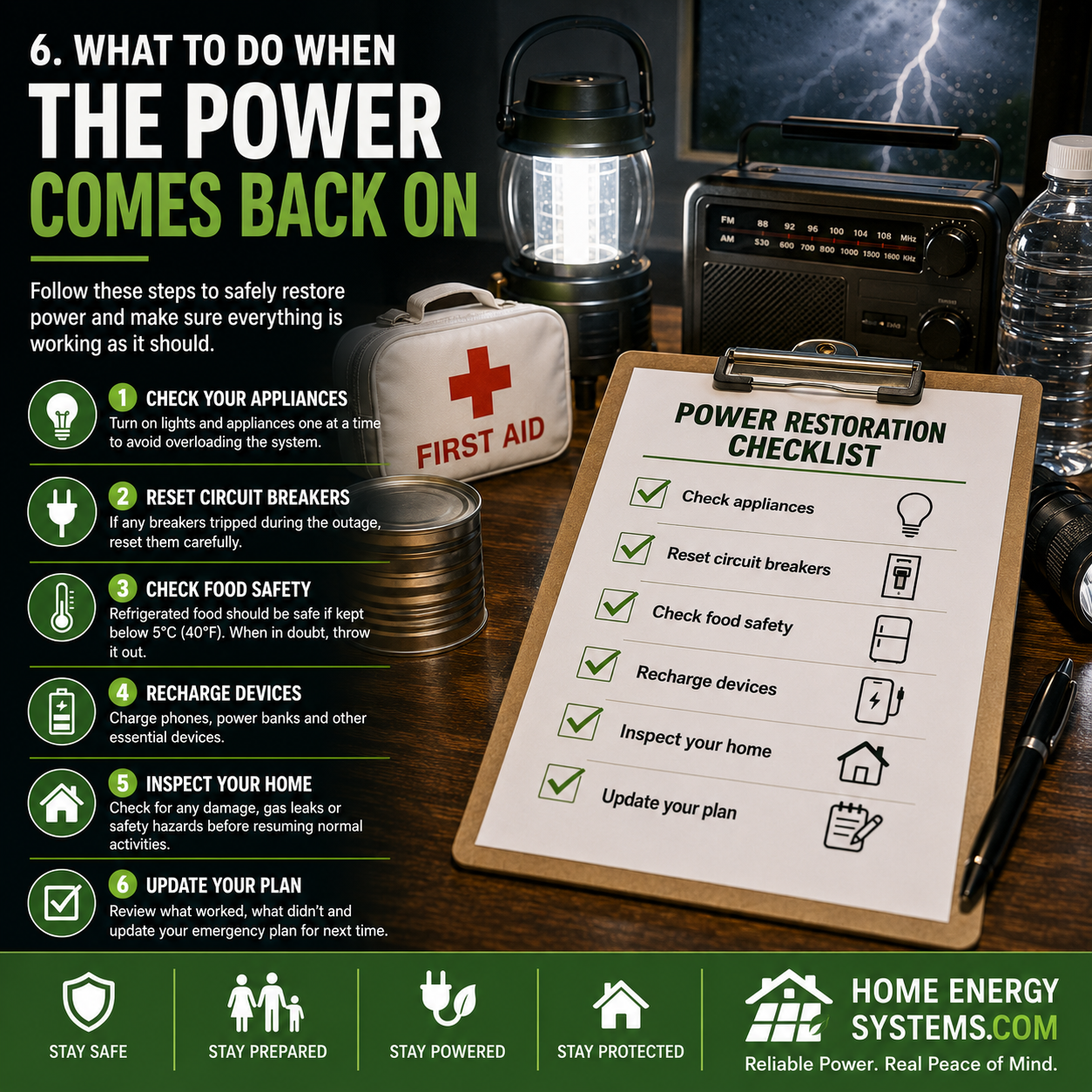
When grid electricity returns, avoid immediately switching every major appliance back on at once.
Then:
- Recharge power banks and emergency lights.
- Recharge portable power stations.
- Check refrigerator and freezer food safety.
- Reset clocks and timers.
- Check heating or cooling controls.
- Check security equipment.
- Replace emergency supplies that were used.
- Review anything that did not work as expected.
Create a Simple Household Power Outage Plan
Start with five steps:
- Create an emergency kit.
- Keep lighting and communications charged.
- Identify essential electrical loads.
- Decide whether you need backup electricity.
- Make sure everyone understands basic outage safety.
Start with lighting, communication, food, water and safety. Then add backup electricity according to your household’s genuine needs.
Frequently Asked Questions
What should I do first during a power outage?
Check that everyone is safe, use flashlights or rechargeable lights, determine whether the outage affects only your property or the wider area, and check for official information from your electricity provider or local authorities. Keep refrigerator and freezer doors closed.
What should be included in a power outage emergency kit?
A useful power outage emergency kit can include flashlights, spare batteries, charged power banks, a battery-powered radio, drinking water, non-perishable food, first-aid supplies, charging cables and appropriate seasonal supplies.
How can I prepare for a long power outage?
Prepare food, water, lighting and communications first. Then identify essential appliances and consider whether a portable power station, home battery, generator or combination of systems is appropriate.
Can I use a generator inside my garage?
No. Fuel-burning generators produce carbon monoxide and should never be operated inside a home, garage, basement or other enclosed or partially enclosed space.
How far should a generator be from the house?
The U.S. CDC recommends keeping portable generators at least 20 feet, or approximately 6 metres, away from windows, doors and vents.
Are battery power stations safer than generators?
Battery power stations do not produce combustion exhaust during normal battery operation, eliminating the carbon-monoxide hazard associated with running a fuel generator.
Final Thoughts: Prepare Before the Lights Go Out
Learning how to prepare for a power outage is really about reducing uncertainty.
Start with a simple power outage emergency kit. Protect food, water and communications. Understand how to stay safe during a power outage. Then decide whether your household needs additional backup electricity.
For some homes, a few power banks and a UPS may be enough. Others may benefit from portable battery stations, solar backup, home battery storage or one of the best generators for power outages.
For the next step, explore our complete guides:
Power Outage Solutions Best Home Backup Systems 2026 Home Battery Storage
Safety note: Emergency, electrical and generator requirements vary by country. Always follow your electricity network operator, emergency authorities, equipment manufacturer and applicable local regulations. Permanent generator, battery and household electrical connections may require professional installation.