Emergency Home Power Guide 2026
Power Outage Solutions: How to Keep Your Home Running in 2026
From keeping the Wi-Fi and refrigerator running to providing backup electricity for essential household equipment, today’s power outage solutions give homeowners far more options than simply waiting for the grid to return.
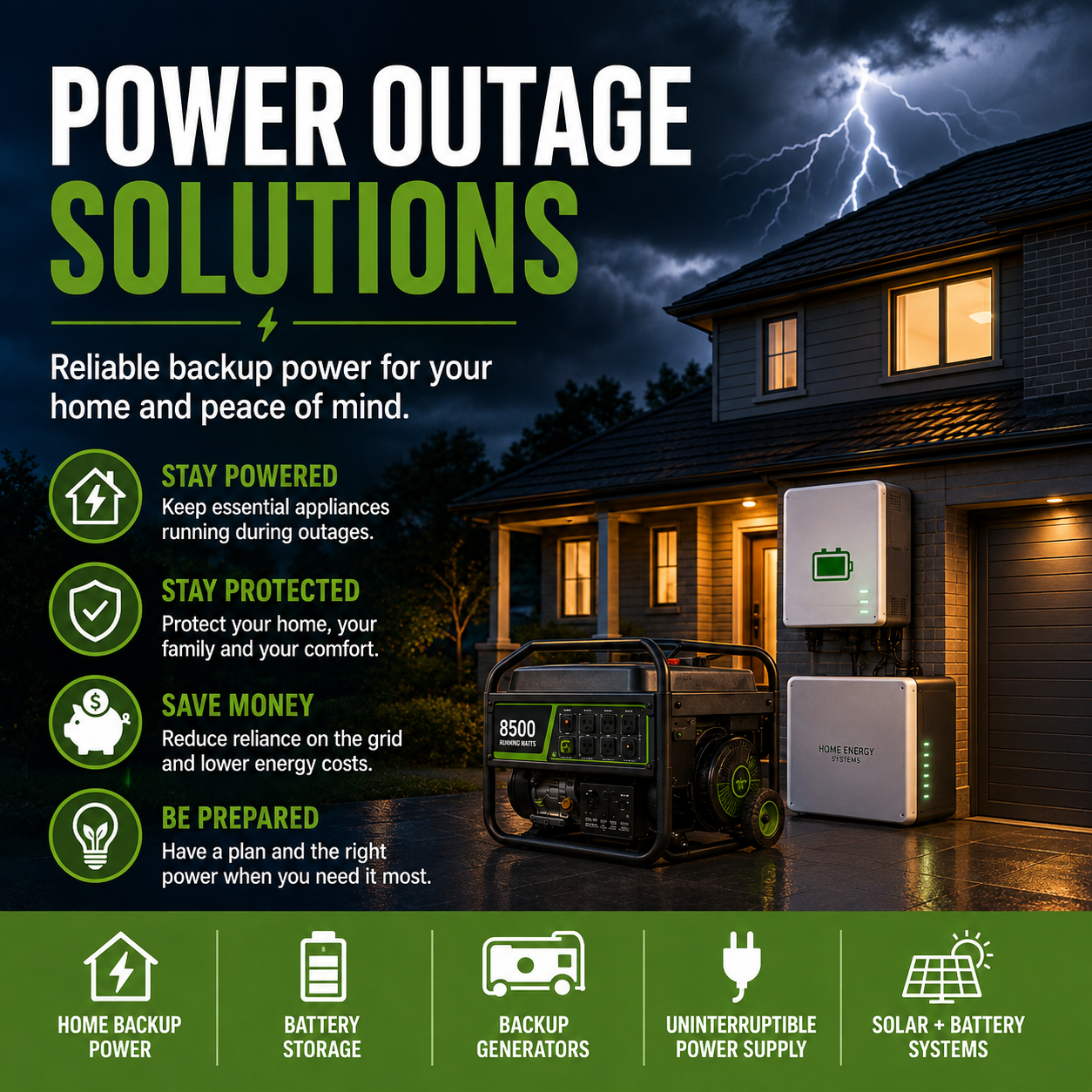
Power outage solutions can range from something as simple as a rechargeable light or small UPS to portable power stations, home battery storage, solar backup systems and permanently installed generators.
The right solution depends on what you need to keep running, how long outages normally last in your area and how much electricity your essential appliances consume.
A short interruption of a few minutes is very different from losing electricity for several hours or several days. That is why it makes sense to build your backup plan in layers rather than automatically buying the largest system you can find.
This guide explains the main power outage solutions available in 2026, what each option can realistically do and how to prepare your home before the electricity goes off.
See our Best Home Backup Power Systems 2026 guide for a closer look at portable power stations, expandable batteries, solar generators and whole-home backup systems.
Power Outage Solutions Video Guide
Watch our Power Outage Solutions video for a quick overview of UPS systems, portable power stations, home batteries, solar backup and generators.
What Are the Best Power Outage Solutions?
For most homes, the best approach is to protect essential appliances first rather than trying to power everything.
Short Outages
UPS systems, rechargeable lighting, power banks and small portable power stations.
Several Hours
Portable power stations capable of running a refrigerator, router, lights and communications equipment.
Long Outages
Expandable battery storage, solar charging, generators or hybrid backup systems.
Whole-Home Backup
Permanently installed batteries or generators connected to selected household circuits.
1. Start With the Appliances You Really Need
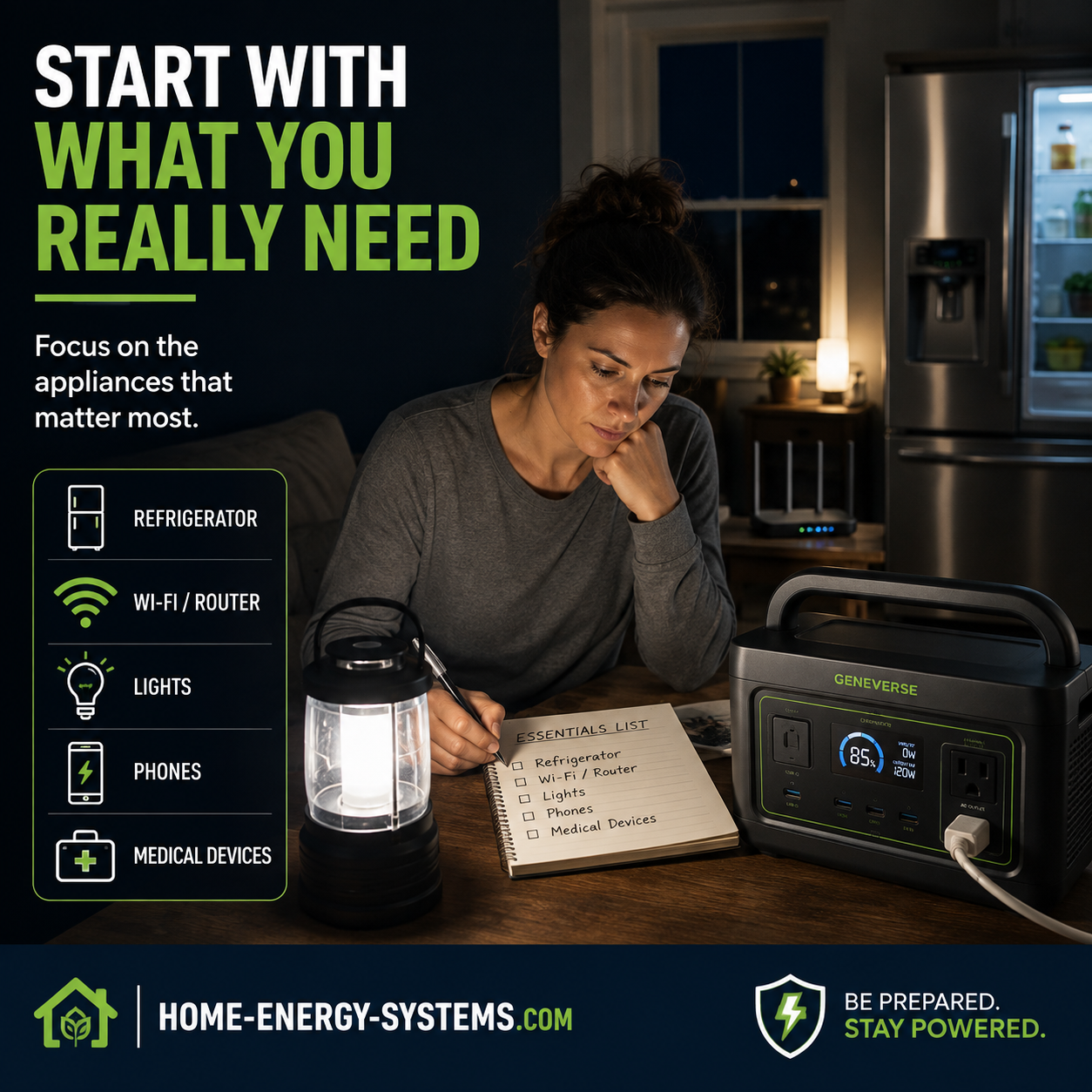
The first step when considering power outage solutions is not choosing a battery or generator. It is deciding what genuinely needs electricity during an outage.
For many households, essential loads include:
- Refrigerator and freezer
- Internet router
- Mobile phones and tablets
- LED lighting
- Heating or boiler controls
- Home security equipment
- Laptops and computers
- Television or radio for information
- Well or water pumps where applicable
- Essential medical or accessibility equipment
Cooking appliances, electric showers, immersion heaters, electric heating, air conditioning, heat pumps and EV chargers can require considerably more electricity.
Trying to operate all of these during an outage dramatically increases the battery capacity or generator output required.
A better strategy for many homes is to create an essential-power list and design the backup system around it.
2. UPS Systems for Computers, Routers and Electronics
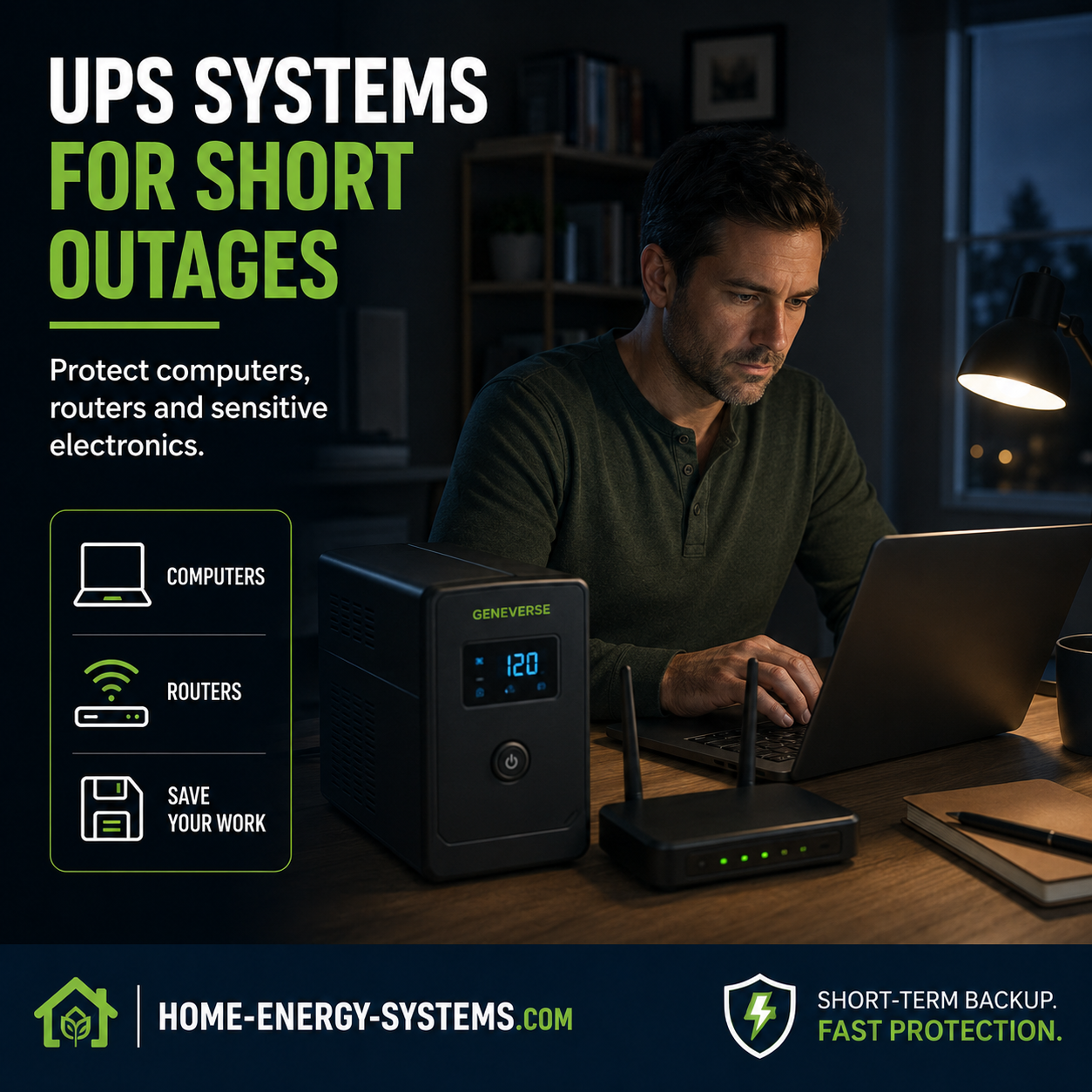
A UPS, or uninterruptible power supply, is one of the simplest power outage solutions for sensitive electronics.
A UPS contains a battery that takes over when grid electricity disappears. Depending on the unit and connected load, it may provide enough time to save work and safely shut down a computer or keep smaller equipment operating during a short interruption.
UPS systems can be particularly useful for:
- Desktop computers
- Home-office equipment
- Internet routers and modems
- Network storage equipment
- Security systems
- Small communications equipment
A UPS is normally designed for relatively short backup periods. It should not be confused with a large portable power station or home battery capable of running appliances for many hours.
If protecting computers and home-office equipment is your priority, our detailed guide to the best UPS for a home office explains VA ratings, watts, runtime, battery types and pure sine-wave output in more detail.
3. Portable Power Stations
Portable power stations have become one of the most flexible power outage solutions for homes because they combine a rechargeable battery, inverter, charging electronics and multiple outlets in one unit.
Unlike a small UPS, a reasonably sized portable power station may be able to operate several essential appliances for hours rather than minutes.
Depending on its battery capacity and inverter output, a portable power station could potentially supply:
- Refrigerators and freezers
- Wi-Fi routers
- Phones and tablets
- Laptops
- LED lights
- Televisions
- CPAP equipment where the system is suitable
- Small kitchen appliances
- Selected heating controls
The two specifications to pay closest attention to are battery capacity, normally shown in watt-hours or kilowatt-hours, and inverter output, normally shown in watts.
A 2,000Wh portable power station may store roughly twice the energy of a 1,000Wh unit, but that does not automatically mean it can operate an appliance requiring a very high starting surge.
Always check both the continuous output and surge capability of the system.
4. Home Battery Storage
Home battery storage moves backup power from a portable appliance toward a permanently installed household energy system.
A suitably designed home battery can automatically supply selected circuits when grid electricity fails. Larger systems may support much more of the house, while smaller installations often concentrate on critical loads.
Typical backed-up circuits might include:
- Refrigeration
- Lighting
- Internet equipment
- Selected sockets
- Heating controls
- Security equipment
- Water pumps
One important point is that not every home battery installation automatically provides backup power during an outage.
The battery, inverter, electrical wiring and changeover or gateway equipment must be designed to safely isolate the home from the electricity network when grid power disappears.
If you are considering permanent battery storage, see our Home Battery Storage Systems guide for a more detailed explanation of battery capacity, inverters and household energy storage.
5. Solar Backup Power
Solar panels can greatly increase the usefulness of battery backup during a prolonged outage, but rooftop solar panels alone do not necessarily keep a house running when the grid fails.
Standard grid-connected solar installations normally shut down during an outage unless they have equipment specifically designed for backup or island operation.
A complete solar backup system may include:
- Solar panels
- Battery storage
- A compatible inverter
- Backup switching equipment
- Selected essential circuits
- Energy monitoring and controls
The major advantage is the possibility of recharging batteries during daylight hours.
If an outage continues for several days, this can make solar-plus-storage considerably more useful than relying on a battery that can only be recharged when grid electricity returns.
Our Solar Backup Power for Homes guide explains how solar panels, batteries, inverters and backup switching work together.
6. Fuel-Powered Generators
Traditional generators remain an important option for long electricity outages, particularly where large electrical loads must be supported or where solar charging may be unreliable.
Generators can continue producing electricity for as long as suitable fuel is available, which gives them a different advantage from battery systems with a fixed amount of stored energy.
However, there are disadvantages:
- Engine noise
- Fuel storage
- Regular maintenance
- Exhaust emissions
- Manual starting on some models
- Safe outdoor positioning requirements
- Potentially more complicated connection to household circuits
A generator should also never be connected to household wiring by improvising a cable into a normal wall socket. Supplying household circuits requires appropriate transfer equipment and a correctly designed electrical installation.
7. Hybrid Battery and Generator Systems
For households that experience longer or more frequent outages, the most resilient solution may be a combination of technologies rather than relying on one device.
For example, a hybrid system could use:
- Battery storage for immediate, quiet backup
- Solar panels for daytime recharging
- A generator for extended periods of poor weather or very high electricity demand
The battery handles normal short outages without requiring an engine to start. Solar can then replenish the battery during daylight hours, while a generator remains available as an additional source of electricity if stored energy becomes low.
This type of layered approach can reduce generator runtime while still providing another option during prolonged grid failures.
8. How Much Backup Power Do You Need?
Before buying a system, calculate the appliances that genuinely need to remain operating.
There are two separate figures to consider:
Power Output
Measured in watts or kilowatts. This tells you how much equipment the system can operate at the same time.
Battery Capacity
Measured in watt-hours or kilowatt-hours. This helps determine how long the battery can keep equipment operating.
Imagine your essential appliances consume an average of 400 watts while running.
If that average load continued for five hours, the theoretical energy requirement would be:
In practice, the battery should normally be larger than the simple calculation because inverter losses, standby consumption, temperature, battery protection limits and changing appliance demand can reduce usable runtime.
Refrigerators, pumps and compressors may also require a considerably higher starting surge than their normal running wattage.
9. Power Outage Solutions Compared
| Solution | Best For | Typical Strength | Main Limitation |
|---|---|---|---|
| Power Bank | Phones and small USB devices | Cheap, simple and portable | Very limited capacity |
| UPS | Computers, routers and electronics | Instant automatic backup | Usually short runtime |
| Portable Power Station | Essential household appliances | Portable, quiet and rechargeable | Finite battery capacity |
| Home Battery | Automatic household backup | Convenient and integrated | Higher installation cost |
| Solar + Battery | Longer renewable backup | Can recharge during daylight | Weather and system design matter |
| Generator | Long outages and larger loads | Can run while fuel remains available | Noise, fuel, maintenance and exhaust |
| Hybrid System | High-resilience homes | Several backup energy sources | Greater cost and complexity |
10. Build Your Power Outage Plan in Layers
You do not necessarily need to buy a large backup system immediately. A sensible emergency-power plan can be built gradually.
Start With Lighting and Communication
Keep rechargeable lights, power banks and charging cables ready. These solve some of the most immediate problems during a short outage.
Protect Computers and Internet Equipment
A small UPS can keep a router online during short interruptions and prevent computers from shutting down without warning.
Add Portable Battery Backup
A portable power station can provide considerably more energy for refrigeration, lighting, communications and other essential equipment.
Consider Solar Charging
Compatible solar panels can extend battery usefulness when outages continue beyond the original stored capacity.
Consider Permanent Backup if Necessary
Homes with frequent outages, water pumps, heating requirements or other important electrical loads may benefit from permanent battery storage, a generator or a hybrid system.
11. Prepare Before the Electricity Goes Off
Backup equipment is most useful when it is ready before an emergency occurs.
Periodically check:
- Battery charge levels
- Power-bank condition
- UPS battery health
- Flashlights and rechargeable lamps
- Generator maintenance where applicable
- Fuel condition and safe storage where applicable
- Charging cables and adapters
- Solar charging equipment
- Emergency contact information
If severe weather is forecast, charge portable batteries, phones and rechargeable lighting in advance rather than waiting for the electricity to disappear.
Our complete guide on how to prepare for a power outage covers emergency kits, food storage, communications, generator safety and household planning in more detail.
12. Which Power Outage Solution Is Right for You?
The best solution depends more on your household than on the product itself.
Apartment or Small Home
A UPS, power banks and a portable power station may provide enough backup for communications, lighting and refrigeration.
Family Home
A larger portable power station or expandable battery can protect several essential appliances during longer outages.
Home With Solar Panels
A compatible solar battery and backup system can provide stored electricity while allowing daytime solar generation to replenish the battery.
Rural or Remote Property
Battery storage, solar generation and a generator can provide several layers of backup where power cuts may last longer.
The key is to avoid spending heavily on equipment that does not match your actual electricity requirements.
Work out what you need to power, calculate its consumption and then compare systems capable of providing the required output and runtime.
Frequently Asked Questions
What is the easiest backup power solution for a home?
For small loads, power banks and UPS systems are the easiest starting point. A portable power station is a practical next step if you also want to operate appliances such as a refrigerator, lighting or a television.
Can a portable power station run a refrigerator?
Many can, provided the inverter can handle both the refrigerator’s running power and its compressor starting surge. Runtime depends on battery capacity, refrigerator efficiency and how often the compressor operates.
Will solar panels keep my house running during a power outage?
Not automatically. Many ordinary grid-connected solar systems shut down when the grid fails. Backup operation requires compatible equipment that can safely isolate the home from the electricity network.
Is a battery better than a generator?
They solve the problem differently. Batteries are quiet and convenient but have limited stored energy. Generators can continue operating while fuel is available but require fuel, maintenance, safe outdoor operation and produce noise and exhaust.
How large should a home backup battery be?
That depends on the appliances you want to operate and the required runtime. Calculate the expected wattage of essential loads and the number of hours you want them to run before choosing battery capacity.
Can I power my entire house during an outage?
It is possible with suitably designed equipment, but whole-home backup requires considerably more capacity and power output than backing up a few essential circuits. Prioritising essential loads is often more economical.
Final Thoughts
There is no single power outage solution that is right for every household.
For one home, a UPS and a modest portable power station may provide everything needed. Another property may require solar panels, expandable battery storage and a generator to remain comfortable through a prolonged outage.
The most effective approach is usually to start with essential loads and build the system around them.
Keep communications and lighting working first. Protect refrigeration and other important appliances next. Then consider whether your household needs enough backup power for longer outages or larger electrical loads.
Modern batteries, portable power stations, solar charging and generators give homeowners more choices than ever before. Matching the technology to your actual electricity requirements can provide reliable backup without paying for capacity you may never use.
Compare larger systems in our Best Home Backup Power Systems 2026 guide, or read our complete power outage preparation guide to build a household emergency plan before the next blackout.