Power Outage Solutions: How to Keep Your Home Running in 2026
From keeping your refrigerator, Wi-Fi and lights running to providing backup electricity for essential household equipment, today’s power outage solutions give homeowners several ways to stay powered when the grid goes down.
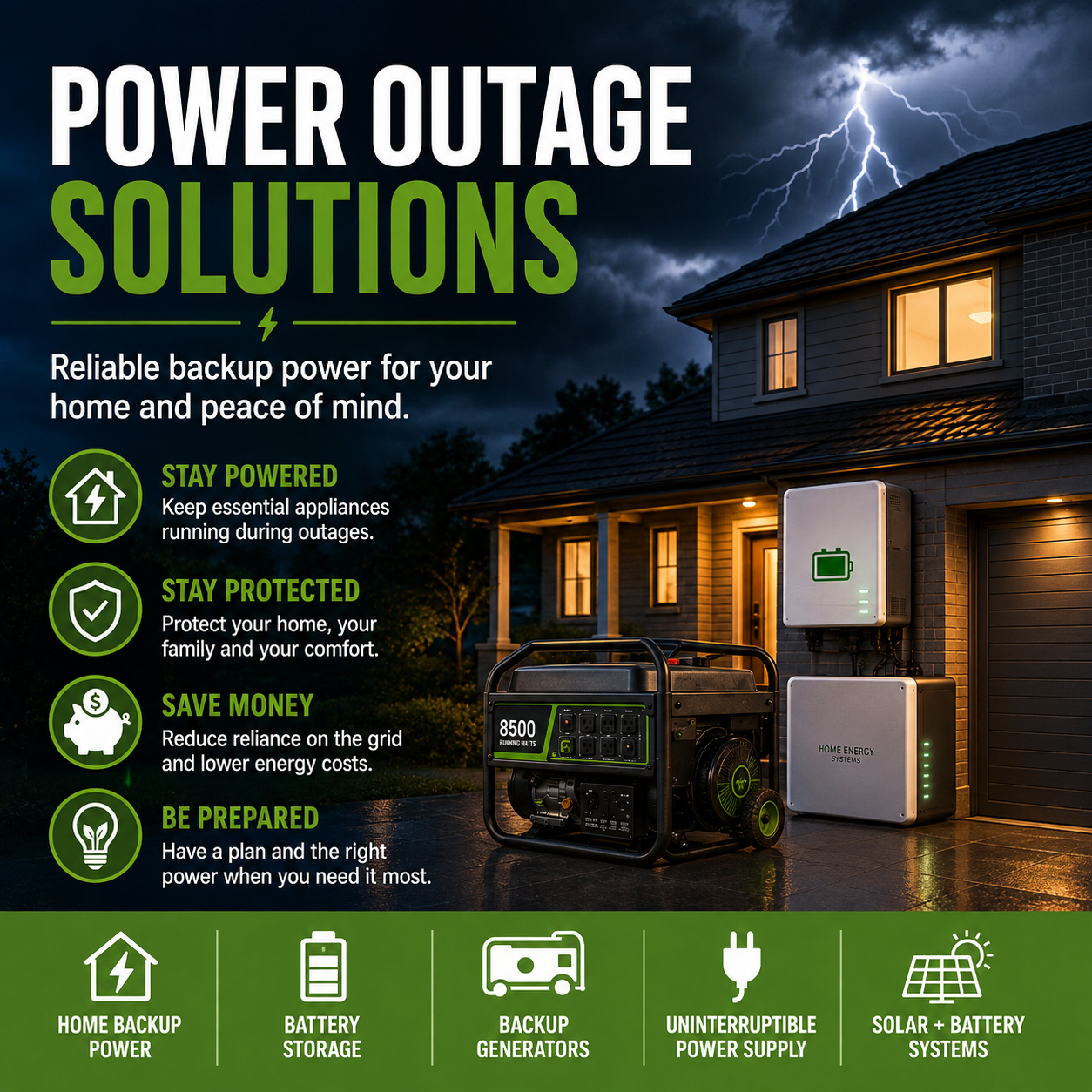
Power outage solutions range from rechargeable lights and small UPS units to portable power stations, home battery storage, solar backup systems and permanently installed generators.
The right choice depends on what you need to keep running, how much electricity those appliances consume and how long an outage could last.
A five-minute interruption requires a very different solution from a blackout lasting several hours or several days. For most households, the sensible approach is therefore to protect essential loads first and add additional backup capacity only where it is genuinely useful.
Quick answer: For short outages, start with rechargeable lighting, power banks and a UPS for sensitive electronics. For several hours of backup, a portable power station can support selected essential appliances. Longer or more frequent outages may justify home battery storage, solar charging, a generator or a combination of these technologies.
If you are already comparing larger systems, see our Best Home Backup Power Systems 2026 guide.
▶ Watch the Video Guide
Power Outage Solutions Video Guide
Watch our overview of UPS systems, portable power stations, home batteries, solar backup and generators.
What Are the Best Power Outage Solutions?
There is no single backup system that is best for every home. A useful way to compare your options is by the expected length of the outage and the loads you need to support.
Short Outages
UPS systems, rechargeable lighting, power banks and small portable power stations can cover communications and sensitive electronics.
Several Hours
A suitably sized portable power station may operate a refrigerator, router, lights, phones and selected household equipment.
Long Outages
Expandable battery storage, solar charging, generators or hybrid backup systems become more useful when outages continue.
Whole-Home Backup
Permanently installed batteries or generators can be designed to supply selected circuits or, with sufficient capacity, much larger household loads.
1. Start With the Appliances You Really Need
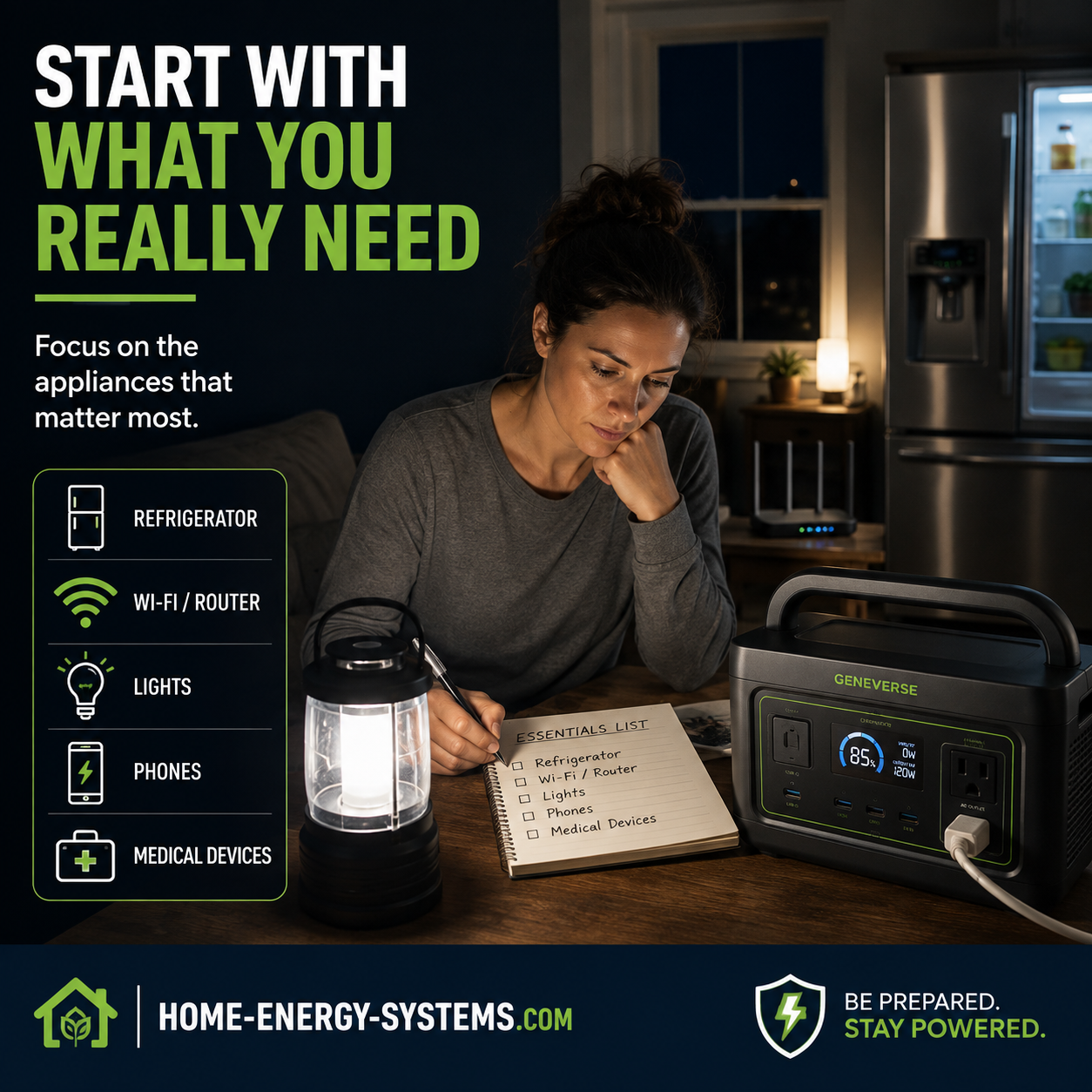
The first step is not choosing a battery or generator. It is deciding what genuinely needs electricity during an outage.
For many households, essential loads may include:
- refrigerator and freezer;
- internet router and modem;
- mobile phones and tablets;
- LED lighting;
- heating or boiler controls;
- home security equipment;
- laptops and computers;
- radio or television for information;
- well or water pumps where applicable; and
- essential medical or accessibility equipment.
Electric cooking, electric showers, immersion heaters, space heating, air conditioning, heat pumps and EV chargers can require considerably more power and energy.
Trying to operate every electrical appliance during an outage can dramatically increase both the inverter output and battery capacity required.
Better strategy: create an essential-load list first. Then calculate the watts required at any one time and the energy needed over the expected outage duration.
2. UPS Systems for Computers, Routers and Electronics
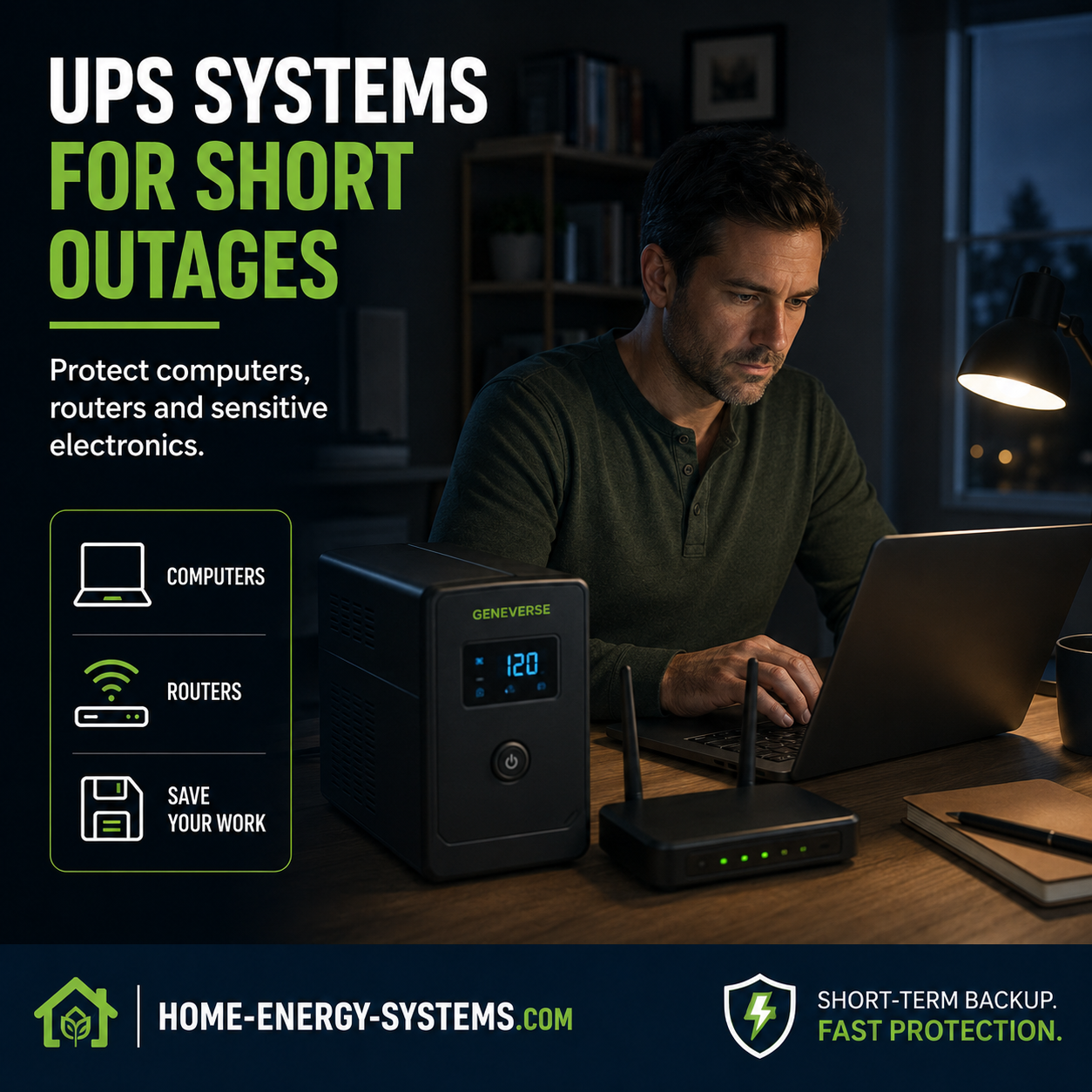
A UPS, or uninterruptible power supply, is one of the simplest power outage solutions for sensitive electronics.
Its internal battery takes over when grid electricity disappears. Depending on the unit and connected load, that may provide enough time to save work and safely shut down a desktop computer or keep smaller equipment operating during a short interruption.
UPS systems are commonly used for:
- desktop computers;
- home-office equipment;
- internet routers and modems;
- network storage equipment;
- security equipment; and
- small communications systems.
A conventional UPS is normally intended for relatively short backup periods. It should not be confused with a larger portable power station or home battery designed to operate appliances for many hours.
If home-office backup is your priority, read our Best UPS for Home Office 2026 guide.
3. Portable Power Stations
Portable power stations are among the most flexible home power outage solutions because they combine a rechargeable battery, inverter, charging electronics and several types of electrical outlet in one unit.
Unlike a small UPS, a suitably sized portable power station may be capable of operating selected essential appliances for hours rather than minutes.
Depending on battery capacity and inverter output, possible loads include:
- refrigerators and freezers;
- Wi-Fi routers;
- phones and tablets;
- laptops;
- LED lighting;
- televisions;
- compatible CPAP equipment;
- some small kitchen appliances; and
- selected heating controls.
The two specifications that matter most are battery capacity, normally expressed in watt-hours or kilowatt-hours, and inverter output, expressed in watts or kilowatts.
Capacity vs output: battery capacity tells you approximately how much energy is stored. Inverter output tells you how much electrical power the system can supply at one time.
A 2,000Wh unit stores roughly twice the nominal energy of a 1,000Wh unit, but it does not automatically follow that it can operate an appliance with a very high startup surge. Always check continuous output and surge capability as well as battery capacity.
4. Home Battery Storage
Home battery storage takes backup power from a portable appliance toward a permanently installed household energy system.
A suitably designed battery installation can automatically supply selected circuits when grid electricity fails. Larger systems may support much more of the home, while smaller installations can concentrate on critical loads such as refrigeration, lighting, communications and heating controls.
One particularly important point is that not every home battery automatically provides backup power during an outage.
The battery, inverter, wiring and backup switching equipment must be designed to safely isolate the backed-up electrical system from the public grid during a power cut.
Before buying: if outage protection is important to you, ask specifically whether the proposed battery installation supports backup operation, which circuits will remain powered and what maximum backup output will be available.
For a deeper explanation of capacity, inverters and household storage, read our Home Battery Storage Systems guide.
5. Solar Backup Power
Solar panels can make battery backup more useful during a prolonged outage, but rooftop solar panels alone do not necessarily keep a house running when the grid fails.
Many conventional grid-connected solar installations shut down automatically during an outage for safety reasons. Continuing to use solar during a blackout requires compatible equipment designed for backup or island operation.
A complete solar backup system may include:
- solar panels;
- battery storage;
- a compatible inverter;
- backup or transfer switching;
- selected essential circuits; and
- energy monitoring and controls.
The major advantage is the possibility of replenishing stored energy during daylight hours. During a multi-day outage, that can make solar-plus-storage considerably more useful than a battery that cannot be recharged until grid electricity returns.
Read our Solar Backup Power for Homes guide for a closer look at how solar panels, batteries, inverters and backup switching work together.
6. Fuel-Powered Generators
Fuel-powered generators remain an important option for longer electricity outages, particularly where large electrical loads must be supported or renewable charging cannot be relied upon.
A generator has one major advantage over a battery with a fixed amount of stored energy: it can continue producing electricity while a suitable fuel supply remains available.
Potential disadvantages include:
- engine noise;
- fuel storage requirements;
- maintenance;
- exhaust emissions;
- manual starting on some models;
- safe outdoor positioning requirements; and
- additional equipment when supplying household circuits.
Generator safety: never operate a combustion generator inside a house, garage, basement or other enclosed or partially enclosed area. Generator exhaust contains carbon monoxide, which can cause serious injury or death.
A portable generator should also never be connected to household wiring by feeding electricity backwards through a normal wall socket. A household backup connection requires correctly designed transfer equipment and appropriate electrical installation.
7. Hybrid Battery, Solar and Generator Systems
For homes that experience longer or more frequent outages, resilience may come from combining several technologies rather than relying on a single backup source.
A hybrid system might use:
- battery storage for immediate and quiet backup;
- solar panels for daytime recharging; and
- a generator for extended periods of poor solar production or unusually high demand.
The battery can handle shorter outages without starting an engine. Solar can replenish stored energy when conditions permit, while the generator provides another source of electricity if battery reserves become low.
This layered approach can reduce generator runtime while providing more options during a prolonged grid failure.
8. How Much Backup Power Do You Need?
Backup sizing involves two separate questions: how much electrical power must the system supply at one time, and how much stored energy is required to achieve the desired runtime?
Power Output
Measured in watts or kilowatts. This determines how much equipment the backup system can operate simultaneously.
Battery Capacity
Measured in watt-hours or kilowatt-hours. This determines how much electrical energy is stored for use during the outage.
For example, if your essential equipment consumes an average of 400 watts and operates at that average load for five hours, the theoretical energy requirement is:
400 watts × 5 hours = 2,000Wh = 2kWh
Real-world runtime will normally be lower than a simple nameplate-capacity calculation suggests. Inverter losses, standby consumption, battery protection limits, temperature and changing appliance loads all affect usable runtime.
Motors and compressors in equipment such as refrigerators, freezers and pumps can also draw substantially more power when starting than during normal operation.
9. Power Outage Solutions Compared
| Solution | Best For | Strength | Limitation |
|---|---|---|---|
| Power Bank | Phones and USB devices | Simple and portable | Very limited capacity |
| UPS | Computers and routers | Automatic backup | Usually short runtime |
| Portable Power Station | Selected essential appliances | Portable, quiet and rechargeable | Finite stored energy |
| Home Battery | Integrated household backup | Automatic and convenient when configured for backup | Higher installed cost |
| Solar + Battery | Renewable extended backup | Potential daytime recharging | Weather and system design affect performance |
| Generator | Long outages and larger loads | Can operate while fuel remains available | Fuel, noise, maintenance and exhaust |
| Hybrid System | Higher-resilience homes | Multiple energy sources | Greater cost and complexity |
10. Build Your Power Outage Plan in Layers
You do not necessarily need to purchase a large whole-home system immediately. A practical emergency-power plan can be built in stages.
Start With Lighting and Communication
Keep rechargeable lights, power banks and charging cables ready. These cover some of the most immediate needs during a short outage.
Protect Computers and Internet Equipment
A UPS can prevent computers from shutting down unexpectedly and may keep internet equipment operating during brief interruptions.
Add Portable Battery Backup
A portable power station provides more stored energy for refrigeration, lighting, communications and selected appliances.
Consider Solar Charging
Compatible solar panels can replenish battery energy when an outage continues beyond the original stored capacity and sufficient sunlight is available.
Consider Permanent Backup
Homes with frequent outages, water pumps, important heating requirements or other critical electrical loads may benefit from permanently installed battery storage, a generator or a hybrid system.
11. Prepare Before the Electricity Goes Off
Backup equipment is most useful when it has been checked and charged before an emergency occurs.
Periodically check:
- battery charge levels;
- power-bank condition;
- UPS battery health;
- flashlights and rechargeable lamps;
- generator maintenance where applicable;
- fuel condition and safe storage where applicable;
- charging cables and adapters;
- solar charging equipment; and
- emergency contact information.
If severe weather is forecast, charge portable batteries, phones and rechargeable lighting before the electricity fails.
Our dedicated How to Prepare for a Power Outage guide covers household planning, emergency supplies, food, communications and backup-power preparation in more detail.
12. Which Power Outage Solution Is Right for Your Home?
The most suitable solution depends more on your household’s electrical requirements than on the technology itself.
Apartment or Small Home
A UPS, power banks and a portable power station may provide useful backup for communications, lighting and selected appliances.
Family Home
A larger portable power station or expandable battery system can provide additional runtime for several essential appliances.
Home With Solar Panels
A compatible battery and backup system can store electricity while allowing suitable solar equipment to contribute energy during an outage.
Rural or Remote Property
Battery storage, solar generation and a generator can provide several layers of resilience where outages may be longer.
Before spending heavily on backup equipment, calculate what you actually need to operate, its normal power consumption, possible starting surge and the required runtime.
Power Outage Solutions: Frequently Asked Questions
What Is the Easiest Backup Power Solution for a Home?
For small loads, rechargeable lights, power banks and a UPS are simple starting points. A portable power station is a practical next step when you also want to operate selected household appliances.
Can a Portable Power Station Run a Refrigerator?
Many can, provided the inverter can handle the refrigerator’s running load and compressor starting surge. Runtime depends on battery capacity, inverter efficiency, refrigerator consumption and how frequently the compressor operates.
Will Solar Panels Keep My House Running During a Power Outage?
Not automatically. Many ordinary grid-connected solar systems shut down when grid electricity fails. Backup operation requires compatible equipment capable of safely isolating the backed-up system from the electricity network.
Is a Battery Better Than a Generator?
They solve the problem differently. Batteries are quiet and convenient but contain a finite amount of stored energy. Generators can continue operating while fuel is available but require safe outdoor operation, fuel and maintenance and produce noise and exhaust.
How Large Should a Home Backup Battery Be?
That depends on the appliances you want to operate and how long you want them to run. Add the expected energy consumption of essential loads and allow for system losses and an appropriate operating margin.
Can I Power My Entire House During an Outage?
It is possible with suitably designed equipment, but whole-home backup can require considerably more inverter output and stored energy than backing up a few essential circuits. Prioritising essential loads is often more economical.
Does a Home Battery Always Work During a Blackout?
No. Backup operation depends on the battery, inverter and electrical installation being specifically configured for outage operation. Ask the installer exactly what happens when grid electricity fails and which circuits will remain powered.
Final Thoughts
There is no single power outage solution that is right for every household.
For one home, a UPS and modest portable power station may provide everything required. Another property may need solar panels, expandable battery storage and a generator to remain powered through a prolonged outage.
The most effective approach is usually to start with essential loads and build your backup system around them.
Keep communication and lighting available first. Protect refrigeration and other important equipment next. Then decide whether your household needs additional capacity for longer outages or larger electrical loads.
Matching backup technology to your actual electricity requirements can provide useful resilience without paying for capacity you may rarely need.
Explore Home Energy Systems
Discover more independent guides to backup power, solar panels, battery storage and home energy technology at Home-Energy-Systems.COM.